I’m weighing in on the health care debate. I’m an impartial observer, because I already have socialized medicine through the VA. Serving in Vietnamearned me that benefit, and the VA works betterthan most systems.
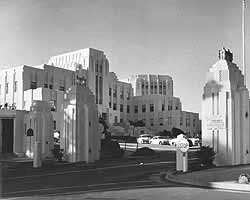
VA Medical Facility, San Francisco
We can learn from history if we pay attention. In 141 B.C.E., a new Han emperor sat on the Dragon Throne in China. His name was Wudi. He ruled for fifty-four years. Wudi believed that all people should have the right to buy certain commodities essential to survival and they should not be included in the free-market system. He implemented government monopolies in certain critical areas like salt, alcohol and iron. Prices were controlled so everyone paid the same low price.
After his death, a national debate known as the “Debate on Salt and Iron” took place. The government monopolies were abolished, and the poor could no longer afford many essentials. The rich grew wealthier. Soon after that, the Han Dynasty entered a period of stagnation like what is taking place in America today, and the Han Dynasty eventually collapsed.
What could we learn from what happened in China during the Han Dynasty?
Isn’t health care a commodity essential to survival?
Lloyd Lofthouse is the award-winning author of the concubine saga, My Splendid Concubine & Our Hart. When you love a Chinese woman, you marry her family and culture too.
If you want to subscribe to iLook China, there is a “Subscribe” button at the top of the screen in the menu bar
It seems that many of the six-thousand students I taught over thirty years felt the same way—that learning would make them mad like Acts says in the New Testament: 26:24 And as he thus spake for himself, Festus said with a loud voice, Paul, thou art beside thyself; much learning doth make thee mad.
Emperor Wudi
In China, during the early Han Dynasty, a different moral standard was set where earning an education was valued. Emperor Wudi from 141-187 BCE (two hundred years before Jesus Christ and five hundred years before Constantine), solidified the ideological framework of official Confucianism with a blending of Confucian, Taoist, and Legalist elements.
It looks like China may be officially returning to Confucianism or some form of it. Confucius taught that a ‘gentleman’ is the ideal figure. Among the traits of this ideal man is continued learning to develop moral character and to gain knowledge that is useful in serving others.
In China, teachers are treated with respect. Not so in the United States. Although a few students were respectful when I was a teacher, many were not. To understand what I mean, read the prologue from my memoir,Crazy Normal.
Although the Communist Chinese government has made it illegal to spit on those statues for public health reasons, hundreds defy that law on a daily basis, and continue to insult those traitors while honoring Yue Fei.
There is another moral hero from China’s history. During the Three Kingdoms era (220-265 A.D.) after the fall of the Han Dynasty, there was a long period of civil war. Out of this era came the story of Guan Yu, who was another model for loyalty and righteousness. Guan Yu lived almost eighteen hundred years ago, yet it is easy to find carvings and statues of him in China today. I have bought several hand carved from wood.
It doesn’t matter if one is a member of the Communist Party, because role models like Yue Fei and Guan Yu still play an important part in how ‘most’ Chinese behave and what they believe. Anyone in China holding a position of power is measured against men like Yue Fei and Guan Yu.
To help gain a better understanding of what honor means to the Chinese, here’s a link to a piece published in the Los Angeles Times.
Most people outside China only know of Beijing (once known as Peking) as the capital of China. However, another city was China’s capital for more than a thousand years.
In fact, Chang’ an (Xi’an) served as the capital for twelve dynasties, including the Western Zhou, Qin, Western Han, Sui and Tang dynasties, spanning more than eleven hundred years. It was also the cultural center of the Silk Road.
In 2008, the last time we visited Xi’an, subway construction was running behind schedule due to a law that does not allow the destruction of historical sites such as the tombs of emperors. There are so many of these tombs below ground that the subway tunnels must be diverted to avoid them resulting in delays.
With such a long history, the Discovery Channel produced a documentary of Xi’an (Chang’ an) called China’s Most Honourable City.
To discover Xi’an’s long history also teaches us much about China’s civilization. Discovery Channel’s Neville Gishford will take us on this historical journey leading to the present.
Gishford says, “It (Han Chang’ an) was more powerful than Rome. If any Roman army had actually gone there, they would have been absolutely annihilated.”
Han Chang’ an (Xi’an) was larger than Constantinople and richer than Egypt’s Alexandria. It was a fortress so powerful that even 20th century artillery could not knock its walls down.
In addition, the massive city wall is more than six hundred years old and longer than 12 kilometers. Cracks are appearing and an engineering team keeps close watch and makes repairs
However, the Xi’an of today was first build over two thousand years ago and has been three cities—not one. The Han Dynasty built the first city (Chang’ an), which is close to the modern city of Xi’an and the old eroding walls are still visible.
At 36 square kilometers, Han Chang’ an was more than one and a half times the size of Rome.
Earlier, I mentioned the subway system that was under construction in modern Xi’an.
For an update, Travel China Guide.com says, “The Xi’an subway system is scheduled to have 6 lines, with a total length of 251.8 kilometers… While the first phase of subway Line 2 has been in use since Sep 16, 2011, the other five lines are designed to be finished in 2018 in sequence.”
When the second phase is completed, the full length of Line 2 will be 26.64 kilometers (about 16.5 miles).
The population of Xi’an has also increased since Neville Gishford hosted the documentary for China’s Most Honourable City. Today, there are more than 8 million people living there.
This segment of Gishford’s documentary starts with Archaeologist Charles Higham, a world famous authority on ancient Asian cities.
Higham says, “A delegation of jugglers from Roman Emperor Marcus Aurelius (161-180 AD, who is regarded as one of the greatest emperors in Roman history) traveled and performed in the Han Court of Chang’ an.”
More than two thousand years ago, the walls of Chang’ an (Xi’an) were made of rammed (compressed) earth and much of the city from kiln fired clay bricks, which was a revolutionary building material at the time that changed the history of architecture.
The builders of Han Chang’ an (Xi’an) used this new technology in revolutionary ways such as building an underground sewer system connected to the moat that surrounded the city.
From the Qin to the Tang Dynasty, 62 emperors ruled China from Chang’ an (Xi’an). The China Daily says in and around Xi’an, there are about 500 burial mounds where the remains of emperors and aristocrats rest.
The largest tombs mark the passing of Emperors Qin Shi Huangdi (259 – 210 BC), Tang Gaozong (628 – 683 AD), and his wife Empress Tang Wu Zetian (624 – 705 AD).
When we left Neville Gishford‘s documentary, China’s Most Honourable City, in Part 2, Chang’ an was the capital of the Tang Dynasty (618 – 907 AD) with a population of over a million — six times the size of ancient Rome.
The Daming Palace, where the Tang Emperors ruled China, was 800 years older and nearly five times larger than Beijing’s Forbidden City. This huge palace was built in one year.
However, it wasn’t the Daming Palace that made Chang’ an (Xi’an) powerful. Long before Manhattan, Hong Kong, Paris and Dubai, Chang’ an was where the world came to shop.
Over a thousand years ago, the wealth of the West poured into China (and it is happening again) and arrived at Chang’ an over the Silk Road.
But wealth wasn’t the only thing China gained. Major religions also arrived in China at this time.
Islam was barely a century old, when Silk Road traders brought this religion to Chang’ an. In another post, A Road to the Hajj from China, I wrote, “The ancient city of Xi’an in Shaanxi province is home to about 60,000 ethnic Chinese Muslims.”
Xi’an claims it has a Muslim history going back thirteen hundred years when Islam was first introduced to China in 650 AD.
In fact, the oldest mosque in China was built in 685-762 AD in Chang’ an during the reign of Emperor Xuanzong of the Tang Dynasty.
Although Christianity and Islam were both introduced to China during the Tang Dynasty, Buddhism had deeper roots in the culture since it first arrived in China from India about 200 BC.
Christianity arrived in China in 635 AD (more than eight centuries after Buddhism and only a decade before Islam), when a Nestorian monk named Aluoben entered the ancient capital city of TangChang’ an.
Then in 629 AD, the Buddhist monk Xuanzang left Chang’ an against the emperor’s orders to travel the world in search of enlightenment. He went west toward India along the Silk Road with a goal to find original Buddhist scriptures. He traveled 10,000 miles over three of the highest mountain ranges in Asia and was gone 16 years.
When Xuanzang returned in 645 AD, he had 1,300 scrolls of Buddhist Sutras, and requested the building of a pagoda, which became the Giant Wild Goose Pagoda—nearly 65 meters tall (more than 213 feet). It was made of rammed earth, and the pagoda would collapse more than once and be rebuilt. No one knows exactly how the Tang Dynasty engineers managed to build a structure that tall of rammed earth.
Neville Gishford‘s Discovery Channel documentary, China’s Most Honourable City, reveals the answer to a mystery when a hidden crypt beneath the Giant Wild Goose Pagoda is discovered using ground based radar. When The Tang Dynasty collapsed due to rebellion, the city was destroyed, but the Giant Wild Goose Pagoda was left untouched.
Gishford reveals that even though TangChang’ an was destroyed, the city was copied throughout Asia and one city in Japan, Kyoto (formally the imperial capital of Japan – 794 to 1869 AD), was a scaled replica of Tang Chang’ an.
In fact, in 1974, the modern city of Xi’an and Kyoto formally established a sister-city relationship.
However, this was not the end of Chang’ an (Xi’an). It would be rebuilt a third time. In 1368, nearly five hundred years after the fall of the Tang Dynasty, the Ming Dynasty (1368 – 1643 AD) would rebuild the Great Wall in addition to Xi’an as a defense against the Mongols that had conquered and ruled China during the Yuan Dynasty (1277 – 1367 AD).
During the Ming Dynasty (1368 – 1643 AD), China mostly isolated itself from the world by rebuilding the Great Wall and a string of impregnable fortresses to protect China’s heartland from Mongol invasion.
One of those fortresses was a new military city built on the ruins of Tang Chang’ an, and the Ming named this city “Western Peace”—which in Chinese/Mandarin is “Xi’an”.
Xi’an was one-sixth the size of Tang Chang’ an, but nearly six hundred years later, its walls are still standing.
Charles Higham says these walls are the most extraordinary, largest, best-preserved set of defensive walls in the world.
The last segment of Neville Gishford‘s Discovery Channel documentary, China’s Most Honourable City, introduces Zheng Canyang, the engineer responsible for preserving Xi’an’s walls, and Zheng explains how the walls would have been defended.
History records that when the walls of this third city faced its first attack, they stood firm, but the attack did not come during the Ming or Qing Dynasties. It came five hundred years later from April to November 1926.
As China bled from the Civil War between warlords, the CCP and the KMT, a powerful Chinese general by the name of Liu Zhenhua attacked Xi’an with a large army and modern artillery.
However, the 20th century artillery rounds only dented the walls, and after months, Xi’an’s walls still stood and Liu Zhenhua’s army retreated.
The siege was part of an anti-Guominjun campaign lasting from late 1925 to early 1927, which raged across North China and had nothing to do with the civil war between CCP and KMT, explaining why this military campaign received no coverage in the popular media or academic circles. Source: A Study of the Siege of Xi’an and its Historical Significance by Kingsley Tsang
The newest enemy to Xi’an’s ancient walls comes from modernization and the millions of inhabitants of the city. As the water table below the city is sucked dry from so many people, this has caused the earth to sink, which is pulling down the walls, and engineers and scientists work to discover ways to save them.
______________
Lloyd Lofthouse is the award-winning author of The Concubine Saga. When you love a Chinese woman, you marry her family and culture too. This is the love story Sir Robert Hart did not want the world to discover.
Subscribe to “iLook China” Sign up for an E-mail Subscription at the top of this page.


 Posted by Lloyd Lofthouse
 iLook China