Chinese Crossbow and other Inventions (3/4)

August 1, 2010

The first firearm was invented in China about one thousand years ago. It was made of bamboo, fired pebbles and had a range of about thirty yards.

Bamboo is strong, flexible and hollow in the center. It was perfect for the first crude gunpowder weapons.  Over time, bamboo was replaced with bronze, and the pebbles became cast-iron chips or pellets. In fact, the first bronze handgun dates to 12th century AD. It was about a foot long and weighed eight pounds.

From these early weapons came cannons.  Long before the rest of the world knew anything about heavy artillery, the Chinese were making strong, mobile cannons from bronze. Since the Chinese already had repeating crossbows, the next step was repeating cannons along with exploding artillery shells.

During the Ming Dynasty, in the 14th century, the Great Wall was equipped with more than 3,000 cannons. In Europe, the first cannons were still being developed. The Chinese also invented the hand grenade about a thousand years ago along with grenade launchers—the bow powered grenade.

A computer analysis demonstrated that China’s largest cannons could fire more than a third of a mile.  It would take centuries before Europeans could match the weaponry of China.

Go to  hinese Crossbow and Other Inventions – Part 4 or return to the Chinese Crossbow and other Inventions Part 2

______________

Lloyd Lofthouse is the award-winning author of The Concubine Saga. When you ove a Chinese woman, you marry her family and culture too. This is the love tory Sir Robert Hart did not want the world to discover.

To subscribe to “iLook China”, look for the “Subscribe” button at the top of the screen in the menu bar, click on it then follow directions.


The First Emperor: The Man Who Made China – Part 7/9

April 22, 2010

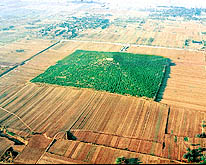
By 215 BC, Emperor Qin Shi Huangdi’s tomb is almost finished. The chamber where his body will rest is the size of a football field and will be hermitically sealed.  Then the tomb will be covered with a million tons of earth creating the hill we see today.

View of Qin Shi Huangdi's tomb

However, the Emperor doesn’t plan to die. Seeking advice from his doctor, he is given mercury capsules. At the time, it was believed that mercury would increase longevity.  Having lots of sex with multiple partners was also considered another way to increase life. The emperor follows the doctor’s advice and sends the doctor on an expedition to find an elixir for immortality.

The emperor isolates himself and delegates the power to rule the empire to those he trusts most. These men suppress free thought. Entire libraries are burned. Those who try to hide documents are branded on the face and sentenced to a life of force labor–mostly on The Great Wall. Anyone who resists is buried alive.

Professor Jeffrey Riegel, University of California, Berkeley, says that Chinese archeologists have no immediate plans to unearth the tomb, because there is no way to safeguard the contents from decay.

Go to Part 8 for The Man Who Made China or return to Part 6

View as Single Page

_________________________

Lloyd Lofthouse is the award-winning author of the concubine saga, My Splendid Concubine & Our Hart. When you love a Chinese woman, you marry her family and culture too. 

To subscribe to “iLook China”, look for the “Subscribe” button at the top of the screen in the menu bar, click on it then follow directions.


The First Emperor: The Man Who Made China – Part 6/9

April 21, 2010

The totalitarian philosophy in the new Chinese empire was called legalism. There are rules that govern every part of every citizen’s daily life with the punishment spelled out. Physical punishment could mean mutilation. For example, if two are caught having sex, they will be beheaded. Every aspect of private life is part of Qin law.

In 220 BC, Emperor Qin Shi Huangdi goes on an inspection tour of his empire.  With the major wars over, millions of troops are put to work finishing the Great Wall of China to stop the nomadic tribes to the north from raiding into China, which they have done for centuries.

The Great Wall of China is the greatest engineering project of the ancient world. It is thirty feet high and more than three thousand miles long. At one point, over a million people are working on the wall and about a quarter of them will die.

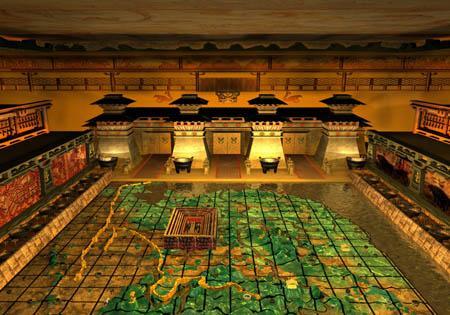
The emperor makes more demands. He sends hundreds of thousands to build a tomb that fits his rank as the first divine emperor of China. The burial mound, larger than the largest pyramid in China, is at the center of an above ground and underground city. His tomb is made of bronze surrounded by mercury rivers and oceans.

Recently, using ground penetrating radar and other instruments, a three dimensional model is built of the underground complex.

Go to Part 7 for the Man Who Made China or return to Part 5

View as Single Page

_______________

Lloyd Lofthouse is the award-winning author of My Splendid Concubine [3rd edition]. When you love a Chinese woman, you marry her family and culture too. This is the love story Sir Robert Hart did not want the world to discover.

Subscribe to “iLook China”!
Sign up for an E-mail Subscription at the top of this page, or click on the “Following” tab in the WordPress toolbar at the top of the screen.

About iLook China


Chinese Cloisonné Vases

March 14, 2010

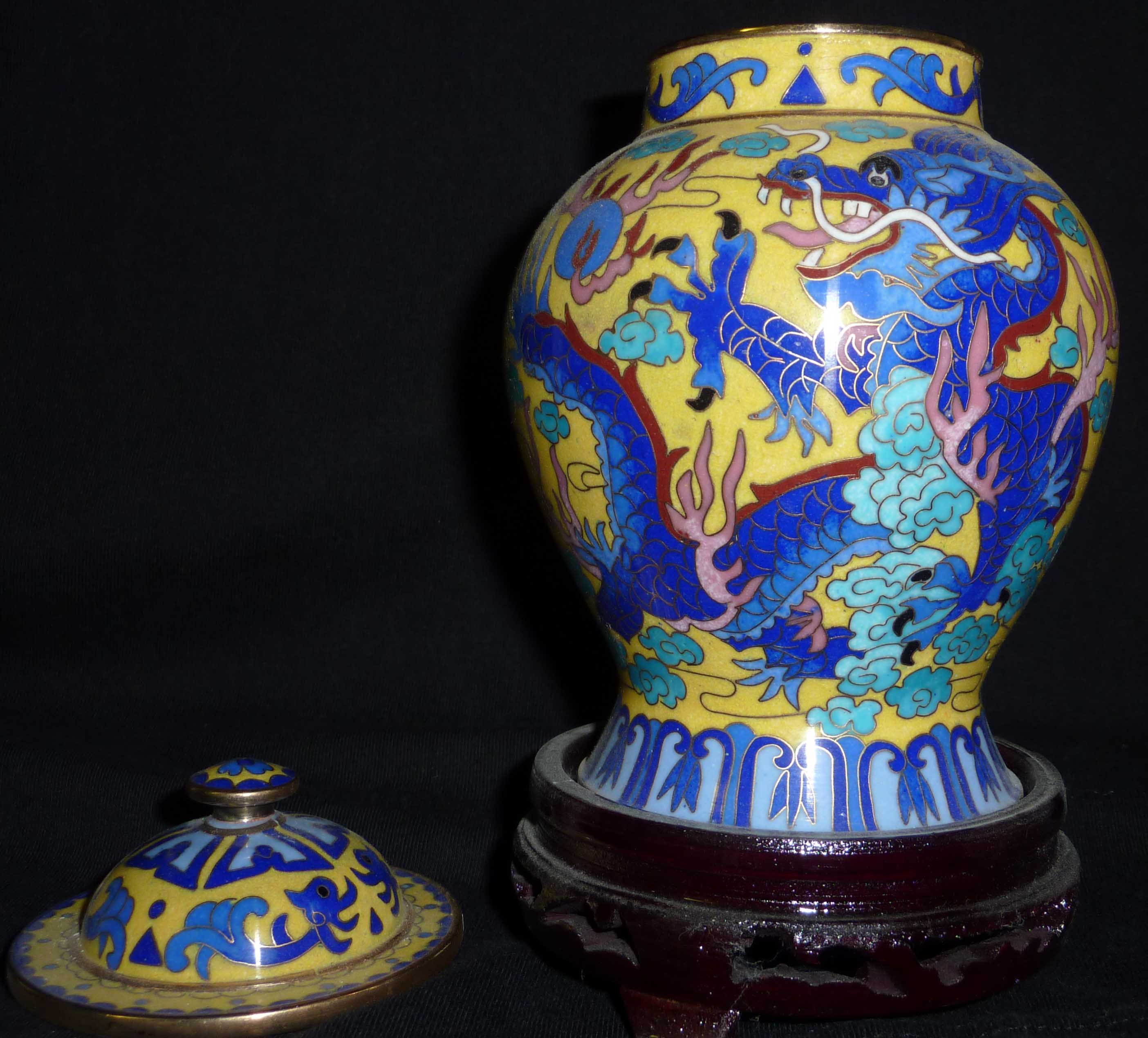
On our way back from the Great Wall at Mutianyu, we stopped at a factory and showroom where we learned about the manufacturing techniques for Cloisonné brass vases. First, we went on a tour where we watched men and women creating vases. Once the tour was over, we went into the showroom.

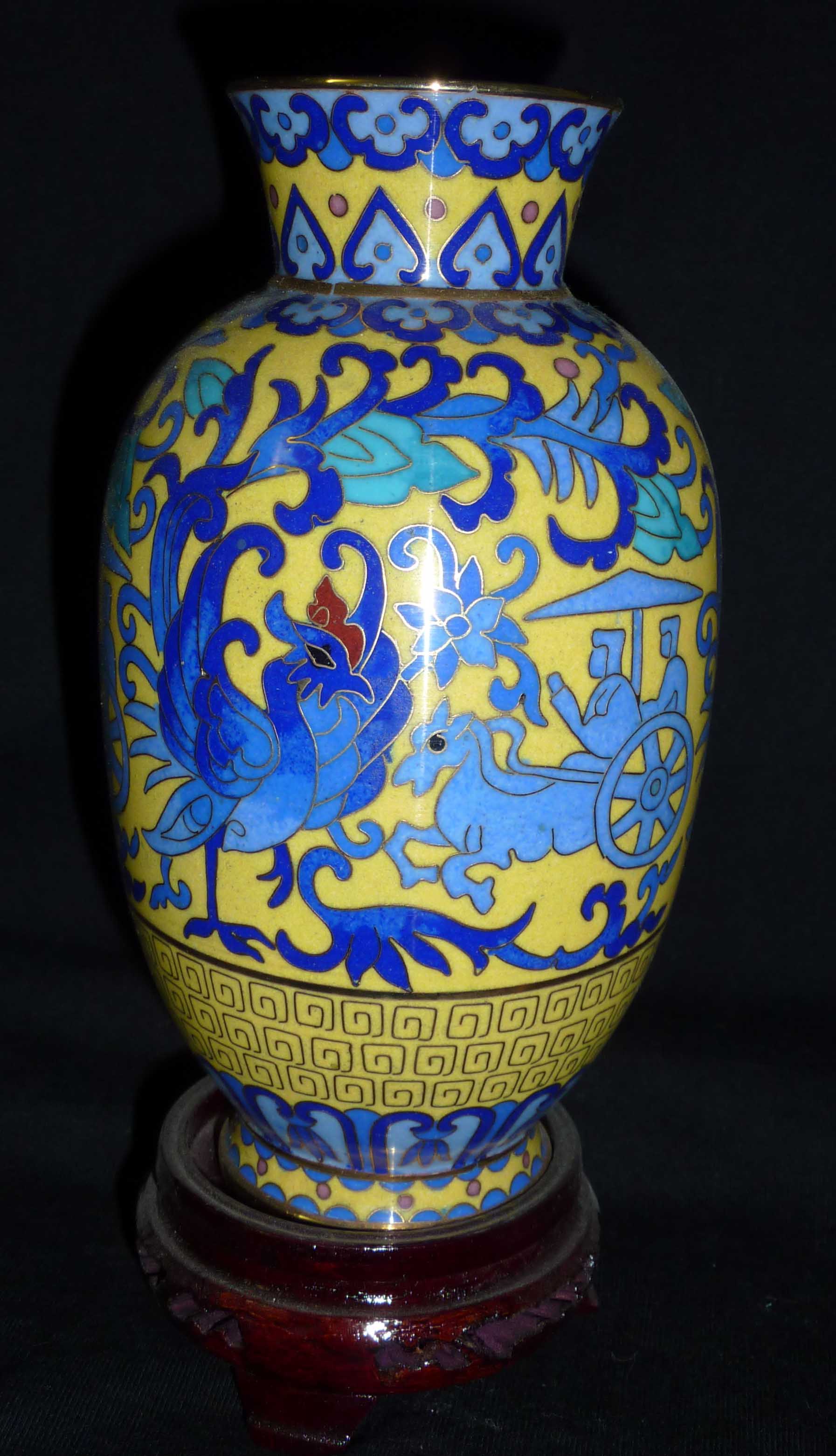
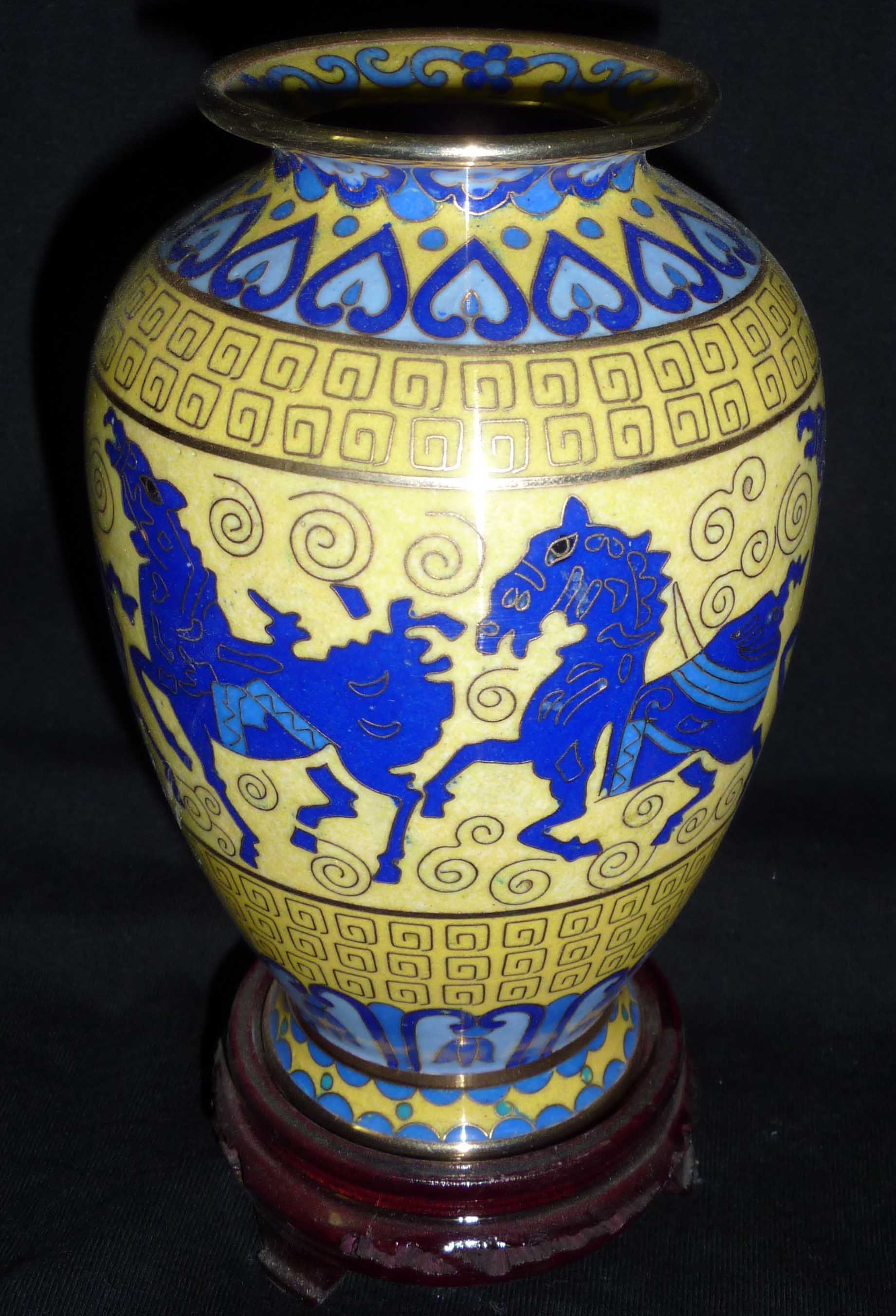
The vases I bought (after negotiating a price) are yellow with a blue trim.  One has a blue dragon on it, the second a phoenix beside a chariot, and the third running horses. Each one is about the size of my hand.

The cloisonné process is enamel on copper craftwork. It first appeared in Beijing in the Yuan Dynasty (1271-1368) and continued during the Ming Dynasty (1368-1644). Cloisonné vases are crafted by using a copper porcelain process. The vase is made from copper with brass wires soldered to the body. Then a porcelain glaze is applied to cells between the brass wires.

After a series of complex procedures, such as burning, burnishing and gilding, the cloisonné vase is done.

Chinese name: 景泰蓝(jǐng tài lán)

If you are interested in the arts, discover Chinese Yu Opera

_______________

Lloyd Lofthouse is the award-winning author of My Splendid Concubine [3rd edition]. When you love a Chinese woman, you marry her family and culture too. This is the love story Sir Robert Hart did not want the world to discover.

Subscribe to “iLook China”!
Sign up for an E-mail Subscription at the top of this page, or click on the “Following” tab in the WordPress toolbar at the top of the screen.

About iLook China


Traveling the Great Wall

March 14, 2010

Everywhere you go in China, there is something new to see and do.  Disneyland is planning to build a theme park near Shanghai.

The sections of the Great Wall we have visited are an hour out of Beijing. The most popular site is at Badaling.  The second choice, Mutianyu, is more dramatic. This portion of the Great Wall runs along the ridge of a mountain range. Badaling, meanwhile, is in a mountain pass.

The best way to reach the Great Wall is by taxi or bus. After you get there, you will discover the usual tourist shops. Since I enjoy haggling, I spend time shopping.

Great Wall at Mutianyu

At Badaling, there were camels and horses you could pay a fee to sit on while having your picture taken.

Once you reach Mutianyu, you have a choice—take a few hours to climb the mountain or ride a ski lift to the top in fifteen minutes. Getting back is easy. Take the toboggan seen during the 2008 Beijing Olympics on network TV and ride down.

______________

Lloyd Lofthouse is the award-winning author of the concubine saga, My Splendid Concubine & Our Hart. When you love a Chinese woman, you marry her family and culture too.

To subscribe to “iLook China”, look for the “Subscribe” button at the top of the screen in the menu bar, click on it then follow directions.