China’s Modern Women

March 6, 2010

The changing role of Chinese women has been dramatic since Mao won China in 1949. Prior to that time, China was ruled by the Kuomintang—a dictatorship. There were never national elections held in China. There wasn’t much that changed under the Kuomintang leadership regarding the role of women. When my wife was born in the late 1950s, her grandmother had bound feet.
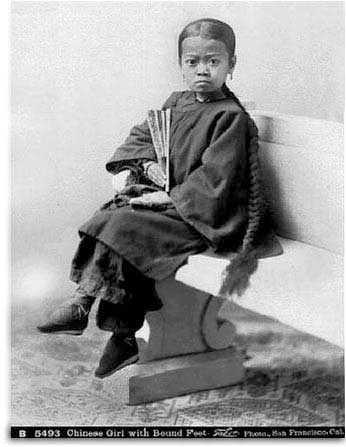
Chinese girl with bound feet

Before Mao, women were grass to be stepped on. Their role was to serve men.

The changes ushered in by Mao set the stage for his wife to become China’s leader after her husband’s death. The only reason she did not assume the leadership was because she was arrested as a member of the Gang of Four and sent to prison for crimes committed during the Cultural Revolution.

Modern Chinese woman

Since Mao, the changes have been even more dramatic.  Woman own businesses, hold political posts in the government, have jobs, and cannot be sold to become a wife or bought to serve as a concubine. They are not property. They are equals to men in many ways.

Learn about Marriage and Money in China.

______________

Lloyd Lofthouse is the award-winning author of The Concubine Saga. When you love a Chinese woman, you marry her family and culture too. This is the love story Sir Robert Hart did not want the world to discover.

To subscribe to “iLook China”, look for the “Subscribe” button at the top of the screen in the menu bar, click on it then follow directions.


China’s Health Care During Mao’s Time

February 27, 2010

After the Communists won China in 1949, health care improved. Prior to that, life expectancy for the Chinese people was thirty-five years. By Mao’s death in 1976, average life expectancy had increased by twenty years.

There were three basic areas of medical care. Free substandard medical care was provided to the proletarian working class, meaning workers and peasants.

Mao started a program called ‘bare-foot doctors’. This program was the backbone of rural health care in China. This meant anyone could become a doctor.

  • Video: Documentary of Bare-Foot Doctors in China

Mao told the people that if you wanted to be a doctor, you didn’t need to go to medical school. All you had to do was have the motivation to provide medical care to needy people and the government would support you and provide limited training.

The second class of medical care went to people like teachers, clerks and secretaries, ‘friends’ of the working class, the proletariat. The only difference was that these ‘friends’ had to pay to get medical treatment. It was possible to face financial ruin from one hospital stay.

The third class were termed enemies of the proletariat like former shop-owners, landlords and denounced intellectuals like liberal arts professors. These people were denied treatment altogether.

Learn about China’s Urban Rural Divide

______________

Lloyd Lofthouse is the award-winning author of The Concubine Saga. When you love a Chinese woman, you marry her family and culture too. This is the love story Sir Robert Hart did not want the world to discover.

To subscribe to “iLook China”, look for the “Subscribe” button at the top of the screen in the menu bar, click on it then follow directions.


After Mao

February 22, 2010

Unlike Mao’s time, today’s Chinese leaders must answer to the seventy-million party members scattered throughout China. These people listen to the 1.3 billion Chinese that do not belong to the party. The result: if an elected official is not doing his or her job, that person usually isn’t reelected.

Deng Xiaoping

Other changes took place after Mao. Under Deng Xiaoping, the People’s Republic announced a policy of “socialism with Chinese characteristics.” John Gittings in The Changing Face of China quoted Deng Xiaoping as saying, “Planning and market forces are not the essential difference between socialism and capitalism. A planned economy is not the definition of socialism, because there is planning under capitalism; the market economy happens under socialism, too. Planning and market forces are both ways of controlling economic activity.”

Soon after Mao died in 1976, Deng Xiaoping’s Beijing Spring was introduced. This was a brief period lasting from 1977 into 1978. During that time, the public was allowed greater freedom to criticize the government, which wasn’t allowed under Mao.

An example of this may be seen in “The Awakening” (Su-Xing), a movie produced during this period starring Joan Chen (Chen-Chung) and Gau Fei. [ISBN: 978-7-88611-603-2]. There are no English subtitles so it helps to have someone that reads or speaks Mandarin beside you while watching the movie that can point out the subtle criticisms of the Party that appear in the film, which was considered controversial at that time.

There was also a new Beijing Spring between 1997 to November 1998 where the Chinese government relaxed some control over political expression and organization. It was during this time that China signed the International Covenant on Civil and Political Rights.

Learn about China’s Modern Dynasty

______________

Lloyd Lofthouse is the award-winning author of The Concubine Saga. When you love a Chinese woman, you marry her family and culture too. This is the love story Sir Robert Hart did not want the world to discover.

To subscribe to “iLook China”, look for the “Subscribe” button at the top of the screen in the menu bar, click on it then follow directions.


About Tibet

February 16, 2010

How does Communist China treat its minorities compared to the way minorities have been treated in the Americas?

Yes, human rights violations did happen in Tibet, but most happened during the Cultural Revolution. Mao ruled China for twenty-seven years (1949 – 1976) but the Cultural Revolution started in the mid 1960s and ended in 1976 with his death, and everyone in China suffered during that decade.

Since Mao considered Tibet to be part of China (and recorded, nonbiased evidence from primary sources prior to the rise of Communism supports that claim), those who suffered in Tibet were treated the same as the rest of China. Monasteries in Tibet were destroyed–but this was going on everywhere in China and after 1976 many of the major monasteries were rebuilt by China.

The next post shows what happened after Mao died—facts we seldom if ever hear. It is always good to have the facts to see who sins and who doesn’t.

Learn what happened After Mao and more about Tibet – Inside China

______________

Lloyd Lofthouse is the award-winning author of the concubine saga, My Splendid Concubine & Our Hart. When you love a Chinese woman, you marry her family and culture too.

If you want to subscribe to iLook China, there is a “Subscribe” button at the top of the screen in the menu bar.


The First of all Virtues – Part 8/9

February 1, 2010

I am married to a Chinese woman who was born in Shanghia, China. She suffered with the rest of China during Mao’s Cultural Revolution.

She moved to the United States in the 1980s and is now a U.S. citizen. If you marry a Chinese woman, you marry her family. I know first-hand that filial piety is alive and well in China.

Contrary to popular Western opinions spread by the media, the Communists did not get rid of it. When I travel to China, my white hair is a ticket to respect that was earned over a long period.

In China, I don’t hear, “Hey, old man.”

If you are interested to see how Mao’s Cultural Revolution influenced people, this short video is a good example.

Go to The First of All Virtues Part 9 or return to Part 7

______________

Lloyd Lofthouse is the award-winning author of the concubine saga, My Splendid Concubine & Our Hart. When you love a Chinese woman, you marry her family and culture too. 

Subscribe to “iLook China”
Sign up for an E-mail Subscription at the top of this page.

About iLook China