True, under Mao Zedong (1893 – 1976), China suffered but that isn’t the whole story. During Mao’s Great Leap Forward and the Cultural Revolution, thirty-seven million died—many from starvation. Mao’s form of communist socialism did not work.
On June 30, 1984, Deng Xiaoping said, “Given that China is still backward, what road can we take to develop the productive forces and raise the people’s standard of living? … Capitalism can only enrich less than 10 per cent of the Chinese population; it can never enrich the remaining more than 90 per cent. But if we adhere to socialism and apply the principle of distribution to each according to his work, there will not be excessive disparities in wealth. Consequently, no polarization will occur as our productive forces become developed over the next 20 to 30 years.”
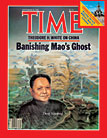
Deng Xiaoping on the cover of Time Magazine
Deng Xiaoping may have been right. Bruce Einhom writing for Business Week, Countries with the Biggest Gaps Between Rich and Poor, October 16, 2009, listed the top countries with the biggest gaps. America was number three on the list. China wasn’t on the list—yet.
What does this mean for America? (CBS/AP) The Census Bureau reports that 12.5 percent of Americans, or 37.3 million people, were living in poverty in 2007, up from 36.5 million in 2006.
After 2000, the situation in America deteriorated quickly (with President George W. Bush in the White House)—all of the gains in middle-class economic security since WWII were erased within a few years.
PBS reported in “Middle Class Squeeze” (December 13, 2002), the shape of income distribution in America is changing and many are finding it increasingly difficult to afford housing while keeping up with necessities such as food, clothing, transportation, and health care.”
What does capitalism, Chinese style, look like? Under Deng Xiaoping’s economic policies, China became the world’s factory floor.
Prior to 1979, the year China opened its economy to world trade, it was rare to find anything made in China. Since then, exports from China have increased 10,000%, and this year China’s economy become the second largest in the world as Japan slipped to third place.
In the last decade, something happened in China that Mao thought he had destroyed. China grew a middle class. During a trip to China in 2008, we saw the Chinese middle class everywhere we went. Instead of the majority of tourists being foreigners, they are now Chinese.
A middle-class family in China usually owns an apartment, a car, eats out and takes vacations. National Geographic in the May 2008 magazine, said, “they owe their well-being to the government’s (Deng Xiaoping’s) economic policies…”
Current estimates show China’s growth will continue and grow between five and eight percent a year. China’s real GDP growth accelerated on a year-over year basis by a full percentage point, rising from 7.9% in the second quarter to 8.9% in the third quarter (reported Oct. 22, 2009).
Learn about China’s Expanding Middle Class
______________
Lloyd Lofthouse is the award-winning author of The Concubine Saga. When you love a Chinese woman, you marry her family and culture too. This is the love story Sir Robert Hart did not want the world to discover.
To subscribe to “iLook China”, look for the “Subscribe” button at the top of the screen in the menu bar, click on it then follow directions.


 Posted by Lloyd Lofthouse
 iLook China