History’s Meaning of the Mandate of Heaven – Part 2/5

October 14, 2010

In the last few years, China has revived some of the old Confucian traditions that were stopped during the Cultural Revolution.

Today, actors reenact the ancient traditions for tourists and many of the tourists are Chinese, who are rediscovering roots not seen since 1949.

The Chinese Communists believed they could do away with the old traditions and replace them with something new.

However, just when they thought they had shaken it, it appears that the past has found a way of returning.

The ancient Chinese believed that earth, nature and the cosmos were part of a harmonious natural order, the Tao or Path.


The search for the right path, Taoism, is the second-great stream of Chinese thought — a natural mysticism beside the natural common sense of Confucius, which wasn’t an alternative, but the other half of a necessary life balance.

Western culture sees nature in terms of control and exploitation. However, to the Chinese, it is the source of all harmony and balance.

The little Taoist Temple on the top of sacred Taishan Mountain was wrecked during the Cultural Revolution. Now, it has been rebuilt and real Taoist monks and nuns returned in 1985 to live there and be committed to the old ways.

More than two thousand years ago, after the Silk Road opened, the Chinese gained the wisdom of the Buddha.

To the Chinese, the Western concept of God was foreign, but Buddhism, with its atheistic and democratic message and deep care for ritual was different.

Buddhism was the third-great stream making up the current of Chinese civilization.

Along with Confucian wisdom and Taoist mysticism, it was believed that these three philosophies contained the essential ideas of civilization and without them, life would be unbalanced.

Return to History of the Mandate of Heaven – Part 1

______________

Lloyd Lofthouse is the award-winning author of the concubine saga, My Splendid Concubine & Our Hart. When you love a Chinese woman, you marry her family and culture too. 

If you want to subscribe to iLook China, there is a “Subscribe” button at the top of the screen in the menu bar.


China and India’s Mutual Collectivism and History – Part 1/2

September 10, 2010

There appears to be an obsession in the West that India, since it is a democracy, is the country that will counter China’s economic and military growth.

The American Interest published a piece in their May/June 2010 issue – The Return of the Raj, which points out that where G. W. Bush failed to build an Indo-U.S. defense pact, Secretary of State Clinton in a visit to India in July 2009 did open the door to significant arms transfers from the U.S. to India.

If the United States and India can together rediscover and revive the Indian military’s expeditionary tradition, they will have a solid basis for strategic cooperation not only between themselves but also with the rest of the world’s democracies. Source: The American Interest

In another piece, A Himalayan rivalry, The Economist focuses on the 1962 conflict between India and China saying, “Memoires of a war between India and China are still vivid in the Tawang valley…”

However, memoires aren’t everything. There is also knowledge, and China is not the same country it was in 1962.

In 1962, some of the factors that led to the war between India and China were linked to Mao’s policies, the Great Leap Forward and the Cultural Revolution.

The Maoists were removed from power in the 1980s, and China is not a socialist nation as it was then.

Go to Part 2

______________

Lloyd Lofthouse is the award-winning author of The Concubine Saga. When you love a Chinese woman, you marry her family and culture too. This is the love story Sir Robert Hart did not want the world to discover.

Subscribe to “iLook China”
Sign up for an E-mail Subscription at the top of this page.

About iLook China


Confucius with Chow Yun Fat

August 6, 2010

When my wife and daughter made their annual summer pilgrimage to China, I asked them to bring back a DVD of the new Confucius with Chow Yun Fat. Unfortunately, the copy they brought would not play on any of the American DVD players we have at home. The world is divided into regions and each region has its own DVDs that won’t play in other regions.

Determined, I resorted to e-bay to find a DVD for the US and Canada.  It cost me about $10 plus postage. The above link will take you to Amazon where you may order one.

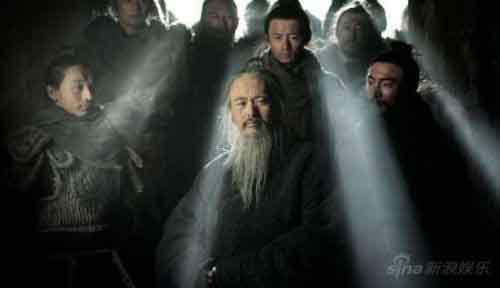
The movie’s visuals are stunning and Chow Yun Fat does an incredibly convincing job of playing Confucius, who, no matter how much he was abused by the rulers of his homeland, he still honored them.

If you don’t speak Mandarin and must rely on the English subtitles, be warned that most of the subtitles are mangled and do not stay on screen long enough.  The challenge is to read the subtitle while keeping an eye on the stunning visuals.

This movie is an epic equal to Cleopatra, Moses and Spartacus.  However, if you expect a potboiler, you won’t get one most of the time. Yet, the battle scenes were amazing no matter how brief they were.

It’s obvious that this movie was filmed for a Chinese/Asian audience and their tastes are not as shallow as what most Americans prefer. I’m sure the Chinese didn’t want to ruin the movie by letting Hollywood get hold of it.

Confucius with his students

The DVD I bought and watched had a photo of Confucius with a beautiful woman on the cover. They must have added her to the cover for that Hollywood sexy touch to appeal to an American audience. In the movie, she plays a minor role and is assassinated for wanting power in a violent world dominated by men busy killing each other.

From what I know of Confucius, the movie showed him close to who he must have been—an honorable man wanting to bring peace to a war-torn land and end the people’s suffering.  He spends more than a decade homeless wondering the land in search of someone who will listen besides the rag-tag band of students who stuck to him like glue.

If anything, we could learn something about dedication and loyalty from this band and their master.

At the bottom of the DVD box, it says, “His teachings were banned under Mao Zedong, who oversaw the destruction of his family home during the Cultural Revolution.”

Ironic, considering that Mao stayed in power his last decade because of what Confucius taught the Chinese about piety.

Discover more about The Life of Confucius

______________

Lloyd Lofthouse is the award-winning author of The Concubine Saga. When you love a Chinese woman, you marry her family and culture too. This is the love story Sir Robert Hart did not want the world to discover.

To subscribe to “iLook China”, look for the “Subscribe” button at the top of the screen in the menu bar, click on it then follow directions.


Mao Zedong, the Poet

July 27, 2010

Many outside China think of Mao Zedong (1893 – 1976) as a brutal dictator. Yet, he was fifty-six when he became the ruler of China and seventy-two at the beginning of The Cultural Revolution.

In fact, while commanding the Red Army during The Long March (1934-1935), we see a man who respected China’s peasants proving he was more of a nationalist than a Communist. Then there was the move away from Communist Russia after Nixon’s visit to China in 1972, when Mao said, “Our common old friend, Generalissimo Chiang Kai-shek, doesn’t approve of this.”

In 1935, Mao’s poem, “The Long March”, reveals an awareness of the sacrifice and the willingness to suffer to accomplish great things.

The Red Army fears not the trials of the March,
Holding light ten thousand crags and torrents.
The Five Ridges wind like gentle ripples
And the majestic Wumeng roll by, globules of clay.
Warm the steep cliffs lapped by the waters of Golden Sand,
Cold the iron chains spanning the Tatu River.
Minshan’s thousand li of snow joyously crossed,
The three Armies march on, each face glowing.

Mao was a complex man, and it wasn’t until after the failure of the The Great Leap Forward (1958 – 1961) that the fatal attraction and power of leadership corrupted him leading to the horrors of The Cultural Revolution (1966 – 1976), which Mao’s critics in the West use to define him.

Anyone who follows all of Mao’s life instead of relying on his last decade would understand that he cared deeply about the common people while punishing the landowners and wealthy, who abused them.  On the other hand, his foe, Chiang Kai-shek, supported the landowners and wealthy while crushing the peasants and workers.

There is a post on About China.info that says, “Mao’s poetry exhibits a spirit of boldness and power, weaving together history, reality and commitment… Bold transformation of myth and literary quotations are a distinct feature of Mao’s poetry.”

At Mao Zedong Poems, Two Birds” A Dialogue (1965), reveals what Mao may have been thinking about as President Johnson increased America’s involvement in Vietnam. Was Mao also warning us of what he was about to do in 1966, when he launched The Cultural Revolution?

Two Birds: A Dialogue (1965)

The roc wings fanwise,
Soaring ninety thousand li
And rousing a raging cyclone.
The blue sky on his back, he looks down
To survey Man’s world with its towns and cities.
Gunfire licks the heavens,
Shells pit the earth.
A sparrow in his bush is scared stiff..
“This is one hell of a mess!
O I want to flit and fly away.”
“Where, may I ask?”
The sparrow replies,
“To a jewelled palace in elfland’s hills.
Don’t you know a triple pact was signed
Under the bright autumn moon two years ago?
There’ll be plenty to eat,
Potatoes piping hot,
Beef-filled goulash.”
“Stop your windy nonsense!
Look, the world is being turned upside down.”

Through Mao’s poetry, we learn more about the man—not the modern emperor.

Discover China’s Privately Passionate Poetry

______________

Lloyd Lofthouse is the award-winning author of The Concubine Saga. When you love a Chinese woman, you marry her family and culture too. This is the love story Sir Robert Hart did not want the world to discover.

Subscribe to “iLook China”!
Sign up for an E-mail Subscription at the top of this page, or click on the “Following” tab in the WordPress toolbar at the top of the screen.

About iLook China


Growing China’s Legal System

July 18, 2010

In October 2008, Stephen Yao, talked about the evolution of the Chinese legal System. During the Cultural Revolution, for ten years, China had no law or legal system.  Then in 1979, Deng Xiaoping initiated the “Open Market Policy”.

Law schools, the ministry of justice and legal services were started in the early 1980s.  Another milestone was in 2001, after China joined the WTO (World Trade Organization).  The economic changes were taking place faster than the legal system was developing.

In 2008, the Chinese legal system had the minimum standards as recognized by the WTO.

In the video, Stephen Yao displays a chart for China’s Legal System and explains briefly what it means.  The second slide shows China’s legal market overview and the multilayered legal structure.

Yao says that the death penalty must be referred to China’s higher court and the lower courts do not have the power to apply the death penalty.

See China Law and Justice System

______________

Lloyd Lofthouse is the award-winning author of The Concubine Saga. When you love a Chinese woman, you marry her family and culture too. This is the love story Sir Robert Hart did not want the world to discover.

Subscribe to “iLook China”
Sign up for an E-mail Subscription at the top of this page.

About iLook China