The ordinary side of urban China delivered by Chi Li

November 19, 2011

My wife and daughter returned from China last summer with a crate of Chinese movies on DVDs—there wasn’t one American movie in the mix and many do not have English subtitles.

Therefore, it is strange that the one Chinese film that impressed me the most (so far) was one I discovered at a local Half Priced Books. The movie was Life Show (2002) adapted from a book by Chinese author Chi Li.

Since the late 1980s, Chi Li has been considered a pioneer of “new realism” and her work depicts ordinary life in China so critics have identified her work with the Western school of “existentialism”.

In fact, it was the “ordinary element” of her work that I saw in the film which captured my curiosity to learn more. Since I’ve traveled to China several times since 1999 and not with tour groups, I’ve visited streets similar to the ones that appear in the film. I’m sure most foreign visitors to China that visit on packaged tours do not see the ordinary side of China as I have.
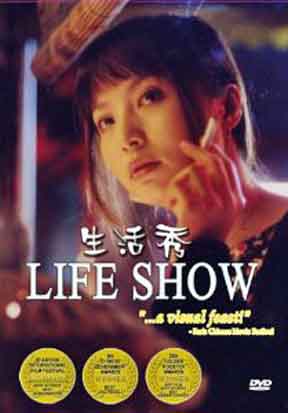
My wife says Chi Li is one of her favorite Chinese authors. The first time I was introduced to Chi Li’s work was through Life Show, which tells the story of Lai Shuangyang, a restaurant owner played by Tao Hong. Shuangyang’s life is busy dealing with family and business but she is lonely until one of her long-time customers, played by Tao Zeru, shows a romantic interest in her.

Zeru plays a middle-aged businessman, and Shuangyang takes a risk and the two strike up a romance that ends when she discovers he is the developer behind the modernization of the area where she has her restaurant.  He offers to take care of her but it is obvious that Shuangyang values her personal freedom and independence and in a fiery scene, she breaks up with him.

Lai Shuangyang’s life is filled with complications. Her younger brother Jiuju is a drug addict in jail/rehab.  The woman that loves Jiuju is Mei, who works for Shuangyang in her restaurant. Mei attempts suicide because Jiuju is not interested in her, and then Shuangyang arranged a marriage for Mei to another man, who is mentally ill.

Her sister in law, Xiaojin, is trying to regain the Lai family’s home, which was given to a neighbor during the Cultural Revolution. In addition, Shuangyang is at risk of losing her restaurant due to a redevelopment project in Wuhan.

Chi Li, the author of Life Show, is one of China’s best-known writers and several of her novels have been translated into French by publisher Actes Sud.

Chi Li was born 1957 in Wuhan, Hubei province, graduated from the Chinese Language Department of Wuhan University and then worked as an editor of a literary magazine called Fang Cao (Fragrant Grass).

Chi Li rarely travels and avoids “literary circles”.  “If my unsociability is thought to be a flaw, I admit I’m a person with a flaw,” Chi has said.
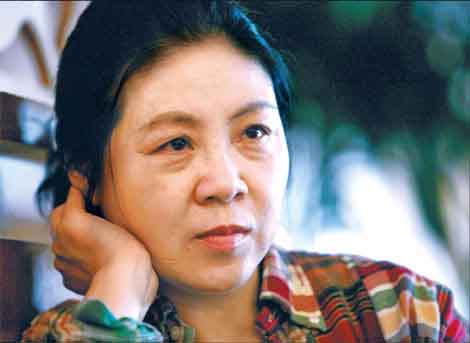
Chi Li, Chinese author of "Life Show"

During the Cultural Revolution, like millions of other young Chinese, she was sent to the countryside to become an “educated youth”. Later she studied medicine and practiced for five years before becoming a teacher.

Today, she is a member of the National People’s Congress (NPC), which provides an opportunity to discuss politics with other representative of the NPC providing an understanding/education of China’s policies and political atmosphere.

Chi Li’s work relates to love, marriage, divorce and extramarital affairs of contemporary Chinese life, while her characters are imbued with common human traits such as ambition, deceit, jealousy, and sexual desire. Her work, Comes and Goes, was a story of extramarital affairs occurring in Wuhan and became a TV series of same name.

The city of Wuhan comes alive in her work—enough to be considered a character. Although many of her novels have been translated into French, there are no English translations yet, which is a shame.

Discover Balzac and the Little Chinese Seamstress or Not One Less

______________

Lloyd Lofthouse is the award-winning author of The Concubine Saga. When you love a Chinese woman, you marry her family and culture too. This is the love story Sir Robert Hart did not want the world to discover.

Subscribe to “iLook China”
Sign up for an E-mail Subscription at the top of this page.

About iLook China


Education in the Real World – Part 1/2

September 5, 2011

Many Americans live in a fantasy world, as you will learn, which may explain why fantasies and animated movies for children often earn so much money at the box office in the United States while more realistic films of a literary nature earn little.

When Henry Kissinger wrote, “American exceptionalism is missionary. It holds that the United States has an obligation to spread its values to every part of the world,” he may not have realized that spreading these idealistic values applies within the US too, from whichever group has enough political power to make it happen.

Two of these values are how to raise and educate children as if all children are equal and there should be no obstacles to success. The only parallel comparison I can make is that what has happened in America since the 1960s, is similar to what happened in China during the Cultural Revolution but without the slogans.

However, like China during the Cultural Revolution, teachers in the US may face denunciation but for different reasons. At least in China, that insanity ended in 1976.

In the US, this led to a public education system that now teaches most children as if they will all go to college, find happiness and succeed equally.

This American Cultural Revolution also spawned the self-esteem movement in parenting and education, which still raises and teaches the average American child to believe what she dreams will come true (even if she doesn’t work for it).

Due to this wide spread belief among many Americans, a law was passed by President G. W. Bush in 2001 called the No Child Left Behind Act (NCLB), which mandated that America’s Public schools had to be successful with all  students from every walk of life and ethnicity by 2014 or be considered a failure.

NCLB did not require students to study or parents to support teachers or education. The penalties for failure are severe and were designed to only fall on the shoulders of America’s public school teachers.

If a teacher was not successful teaching every child from every walk of life that was enrolled in his class, he could lose his teaching job and see the school where he taught closed even if he succeeded with more than half of his students.

Many factors may cause a child not to cooperate with his teachers or learn in school. When we consider the impact of poverty, hunger, health, safety, environment, lifestyle, and broken families on children, not every child is equal.

When it comes to school, if a child’s mind is occupied by other, more pressing priorities such as hunger or safety, education often takes a back seat to survival, which is a fact that many in the United States refuse to accept.

However, when we study the education systems of other countries such as China, it seems that these real life issues ignored in the United States are treated as a reality of life.

Continued on September 6, 2011 in Education in the Real World – Part 2

______________

This edited and revised post originally appeared on August 8, 2011, at Crazy Normal as Civil Disobedience and No Child Left Behind – Part 4

______________

Lloyd Lofthouse is the award-winning author of The Concubine Saga. When you love a Chinese woman, you marry her family and culture too. This is the love story Sir Robert Hart did not want the world to discover.

To subscribe to “iLook China”, look for the “Subscribe” button at the top of the screen in the menu bar, click on it then follow directions.


Waking the Unconscious Demon Within

August 21, 2011

Recently, I wrote a post about Mao and Complex Post Traumatic Stress Disorder (CPTSD), and provided “overwhelming” evidence that Mao may have suffered from CPTSD. The reason I first thought of this is that I have lived with PTSD since I served in Vietnam as a U.S. Marine. I am no stranger to this malady, and I know I am capable of barbaric behavior under the right circumstances.

Now, more evidence suggests that this demon becomes more difficult to manage as we age.

PTSD Forum had a post about the Dragon Brain – The Dark Side of the Lizard Brain, which along with a study at Stanford forty years ago may offer more insight of how Mao, starting out as a young sensitive poet and activist for the poor, was responsible for decisions later in his life that led to the failed Great Leap Forward then The Cultural Revolution.

The PTSD Forum says, “The down side (of PTSD) is a tendency to be more critical … to sense a threat where none may exist, or to sense a bigger threat than actually appears.”

Anxiety Insights.info says,” Post-traumatic stress, a condition that can cause patients to feel physical pain on remembering a traumatic event, is known to have a number of effects on the mind and body.”

In addition, PTSD may get worse as we grow older. In a comment on Veterans Benefits Network, Patrick428 says, “As we grow older there is a tendency to have less control of our frustrations and we anger more easily… This is why I say PTSD is much more problematic at an older age than was at a younger age.”

I suspect there may be a link between PTSD and a piece that I read in the July/August 2011 Stanford magazine — Six Days on the Dark Side -The Menace Within.

Forty years ago professor Phil Zimbardo (retired 2007) of Stanford’s psychology department conducted an experiment that was meant to run for twelve days but was stopped after six.  What the Stanford Prison Experiment (PSE) revealed was that ordinary college students were capable of doing terrible things under the right/wrong circumstances (like what happened at Abu Ghraib where Iraqi prisoners were abused and tortured by U.S. troops).

In fact, in the last decade, after the revelations of abuses committed by U.S. military and intelligence personal at prisons in Iraq and Afghanistan, the SPE provided lessons in how good people placed in adverse conditions can act barbarically.

After Mao’s death and during Deng Xiaoping’s Beijing Spring, it was the collective consensus in China that Mao liberated China and was a good ruler 70% of the time. It may be difficult for many in the West to accept that Mao liberated most of the people of China from a worse life, but he did.

Now we may look back in hindsight and see that Mao was a product of his environment. He was not only the leader of the  People’s Republic of China, but he was also making decisions (mostly during the last decade of his life) influenced not only by CPTSD but also what SPE revealed about how good people placed in adverse conditions can act barbarically.

That does not make him a monster. It makes him the victim of an environment he had little control over at a young age, and if you want to discover what that environment was, I suggest reading Mao and Complex Post Traumatic Stress Disorder and the links provided that reveals some of his life.

______________

Lloyd Lofthouse is the award-winning author of The Concubine Saga. When you love a Chinese woman, you marry her family and culture too. This is the love story Sir Robert Hart did not want the world to discover.

To subscribe to “iLook China”, look for the “Subscribe” button at the top of the screen in the menu bar, click on it then follow directions.


Mao and Complex Post Traumatic Stress Disorder – Part 1/2

August 7, 2011

Today, Mao is judged by a Western value system that did not exist during his lifetime. His world was a place and time that molded him to be a survivor in a brutal world where failure often meant death.

It is now accepted that who individuals grow up to become as adults is partially due to genetics but mostly from the environment and lifestyle one experiences.

Mao grew up in another world nothing like most experience in the West, but he has been judged by Western humanitarian beliefs known today as “political correctness” that did not exist when he was born into China’s collective culture where the reverse was true and the individual was not more important than the whole.

There is a strong possibility that Mao also suffered from Post Traumatic Stress Disorder (PTSD) and this may have influenced his behavior and decisions during the years he ruled China.

Helping Psychology says, “PTSD victims tend to be in a continuous state of heightened alertness. The trauma that precipitates the disorder essentially conditions them to be ever-ready for a life threatening situation to arise at any moment … But the continuous releases of brain chemicals that accompany this reaction time – and their inability to control when this heightened reactivity will occur – take psychological and biological tolls on PTSD victims over time.”

Before I continue, I want to say that American troops are not the only humans on this planet to suffer from PTSD. Every person is susceptible to the ravages of violent trauma and if we examine Mao’s life, it would be impossible to deny that PTSD may not have played a role in the decisions he made in old age.

In fact, Medicine Net.com says, “Complex posttraumatic stress disorder (C-PTSD) usually results from prolonged exposure to a traumatic event or series thereof and is characterized by long-lasting problems with many aspects of emotional and social functioning.”

After examining Mao’s long history with violence and war, it is safe to say that he may have been a candidate for C-PTSD.

Before I wrote this two part series, I scheduled The Long March and China’s Great Leap Forward to appear in addition to The Cultural Revolution.

Continued on August 8, 2011 in Mao and Complex Post Traumatic Stress Disorder – Part 2

______________

Lloyd Lofthouse is the award-winning author of The Concubine Saga. When you love a Chinese woman, you marry her family and culture too. This is the love story Sir Robert Hart did not want the world to discover.

To subscribe to “iLook China”, look for the “Subscribe” button at the top of the screen in the menu bar, click on it then follow directions.


Kissinger on NPR’s “Talk of the Nation” with Neal Conan and Ted Koppel – Part 3/3

July 11, 2011

NPR’s Neal Conan said the deaths from the Cultural Revolution were between 20 to 40 million, which demonstrated his ignorance since that many deaths took place earlier during The Great Leap Forward (1958 – 1960).

The Great Leap Forward was supposed to be a 5-year plan, but it was called off after just three tragic years. The period between 1958 and 1960 is known in China as the “Three Bitter Years”.

The loss of life during The Cultural Revolution (1966 – 1976) was about 2 (or more) million and many were suicides due to the denunciations and persecutions and the fact that society had been turned upside down. The Cultural Revolution deeply damaged the country economically and socially. Sociologist Daniel Chirot claims that around 100 million people suffered and at least one million people, and perhaps as many as 20 million, died in the Cultural Revolution but there is no way to prove this claim.

The deaths from the Great Leap Forward were mostly from starvation due to a famine, which may have been caused by a combination of Mao’s failed agricultural and industrialization policies and poor weather leading to crop failures and a famine. Since no one knows the exact number of deaths due to these blunders/weather, some have said 10 million while others have claimed 60 million. Most experts agree that the number was about 20 or 30 million.

What one believes about the results of The Great Leap Forward and the Cultural Revolution has to do with prejudices, or personal political opinions. One thing most can agree on is that this period of China’s history was a failure and a tragedy.

During the interview, no one asked or mentioned how the Communist Party led by Deng Xiaoping after Mao’s death in 1976, repudiated the Maoist Revolutionary thought that was responsible for the tragedy, and then opened China to world trade, joined the World Trade Organization (WTO) and launched the Chinese Capitalist Revolution leading to the economic miracle China has become today.

If you are interested in hearing the entire interview, visit Henry Kissinger appearing on NPR’s Talk of the Nation or read the transcript.

Return to Kissinger on NPR’s “Talk of the Nation” – Part 2 or start with Part 1

______________

Lloyd Lofthouse is the award-winning author of the concubine saga, My Splendid Concubine & Our Hart. When you love a Chinese woman, you marry her family and culture too.

To subscribe to “iLook China”, look for the “Subscribe” button at the top of the screen in the menu bar, click on it then follow directions.