Crime and the Law – Thirty Years in China

November 17, 2010

A discussion at the China Law Blog launched my investigation of crime and corruption in China. This post is one of several on this topic as a response to a few stereotypical comments at the China Law Blog discussion such as:

amp 5 said, “I’ve also asked my Chinese friends about this and the answer I usually get is along the lines of ‘The CCP is our version of the mafia’.”

Sun Kim said, “Ragtag groups that undoubtedly operate with the unspoken approval of the provincial government and/or the CCP as they ultimately help support the economy, albeit in shady terms.”

Rui Ramosu said, “The difference being, as someone above quite cogently noted, is that the government is ultimately able to control the organized crime, but turns a blind eye to it as long as it stays under control.”

James G said, “And China hasn’t really done a good job of eliminating organized crime. They have done a superb job or hiding it from foreigners, though.”

In fact, these comments are all wrong and are perfect examples of ignorant people parroting the Sinophobia and fear of Communism that exists in America and other Western nations.

Soon after 1949 until 1982, China was drug free and had to deal with few of the crimes that have plagued America and other nations for centuries.

It wasn’t until China opened its doors to world trade in the early 1980s that organized crime and corruption returned to China on a large scale.

Thirty years later, China’s growing legal system and police now deal with prostitution, gambling, drugs and all the rest just as the US and other nations in the free world have done for centuries.

In the last decade since my first trip to China, I’ve discovered that greedy individuals and groups in the smaller cities and remote provinces conduct most of the serious crime in China.

Since the Communist Party has more than 70 million members, it makes sense that some will be involved in illegal activities and thousands have already been convicted and dealt with.

China’s infant legal system was first launched in the early 1980s in Beijing, Shanghai, Guangzhou (Canton) and other major cities. From that start, the legal system has slowly spread to the remote areas of China.

One step toward developing a modern police and legal system happened in 1984 when China became a member of Interpol, and Mr. Zhu En Tao, a member of the Communist Party of China, was appointed Deputy Director of the China Centre, Interpol.

Here are a few examples that show what China is doing to combat crime and corruption in China and internationally.

China has executed 72 people over the past week for drug trafficking offences…. Source: Independent.co.uk, June 2000

In 1994, New York resident Nguyen Hao Duc allegedly planned in cold blood, then carried out the murder of two innocent young men as part of a narcotics conspiracy. He then fled, settling eventually in the Pearl Delta area of Guangdong Province and supported by associates in the United States who sent him monthly living expenses.…

Based on information provided by the FBI to the Chinese officials, Nguyen was located…. In short order, officers of Guangdong’s Public Security Bureau arrested him in the town of Jiangmen, predicated on a Foreign Police Cooperation request made by the FBI Legal Attaché stationed in Beijing.

Then, on July 20, 2003, officers of the Ministry of Public Security transferred custody of Nguyen to two FBI Agents and a New York Police Detective, and Nguyen returned this month to the United States to face trial. Source: FBI.gov, July 2003

China has been active in seeking international cooperation in the fight against corruption. Since 1998, Chinese prosecutors have captured a total of about 70 criminal corruption suspects from abroad through legal assistance channels with foreign countries… Chinese police have also seized more than 230 Chinese criminal suspects from more than 30 countries and regions during the 1993 to January 2005 period with the help of Interpol, the international police body. Source: Asia Times, Oct. 29, 2005

China’s anti-drug efforts in the past year resulted in the cracking of several key transnational drug trafficking cases and the planting of opium replacement crops in the “Golden Triangle” areas, China’s police said.  Source: People’s Daily, November 22, 2006

Almost 800 illegal gambling dens in China, Malaysia, Singapore and Thailand were raided in one of Interpol’s biggest co-ordinated crackdowns. Cars, bank cards, computers and mobile phones were also confiscated. The dens handled more than $150m in bets, Interpol said. Source: Guardian.co.uk, July 2010

Between 2001 and 2005, Chinese police opened more than 28,000 trafficking cases, the Chinese government arrested more than 25,000 suspected traffickers, and rescued more than 35,000 victims. During 2006, China police investigated 3,371 trafficking cases; provincial governments rescued 371 victims and arrested 415 traffickers. China also cooperated with Vietnamese, Thai and Burmese authorities to rescue victims. Source: Human Trafficking.org

Discover more about Growing China’s Legal System

______________

Lloyd Lofthouse is the award-winning author of the concubine saga, My Splendid Concubine & Our Hart. When you love a Chinese woman, you marry her family and culture too.

If you want to subscribe to iLook China, there is a “Subscribe” button at the top of the screen in the menu bar.


Bo Xilai’s 32 Million

October 26, 2010

When you hear about crime and corruption in China and how horrible it is, remember the name Bo Xilai, and what he is doing to combat that image.

In 1930, mountainous Chongqing was home to about 200 thousand people.  Today, this municipality is the fastest growing urban center on the globe with an eye popping 32 million. Seven and a half million live in the metro area.

Chongqing is not one of China’s bustling coastal cities as Shanghai is. It sits almost 900 miles inland west of Shanghai or more than 1400 kilometers from the sea. Chongqing is the biggest inland river port on the Yangtze in western China.

During World War II, Chiang Kai-shek’s nationalist retreated here to set up their provisional capital—far from the Japanese front lines.

In the first decade of the 21st century, the city became notorious for organized crime and corruption well before the Communist era.


The word “alleged” means an assertion made by a party in legal proceedings that is still to be proven.

In Chongqing, gangsters oversaw businesses involving billions of yuan and the corruption reached into the law-enforcement and justice systems.

 In 2009, city authorities under the leadership of municipal Communist Party secretary Bo Xilai decided to do what none has accomplished before.

Foreign Policy magazine in Chicago on the Yangtze says the Chongqing Security Bureau cracked 32,771 criminal cases, arrested 31 mob bosses, sentenced six to death and gave the others long prison sentences.

Foreign Policy says that some of China’s political writers refer to Bo as an example of the “New Maoism” (I’ll write about “Maoism” in the next post).

Bo Xilai’s tough stand against crime earned him “Man of the Year” in a recent People’s Daily Internet Poll.  He is extremely popular among the working class and feared by corrupt officials and organized crime in China.

______________

Lloyd Lofthouse is the award-winning author of the concubine saga, My Splendid Concubine & Our Hart. When you love a Chinese woman, you marry her family and culture too. 

If you want to subscribe to iLook China, there is a “Subscribe” button at the top of the screen in the menu bar.


Everyone Cannot Be Rich – Even in China

October 18, 2010

I read an interesting piece from the Inter Press Service. Antonaneta Becker writes of growing resentment in China of the widening gap between the rich and poor.

She mentions talk of a revolution to redistribute the wealth.

What Becker fails to mention is that in India the poverty and corruption is worse. The Economist for October 2 says, “that China has done a better job than India of curbing corruption…”

China isn’t alone when it comes to bribes and corruption.

Earlier this year in Thailand, unrest over corruption turned deadly resulting in cancelled flights from 40 countries.


In fact, a report in the Asian Journal of Public Administration says, “Corruption is a serious problem in many countries. Indeed, in many parts of the world, corruption has become a way life…”

Becker may not be aware that in 1949 when the Communists came to power, about a million wealthy landowners were executed and land was distributed among the poor. 

With the landowners gone, agriculture broke down resulting in famines that led to the deaths of about 30 million poor Chinese.

Becker is right about China’s central government fearing an uprising among the poor. 

However, rebellions of this nature have happened in China before and most have failed.  During the 19th century, those failures cost more than 30 million lives when the Qing Dynasty showed the world that they still had the mandate to rule.

The best solution is to see that the poor have a house and earn enough to buy food since the price of challenging the mandate to rule is often chaos, anarchy and death.  No one wins.

See Global Censorship and Corruption

______________

Lloyd Lofthouse is the award-winning author of the concubine saga, My Splendid Concubine & Our Hart. When you love a Chinese woman, you marry her family and culture too. 

If you want to subscribe to iLook China, there is a “Subscribe” button at the top of the screen in the menu bar.


Comparing India and China’s Economic Engines

October 13, 2010

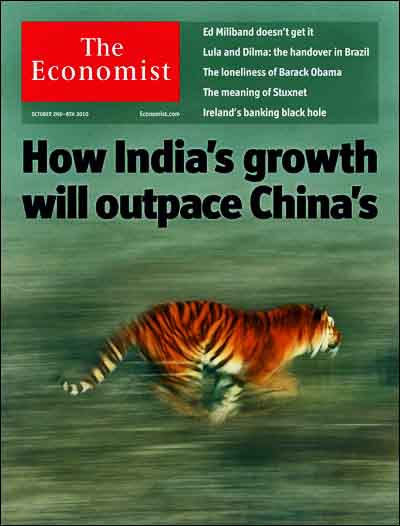
The cover for The Economist of October 2 – 8, 2010, is betting on a race that cannot be won by India.


I opened the magazine and read the two pieces that the cover was about.  One is about India’s surprising economic miracle and the second piece was A bumpier but freer road.

On page 11, I read, “many observers think China has done a better job than India of curbing corruption…”

On page 77, a Western banker was quoted saying, “It’s much easier to deal with the well-understood ‘org chart’ of China Inc than the freewheeling chaos of India.”

After reading both pieces comparing China with India, it was obvious that India would never beat China economically.

The Economist wants India to win this race, because it is called a democracy as is the U.S., but what isn’t mentioned is that China is becoming a republic with a Chinese twist, which is what Dr. Sun Yat-sen wanted.

The reason The Economist is wrong about India is because America’s Founding Fathers hated democracy and they had a good reason.

The Live Journal goes into detail on this topic.  To quote the Live Journal, “It would be an understatement to say that the (U.S.) Founding Fathers hated democracy. They warned against it vehemently and relentlessly. They equated it – properly – with mob rule.

“in a democracy, two wolves and a sheep take a majority vote on what’s for supper, while in a constitutional republic (which China is becoming), the wolves are forbidden on voting on what’s for supper and the sheep are well armed.…

“The Founders, who hated democracy, gave us a free country (a republic). Our (meaning many Americans) ignorance of history, which has lead to a love of democracy, is causing us to surrender our freedoms at an alarming rate.”

Dr. Sun Yat-sen (1866 – 1925), known as the father of modern China, said he wanted to model China’s government after America but by combining Western thought with Chinese tradition.

When he said this, it was 1910, and America, by definition, was still a republic. Once you read the two pieces in The Economist, you may understand why India’s democracy cannot beat China’s evolving republic.

This topic is continued (with more details and facts) at India Falling Short

_______________

Lloyd Lofthouse is the award-winning author of My Splendid Concubine [3rd edition]. When you love a Chinese woman, you marry her family and culture too. This is the love story Sir Robert Hart did not want the world to discover.

Subscribe to “iLook China”!
Sign up for an E-mail Subscription at the top of this page, or click on the “Following” tab in the WordPress toolbar at the top of the screen.

About iLook China


Corruption in China may often stem from Cultural Pressure

August 12, 2010

I’m thinking about what motivated the CEO of Enron and others to steal from their employees and stockholders so they could party, live in mansions and travel as if they were members of the jet set.

In America, there is a history of insider trading, securities and commodities fraud, corporate fraud, health care fraud, antitrust violations, bribery, embezzlement and organized crime.

In fact, the FBI estimates that white-collar crime costs the US more than $300 billion annually.

In China that would be more than 2 trillion yuan.

Western civilization is based on individualism so the primary motivation of those white-collar criminals would probably be individual greed.

However, in Chinese culture, the motivation to become corrupt may not be just from greed.  The American media appears obsessed over corruption in China without addressing how culture plays a role.

In rural China, the peasant, who works the fields, probably is only motivated to grow enough food so his family will not starve while selling enough to keep a roof over their heads.

Most peasants live according to the concept of Taoism, which roughly interpreted means go with the natural order of things or do as little as possible to survive while living in a passive state.

Confucianism teaches the opposite and has more influence in urban China where most of China’s middle class lives and works. Here, loss of face is enough to motivate the individual to become corrupt so he will not look like a loser in the minds of his family, associates or friends. The other choice is suicide.

Since Jesus Christ supposedly said, “Let he who has no guilt cast the first stone”, I want to mention that I read about representatives in both houses of Congress in Washington DC costing the US taxpayer about a million annually for moral corruption. Why—to settle with abused congressional employees, who have been harassed (I’m thinking sexual) or treated badly by their political bosses over the past 14 years. Source: Politico

Back to corruption in Taiwan and China.

The Economist reportedthat corruption flourishes in Taiwan in the judicial system.  The same piece also says that Chen Shui-bian, the former president of Taiwan from the Democratic Progressive Party (DPP), is serving a 20 year sentence for corruption.  On the next page of the July 24th issue is another piece about academic fraud in (mainland) China.

Although greed may play a role in Chinese corruption, another factor may be a more powerful force and that is maintaining, “face” or increasing it since upwardly mobile Chinese are expected to constantly gain face.

To do this, one has to gain in wealth, stature or reputation. This puts a lot of pressure on a Chinese man, which reminds me of the Taiwanese architect our daughter found hanging dead in a tree a few years back during a family hike in Southern California.

_______________

Lloyd Lofthouse is the award-winning author of My Splendid Concubine [3rd edition]. When you love a Chinese woman, you marry her family and culture too. This is the love story Sir Robert Hart did not want the world to discover.

His latest novel is the multiple-award winning Running with the Enemy.

Subscribe to “iLook China”!
Sign up for an E-mail Subscription at the top of this page, or click on the “Following” tab in the WordPress toolbar at the top of the screen.

About iLook China

China’s Holistic Historical Timeline