Tiananmen Square Revisited

July 23, 2010

When I was writing and posting Part 8 for China’s Capitalist Revolution, there was a scene in that segment of the documentary of a student dressed in pajamas sitting in a chair.  This so-called student leader for the Tiananmen Square incident was rude, arrogant and demanding.

There was no sign of the piety I see everyday—that I have lived with and witnessed since I married into a Chinese family. My wife and her family lived in China during Mao’s time. They suffered through the same changes everyone else did but their respect for piety never changed.

I read the “What is the truth about Tiananmen Square?” post again.

Why did President H. W. Bush change ambassadors in the middle of the incident with a man who had once been an operative for the CIA working in Asia inserting agents into China? James Lilly wouldn’t have to meet with the students himself. He knew who the double agents in China were. He had to know.

http://www.youtube.com/watch?v=UCQPE2ghggs 

“The protesters were not demanding Western style politics or an end to Communist Party rule as many in the West believe.  They wanted the government to listen to their opinions about   reforms and corruption.  The banners the protesters carried said, “We Support the Great Glorious Communist Party of China.” Source: China’s Capitalist Revolution, Part 7

It was the Western media and the rude, arrogant students, who turned the event into a democracy movement but only after Lilly was in the country or on his way. Did President Bush seize an opportunity?

In fact, it wasn’t until after that student treated his elders with disrespect, that Deng Xiaoping sent the troops in—a reaction to be expected in a country with a collective culture like China’s where practicing piety is the same as breathing.

What choice did he have?  After all, the students had demanded the negotiations be broadcast live on TV to the nation. Embarrassed in front of the country he ruled, Deng had no choice. It was a great loss of face for him and the government.  Loss of face is probably the leading cause of suicide in Asian countries like Japan and the two Koreas.

That student acted as if he was untouchable–that he had insurance. Maybe he did. He had taken a huge risk to gain face, and it turned into a tragedy.

Moreover, why has America’s media made such a big deal out of the Tiananmen Square incident where hundreds died and almost nothing about the slaughter conducted by (an American ally) Chiang Kai-shek’s troops in Taiwan where almost thirty thousand were murdered? See 2/28 Massacre in Taiwan

_________________________

Lloyd Lofthouse is the award-winning author of the concubine saga, My Splendid Concubine & Our Hart. When you love a Chinese woman, you marry her family and culture too. 

Sign up for an RSS Feed for iLook China


China’s Great Leap Forward (1958 to 1961) – Part 3 of 6

June 22, 2010

The nation goes on a cleaning spree. Posters say everyone must help exterminate pests. Songs were sung, “Pest free areas are glorious. Let’s wipe out the flies, bugs, mosquitoes and rats.”

Sparrows were considered pests since they were accused of eating crops. Whoever killed the most sparrows in each village was rewarded. However, exterminating sparrows caused insect populations to explode endangering crop yields.

Cleaning Rice in Mountain Village

Then the people were asked to watch for capitalistic or counter revolutionary behavior and to denounce suspicious people.

In 1958, the boldest program was launched. Mao wanted to out-produce industrialized nations in manufacturing and crop yields. The land given to the peasants was confiscated and 100 thousand people communes were created. Mao believed that more people meant larger projects. He said,  “Revolutionary enthusiasm will triumph over all obstacles.”

To achieve Mao’s goals, the Communist Party encouraged competition between communes. Instead, overproduction caused crops to rot in the fields and the communes hid the truth by faking records.

Huge construction projects began without proper planning leading to accidents and deaths, which were hidden by the project managers. No one wanted Mao to discover the lack of proper revolutionary enthusiasm.

Return to Part 2, China’s Great Leap Forward or go to Part 4

______________

Lloyd Lofthouse is the award-winning author of the concubine saga, My Splendid Concubine & Our Hart. When you love a Chinese woman, you marry her family and culture too.

If you want to subscribe to iLook China, there is a “Subscribe” button at the top of the screen in the menu bar.


Popularity is a Fad

April 26, 2010

 My wife and daughter returned from China before the 2008 opening ceremony for the Beijing Olympics and said Christianity is popular in China. They said that wearing the cross was the stylish thing to do.

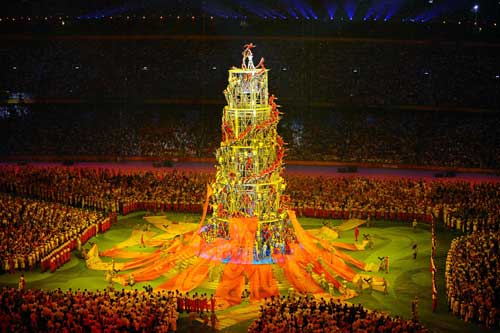
2008 Beijing Olympic's Closing Ceremony - the Human Pillar

I find it disturbing when religion is the stylish thing to do. That’s sort of like wearing clothing that is the latest fad and fads change often. If people are in a religion because it is stylish, what will those people believe next?

Once I started to understand the Confucian foundation of Chinese culture, I found it difficult to blame China’s Communist Party for how organized religions are treated in China. If an Emperor ruled China today instead of the Communist Party, would things be the same or worse? After all, Emperors and popular peasant rebellions are responsible for slaughtering or throwing foreigners and their religions out of China more than once before communism was a concept.

See “Chinese Facehttp://wp.me/pN4pY-7V


China’s Modern Dynasty

February 21, 2010

In 2012, the new rulers of China will “all” have been educated in the West.

After Mao died, Deng Xiaoping and his supporters “rebuilt” the government. The party instituted term limits, two five-year terms for any political position and an age limit of sixty-seven.

Mao

These changes were implemented to avoid having another modern emperor like Mao. Those who spoke out against Mao while he ruled China were usually killed, went to prison or fell out of favor. Deng Xiaoping’s son was dropped from a high rise and paralyzed for life—the message to Deng was to “shut up or else”.

A high-ranking, retired Communist who fought with Mao during World War II and the revolution told me that the seventy million party members (like America’s Democrats and Republicans) do not always agree on issues.

The difference is that the world hears little of what goes on behind the scenes in China. Doing business that way has little to do with the party. That type of behavior is classically Chinese—not to talk about the elephant in the room or to hang out your dirty laundry for everyone to see as the West does. Behaving like that goes against what “face” means in China.

______________

Lloyd Lofthouse is the award-winning author of the concubine saga, My Splendid Concubine & Our Hart. When you love a Chinese woman, you marry her family and culture too. 

If you want to subscribe to iLook China, there is a “Subscribe” button at the top of the screen in the menu bar.


Honor Chinese Style – Part 3

February 5, 2010

In 1935, Lin Yutang wrote, “Face cannot be translated or defined. It is like honor and is not honor. It cannot be purchased with money, and gives a man or a woman a material pride. It is hollow and is what men fight for and what many women die for.

“It is invisible and yet by definition exits by being shown to the public. It exists in the ether and yet can be heard, and sounds eminently respectable and solid. It is amenable, not to reason but to social convention.

“It protracts lawsuits, breaks up family fortunes, causes murders and suicides, and yet it often makes man out of a renegade who has been insulted by his fellow townsmen, and it is prized above all earthy possession.

“It is more powerful than fate and favor, and more respected than the constitution. It often decides a military victory or defeat, and can demolish a whole government ministry. It is that hollow thing which men in China live by.” (Lin Yutang, My Country and My People, Halcyon House, New York, NY, 1938, page 200)

Chinese like Yue Fei and Guan Yu were honorable men and gained much face because of their beliefs and behavior.

When anyone in China reacts to anything, politically or personally, honor plays a big role. It doesn’t matter if one is a member of the Communist Party, a farmer or a factory worker or one of the wealthiest members of the new capitalist elite.

Most Chinese measure what is important in life by a different standard than the rest of the world.

Discover Honor Chinese Style – Part 1

______________

Lloyd Lofthouse is the award-winning author of The Concubine Saga. When you love a Chinese woman, you marry her family and culture too. This is the love story Sir Robert Hart did not want the world to discover.

Subscribe to “iLook China”!
Sign up for an E-mail Subscription at the top of this page, or click on the “Following” tab in the WordPress toolbar at the top of the screen.

About iLook China