China’s Capitalist Revolution (Part 7 of 9)

July 4, 2010

In the first three months of 1989, more than six-thousand corrupt officials were convicted. Many more were beyond the reach of investigators since some had the protection of high-ranking party officials in Beijing.

Then Deng’s right-hand man, who was very popular with the people, died from a heart attack. Without his voice to speak for the people, anger erupted over the corruption and rising prices. People flooded Tiananmen Square.

The protesters were not demanding Western style politics or an end to Communist Party rule as many in the West believe.  They wanted the government to listen to their opinions about   reforms and corruption.  The banners the protesters carried said, “We Support the Great Glorious Communist Party of China.”

However, inside the Great Hall of China, Deng was told the demonstrators wanted to overthrow the Communist Party.  Deng reacted with anger. He believed that Western style democracy would end China’s growth. He said, “We can’t have the separation of powers. We can’t copy the West.”

College students and workers came to Tiananmen Square to show support. Russia’s President Gorbachev arrived to see China’s progress.  The demonstrations were happening at the worst possible time. The protesters were an embarrassment.

As soon as Gorbachev left, Deng called a meeting to discuss what to do.  There were reports that people all over China were protesting.

Return to China’s Capitalist Revolution Part 6 or go to Part 8

_________________________

Lloyd Lofthouse is the award-winning author of The Concubine Saga. When you love a Chinese woman, you marry her family and culture too. This is the love story Sir Robert Hart did not want the world to discover.

To subscribe to “iLook China”, look for the “Subscribe” button at the top of the screen in the menu bar, click on it then follow directions.


China’s Capitalist Revolution (Part 6 of 9)

July 4, 2010

For those Red Hat capitalists who survived harassment from the hardliners, the rewards were huge—fortunes were made. Some Chinese were following Deng Xiaoping’s advice “To Get Rich Gloriously.”

However, there was an area of China’s industry that Deng couldn’t change—factory owned industries, which were outdated and inefficient. The state industries still placed politics over profit. In the average state-owned factory, 15 to 20% of the workers did nothing but read and shout slogans.

Deng decided to take state-owned industries from government management.  He said we are going to bring in experts to run our factories like they do in the West. In fact, Beijing was spending a quarter of its revenues supporting state-owned enterprises. The Chinese constitution guaranteed jobs and no one could be fired.

In 1986, Deng decided to allow unprofitable state-owned enterprises to close. Millions lost jobs. With people out of work, crime soared.  In 1989, Deng did away with price controls. There was a panic while workers in private industries were earning much more than people in state-owned industries.

Then bribery became a problem as those in charge at the local level started to accept bribes from foreign investors.

Return to China’s Capitalist Revolution Part 5 or go to Part 7

_________________________

Lloyd Lofthouse is the award-winning author of The Concubine Saga. When you love a Chinese woman, you marry her family and culture too. This is the love story Sir Robert Hart did not want the world to discover.

To subscribe to “iLook China”, look for the “Subscribe” button at the top of the screen in the menu bar, click on it then follow directions.


China’s Capitalist Revolution (Part 2 of 9)

July 1, 2010

In 1978, Deng was elected leader of the Communist Party beating the Maoists.  His goal was to have China’s economy catch up with the West within 20 years. “In this new age we will focus our efforts on modernizing industry, agriculture, technology and national defense to transform the country by the end of the century in a Chinese way.”

The first challenge was to grow food for China’s starving peasants. During Mao’s failed programs, millions had died. At the end of 1979, peasants in Anhui had started a private farming system. In one year, food production had increased three fold.

Deng was happy to support whatever worked, but local party bosses resisted change after 30 years of Maoism. There was a saying, “We’d rather have the weeds of socialism than the fruits of capitalism.”

Deng surprised the Maoists by giving his blessing to the farmers of Anhui, and by 1981, Anhui was feeding itself. They said, “We’ve been liberated. It’s not like in the past when peasants were rounded up like an army.”

The next step was to modernize China’s industry and that meant China had to work with the United States. Deng also wanted and ally because of threats from the Soviet Union.

Return to China’s Capitalist Revolution Part 1 or go to Part 3

_________________________

 Lloyd Lofthouse is the award-winning author of The Concubine Saga. When you love a Chinese woman, you marry her family and culture too. This is the love story Sir Robert Hart did not want the world to discover.

To subscribe to “iLook China”, look for the “Subscribe” button at the top of the screen in the menu bar, click on it then follow directions.


Dictatorship Defined

April 7, 2010

There is so much misleading information on the Internet and from the Western media regarding China that it boggles the mind. For example, China’s President is listed as a dictator but by definition, he cannot be a dictator.

Dictatorship: 1) government by a ruler who has complete power 2) a country that is ruled by one person who has complete power (source: Longman Advanced American Dictionary)

Chinese Constitution: Article 1

Article 1. The People’s Republic of China is a socialist state under the people’s democratic dictatorship led by the working class and based on the alliance of workers and peasants. The socialist system is the basic system of the People’s Republic of China. Sabotage of the socialist system by any organization or individual is prohibited. Source: Chinese Constitution

I asked my wife, “How can China use the term dictatorship in Article 1 if China isn’t ruled by a dictator?”

She replied, “In Chinese, ‘people’s democratic dictatorship‘ means the people have the power. It’s a translation error.”

I then Googled dictatorship and discovered Parade’s Annual list of…the World’s 10 Worst Dictators.

Parade’s definition of a dictator says, “A ‘dictator‘ is a head of state who exercises arbitrary authority over the lives of his citizens and who cannot be removed from power through legal means.” Hu Jintao, China’s president, was number six on Parade’s list, but the claims used to include Hu Jintao are wrong.
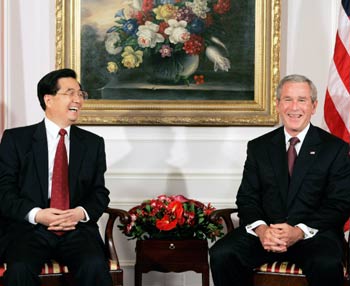
Presidents Hu Jintao and George Bush

For example, Parade claims that at least 400,000 residents of Beijing were forcibly evicted from their houses prior to the 2008 Olympics. That’s not true—the people sent from Beijing before the 2008 Olympics was transient labor and did not have residence cards and could not own property in Beijing. They were not legal residents and many transient laborers in China rent rooms shared with others in a communal environment crowded with bunk beds crammed in every possible space—like a military barracks. I know, because I’ve seen places like this in Shanghai. I also learned that the government paid for the transportation costs.

The reason Beijing sent those people away was because some were from Tibet and Xinjiang and may have been separatists, who might have staged protests to embarrass China—something the Chinese government avoids like the plague. The truth is, those people were sent home to their villages and were allowed to return to work after the Beijing Olympics. For them, it was like a vacation. Most also return to their villages during the Chinese New Year to be with their families because that’s where their homes are.

Since the Chinese Constitution rules China, Hu Jintao does not exercise arbitrary authority over the lives of his citizens. In fact, I doubt if he makes any legal decisions since the Chinese Constitution puts that power in the hands of China’s legal system. Discover more at China Law and Justice System

Parade is also wrong that China’s president cannot be removed from power through legal means.

Article 79 says, “The term of office of the President and Vice-President of the People’s Republic of China is the same as that of the National People’s Congress, and they shall serve no more than two consecutive terms.”

Article 59. The National People’s Congress is composed of deputies elected by the provinces, autonomous regions and municipalities directly under the Central Government, and by the armed forces.

Article 63. The National People’s Congress has the power to recall or remove from office the following persons:

(1) The President and the Vice-President of the People’s Republic of China;

(2) The Premier, Vice-Premiers, State Councillors, Ministers in charge of Ministries or Commissions and the Auditor-General and the Secretary-General of the State Council;

(3) The Chairman of the Central Military Commission and others on the commission;

(4) The President of the Supreme People’s Court; and

(5) The Procurator-General of the Supreme People’s Procuratorate.

Discover Stereotypes and/or The Failure of Multiculturalism in the United States

______________

Lloyd Lofthouse is the award-winning author of The Concubine Saga. When you love a Chinese woman, you marry her family and culture too. This is the love story Sir Robert Hart did not want the world to discover.

To subscribe to “iLook China”, look for the “Subscribe” button at the top of the screen in the menu bar, click on it then follow directions.