Running toward the Tang Dynasty (618 – 906 AD) – Part 1/4

September 24, 2010

If we were to compare Chinese civilization to an amusement ride, it would be a roller coaster.

As each dynasty ended, there was usually a period of chaos, war and anarchy among rival factions.

After the collapse of China’s last Dynasty, the Qing, between 1911 and 1949, chaos, anarchy, warlords, rebellion and World War II tore at the fabric of China. See The Roots of Madness

Then Communist China was born, which eventually led to China’s Capitalist Revolution.

The Xia Dynasty (about 2205 – 1766 BC) ended with the reign of a tyrannical emperor, who lived an extravagant life. When patriotic ministers attempted giving him good advice, he killed them. Then the people rose in rebellion.

The Shang Dynasty (1766 – 1122 BC) ended in similar circumstances when the last emperor lived a luxurious life and tortured both his ministers and people. Another rebellion led by the chief of the Zhou tribe brought down the Shang.

The Zhou Dynasty (1122 – 221 BC) was divided between the Eastern and Western Zhou Dynasties, which fell apart during the Spring and Autumn (770 – 475 BC) Period and the Warring States Period (476 – 221 BC) when the Zhou Emperor didn’t have the power to control the nobles, who fought amongst themselves again leading to chaos and anarchy.

The short Qin Dynasty (221 to 207 BC) unified all China ending the Warring States Period.

However, Qin Shi Huangdi, China’s first emperor, was brutal and soon after his death, the Qin Dynasty was swept aside to be replaced by the Han Dynasty.

The Han Dynasty (207 BC to 220 AD) was divided into the Western and Eastern Han. Near the end of the Han, the last two emperors were weak. The rule of law broke down again and life was hard.

The Han ended with another rebellion leading to the Three Kingdom’s Period (220 – 280 AD), which meant more chaos and anarchy before China would be unified again under one emperor.

With the end of the Three Kingdoms Period, the Jin Dynasty (265 – 420 AD) ruled until the final emperors were too weak to control the warlords, which led to chaos and anarchy.

The Jin Dynasty was followed by four successive southern dynasties (420 – 589 AD)  and five northern dynasties (386 – 581 AD) followed by the Sui Dynasty that lasted for 38 years when the last emperor of the Sui yielded the throne to the Emperor Gaozu of the Tang Dynasty.

The early Tang emperors built an empire that pushed China’s boundaries to their farthest existence and a culture whose achievements would profoundly influence all Asia.

A thriving economy with complex international ties created one of the richest, strongest and most sophisticated states in world history.

The western capital of Chan-an, which had been the first capital of the Zhou, Qin and Han Dynasties, had a population of a million inside the city walls.

Continued in the Tang Dynasty – Part 2

______________

Lloyd Lofthouse is the award-winning author of the concubine saga, My Splendid Concubine & Our Hart. When you love a Chinese woman, you marry her family and culture too. 

If you want to subscribe to iLook China, there is a “Subscribe” button at the top of the screen in the menu bar.


In Search of the Tomb of Cao Cao – Part 3/3

September 20, 2010

Due to a victory against overwhelming odds, Cao Cao became one of the top generals of the Eastern Han Dynasty (23 – 220 A.D.)

In 189 AD, the emperor died and there was a power struggle to see who would control the dynasty. Thousands were murdered. 

By 196 AD, out of the chaos, Cao Cao became the power behind the powerless, last emperor.

Due to the years of struggle, many of the farms had been abandoned leading to famine.

Cao Cao described the situation, “Dead body’s can be seen here and there.  No roosters can be heard crowing anywhere.”  

Cao Cao became prime minister and reestablished the farms around the capital to end the famine. To deal with the danger, each farm was populated with a mixture of farmers and soldiers to work the land.

The following harvests ended the food shortages and the famine.

The following video reports the discovery of Cao Cao’s tomb in late 2009, in Xigaoxue village near the ancient city of Anyang in Henan Province.

The archeologists discovered an epitaph and inscriptions that indicate the tomb belonged to Cao Cao.

Pan Wenbing, the archaeological team leader said, “Cao Cao commonly used broadswords and short spears for defense. We have found six of them in the tomb.”

The skull of a man in his 60s was discovered, which fits Cao Cao’s age at death. 

After his death, Cao Cao was named Emperor Wei Wudi of the Wei Dynasty (215 – 265 AD).  Source: kongming.net

Return to In Search of the Tomb of Cao Cao – Part 2

______________

Lloyd Lofthouse is the award-winning author of the concubine saga, My Splendid Concubine & Our Hart. When you love a Chinese woman, you marry her family and culture too.

If you want to subscribe to iLook China, there is a “Subscribe” button at the top of the screen in the menu bar.


China and India’s Mutual Collectivism and History – Part 2/2

September 10, 2010

Unlike India, China’s one party political system allows for quick decisions that often benefit the country.

Another important factor to remember is that China is still a collectivist nation as India is.

Due to this fact, China and India have more in common than India and America.

It does not matter that India is considered the world’s largest democracy, because to counter that, India also has a large bureaucracy that makes it difficult to get things done.

However, in India, the bureaucracy has a reputation for being tremendously arrogant. It is a truism that Indian bureaucrats are generally smug and supercilious… source: Open India

Indian bureaucracy has often been criticized for being cumbersome and stretching procedures to sanction projects. Source: Meri News

Unlike India, China’s one party political system allows for quick decisions that often benefit the country.

Another important factor to remember is that China is still a collectivist nation as India is.

Due to this fact, China and India have more in common than India and America.

It does not matter that India is considered the world’s largest democracy, because to counter that, India also has a large bureaucracy that makes it difficult to get things done.

However, in India, the bureaucracy has a reputation for being tremendously arrogant. It is a truism that Indian bureaucrats are generally smug and supercilious… source: Open India

Indian bureaucracy has often been criticized for being cumbersome and stretching procedures to sanction projects. Source: Meri News

A friend, Tom Carter, while shooting his next book in India, discovered that it was easier to travel and stay in China than India.

A study of Individualist and collectivist orientations across occupational groups in India by Anjali Ghosh where he refers to a study by Sinha & Verma (1994) … that master’s-level students express more idiocentric (individualist) orientations than allocentric (collectivist) due to Western influence, immediate life concerns and exposure to mass media.

However, Verma & Triandis (1999) observed that Indian students were more vertical collectivist than U.S. students were.

Another fact is that China and India both have ancient civilizations more than 5,000 years old and they are next-door neighbors as Canada and the US are.

See The Collective Culture versus Individualism or return to China and India’s Mutual Collectivism and Shared History – Part 1

A friend, Tom Carter, while shooting his next book in India, discovered that it was easier to travel and stay in China than India.

A study of Individualist and collectivist orientations across occupational groups in India by Anjali Ghosh where he refers to a study by Sinha & Verma (1994) … that master’s-level students express more idiocentric (individualist) orientations than allocentric (collectivist) due to Western influence, immediate life concerns and exposure to mass media.

However, Verma & Triandis (1999) observed that Indian students were more vertical collectivist than U.S. students were.

Another fact is that China and India both have ancient civilizations more than 5,000 years old and they are next-door neighbors as Canada and the US are.

See The Collective Culture versus Individualism or return to China and India’s Mutual Collectivism and Shared History – Part 1

______________

Lloyd Lofthouse is the award-winning author of The Concubine Saga. When you love a Chinese woman, you marry her family and culture too. This is the love story Sir Robert Hart did not want the world to discover.

Subscribe to “iLook China”
Sign up for an E-mail Subscription at the top of this page.

About iLook China


China and India’s Mutual Collectivism and History – Part 1/2

September 10, 2010

There appears to be an obsession in the West that India, since it is a democracy, is the country that will counter China’s economic and military growth.

The American Interest published a piece in their May/June 2010 issue – The Return of the Raj, which points out that where G. W. Bush failed to build an Indo-U.S. defense pact, Secretary of State Clinton in a visit to India in July 2009 did open the door to significant arms transfers from the U.S. to India.

If the United States and India can together rediscover and revive the Indian military’s expeditionary tradition, they will have a solid basis for strategic cooperation not only between themselves but also with the rest of the world’s democracies. Source: The American Interest

In another piece, A Himalayan rivalry, The Economist focuses on the 1962 conflict between India and China saying, “Memoires of a war between India and China are still vivid in the Tawang valley…”

However, memoires aren’t everything. There is also knowledge, and China is not the same country it was in 1962.

In 1962, some of the factors that led to the war between India and China were linked to Mao’s policies, the Great Leap Forward and the Cultural Revolution.

The Maoists were removed from power in the 1980s, and China is not a socialist nation as it was then.

Go to Part 2

______________

Lloyd Lofthouse is the award-winning author of The Concubine Saga. When you love a Chinese woman, you marry her family and culture too. This is the love story Sir Robert Hart did not want the world to discover.

Subscribe to “iLook China”
Sign up for an E-mail Subscription at the top of this page.

About iLook China


Emperor Wu of Zhou Dynasty – Part 4/4

September 7, 2010

The Temple of Heaven in Beijing is a tribute to the Rituals from the Zhou Dynasty.

What the Zhou Dynasty established is still embedded in everyday aspects of Chinese social life. Showing respect for family ancestors originated with the Zhou Dynasty and is practiced today all over China.

The Book of Songs was the first poetry collection in Chinese history. Among the poems is the Eulogy for the Zhou Dynasty.


Video: Chinese with English subtitles.

The Book of Changes, which also discusses military thought, came from the Zhou Dynasty.

The civilization established by the Zhou Dynasty influenced the cultures of Korea, Japan and Southeast Asia.

Duke Zhou, Emperor Wu’s younger brother, was regent for seven years when King Cheng was mature enough to assume the power of king.  Duke Zhou stepped aside.

The Zhou Dynasty is also known for its bronze castings with history unscripted on them. Jade became important at this time too.

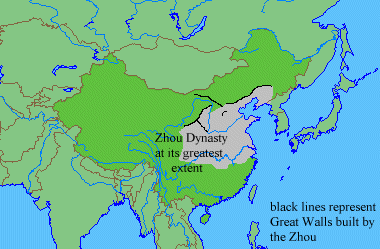
Zhou Dynasty at its greatest

The Zhou Dynasty attached great importance to agriculture and a large number of bronze farming tools were extensively used.

The Zhou Dynasty continued to expand as other states were slowly absorbed.  The Zhou also fought the nomads to the north and northwest.

Return to Emperor Wu of Zhou Dynasty – Part 3 or start with Part 1

______________

Lloyd Lofthouse is the award-winning author of The Concubine Saga. When you love a Chinese woman, you marry her family and culture too. This is the love story Sir Robert Hart did not want the world to discover.

To subscribe to “iLook China”, sign up for an E-mail Subscription at the top right-hand side of this page and then follow directions.