She describes herself as a girl from China who came to America with $45 and knowing two words of English, “Merry Christmas.” Source: SFGate
When Zheng Cao burst onto the San Francisco Opera scene in 1995, she played Siebel in “Faust.” Since then, she’s performed in opera houses throughout North America, Europe and Asia.
Today, an inspiration, the Shanghai-born Mezzo-soprano has defied the odds of surviving stage four lung cancer and a diagnoses that said she had six months to live.
When diagnosed, she received a death sentence. Months later, she would learn that the rigorous treatment plan had dramatically reduced the cancer threat.
“This is the most impressive response I’ve seen in my life,” Dr. Rosenbaum said.
Zheng Cao’s tumors either had decreased in size, were no longer visible or no longer considered active.
To learn more about Zhen Cao’s journey, visit her Blog at Caring Bridge.org.
Zheng Cao holds degrees from the Shanghai Conservatory and the Curtis Institute of Music.
While studying, she worked as a singer on the Holland American cruise line where she met Troy Donahue in 1991.
Donahue said, “We were very serious, very committed to each other. It’s the greatest relationship I’ve ever had in my life.” Source: Troy Donahue at encore4.net
Zheng Cao and Troy Donahue were engaged until his death in 2001. She turned 44 on June 9, 2010.
Lloyd Lofthouse is the award-winning author of My Splendid Concubine [3rd edition]. When you love a Chinese woman, you marry her family and culture too. This is the love story Sir Robert Hart did not want the world to discover.
Subscribe to “iLook China”!
Sign up for an E-mail Subscription at the top of this page, or click on the “Following” tab in the WordPress toolbar at the top of the screen.
Arriving early at the local library to attend a lecture called the Wit and Wisdom of Abraham Lincoln, I stopped by the library’s used bookstore first and found a three-dollar DVD of Hao Jiang Tian’s From Mao to the Met. Later that evening, my wife said she had been looking for that DVD, and she invited her sister and father to join us when we watched it.
Funded by the Committee of 100, this one-man show features Metropolitan Opera basso Hao Jiang Tian weaving song and story into a compelling tale of growing up in China under Chairman Mao, based on his autobiography (with co-author Lois B. Morris) “Along the Roaring River: My Wild Ride from Mao to the Met“.
What I enjoyed most about the one-man show was that Tian never condemned Mao, the CCP or China for his bitter-sweet journey.
Instead, this fantastic opera singer says it was fate that led him from Mao to the Met. When you stop to think about it, fate is the river-of-life known later as history—the current that carries all of us through life often without much say in that history.
As a child, Tian hated his piano lessons. Then with the arrival of Mao’s Cultural Revolution, Tian said, “So one happiest day came when I heard an announcement from the loudspeakers: My piano teacher was arrested as a counterrevolutionary. And then I was so happy. And so immediately I ran to the courtyard, screaming and jumping with joy.”
Thirty years later, Tian returned to Beijing and visited his piano teacher, who said, “Well, that was a crazy period, and it was so hard to figure out who was right and who was wrong.”
In his one man show, Tian performs songs of the Cultural Revolution, American standards such as “Some Enchanted Evening”, Irish song “Danny Boy” and operatic arias from his favorite roles; Tian tells the story of the music-and the woman- that changed his life.
NPR says, “For more than 20 years, the basso voice of Hao Jiang Tian has filled major American opera houses. As one of the few Chinese stars in opera, his life story is as remarkable as his work. … Tian is one of the few opera singers to emerge from China.” Source: NPR.org
Lloyd Lofthouse is the award-winning author of My Splendid Concubine [3rd edition]. When you love a Chinese woman, you marry her family and culture too. This is the love story Sir Robert Hart did not want the world to discover.
Subscribe to “iLook China”!
Sign up for an E-mail Subscription at the top of this page, or click on the “Following” tab in the WordPress toolbar at the top of the screen.
If not, this is what it means: “Found poems take existing texts and refashion them, reorder them, and present them as poems. The literary equivalent of a collage, found poetry is often made from newspaper articles, street signs, graffiti, speeches, letters, or even other poems.” Source: Poets.org
Well, I found something about consumer related corruption, but it wasn’t linked to China. It took place in the United States, and I’m going to write a “found” post by piecing together a collage of corruption with one example from China compared to similar private sector corruption in the United States where greedy CEOs took short cuts to boost profits.
On “60 Minutes” Sunday night, March 10, 2013, I first heard about the NECC Drug Scandal: Fake names used to bypass regulations (the story first broke September 2012). I then Googled “NECC Drug Scandal” and came up with 786,000 hits.
Then I Googled “Chinese drywall import scandal” (2001) and came up with more than 4.4 million hits.
Since the late 1990’s there has been a conservative political agenda in the United States to take away and/or limit Federal government regulatory and watchdog protection for consumers. One of those exemptions from FDA over-site led to the NECC Drug Scandal. That same conservative political agenda also led to the 2007-08 global financial crises.
Wiki reports that from the NECC scandal (started September 21, 2012 and still ongoing) there have been 48 deaths, 720 injuries and more than 400 lawsuits filed against NECC.
Let’s compare that to the potential for injury from the Chinese drywall scandal: “The Center for Disease Control, in collaboration with The Agency for Toxic Substances and Disease Registry released a guide indicating the residents of affected homes reported irritated and itchy eyes and skin, difficulty breathing, persistent cough, bloody noses, runny noses, recurrent headaches, sinus infection, and asthma attacks.”
Out of curiosity, I Googled, “the Ford Pinto Case (1972) where, due to a cover up at Ford, people died.”The cases involving the explosion of Ford Pintos due to a defective fuel system design led to the debate of many issues, most centering around the use by Ford of a cost-benefit analysis and the ethics surrounding its decision not to upgrade the fuel system based on this analysis.” My Google search came up with 719,000 hits. Twenty-seven deaths were attributed to Ford Pinto fires.
Does this “found” post on corruption and good-old-fashioned universal human greed reveal that a scandal in China will cause more of an uproar than a similar or worse scandal in the United States? If so, why? After all, no one has died yet from that tainted drywall that was made in China and sold in the US.
If the fungus tainted drugs from NECC had been made in China and exported to the United States, how many Google hits do you think would result?
Lloyd Lofthouse is the award-winning author of My Splendid Concubine [3rd edition]. When you love a Chinese woman, you marry her family and culture too. This is the love story Sir Robert Hart did not want the world to discover.
Subscribe to “iLook China”!
Sign up for an E-mail Subscription at the top of this page, or click on the “Following” tab in the WordPress toolbar at the top of the screen.
The Chinese Communist Party (CCP) has 83 million members, more than a quarter of the US population. For a comparison, there are about 63-million Democrats, 47-million Republicans and 32-million independents registered to vote in the United States.
How does a Chinese citizen become a member of the CCP?
One source for CCP members may come from the Communist Youth League of China that has 73-million members. China’s Youth League, although overseen by the CCP, is a separate organization. The two are not necessarily one and the same and not all Youth League members go on to join the CCP.
The China Daily says, “It (the Youth League) is a school where a large number of people learn about socialism with Chinese characteristics and about communism through practice. It is the Party’s assistant and reserve force.”
However, “Many of today’s party members are culled from the top ranks of high schools and colleges: top students are invited to join the party, and it is the sort of invitation that can’t be refused. Others can be nominated by friends who are party members, or apply on their own initiative if they have the support of other party members. During the past two decades, the ranks of the party have been expanded to include businessmen (who were previously not allowed to join) as well as more ethnic minorities, who currently account for 7 per cent of party members.” Source: Beyond Bricks
The conclusion of Leslie Hook’s Beyond Brick’s piece quoted Sidney Rittenberg, who says of the CCP, “Dictatorship gives you more dictatorship, not democracy.”
But, I do not agree with the term “dictatorship” to describe the CCP. China is ruled by an authoritarian, one party political system and decisions are made by the consensus of hundreds of Party members. A dictatorship is a form of government in which absolute power is concentrated in a dictator or a small clique. Source: Merriam-Webster.com
There are also factions within the CCP that have different political opinions and agendas that balance each other. Political theorists have identified two groups within the Communist Party, a structure which has been called “one party, two factions”. The first is the “elitist coalition” or Shanghai clique which is composed mainly of officials who have risen from the more prosperous provinces. The second is the populist coalition, the core of which are the tuanpai, or the Youth League faction which consists mainly of officials who have risen from the rural interior, through the Communist Youth League.
Within his “one party, two factions” model, Li Cheng has noted that one should avoid labeling these two groupings with simplistic ideological labels, and that these two groupings do not act in a zero-sum, winner take all fashion. Neither group has the ability or will to dominate the other completely.
Then there is this study from the China Quarterly that explains why we find so many of China’s wealthy as members/supporters of the CCP.
“This article presents original survey data from 1999 and 2005 to evaluate the Communist Party’s strategy towards the private sector. The CCP is increasingly integrating itself with the private sector both by co-opting entrepreneurs into the Party and encouraging current Party members to go into business. It has opened the political system to private entrepreneurs, but still screens which ones are allowed to play political roles. Because of their close personal and professional ties, and because of their shared interests in promoting economic growth, China’s capitalist and communist officials share similar viewpoints on a range of political, economic and social issues. Rather than promote democratic governance, China’s capitalists have a stake in preserving the political system that has allowed them to prosper, and they are among the Party’s most important bases of support.” Source: The China Quarterly, 192, December 2007, pp.827-854
Lloyd Lofthouse is the award-winning author of My Splendid Concubine [3rd edition]. When you love a Chinese woman, you marry her family and culture too. This is the love story Sir Robert Hart did not want the world to discover.
Subscribe to “iLook China”!
Sign up for an E-mail Subscription at the top of this page, or click on the “Following” tab in the WordPress toolbar at the top of the screen.
While visiting China in September/November of 2008, we went to Guilin, went underground to the Reed Flute Cave, hiked the Dragon’s Back, cruised the Li River and spent two days in Yanghsuo.
Then we saw Zhang Yimou’s breathtaking staged production, the Impressions of Liu Sanjie, that I recommend to anyone visiting Southeast China.
Zhang Yimou, the director,is an internationally acclaimed Chinese filmmaker. He made his directorial debut in 1987 with the film “Red Sorghum”.
In the 1990s, Zhang Yimou directed “Raise the Red Lantern”—nominated for Best Foreign Language Film at the 1991 Academy Awards.
The “Impressions of Liu Sanjie” is performed on the river at night. However, you may be more familiar with Zhang Yimou’s opening and closing ceremonies for the 2008 Beijing Olympics.
The “Impressions of Liu Sanjie” is performed with the Karst Mountainsand the Li River as the setting.
The cast comes from the local Guangzi Zhuan Autonomous Region and many may be fishermen by day and actors at night and are from the Zhuang and Yao minority groups, who live in that region.
_______________
Lloyd Lofthouse is the award-winning author of My Splendid Concubine [3rd edition]. When you love a Chinese woman, you marry her family and culture too. This is the love story Sir Robert Hart did not want the world to discover.
Subscribe to “iLook China”!
Sign up for an E-mail Subscription at the top of this page, or click on the “Following” tab in the WordPress toolbar at the top of the screen.


 Posted by Lloyd Lofthouse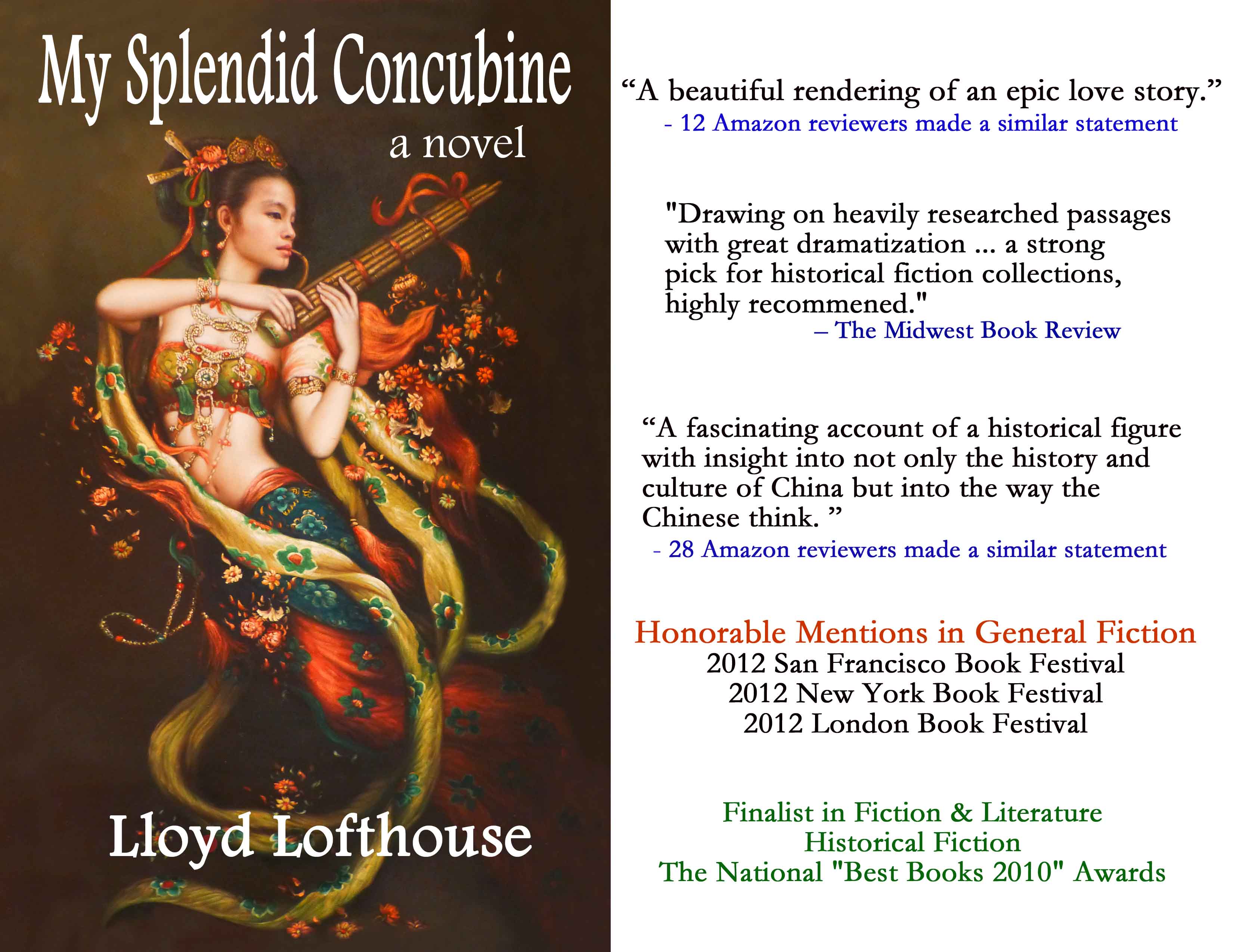
 iLook China