China’s Great Famine (1959 – 1961) – Viewed as Single Page

January 28, 2010

In America and the rest of the West, most people believe that Mao was a monster worse that Adolf Hitler or Stalin and is responsible for killing at least 30 to 60 million people during what is known as China’s Great Famine.

In fact, many Chinese also believe that millions died of starvation during The Great Famine (1958 – 1961) due to Mao’s demanding agricultural production goals during China’s Great Leap Forward.

Until recently, I also believed this without doubt since that is all I have ever heard.

The details that may have caused this famine are not common knowledge and it appears that no attempt by the Western media has been made to reveal them.

However, after discovering what happened in China and the world during Mao’s Great Leap Forward, what was once a certainty (at least to me) is now a mystery and possibly another hoax equal to the hoax that Tibet was never part of China before 1950 and there was a massacre in Tiananmen Square in 1989, which Wiki Leaks recently proved wrong.


No mention of drought, floods and severe weather that cut crop yields, and the number of deaths quoted in the video cannot be supported with evidence. In addition, evidence that does exist supports far fewer deaths.

Why Mao may have become scapegoat or victim of a hoax is worth examining.

The reason I say this is because in 1949 when Mao came to power, life expectancy in China was about 35, and then in 1960 life expectancy improved to about 60 or almost double what it had been in 1949, while the population of China increased by 19.5% with child mortality rates improving dramatically.

If Mao’s policies were responsible for these improvements in life expectancy and population growth, how could he also be the monster responsible for causing a famine that may have killed millions?

If a famine did occur, my research revealed that other factors may have contributed to the deaths and all but one of those factors did not deliberately cause people to die of starvation.

After learning of these other factors and completing the puzzle, it is obvious (at least to me) that Mao and the Communist Party did not order the deaths of 15 to 70 million people (the numbers quoted in the West vary widely because different people have made different claims without valid evidence to support those claims. There is evidence that supports the lower number.).

Before I started researching this post, I believed that Mao’s agricultural reform policies were mostly responsible for the famine, and then I learned that drought and severe weather also played a role in the famine.

The other factors that may have contributed to China’s so-called Great Famine will be listed in order of influence with the most damaging factor listed first and the least damaging last.

The first factors that may have contributed to the famine were droughts, floods and general bad weather.

In 1959 and 1960, the weather was less favorable, and the situation grew considerably worse, with many of China’s provinces experiencing severe famine.

Droughts, floods, and bad weather caught China completely by surprise, and in July 1959, the Yellow River flooded in East China and directly killed,either through starvation from crop failure or drowning, an estimated 2 million people.

In 1960, at least some degree of drought and other bad weather affected 55 percent of cultivated land, while an estimated 60 percent of northern agricultural land received no rain at all. Source: Great Leap Forward – Climate Conditions and famine in China (Wiki)

In fact, droughts and famine are common in China. Between 108 BC and 1911 AD, there were no fewer than 1,828 major famines in China or one nearly every year in one or another province.

In the West, most if not all of what we hear about Mao is that he was a brutal monster responsible for the deaths of about 30 million people during the Great Leap Forward as if he pulled the trigger and ordered others to deliberately kill people by the millions as Hitler and Stalin did.

However, the facts do not support this claim.

The first time I heard that droughts and extremely bad weather also played a role in the so-called Great Famine was early July 2011 while I was researching another topic for this Blog and stumbled on that mostly unknown fact by accident.

Then I discovered another more insidious factor when I started working on this post, which may have contributed significantly to the early deaths of millions in China and no one in China was responsible for this one.

This factor was influenced by both American and Chinese paranoia generated by the Korean War (1950 – 1953), America’s involvement in Vietnam (1955 – 1975), McCarthyism‘s Red Scare (1947 – 1957) and the Cold War with Communist Russia (1945 – 1991).

The War in Korea (1950 – 1953), Vietnam (1955 – 1975), McCarthyism (1947 – 1957) and the Cold War with the USSR (1945 – 1991) set the stage for what may have contributed to mass deaths by starvation in China during the Great Leap Forward.

During the McCarthy era (1947 – 1957), thousands of Americans were accused of being Communists or communist sympathizers and became the subject of aggressive investigations and questioning before government or private-industry panels, committees and agencies.

In 1950, since China fought alongside North Korea against allied UN forces under the leadership of the US, the United States implemented a “complete embargo” that forbade all financial transaction with Communist China.

The US also convinced many of its allies to join this “complete embargo” to cut China off from the world.

After the Korean war, the United States did not lift this embargo for the next twenty years (1949-1969), with a goal to disrupt, destabilize, and weaken China’s communist government by causing the people to suffer and this “complete embargo” was one of the tools to achieve this.


The US embargo on China was a “complete embargo”, whch certainly must have contributed to the death toll of the Great Famine, a factor never mentioned before.

High American government sources have admitted that the objective of the economic warfare was aimed at causing a breakdown of Communist China. The idea was that problems in the Chinese economy would lead to loss of support from the people causing the collapse of the Communist Republic. Source: China for all.info and Asia for Educators – Columbia.edu

This embargo was lifted in 1969, when Richard Nixon was President. Source: Washington Post.com

However, while people were starving in China and US officials were waiting for Communist China to collapse, Washington D.C. had no idea how much suffering the Chinese people were capable of enduring and that even with the drought and famine, most Chinese were better off than they had been in centuries.

The evidence that the quality of life was improving was the fact that in 1949 when Mao came to power, life expectancy in China was 35, and by 1960 life expectancy had improved to age 60 or almost double what it had been in 1949, while the population of China increased by 19.5% with child mortality rates improving dramatically.

Field-studies in the 1930s revealed that in all parts of China, large numbers of landless laborers lived in tremendous poverty, and their situation had not changed since the sixteenth century. Source: China for all.info

If you want more evidence, I refer you to Pearl S. Buck’s “The Good Earth”.

We may never know how much of an impact America’s “economic warfare” against China crippled its ability to import food to feed its starving people in a time of drought and famine. In fact, this may have also influenced Mao’s decisions since he wanted the world to see China as strong and capable of feeding itself.

If anyone pulled a trigger on China’s people, it was not Mao. It was Washington D.C. fueled by fear of everything Communist caused by the Korean War, Vietnam, McCarthyism’s Red Scare and the Cold War with Communist Russia.

The last damaging factors that may have led to millions of deaths due to famine and starvation was the statistical lies of rural farmers and local party bosses reporting crop yields in rural China and Mao’s impossible goals to create a miracle in five years.

Mao’s five-year plan for the Great Leap Forward set quotas (goals) to develop agriculture and industry so China would catch up to America and the other Western nations that had invaded China during the 19th century (England, France, Japan, Germany, Russia, America, etc.)

Mao believed that both agriculture and industry had to grow to allow the other to thrive.

Industry could only prosper if the workers were well fed, while the agricultural workers needed industry to produce the modern tools needed for modernization.

For this to happen, rural China was reformed into a series of giant communes.

However, the droughts, floods and other severe weather arrived soon after this five-year plan was implemented and set the stage for a tragedy caused by nature and supported by American “economic warfare” in the form of a “complete embargo” of China.

Due to quotas set by Mao’s agricultural policies, no one wanted to be seen as a failure and/or unpatriotic so this generated boastful claims about output that were followed by more boastful claims of incredible crop yields.

Nobody – least of all the central government in Beijing – knew the real output figures and nobody was trying to find out. Instead, there was a sense of general euphoria in Beijing that China was succeeding.

While rural farmers and party posses lied about crop yields, China started exporting rice and wheat to other countries as a source of revenue, since Beijing believed there was a bumper crop. The result was that only urban areas suffered with reduced rations but with still enough food to survive.

However, the situation was different in the areas that lied the most and resulted in mass starvations largely confined to rural China, where, because of drastically inflated production statistics, very little grain was left for the peasants to eat.

Food shortages were bad throughout the country. However, the provinces, which had adopted Mao’s reforms with the most energy, zeal and the highest boasts, such as Anhui, Gansu and Henan, tended to suffer disproportionately.

Sichuan, one of China’s most populous provinces, known in China as “Heaven’s Granary” because of its fertility, is thought to have suffered the greatest absolute numbers of deaths from starvation due to the vigor with which provincial leader Li Jinquan undertook Mao’s reforms.

Once the central government in Beijing discovered the truth, the Chinese Communist Party acted quickly to correct the errors in national agricultural decision-making, to conserve food, and to save as many lives as possible implementing drastic measures to feed those in need and to restore agricultural productivity.

Grain exports were stopped, and imports from Canada and Australia (in spite of America’s complete embargo) helped to reduce the impact of the food shortages. Source: Library Index.com

The final question is: Would Mao’s Great Leap Forward have been more successful if there had been no drought, no floods and no “complete (U.S.) embargo” and the people had not lied about crop yields?

It is no secret that millions of rural people starved to death in China during the famine of 1959 – 1960, but it was a “great” tragedy caused by a complex series of circumstances and was not murder.

In addition, the actual number of deaths was significantly lower than what has been claimed in the West.

The CCP’s lofty goal was to prove to the world that the Party ruled China successfully by boosting crop yields and industrial output.

Another reason the CCP set such unrealistic goals for the five-year plan that contributed to the tragedy that was Great Leap Forward was because of Taiwan, which was recognized by the world as the official government of China and still held its seat in the United Nations.

It wouldn’t be until 1971 that the U.N. recognized the People’s Republic of China instead, and the United States wouldn’t switch diplomatic relations with China from Taipei to Beijing until 1979, finally recognizing the Communist Party as the legitimate ruler of China.

Recommended reading on this topic for those who seek the unblemished truth: From the Monthly Review, Did Mao Really Kill Millions in the Great Leap Forward? by Joseph Ball

From Griffith University, Australia, Poverty, by David C. Schak, Associate Professor

______________

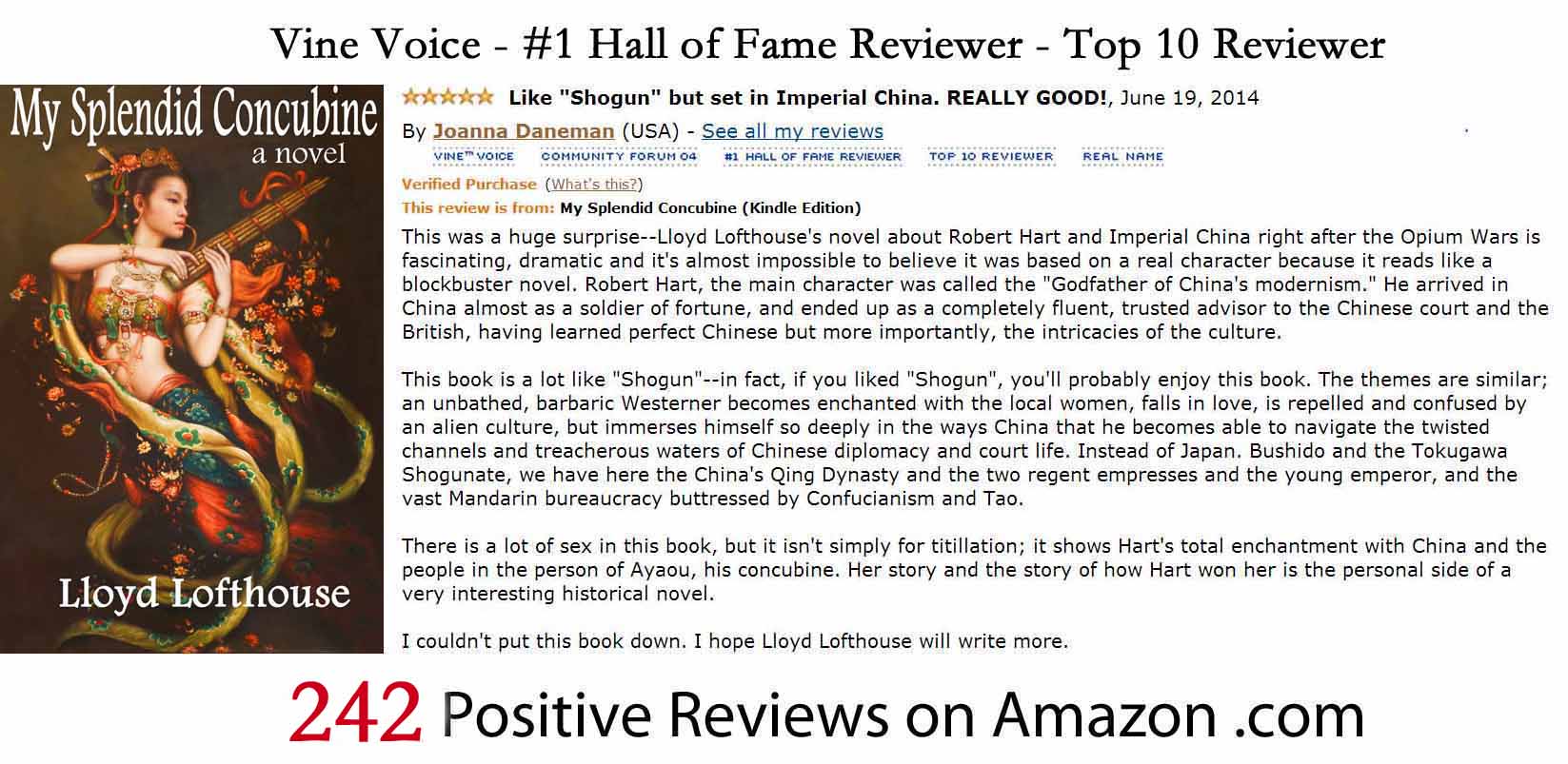
Lloyd Lofthouse is the award-winning author of The Concubine Saga. When you love a Chinese woman, you marry her family and culture too. This is the love story Sir Robert Hart did not want the world to discover.

To subscribe to “iLook China”, look for the “Subscribe” button at the top right of the screen.

Note: This post first appeared as a four-part series on August 31, 2011 as China’s Great Famine – Part 1


China’s Holistic Historical Timeline: Part 5 of 5

January 28, 2010

Timeline Viewed as Single Page

Deng Xiaoping

The Sino-Vietnam War of 1979

The Controversy, Complexity and Reality behind China’s One-Child Policy

The Tiananmen Square Hoax

Tiananmen Square Revisited

What is the truth about Tiananmen Square?

On the trail of Dr. Li’s illusive Memories

Water: the Democracy versus the Authoritarian Republic

Greenpeace and the growth of environmentalism in China

China’s Educated Women Work to Bring about Change from Within

China’s Stick People – the rural urban divide

China’s Porn War

Evil Tobacco

Joining the Party

Communism and Socialism are NOT the SAME

Country Driving with Peter Hessler

Oprah Times Four in China

Hooters in China

What do Shanghai’s IKEA and Cupid have in common?

Macao Bringing in the Cash

Falun Gong’s Media Machine

The differences between Individualism and Collective Cultures

Return to China’s Holistic Historical Timeline: Part 4 or start with Part 1

Timeline Viewed as Single Page

_______________

Lloyd Lofthouse is the award-winning author of My Splendid Concubine [3rd edition]. When you love a Chinese woman, you marry her family and culture too. This is the love story Sir Robert Hart did not want the world to discover.

His latest novel is the multiple-award winning Running with the Enemy.

Subscribe to “iLook China”!
Sign up for an E-mail Subscription at the top of this page, or click on the “Following” tab in the WordPress toolbar at the top of the screen.

About iLook China


China’s Holistic Historical Timeline: Part 2 of 5

January 28, 2010

Timeline Viewed as Single Page

206 BC – 219 AD

The Han Dynasty

Buddhism in China

With or Without Paper

Measuring Earthquakes


Near the end of the Han Dynasty to 280 AD

Romance of the Three Kingdoms


300 – 644 AD

A Millennia of History at a Silk Road Oasis

[youtube-http://www.youtube.com/watch?v=R29A0GyLYlE]


596 – 644 AD

Hsuan-tsang – From China to India for Enlightenment


618 – 906 AD

The Tang Dynasty

Wu Zetian, China’s only Female Emperor and an early feminist

Ancient Feminism in China

Tang Dynasty Poetry

The Accidental Discovery of Gunpowder

Ice Cream from China – Myth or Fact

The First Cinderella was Chinese

The Tea Horse Road

Chinese Crossbow and other Inventions

Quyi: Chinese Singing and Storytelling

Christianity and Islam in China

The Kaifeng Jews


 925 – 1279 AD

Sung Dynasty

China’s Imperial Encyclopedia

China’s Bound-Feet Women

The Machines of China


1279 – 1368 AD

Yuan Dynasty: Kublai Khan’s Mongol Empire [China conquered]

Shanghai’s History & Culture

China’s Real Karate Kids

The Millennium Cult

The White Lotus Mutation

Continued with China’s Holistic Historical Timeline: Part 3 or return to Part 1

Timeline Viewed as Single Page

 _______________

Lloyd Lofthouse is the award-winning author of My Splendid Concubine [3rd edition]. When you love a Chinese woman, you marry her family and culture too. This is the love story Sir Robert Hart did not want the world to discover.

His latest novel is the multiple-award winning Running with the Enemy.

Subscribe to “iLook China”!
Sign up for an E-mail Subscription at the top of this page, or click on the “Following” tab in the WordPress toolbar at the top of the screen.

About iLook China


China’s [Politically Motivated?] Science Fiction Craze – Viewed as Single Page

January 28, 2010

This Blog explored (with Tom Carter’s guest post) how Harlequin Romance Invaded China without mentioning that romance literature in China has a history reaching back before the Dream of the Red Chamber (1715-1763), which has a tragic Romeo and Juliet love story between its covers.

I’ve also written of the rise of China’s film industry in Hollywood to Bollywood to a Rising Chinawood, while exploring the folklore and films of China’s Vampires.

As a child, I read many historical texts on Genghis Khan, Alexander the Great, the Napoleonic Wars, the British Empire, and historical fiction on similar subjects.

Then as an adolescent in middle and then high school I devoured science fiction and fantasy novels often one or two a day.

Today, I mostly read mysteries and literature but find my science fiction fantasy fix from film productions such as The Lord of the Rings, TV’s Stargate and Star Trek franchises in addition to George Lucas‘s Star Wars Saga.

Recently, I’ve been watching the complete series of Earth 2 while reading mysteries and thrillers.

In fact, the future we live with today was predicted in the early pages of Western science-fiction literature and China has noticed that science fiction literature often predicts and precedes scientific innovations such as laptop computers, the Internet, the Amazon Kindle and even doors that open automatically.

The British Telegraph’s HG Wells on Google: which of his predictions came true? reminds us that H. G. Wells first mentioned genetic engineering in The Island of Dr. Moreau (1896), lasers in The War of the Worlds (1898), the first moon landing in The First Men in the Moon (1901), nuclear power and weapons in the World Set Free (1914), and the Second World War in The Shape of Things to Come (1933).

In addition, Computer Science Schools.net lists 15 Science Fiction Predictions that came True, while Blog Tutor.com lists eight.

Blog Tutor says, “At the time of their writing, these science fiction ideas often seemed impossible to fantastic to ever come true—and yet today’s technology seems to keep pace with the dreams of writers past.

Although Cyberspace hasn’t quite reached the level of technology William Gibson predicted in 1986’s Burning Chrome, no one can deny that the Internet’s alternative worlds … are working towards the virtual…”

With that introduction, it may not come as a surprise that science fiction fits with China’s goals to catch up with and possibly surpass the West and reclaim its heritage and history of being the most powerful and technological advanced country and culture on the planet as it was for more than two thousand years before the 19th century and the Opium Wars.

In fact, we learn from The Race is On that “China’s Government actively encourages its citizens to read Science Fiction… Mark Charan Newton calls this the “Cult of Science Fiction – that is, the faith in dreaming up Big Ideas… So perhaps the Chinese are onto something with their focus on science fiction: a genre that weds the scientific to the artistic.”

The history of science fiction in China predates the CCP’s encouragement today, and that interest started in the late nineteenth and early twentieth centuries — a cultural phenomenon that emerged from Western Europe’s Industrial Revolution. One site I visited while researching this topic even dated science fiction to ancient China.

In Sci-fi books? China’s got tons of those, Asia Obscura.com says, “When it comes to sci-fi movies, China’s really falling behind. One that really did impress me, though, was the very first to be produced in China: 1980′s gorgeous, fun, and campy ‘Death Ray on Coral Island’ (珊瑚岛上的死光).

“In ‘Death Ray,’ a good-hearted team of Chinese scientists, based in what appears to be San Francisco, finally succeed in completing their fabulous futuristic invention. That is, until the sinister back-stabbing Americans, played with Bond-villainous glee by Chinese actors in whiteface and prosthetic noses, decide to steal the invention for their evil plots…”, which reveals another perspective of the US.

Then Foreign Policy.com introduces us to The Prosperous Time: China 2013, written by 58-year-old Hong Kong novelist Chen Guanzhong, who has lived and worked in Beijing for much of his life.

China 2013 presents an ambivalent vision of China’s near future: outwardly triumphant (a Chinese company has even bought out Starbucks), and yet tightly controlled”, which may be a prediction that China’s one party republic is here to stay.

Even after 1949 with the founding of the People’s Republic of China, science fiction literature continued to flourish. During this period, the genre adopted a popular science approach and directed the majority of its stories towards younger readers.

However, during the Cultural Revolution (1966-1976), science fiction stagnated and then revived after March 1978 when the Central Committee of the Chinese Communist Party and the State Council convened a national scientific congress in Beijing, proclaiming to China, “Science’s spring has come.”

Scientific enthusiasm and popular science followed, greatly promoting the development of science fiction in China.

From China.org we learn, “The monthly circulation of Science Fiction World, one of China’s most popular magazines, has exceeded 500,000, dwarfing all international counterparts. Yang Xiao, head of the magazine’s editorial board, said 70 percent of its readers were students who shared single copies of the journal between dozens of friends because they could not afford their own. Millions of Chinese young people were affected by science fiction, said Yang, who hailed the rise of the modernist genre among the people who would decide the nation’s future.”

Another sign of the progress of science fiction literature in China first took place August 25, 2007 at the Chengdu International SF/F Conference. Over two days, authors from America, Canada, Britain, Russia, Japan, and China, and over twenty-thousand science fiction fans arrived in Chengdu for the event, which in turn increased the influence of SF in China due to media coverage.

Then from Chinese Science Fiction.org, we discover the second Chengdu Science Fiction and Fantasy conference was held November 12, 2011 in Chengdu.

Meanwhile, China continues with plans to build a space station, and then a productive mining colony of rare-earth minerals on the moon with a future exploration of Mars on the books, while the United States space program languishes.

The cause of this development is due to the US national debt and the costs of the war on Islamic terrorism, which may have been caused by what Henry Kissinger calls, “American exceptionalism is missionary. It holds that the United States has an obligation to spread its values to every part of the world” even if the world isn’t interested resulting in this resistance from the Middle East.

In addition, many young people in the United States with a high sense of self-esteem do not read books while watching too much TV has been scientifically linked to lack of a development in part of the brain where imagination blossoms.

Note: You may read more on this topic [written by British thriller writer O. C. Heaton] over at A Rush of Green.

Lloyd Lofthouse is the award-winning author of My Splendid Concubine, Crazy is Normal, Running with the Enemy, and The Redemption of Don Juan Casanova.

Where to Buy

Subscribe to “iLook China”!
Sign up for an E-mail Subscription at the top of this page, or click on the “Following” tab in the WordPress toolbar at the top of the screen.

About iLook China

China’s Holistic Historical Timeline


China’s Holistic Historical Timeline: Part 1 of 5

January 28, 2010

Timeline Viewed as Single Page

This holistic timeline in no way represents all of China’s history. This menu of China’s history is here for individuals who want to learn about China and the Chinese from near the beginning to today.

What I’ve done is provide links in chronological order—or as close as possible—to posts on this site that offer a look at China’s long history and her people. Click on the links [in red] to discover some of China’s historical, cultural and artistic evolution.

If you see a post that you feel is in the wrong time slot, let me know and I will look into it. New links may be added at any time.

This timeline takes up a lot of memory and may load too slowly. That is why I divided the timeline up into five parts. If your system can handle the larger file, click on Timeline Viewed as Single Page. However, if the single page loads too slowly, stick to the five parts and visit one at a time.

6987 BC

The Ancient Yue


3000 BC

The Discovery of Silk

God, Ancient Astronauts and China’s Yellow Emperor


2256 – 2205 BC

ShangDi, China’s God of Creation


2205-1783 BC

The Xia, China’s Oldest Known Dynasty


1783 – 1123 BC

Shang Dynasty

The Mandate of Heaven

Links to the Stars – Ancient Astronomy

Spring Festival, Year of the Tiger

The Vanishing Street Art of Chinese Calligraphy

Chinese Drums

The Sheng, one of China’s Oldest Musical Instruments


1126 – 222 BC

China’s Spring and Autumn Period

Emperor Wu of Zhou Dynasty

Guqin means Ancient Musical Instrument

China Points the Way

Sun Tzu’s “The Art of War”

The Bodhidharma

The Life of Confucius

The Influence of Confucius

The two-faces of Confucius

Confucius Returns

Confucius with Chow Yun Fat

A short history of Taoism and its meaning

Yin Yang

China’s Grand Canal

China’s Ancient Chimes


259 – 210 BC

The First Emperor, Qin Shi Huangdi, the man who unified China

Xian, China’s Ancient Capital

The Search for the Tomb of Cao Cao

The Seven Wonders of China starting with the Qin Shi Huangdi

Tea for Emperors and Tibet

Continued with China’s Holistic Historical Timeline: Part 2

 Timeline Viewed as Single Page

_______________

Lloyd Lofthouse is the award-winning author of My Splendid Concubine [3rd edition]. When you love a Chinese woman, you marry her family and culture too. This is the love story Sir Robert Hart did not want the world to discover.

His latest novel is the multiple-award winning Running with the Enemy.

Subscribe to “iLook China”!
Sign up for an E-mail Subscription at the top of this page, or click on the “Following” tab in the WordPress toolbar at the top of the screen.

About iLook China