Tibet Inside China (Viewed as Single Page)

January 28, 2010

In 2008, I wrote a post about Tibet on another forum. Someone with a Tibetan sounding name left a comment in crude English calling me a “Communist rabbit”.

Name-calling seems to be popular these days. In America, people like Glenn Beck (FOX network), Rush Limbaugh (600 radio stations), Ann Coulter and the Tea Baggers have developed name-calling into an art form—not much substance but disguised racism, colorful and angry.

The Tibetan government in exile’s Prime Minister Samdhong Rinpoche was quoted in “Good” magazine’s May/June 2008 Issue that six-million Tibetan Buddhists still lived in Tibet. He also said that Tibet has never historically been part of China. That isn’t true. Tibet was ruled by three of China’s Imperial Dynasties.
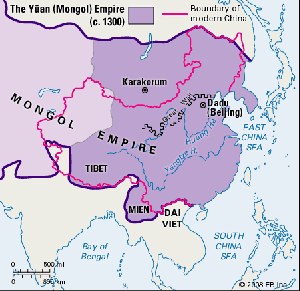
Yuan (Mongol) Dynasty 1277 – 1367

Tibet was first ruled by China during the Yuan Dynasty (1277-1367). Then, when the Ming Dynasty (1368-1643) reclaimed China, a Ming Imperial army was sent to Tibet to drive out the last of the Mongols–holdovers from the Yuan Dynasty. The Ming emperor ordered his army to stay.

When the Ch’ing (Manchu) Dynasty (1644-1911) came to power, the Chinese empire expanded further and Tibet remained in China. Later, I’ll provide evidence from a 1912 National Geographic magazine as proof.

I previously quoted the Tibetan government in exile’s Prime Minister Samdhong Rinpoche claiming that six million Tibetan Buddhists still lived in Tibet.

China, on the other hand, reports that Tibet’s population was 2.84 million at the end of last year, 31,500 more than at the end of 2006. Among its permanent residents, more than 2.5 million, or 95.3 percent, were Tibetans. (Tibet’s population was 1.14 million in 1951.)
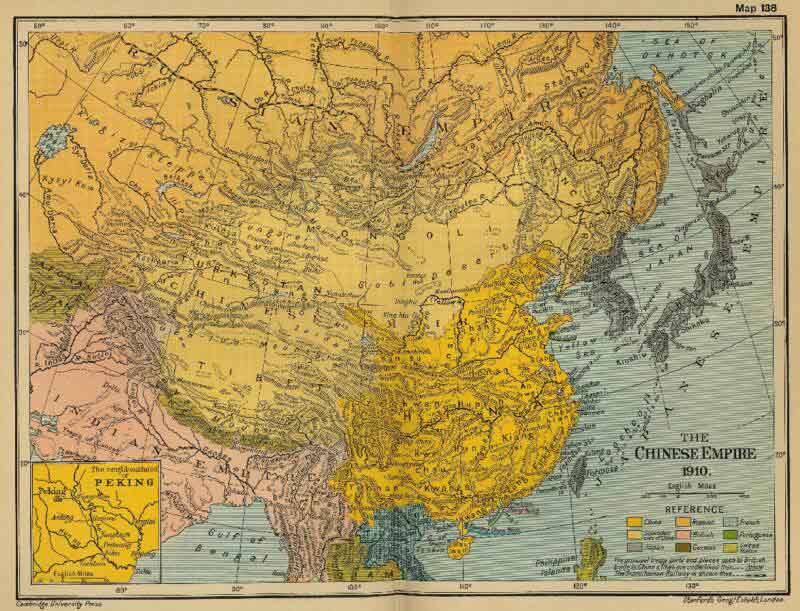
1910 Map of Qing (Manchu) Dynasty – China

More evidence that is interesting comes from the CIA World Factbook. It seems that there are about 80,000 Tibetan refugees living outside Tibet/China. Wikipedia estimates about 5,000 to 9,000 live in the United States. The rest live closer to the Tibetan government in exile.

There were no Tibetans in America prior to the 1950s. Chinese first immigrated to America in the 18th century, and Chinese Americans make up the largest Asian population in America today—more than three million.

The most damaging evidence against Rinpoche’s claims come from the October 1912 issue of The National Geographic Magazine (I have a copy—it cost me $20 on e-bay). Since the earliest evidence of Communists in China was about 1920, and it wasn’t until 1949 that the Communists came to power under Mao, there is no way the Chinese doctor who wrote that 1912 piece could have lied for the Communists.
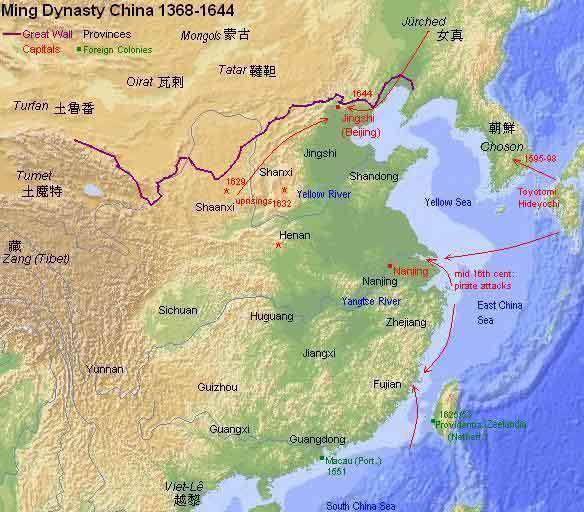
Ming Dynasty (1368 – 1643 AD)

In the 1912 issue of The National Geographic Magazine on page 979, Dr. Shaoching H. Chuan wrote, “Tibet is governed by the Dalai Lama as politco-religous head and two “Ambans” as the political dictators. The Ambans are appointed by the Chinese Emperor every four years. All governmental affairs have to undergo examination by the two Ambans, and all government policy must be sanctioned by them before it can be put into operation. Literally, the Dalai Lama is under the authority of the two Ambans…” (Page 979)

From recent news, it appears that rough times may be ahead for the People’s Republic of China (PRC). In China sees US as hedge for Taiwan, Tibet (Asia Times) by Peter Lee, the author says, “After the Dalai Lama is gone, there is a strong possibility that motivated and organized pro-independence activists (militants) will be able to win power in the Tibetan government in exile.”
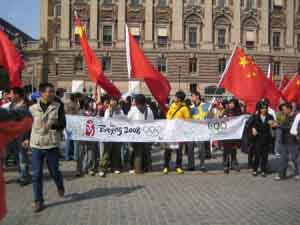
Chinese Protesting Against Tibetan Separatists

Militant Tibetan separatist groups have not been happy with the Dalai Lama’s call for autonomy talks with China instead of calling for a fight to gain independence. Tibetan militant groups want Tibet to break from China even if it means taking a violent path—one the Dalai Lama does not advocate.

What would Tibet be like if the separatists had their way and broke free from China?

Would they return to the system of landowners and serfs (slaves)?

Would the Tibetan Buddhists require that every family send at least one son to become a Buddhist monk as before?

Would mandatory schooling (as we have in the United States) be shut down so the literacy rate would plummet from the high 90% back to a single digit like it was prior to 1950?

Would the wealth and the land be returned to the one percent that had it all before Mao’s troops occupied Tibet?

Regardless of the evidence that proves the Tibetan government in exile is not telling the truth about Tibet being part of China for centuries before declaring independence in 1913 (when the Ch’ing Dynasty was collapsing and the British Empire urged Tibet to break free for political reasons), the Dalai Lama and his Prime Minister represents less than 100,000 Tibetans outside China.


Robert Hart’s (1835 – 1911) letters supports one side of this argument.

If Rinpoche’s figure of six million is correct, that means the Tibetan government in exile represents about 1% of the Tibetan population. If China’s 2.5 million is correct, the percentage goes up to 3.2%. Not much of a base to wage a violent rebellion. There are more troops in the PRC’s army than the entire Tibetan population inside and outside of China.

I also wonder if that 1% in exile were the Tibetan landowners. Did they leave most of the serfs/slaves behind when they fled?

Maybe the Tibetan separatists/rebels (whatever term you like), with help from the CIA, should join the American Tea Bagger movement and gain the support from the likes of Ann Coulter, Glenn Beck and Rush Limbaugh.

They could sit around the campfire during protests and sing hymns about marching into battle to take back the wealth and return to the good-old-days, which would be the opposite of Robin Hood. In this case, the landowners that fled old Tibet (1% of Tibet’s population) would take back what they owned when they left and restore Tibet to the way it was.

In fact, The steady improvement of health care and living standards has raised the average life expectancy of Tibetans from 36 years in the old Tibet to the present 65 years.… It is recorded that during the 150 years before Tibet was (returned to China) there were four pandemic outbreaks of smallpox, one of which, in 1925, killed 7,000 people in the Lhasa area alone. Outbreaks of typhoid fever in 1934 and 1937 carried off some 5,000 people in Lhasa. Source: China-un.ch, which is supported by the facts in the 1912 piece published in the National Geographic Magazine.

Here is a suggested slogan for the Tibetan separatists (former landowners) living in India. “Freedom for landowners, illiteracy for serfs and life expectancy of 36 again!”

Originally posted as a five-part series starting on April 11, 2010 at Tibet Inside China – Part 1

_______________

Lloyd Lofthouse is the award-winning author of My Splendid Concubine [3rd edition]. When you love a Chinese woman, you marry her family and culture too. This is the love story Sir Robert Hart did not want the world to discover.

Subscribe to “iLook China”!
Sign up for an E-mail Subscription at the top of this page, or click on the “Following” tab in the WordPress toolbar at the top of the screen.

About iLook China


Xi’an (Chang’ an) – China’s Ancient Capital [Viewed as Single Page]

January 28, 2010

Most people outside China only know of Beijing (once known as Peking) as the capital of China. However, another city was China’s capital for more than a thousand years.

In fact, Chang’ an (Xi’an) served as the capital for twelve dynasties, including the Western Zhou, Qin, Western Han, Sui and Tang dynasties, spanning more than eleven hundred years. It was also the cultural center of the Silk Road.

In 2008, the last time we visited Xi’an, subway construction was running behind schedule due to a law that does not allow the destruction of historical sites such as the tombs of emperors. There are so many of these tombs below ground that the subway tunnels must be diverted to avoid them resulting in delays.

With such a long history, the Discovery Channel produced a documentary of Xi’an (Chang’ an) called China’s Most Honourable City.

To discover Xi’an’s long history also teaches us much about China’s civilization. Discovery Channel’s Neville Gishford will take us on this historical journey leading to the present.

Gishford says, “It (Han Chang’ an) was more powerful than Rome. If any Roman army had actually gone there, they would have been absolutely annihilated.”

Han Chang’ an (Xi’an) was larger than Constantinople and richer than Egypt’s Alexandria. It was a fortress so powerful that even 20th century artillery could not knock its walls down.

Today, Xi’an is home to millions of people and thousands of men made of clay, the Terra Cotta Warriors guarding China’s first emperor.

In addition, the massive city wall is more than six hundred years old and longer than 12 kilometers. Cracks are appearing and an engineering team keeps close watch and makes repairs

However, the Xi’an of today was first build over two thousand years ago and has been three cities—not one. The Han Dynasty built the first city (Chang’ an), which is close to the modern city of Xi’an and the old eroding walls are still visible.

At 36 square kilometers, Han Chang’ an was more than one and a half times the size of Rome.

Earlier, I mentioned the subway system that was under construction in modern Xi’an.

For an update, Travel China Guide.com says, “The Xi’an subway system is scheduled to have 6 lines, with a total length of 251.8 kilometers… While the first phase of subway Line 2 has been in use since Sep 16, 2011, the other five lines are designed to be finished in 2018 in sequence.”

When the second phase is completed, the full length of Line 2 will be 26.64 kilometers (about 16.5 miles).

The population of Xi’an has also increased since Neville Gishford hosted the documentary for China’s Most Honourable City. Today, there are more than 8 million people living there.

This segment of Gishford’s documentary starts with Archaeologist Charles Higham, a world famous authority on ancient Asian cities.

Higham says, “A delegation of jugglers from Roman Emperor Marcus Aurelius (161-180 AD, who is regarded as one of the greatest emperors in Roman history) traveled and performed in the Han Court of Chang’ an.”

More than two thousand years ago, the walls of Chang’ an (Xi’an) were made of rammed (compressed) earth and much of the city from kiln fired clay bricks, which was a revolutionary building material at the time that changed the history of architecture.

The builders of Han Chang’ an (Xi’an) used this new technology in revolutionary ways such as building an underground sewer system connected to the moat that surrounded the city.

From the Qin to the Tang Dynasty, 62 emperors ruled China from Chang’ an (Xi’an). The China Daily says in and around Xi’an, there are about 500 burial mounds where the remains of emperors and aristocrats rest.

The largest tombs mark the passing of Emperors Qin Shi Huangdi (259 – 210 BC), Tang Gaozong (628 – 683 AD), and his wife Empress Tang Wu Zetian (624 – 705 AD).

When we left Neville Gishford‘s documentary, China’s Most Honourable City, in Part 2, Chang’ an was the capital of the Tang Dynasty (618 – 907 AD) with a population of over a million — six times the size of ancient Rome.

The Daming Palace, where the Tang Emperors ruled China, was 800 years older and nearly five times larger than Beijing’s Forbidden City. This huge palace was built in one year.

However, it wasn’t the Daming Palace that made Chang’ an (Xi’an) powerful. Long before Manhattan, Hong Kong, Paris and Dubai, Chang’ an was where the world came to shop.

Over a thousand years ago, the wealth of the West poured into China (and it is happening again) and arrived at Chang’ an over the Silk Road.

But wealth wasn’t the only thing China gained. Major religions also arrived in China at this time.

Islam was barely a century old, when Silk Road traders brought this religion to Chang’ an. In another post, A Road to the Hajj from China, I wrote, “The ancient city of Xi’an in Shaanxi province is home to about 60,000 ethnic Chinese Muslims.”

Xi’an claims it has a Muslim history going back thirteen hundred years when Islam was first introduced to China in 650 AD.

In fact, the oldest mosque in China was built in 685-762 AD in Chang’ an during the reign of Emperor Xuanzong of the Tang Dynasty.

Although Christianity and Islam were both introduced to China during the Tang Dynasty, Buddhism had deeper roots in the culture since it first arrived in China from India about 200 BC.

Christianity arrived in China in 635 AD (more than eight centuries after Buddhism and only a decade before Islam), when a Nestorian monk named Aluoben entered the ancient capital city of Tang Chang’ an.

Then in 629 AD, the Buddhist monk Xuanzang left Chang’ an against the emperor’s orders to travel the world in search of enlightenment. He went west toward India along the Silk Road with a goal to find original Buddhist scriptures. He traveled 10,000 miles over three of the highest mountain ranges in Asia and was gone 16 years.

When Xuanzang returned in 645 AD, he had 1,300 scrolls of Buddhist Sutras, and requested the building of a pagoda, which became the Giant Wild Goose Pagoda—nearly 65 meters tall (more than 213 feet). It was made of rammed earth, and the pagoda would collapse more than once and be rebuilt. No one knows exactly how the Tang Dynasty engineers managed to build a structure that tall of rammed earth.

Neville Gishford‘s Discovery Channel documentary, China’s Most Honourable City, reveals the answer to a mystery when a hidden crypt beneath the Giant Wild Goose Pagoda is discovered using ground based radar. When The Tang Dynasty collapsed due to rebellion, the city was destroyed, but the Giant Wild Goose Pagoda was left untouched.

Gishford reveals that even though Tang Chang’ an was destroyed, the city was copied throughout Asia and one city in Japan, Kyoto (formally the imperial capital of Japan – 794 to 1869 AD), was a scaled replica of Tang Chang’ an.

In fact, in 1974, the modern city of Xi’an and Kyoto formally established a sister-city relationship.

However, this was not the end of Chang’ an (Xi’an). It would be rebuilt a third time. In 1368, nearly five hundred years after the fall of the Tang Dynasty, the Ming Dynasty (1368 – 1643 AD) would rebuild the Great Wall in addition to Xi’an as a defense against the Mongols that had conquered and ruled China during the Yuan Dynasty (1277 – 1367 AD).

During the Ming Dynasty (1368 – 1643 AD), China mostly isolated itself from the world by rebuilding the Great Wall and a string of impregnable fortresses to protect China’s heartland from Mongol invasion.

One of those fortresses was a new military city built on the ruins of Tang Chang’ an, and the Ming named this city “Western Peace”—which in Chinese/Mandarin is “Xi’an”.

Xi’an was one-sixth the size of Tang Chang’ an, but nearly six hundred years later, its walls are still standing.

Charles Higham says these walls are the most extraordinary, largest, best-preserved set of defensive walls in the world.

The last segment of Neville Gishford‘s Discovery Channel documentary, China’s Most Honourable City, introduces Zheng Canyang, the engineer responsible for preserving Xi’an’s walls, and Zheng explains how the walls would have been defended.

History records that when the walls of this third city faced its first attack, they stood firm, but the attack did not come during the Ming or Qing Dynasties. It came five hundred years later from April to November 1926.

As China bled from the Civil War between warlords, the CCP and the KMT, a powerful Chinese general by the name of Liu Zhenhua attacked Xi’an with a large army and modern artillery.

However, the 20th century artillery rounds only dented the walls, and after months, Xi’an’s walls still stood and Liu Zhenhua’s army retreated.

The siege was part of an anti-Guominjun campaign lasting from late 1925 to early 1927, which raged across North China and had nothing to do with the civil war between CCP and KMT, explaining why this military campaign received no coverage in the popular media or academic circles. Source: A Study of the Siege of Xi’an and its Historical Significance by Kingsley Tsang

The newest enemy to Xi’an’s ancient walls comes from modernization and the millions of inhabitants of the city. As the water table below the city is sucked dry from so many people, this has caused the earth to sink, which is pulling down the walls, and engineers and scientists work to discover ways to save them.

______________

Lloyd Lofthouse is the award-winning author of The Concubine Saga. When you love a Chinese woman, you marry her family and culture too. This is the love story Sir Robert Hart did not want the world to discover.

Subscribe to “iLook China”
Sign up for an E-mail Subscription at the top of this page.

About iLook China


Note: This post first appeared as part of a five-part series on October 21, 2011 as Xi’an (Chang’ an) – China’s Ancient Capital – Part 1


Modern Chinese Parents and Children (Viewed as Single Page)

January 28, 2010

A Guest post from Hannah in China (first appeared as a three part series with Modern  Chinese Parents and Children – Part 1, which appeared on May 29, 2011)

Before I start to talking about Chinese parents and children, first let us have a look of the currently pretty hot arguing book, Battle Hymn of the Tiger Mother, which is a Chinese-American Yale law professor mom that wrote about how she was strict with her two daughters by making a lot of can’t doing rules, and she was acting like a wicked witch to push them to study.

I will not comment on which parenting method is better, Chinese or Western.

What I want to say is the book’s author Amy Chua’s way of parenting is typically Chinese though she is 4th-generation American.

Note from Blog host: Evidence of this may be found among reviews and comments on Amazon.UK. Rosie in the UK wrote, “I am Chinese now living in the UK and I admit I was outraged when I first read theWSJ excerpt of her (Amy Chua’s) book. My first thoughts were I can’t believe anyone would do something like that to their children. However, as I thought more about it and I guess living out here in the UK I’ve been so used to the numbing and dummying of our children’s perceived fragile self esteem and always making sure that their feelings and wants are met for fear of damaging them emotionally, I forgot that, hey, I was brought up pretty much the same way.”

Hanna says, “We Chinese have a long history of parents being strict with their children. From old days, the Ke Ju Kaoshi (official examination) was the only chance for people to change their fate and life.

“To achieve this, they must study really hard. We have an old saying about this “Shi Nian Han Chuang Ku Du Ri, Jin Chao Jin Bang Ti Ming Shi”, which means “Ten years of study at a cold window only for the day of passing the examination.”

“To study, students must be pushed even by using the stick.”

In addition, modern Chinese are also having many new chances but this still won’t change the way most Chinese parents raise children, because China now has the “Gaokao”, which is the high school examination to get into a university or college.

Because of the competition, parents can’t afford or wouldn’t dare to let the child just play and have fun. Children don’t know what is best for them.

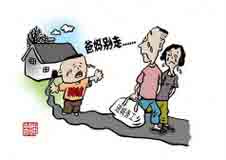
Parents must force them to study but spoil them at the same time. When the child gets the great score, that means everything to parents. The kids don’t have to do anything else in life but study. Therefore, the story is the boy went into a famous college but didn’t know how to peal the eggshell.

Note from Blog host: Another review from Amazon.UK supports what Hanna is saying. The reviewer wrote, “I know how appalling some of those things sound to many. Not me, since I am Chinese myself and I have been brought up that same way, if not more strict.…. However when I grow up (now 40), I see the vast difference of parenting among other people in different countries (I live in UK now with my English husband), and what repercussions it has on the kids when they grow up. I am glad I was brought up the way I was.”

Hanna says, “Chinese parenting is not about ‘feelings’, but it’s not to say that the parents do not care.”

The child has to finish the school homework to 10 pm at night five days a week. Then after school, the child goes to the special training to develop other skills such as piano. This is not about what the the child is interested but it’s what the parents decided based on what they believe is necessary. What we learn in China is that the children have to attend eight different hobbies classes. There’s no free time.

In fact, in China, children should not argue with their parents and the child must do what the parents say.

When the child is good at studying, it means “Guang Zong Yao Zu”, (bring honor to your ancestors).

When you get the low score (100% score is best. 60% means you barely passed the exam. 90% is good. However, even just 1% lower and the child gets the “cold face”).

This not only means teachers calling parents endless times for meetings and punishment from the parents but it embarrasses your ancestors too.

This means when children are doing the homework, parents watch them until they finish to insure no mistakes.

Another recent review from Amazon.US points out an interesting thought. “The (Amy Chua) book raises an important question: Is America’s assumed educational mediocrity really the fault of our public schools (as some believe) or is it the fault of an epidemic of indulgent parenting (as others believe)? Asian kids seem to do remarkably well in the public schools… and raising little complaint about the quality of the schools.”

As for myself, Hanna writes, I think I’m the lucky one born in a family offering more freedom. Luckily I was a good student so my parents didn’t have to pay as much attention to me.

Did they spoil me? Sure. Did they care about my feelings? Yes, because they allowed me talk and argue with them.

If your child is no good at school, you must still love them. However, being strict so they have a good future is not worth it if they hate you later. No matter what kind of family you live in – strict or spoiled – the important thing is to love. Then the world can be better place.

(From the Blog’s host) Amy Chua was heard from again recently when she wrote for USA Today, Tiger Mom: Here’s how to reshape U.S. education.

Chua says, “My memoir — seen in the West as a story about “extreme” parenting — is being marketed the opposite way in China, as a story about the importance of giving kids more freedom. Amusingly, the book’s title in China is Parenting by a Yale Professor: Raising Kids in America, and I was asked by one Chinese women‘s magazine to give its readers tips on “how to be friends with your kids.”


Discover Hannah’s review of Red Mansion, a Chinese TV series, or visit her Blogs at Hannah Travel Adventure (Chinese) or Hannah China Backpacker (English)

______________

To subscribe to “iLook China”, look for the “Subscribe” button at the top of the screen in the menu bar, click on it then follow directions


Spoiled and Confused — China’s new urban generation (Viewed as Single Page)

January 28, 2010

This guest post by Chris “Foreign Monkey” Bewley first appeared as a four-part series, which started on May 25, 2011 as Spoiled and Confused — China’s new urban generation – Part 1

Chris Bewley has taught English as a foreign language for the past 10 years all over the world, including Japan, Korea, Mexico and Brazil.

__________________________

When I first arrived in China as an English teacher, I had lofty scholastic goals: I wanted to try a creative variety of class activities and apply a broad spectrum of teaching methods that my students could benefit from to make them competitive in academia and, later, the international job market.

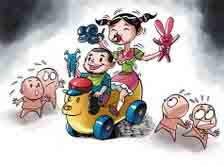
Almost 1 year later, my primary responsibility as a “Foreign Expert English Instructor” has been distilled down to little more than babysitting a bunch of spoiled, undisciplined children who for the most part want nothing to do with English.

At my crowded primary school in a small, semi-urban city in East China, there exists what I have coined the “20/20/20” split in each of my classes (60 kids per class): 20 eager/20 indifferent/20 bad. Basically, I’m teaching 20 while trying to control 40.

To make it fair for everyone, I have to dumb-it-down/ fun-it-up every class. Instead of actually teaching, I find myself playing games with them and jumping around for them like a monkey, which is the only way to retain their attention.

On the positive side, of the eager 20, there are several extremely smart students who I expect one day to be quite successful in what ever they do. Unfortunately, whenever those eager 20 are trying to learn, the other naughty 40 will try just as hard to spoil it for them.

In the past year, I’ve had only a handful of students ever raise their hand and ask ME a question about the English language. That’s 1,200 students/week x 30 weeks, which equals 36,000 (thirty-six thousand) chances for a student to raise a question, but only five ever have. On the rare occasion that my students do ask me questions, it’s usually regarding the price of my clothes or how much I get paid.

Criticism about my lessons that I have received from students, parents and Chinese teachers alike includes “it’s too difficult”, “it’s not fun enough”, “there’s not enough participation/activity,” but never have I ever heard that my classes are too easy, which in my opinion they most certainly are.

By now, I have figured out that English lessons in (urban) China are just a show; a clown show; a monkey show – starring myself as the foreign monkey.

For parents’ week last month, whilst dozens of “concerned” parents and school administrators observed my classes for 5 days in a row, rather than actually teach their children, I just played a bunch of silly games and sang some songs with them, and, guess what? That made all the parents really, really happy!

Most recently, I found myself having to literally, physically, throw out my Chinese teaching assistant (a recent college graduate with no classroom experience hired right off the street for a minimal salary) to avoid a mutiny from within.

You see, she absolutely refused to discipline the rowdiest students, and did nothing to help control their deafening volume when I was trying to teach.


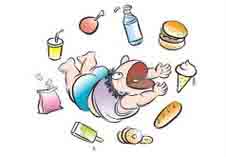
A quarter of China’s rural youth overweight!

When I approached her about this, her response was: “you are not a real teacher!” I imagine that this assistant was once (11 years ago, to be precise) a spoiled, indifferent primary school student herself; how sadly ironic that at age 21 she still indentified with the students rather than with me, the teacher.

China’s universities are being touted with utilitarian promise, a promise that trickles down all the way to the elementary school level. The Chinese’s fear of poverty has undermined intellectual diversity; plagiarism and cheating are rampant and go unpunished, reading books is not encouraged, greater importance has been placed on math than any other subject starting in the earliest years of child development, and there are no other languages other than English offered until university.

The
English “industry” in China is what I call “C.O.O.C”: completely out of control! There is literally a new, privately run children’s English “school” popping up on every other corner every other week. Nor is it an industry that has grown in a healthy, steady way from its infantile beginning; it is a product for infants in hyper-drive.

A perfect parallel to this is the car situation in China, which is also out of control.

I hate to say it because it has become an international cliché, but, truly, nobody in China knows how to drive or even park properly. Automobile ownership in China has, along with its economy, bloomed at an alarming rate in the past 5 years, resulting in massive congestion everywhere from the smallest towns to the largest cities.

It’s obvious that the people who own these cars use them primarily as status symbols rather than for necessity; it rarely rains in my city and there are no hills, yet every single day, 6 times a day, hundreds of parents dropping off/picking up their children in new, black Audis will cause an hour-long gridlock directly
in front of my school rather than be seen walking or riding a bicycle.

Please don’t get me wrong, I am not a “China-hater.”

Colorful street life, extremely friendly people, great food, affordable massage parlors, a handful of good friends both Chinese and foreign, and a decent income have been sufficient to keep me reasonably comfortable.

But in the end, I have to ask myself: what am I here for? Because it’s obvious that China doesn’t want me to actually teach anybody anything.

_____________________

Chris Bewley has taught English as a foreign language for the past 10 years all over the world, including Japan, Korea, Mexico and Brazil.

To subscribe to “iLook China”, look for the “Subscribe” button at the top of the screen in the menu bar, click on it then follow directions.


Environmentalism in China (Viewed as Single Page)

January 28, 2010

To understand why China is often the focus of so much attention when it comes to pollution, such as carbon emissions from oil, coal, gasoline, diesel and burning wood, we should start where the industrial revolution began and that is in the West (more than two centuries ago). I will start with an “old” friend that believes environmentalists worship the environment instead of God. I do not agree.

Instead, I see environmentalism as humanity’s effort to save the world from a potential catastrophe. If anything, the Christian God would support environmentalism, since He entrusted the earth to humanity’s care. Nowhere in Genesis or the Bible does God tell man to destroy and/or pollute the earth.

In fact, He says in Genesis 1:28, “Be fruitful, and multiply, and replenish the earth, and subdue it: and have dominion over the fish of the sea, and over the fowl of the air, and over every living thing that moveth upon the earth.”

Then, in Numbers 35:33, the Christian Bible says, “So ye shall not pollute the land wherein ye are…” and 35:34, “Defile not therefore the land which ye shall inhabit…”

My “old” friend, that claims Global Warming is a hoax, has joined those that shout “no” loudest at the scientific theories that current trends in Global Warming are caused by carbon emissions, which “may” create what is known as greenhouse gasses that become trapped in the atmosphere.

If you want to learn more about the theory behind Global Warming, visit the Environmental Defense Fund and read the Basics of Global Warming, which my “old” friend believes is a hoax.

My “old” friend may also be described as an evangelical, born-again Christian, conservative libertarian that believes everything bad that happens is the fault of liberals. He also listens to neoconservative talk show host Dennis Prager and belongs to a chapter of the Dennis Prager fan club, which meets regularly.

If you decide to discover what Dennis Prager preaches to his fans, I suggest reading Why Liberals Fear Global Warming more Than Conservatives Do. You may quickly learn how an American radio talk-show host uses emotional language to manipulate the people that “worship” what he preaches daily.


Black Carbon causes an estimated 1.5 million deaths per year.

However, when we return to what the Christian Bible says about pollution, how guilty is the US (and American conservatives such as Dennis Prager and his fans) when it comes to what the Christian Bible says not to do?

To discover the answer, we will focus on Black Carbon and CO2 emissions as a source of pollution.

Between 1990 and 2008, according to the United Nations Statistics Division, the US produced 314.6 million metric tons of CO2, while China produced 57.23 million metric tons. One metric ton is 1,000 kg or 2,204.62 pounds, which means one million metric tons weighs one billion kg or more than two billion pounds.


Chinese Environmentalists Target Apple

In addition, in 2008, the Earth System Science Education Alliance reported, “Black soot is made up of microscopic carbon particles released during the incomplete combustion of fossil fuels (oil, gasoline, diesel fuel, coal and the burning of wood)…

“Soot, we now understand, is hazardous to our health and is suspected of contributing to global warming.”

In fact, soot has only recently been identified as a major player in the loss of ice and snow in the Polar Regions.

While the US has reduced CO2 emissions from 19.7 million metric tons in 1997 (the highest point on record) to 17.5 in 2008, China increased CO2 emissions from 2.8 million metric tons to 5.3.

In 2008, the US still produced more than three times the amount of CO2 China produced.

Facts and Details.com says, “The U.S. emits about 21% of the world’s CO2 and 6.1% of the world’s Black Soot. However, the majority of today’s black carbine emissions are from developing countries in Asia, Latin America, and Africa.

“China and India together account for 25-35% of global black carbon emissions.”


Using technology to confront polluters in China

What isn’t mentioned is that the US population is less than 5% of the global total while China and India together represent 36%. From these facts, it is clear that the US still pollutes more than its share of black soot and CO2 compared to China and India.

What is China doing to solve the pollution challenge before it equals the more than two hundred years of pollution from the US and Europe?

In China, the environmental movement started in recent years from the top down and the bottom up. Evidence of this fledgling movement appears in several Western media sources.

For a more detailed history, The China Daily’s Sun Xiaohua wrote A Legal Leap Forward, which starts with an accidental environmental disaster that took place the day before China passed its first ever draft of the Environmental Protection Law of the People’s Republic of China in 1979.

The man that caused the accidental environmental disaster was sentenced to two years in jail. As we all know, passing laws are easy compared to enforcing them, and it doesn’t matter if we are in the US or China. Some environmental disasters are accidents, as in this case, and some are intentional due to greed.

In The Atlantic, Christina Larson wrote China’s Nascent Environmentalism, and said, “Since 2007, I have been reporting in China (and elsewhere in Asia), looking at the efforts of China’s environmentalists, scientists, lawyers, and others to rein in their country’s enormous (I question the use of the word ‘enormous’ when we compare more than two hundred years of CO2 and Black Soot pollution in the US to China) pollution toll and related problems.

Larson says, “China may clean up its environmental mess eventually … but it almost certainly won’t do so in the same fashion as the West.”


Green Long March in China – 2009

Then Arrol Gellner, writing for SFGate of China’s environmentalist ways, says, “At China’s current rate of progress, and despite its posturing to the contrary, industrial polluters may well be brought up to Western standards within the next decade.

“What’s more,” Gellner writes, “when China decides that it’s ready to tackle its environmental problems full force, it’ll move quickly. Unlike us fiercely independent-minded Americans, the Chinese people, for the most part, are far more amenable to sweeping change being imposed from the top down – a deep-seated cultural trait that stems, not from China’s trifling time under communism, but rather from its nearly 3,500 years under dynastic rule.”

Another example by Philip P. Pan appeared in the Houston Chronicle of an environmental grass roots movement to do away with disposable wooden chopsticks. A quote by Kang Dahu, a truck driver in China says it best. “The disposable ones are such a waste! We’re destroying what little is left of our forests to make them,” said Kang, 22, who does volunteer work with several environmental groups. “Just imagine, years from now, when my grandchildren ask me what happened to all of China’s trees, I’ll have to say, `We made them into chopsticks.’ Isn’t that pitiful?”

In addition, Zhang Zhe, 24, who works for an environmental education group supported by British zoologist Jane Goodall, says, “Chopsticks are just an example. People are beginning to ponder even ordinary things.”

To discover more of how diverse this environmental awakening is in China, the October 2011 issue of Smithsonian magazine introduces us to the Bird Whisperer, a Buddhist monk named Tashi Zangpo, who is saving one of the world’s rarest birds, the Tibetan bunting.

“Tashi, now 41,” Phil McKenna writes, “has crisscrossed the Tibetan plateau drawing 400 bird species. He is currently compiling a field guide that evokes the work of John James Audubon or Roger Tory Peterson. He wears prayer beads on one wrist and a digital watch with altimeter and compass on the other.”

However, in America, regardless of what is happening in Asia, China is often criticized in the media and by the public (after reading about it in the media) for air pollution blowing more than 6,000 miles across the Pacific to the United States.


The breathing earth

From Where Does Our Pollution Go, we learn that “Winds can carry pollution around the planet, therefore, all nations are connected by air currents,” and then from MSNBC, we discover that the U.S. exports its air pollution to Europe.

When I Googled “air pollution from China to America”, the results were more than 9.4 million hits, but when I searched “air pollution from America to Europe”, there were more than 17 million.

MSNBC’s Michael Schirber of Live Science reported in 2005, that “On Nov. 14, 2001, a low-pressure system caused a large mass of air huddled over the eastern half of the United States to rise up several miles, where it was then carried by the jet stream to Europe,” which resulted in a 33% increase in ozone levels in the Alps.

In addition, Schirber says, “European pollution has been tracked to Asia, as well as the Arctic…” He compares the wind to a conveyor belt.

In fact, the University Corporation for Atmospheric Research reported in October 2009 that when it comes to global air pollution, what goes around comes around. “Air pollution from factories, traffic, and power plants in Asia wafts over the Pacific Ocean to the United States, while pollutants produced in the United States wind up in Europe.”

Then there are those in America and Europe (and elsewhere in the world) that claim CO2 is not a pollutant and is not contributing to Global Warming.


Ocean Acidification — Changing Planet — As higher amounts of carbon dioxide become absorbed by the oceans, some marine organisms are finding it is a struggle to survive

For such naysayers, in January 2008, a Stanford Report written by Louis Bergeron reported on a study conducted by a Stanford scientist that linked carbon dioxide emissions to increased deaths.

“For the first time,” Bergeron wrote, there were direct links between increased levels of carbon dioxide in the atmosphere and increases in human mortality…

The study detailed how for each increase of 1 degree Celsius caused by carbon dioxide, the resulting air pollution would lead annually to about a thousand additional deaths and many more cases of respiratory illness and asthma in the United States.

So, next time you hear someone criticize China for air pollution crossing the Pacific Ocean to the US, consider the amount of CO2 and Black Soot China produced in the last thirty years of industrialization compared to the UK, Europe and America’s more than two centuries.

Once you know the facts and you were given a choice to live in Europe or America, where would the air probably be cleaner/healthier?

______________

Lloyd Lofthouse is the award-winning author of The Concubine Saga. When you love a Chinese woman, you marry her family and culture too. This is the love story Sir Robert Hart did not want the world to discover.

To subscribe to “iLook China”, sign up for an E-mail Subscription at the top  right-hand side of this page.

About iLook China

Note: This post first appeared as a four part series on October 31, 2011 in Environmentalism in China – Part 1