Why China is Studying Singapore – Part 3/3

February 6, 2010

In the 2010, January, National Geographic Magazine, there was a feature about Singapore that said, “the per capital income for its 3.7 million citizens exceeds that of many European countries, the education and health systems rival anything in the West, government officials are largely corruption free, 90 percent of households own their own homes, taxes are relatively low and sidewalks are clean (and safe), and there are no visible homeless people or slums.”

Singapore beach scene

When was the last time you heard the Western media or an American politician criticize Singapore’s government?  Probably never.

There’s a reason for that. Singapore is a strong US ally and an English-speaking city-state.

It makes sense that China should want to model their economic and political system after another country with similar values and a stronger and more stable economy than the United States. The Chinese, like the Singaporeans, save money too. When the world economy collapsed while George W. Bush lived in the White House, China had a few trillion dollars in reserve with no national debt, and the Chinese people work harder and save more money than any other country.

Compare that to the United States and you will know why China’s role model is Singapore—not the United States of America. Now, see what a traveler said about Singapore.

Return to Part 2 of Why China is Studying Singapore

______________

Lloyd Lofthouse is the award-winning author of the concubine saga, My Splendid Concubine & Our Hart. When you love a Chinese woman, you marry her family and culture too. 

If you want to subscribe to iLook China, there is a “Subscribe” button at the top of the screen in the menu bar.


Why China is Studying Singapore – Part 2/3

February 6, 2010

Let’s look at Singapore—known as the Switzerland of Southeast Asia where a student might be caned for talking back to a teacher. For sure, he will be fined and caned for spitting gum on a sidewalk.  But not in America where we are free to do what we want even if that means defacing or stealing someone else’s property.

Singapore City View

I’ve heard and read more than once that Singapore was the economic model that China was watching closely—not America with its chaotic market system that expands and collapses like a popped balloon. 

This sounds like the China we often hear about in the Western media or out of the mouth of an American politician. “…is a socially engineered, nose-to-the-grindstone, workaholic rat race, where the self-perpetuating ruling party enforces draconian laws … squashes press freedom, and offers a debatable level of financial transparency—”

That description was not about China. It was for Singapore, a city-state that has a government-enforced savings plan and an average unemployment rate of about three percent.

Return to Part 1 of The Reasons Why China is Studying Singapore or go to Part 3

______________

Lloyd Lofthouse is the award-winning author of the concubine saga, My Splendid Concubine & Our Hart. When you love a Chinese woman, you marry her family and culture too. 

If you want to subscribe to iLook China, there is a “Subscribe” button at the top of the screen in the menu bar.


Deng Xiaoping’s 20/20 Vision

February 5, 2010

True, under Mao Zedong (1893 – 1976), China suffered but that isn’t the whole story. During Mao’s Great Leap Forward and the Cultural Revolution, thirty-seven million died—many from starvation. Mao’s form of communist socialism did not work.

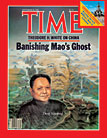
On June 30, 1984, Deng Xiaoping said, “Given that China is still backward, what road can we take to develop the productive forces and raise the people’s standard of living? … Capitalism can only enrich less than 10 per cent of the Chinese population; it can never enrich the remaining more than 90 per cent. But if we adhere to socialism and apply the principle of distribution to each according to his work, there will not be excessive disparities in wealth. Consequently, no polarization will occur as our productive forces become developed over the next 20 to 30 years.”

Deng Xiaoping on the cover of Time Magazine

Deng Xiaoping may have been right. Bruce Einhom writing for Business Week, Countries with the Biggest Gaps Between Rich and Poor, October 16, 2009, listed the top countries with the biggest gaps. America was number three on the list. China wasn’t on the list—yet.

What does this mean for America? (CBS/AP)  The Census Bureau reports that 12.5 percent of Americans, or 37.3 million people, were living in poverty in 2007, up from 36.5 million in 2006.

After 2000, the situation in America deteriorated quickly (with President George W. Bush in the White House)—all of the gains in middle-class economic security since WWII were erased within a few years.

PBS reported in “Middle Class Squeeze” (December 13, 2002), the shape of income distribution in America is changing and many are finding it increasingly difficult to afford housing while keeping up with necessities such as food, clothing, transportation, and health care.”

What does capitalism, Chinese style, look like? Under Deng Xiaoping’s economic policies, China became the world’s factory floor.

Prior to 1979, the year China opened its economy to world trade, it was rare to find anything made in China. Since then, exports from China have increased 10,000%, and this year China’s economy become the second largest in the world as Japan slipped to third place.

In the last decade, something happened in China that Mao thought he had destroyed. China grew a middle class. During a trip to China in 2008, we saw the Chinese middle class everywhere we went. Instead of the majority of tourists being foreigners, they are now Chinese.

A middle-class family in China usually owns an apartment, a car, eats out and takes vacations. National Geographic in the May 2008 magazine, said, “they owe their well-being to the government’s (Deng Xiaoping’s) economic policies…”

Current estimates show China’s growth will continue and grow between five and eight percent a year. China’s real GDP growth accelerated on a year-over year basis by a full percentage point, rising from 7.9% in the second quarter to 8.9% in the third quarter (reported Oct. 22, 2009).

Learn about China’s Expanding Middle Class

______________

Lloyd Lofthouse is the award-winning author of The Concubine Saga. When you love a Chinese woman, you marry her family and culture too. This is the love story Sir Robert Hart did not want the world to discover.

To subscribe to “iLook China”, look for the “Subscribe” button at the top of the screen in the menu bar, click on it then follow directions.


A Media Slugfest Using Taiwan

February 2, 2010

This morning, I read two pieces in the Contra Costa Times Travel section for Sunday, December 12, 2009. Both pieces were about China. The first was written by Carol Pucci, Seattle Times, and was about travelling around China independent of tourist groups, and I found the description of China to be one I’ve experienced many times since my first trip in 1999.

The second piece by John Boudreau, Mercury News, was a comparison between traveling to Taiwan and the mainland. Although it wasn’t as entertaining as Carol Pucci’s piece in the Seattle Times, it was interesting. However, I felt the piece by Boudreau was a little misleading when he wrote, “China maintains democratically ruled Taiwan as its territory. Taiwan, on the other hand, has evolved independently of Beijing since Chiang Kai-shek and his Nationalist forces fled to the island from Mao Zedong’s communist soldiers in 1949.”  That statement is accurate, but I felt it wasn’t telling the whole story.

When Mao and his Chinese Communist Party won China in 1949, Chiang Kai-shek and his Kuomintang were the overloads of China. Chiang Kai-shek was a dictator and China had never held popular elections like in America and Europe, so in reality, one totalitarian government forced out another one. Of course, the United States supported Chiang Kai-shek. It didn’t matter if he was a dictator or not–at least he wasn’t a Communist.

It wasn’t until the 1986, under pressure from the United States and the United Nations, that Taiwan became a multi-party democracy and held elections.  If they had not done that, the United States was threatening to stop protecting them from the mainland. That’s the primary reason that Taiwan became a democracy. A year later, Chiang Ching-kuo, Chiang Kai-shek’s son, lifted martial law. Until that day, Taiwan had been ruled by one party just like mainland China and was oppressed by martial law for thirty-seven years. I wonder why that wasn’t mentioned in Boudreau or Pucci’s pieces.

The big difference between these two one party systems was that in China, the communists leaned toward helping the working class improve their lifestyles while in Taiwan the rich and powerful were favored and everyone else was a second class citizen.  When Chiang Kai-shek’s Nationalists ruled mainland China, the situation was the same. The poor people wanted change and that was what Mao, for better or worse, gave them. Under the Nationalists, there were drugs, prostitution, dangerous gangs, and women were second-class citizens. The communists dealt with those issues after they came to power—sometimes brutally.  Chiang Kai-shek’s Nationalists could be brutal too.

What is Martial Law?

Off the beaten path in China by Carol Pucci

China Crossings, Travel in China and Taiwan by John Boudreau

______________

Lloyd Lofthouse is the award-winning author of the concubine saga, My Splendid Concubine & Our Hart. When you love a Chinese woman, you marry her family and culture too.

If you want to subscribe to iLook China, there is a “Subscribe” button at the top of the screen in the menu bar.


The First of all Virtues – Part 9/9

February 1, 2010

There are always exceptions when it comes to practicing piety. Even in China, there will be the occasional rude individual. The thing is, I haven’t seen or heard one yet, and I have visited China many times since 1999.

I did have a disrespectful, American born Asian student (once) during the thirty years I was a teacher.

I also had a small number of hard-working, respectful students from all ethnic groups—even those that were American born, but those types seem to be a dying breed in Western culture.

My best students were usually immigrants that came to the United States after living in their birth country for several years.

In addition, I had one American born student enter high school as a freshman after being home taught for eight years by his Caucasian, conservative Christian parents. He was a great person—polite and he worked hard.

He never said, “Hey, old man.”

Visit this site and you will quickly discover that someone does not agree with me about China. China, rude, dirty and annoying.  Maybe this person has a Chinese face.

The Chinese can be very abrupt and rude with each other but usually treat foreign faces with respect.

Return to The First of All Virtues Part 1 or return to Part 8

______________

Lloyd Lofthouse is the award-winning author of the concubine saga, My Splendid Concubine & Our Hart. When you love a Chinese woman, you marry her family and culture too.

Subscribe to “iLook China”
Sign up for an E-mail Subscription at the top of this page.

About iLook China