The Qing – China’s Last Dynasty – Part 1/3

December 11, 2010

The Qing and/or Manchu Dynasty was established due to a revolution led by Li Tzu-cheng (1605-1645), who attacked Beijing in April 1644.

The Qing Dynasty survived from 1644 to 1911 AD.

After the rebels entered the city, the last Ming Dynasty emperor hung himself on a hill that is part of the Forbidden City.

Meanwhile, a Manchurian army led by Dorgan was allowed through the Great Wall, defeated the Chinese rebels, executed Li Tzu-cheng, and made Fu-lin, a Manchurian, the emperor of China, which was the beginning of the last imperial dynasty.

This was the second time in China’s history that foreigners ruled the Middle Kingdom. The first time was during the brief Mongol Yuan Dynasty (1277-1367 AD).

A CCTV 9 Travelogue History Special takes us on a tour of the Qing Dynasty.

During the Ming and Qing Dynasties, many wealthy businessmen built large estates on the fertile lands of Shanxi province not far from Beijing.

The Wang family’s estate is situated in Lingshi county. This mansion is an example of the architecture of the Qing Dynasty

This estate covers 150,000 square meters (about 180 thousand square yards).

There was even a school for the family’s children.

The host of this program says that walking into the estate’s courtyard is like walking into a museum.

Everywhere you look, there are works of art. Every stone carving, every statue means something. The art represents either family tradition or the Qing Dynasty culture or the social status of the family.

Continued in The Qing – China’s Last Dynasty – Part 2

______________

.

Lloyd Lofthouse is the award-winning author of “The Concubine Saga”, My Splendid Concubine & Our Hart. When you love a Chinese woman, you marry her family and culture too.

To subscribe to “iLook China”, look for the “Subscribe” button at the top of the screen in the menu bar, click on it then follow directions.


Meet the Winemaker from Shanxi Province

November 8, 2010

There are about two million private companies operating in China, and women own twenty percent (400,000).

Meet one of those women. Judy Leissner is Chinese and she was 24 when she became the CEO and President of 168-acre Grace Vineyard in Shanxi province, south of Beijing.  

The first grape-vine plantings were in 1997 and the first vintage in 2001.

Judy started the winery because her father liked to drink. Today, Judy produces a quality wine—about 700,000 bottles annually.

Most people do not know that wine is produced in China.

In fact, Judy has competition since there are about 400 wineries in China.

Judy says there is an opportunity in China to make a lot of money in a short period of time, because the country is developing and growing.

The difference between the wine market in China and the rest of the world is that most drinkers in China must drink because they have to.  It’s part of the culture of doing business.

Learn more about Chinese Women in Science & Business

______________

Lloyd Lofthouse is the award-winning author of The Concubine Saga. When you love a Chinese woman, you marry her family and culture too. This is the love story Sir Robert Hart did not want the world to discover.

To subscribe to “iLook China”, look for the “Subscribe” button at the top of the screen in the menu bar, click on it then follow directions.


Emperor Wu of Zhou Dynasty – Part 3/4

September 7, 2010

Historical records shows that the Zhou people introduced what would become Chinese social codes—some followed to this day.

Duke Zhou, a younger brother to Emperor Wu, became an important figure after his older brother’s death.

According to tradition, the oldest son would succeed to his father’s position. Due to this, King Wu’s son, Jisong, became emperor after his father’s death.

Jisong became King Cheng but was too young to rule, so his uncle, the Duke of Zhou, became regent.

Some of the vassal states didn’t like this and revolted. Duke Zhou led a military expedition to suppress the revolt.


Video: Chinese with English subtitles

Duke Zhou then wrote China’s first laws known as the Ritual of Zhou—more than 3,000 rules that covered behavior and manners.

The rules also formulated wedding rituals and required ancestral temples in each vassal state, which encouraged loyalty to the king. The Zhou Dynasty attached great important to ritual and music.

The Kings of Zhou proclaimed that they were “the sons of Heaven.”  There were rituals for burials.

Worship for ancestors and Heaven were of prime importance and were practiced into the 20th century, which explains the Temple of Heaven in Beijing.

The Zhou tomb of the Marquis of Jin was discovered in 1992 in Shanxi province. Many jade articles were found.

Return to Emperor Wu of Zhou Dynasty – Part 2 or continue to Part 4

______________

Lloyd Lofthouse is the award-winning author of The Concubine Saga. When you love a Chinese woman, you marry her family and culture too. This is the love story Sir Robert Hart did not want the world to discover.

To subscribe to “iLook China”, sign up for an E-mail Subscription at the top right-hand side of this page and then follow directions.


Seven Wonders of China (5/5)

August 11, 2010

To protect the Shibaozhai temple, the Chinese government had a six-hundred foot high, thirty-three foot thick dike built to protect it.  When completed, the dike will surround the temple and cliff.

7. Forbidden City, Beijing

The Forbidden City is the largest, ancient palace in the world and is one of the most visited tourist sites on the planet.  This palace covers more than 7 million square feet in central Beijing next to Tiananmen Square.  That is the size of eighty football fields and the palace is surrounded by a moat.

In the early fourteen hundreds, the emperor moved the capital of China to Beijing to establish better control over the country.  It took a million laborers and artists fourteen years to build.  The Forbidden City has 9,999.5 rooms—as close as man can get to the palace of the gods, which is supposed to have ten-thousand rooms.

Before the Forbidden City became a tourist attraction, the penalty for sneaking inside was death usually by being beheaded.  Once the empresses and concubines of the emperor moved into the Forbidden City, none were allowed to leave.  Twenty-four emperors ruled China from inside the walls of this palace.

See The Han Dynasty or return to The Seven Wonders of China – Part 4

______________

Lloyd Lofthouse is the award-winning author of The Concubine Saga. When you love a Chinese woman, you marry her family and culture too. This is the love story Sir Robert Hart did not want the world to discover.

Subscribe to “iLook China”!
Sign up for an E-mail Subscription at the top of this page, or click on the “Following” tab in the WordPress toolbar at the top of the screen.

About iLook China


Confucius with Chow Yun Fat

August 6, 2010

When my wife and daughter made their annual summer pilgrimage to China, I asked them to bring back a DVD of the new Confucius with Chow Yun Fat. Unfortunately, the copy they brought would not play on any of the American DVD players we have at home. The world is divided into regions and each region has its own DVDs that won’t play in other regions.

Determined, I resorted to e-bay to find a DVD for the US and Canada.  It cost me about $10 plus postage. The above link will take you to Amazon where you may order one.

The movie’s visuals are stunning and Chow Yun Fat does an incredibly convincing job of playing Confucius, who, no matter how much he was abused by the rulers of his homeland, he still honored them.

If you don’t speak Mandarin and must rely on the English subtitles, be warned that most of the subtitles are mangled and do not stay on screen long enough.  The challenge is to read the subtitle while keeping an eye on the stunning visuals.

This movie is an epic equal to Cleopatra, Moses and Spartacus.  However, if you expect a potboiler, you won’t get one most of the time. Yet, the battle scenes were amazing no matter how brief they were.

It’s obvious that this movie was filmed for a Chinese/Asian audience and their tastes are not as shallow as what most Americans prefer. I’m sure the Chinese didn’t want to ruin the movie by letting Hollywood get hold of it.

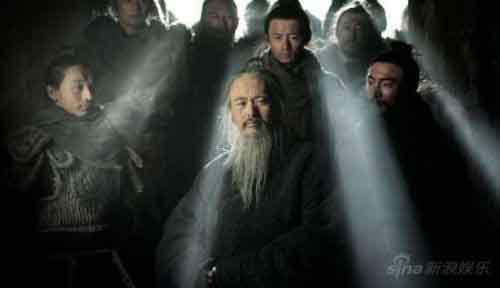
Confucius with his students

The DVD I bought and watched had a photo of Confucius with a beautiful woman on the cover. They must have added her to the cover for that Hollywood sexy touch to appeal to an American audience. In the movie, she plays a minor role and is assassinated for wanting power in a violent world dominated by men busy killing each other.

From what I know of Confucius, the movie showed him close to who he must have been—an honorable man wanting to bring peace to a war-torn land and end the people’s suffering.  He spends more than a decade homeless wondering the land in search of someone who will listen besides the rag-tag band of students who stuck to him like glue.

If anything, we could learn something about dedication and loyalty from this band and their master.

At the bottom of the DVD box, it says, “His teachings were banned under Mao Zedong, who oversaw the destruction of his family home during the Cultural Revolution.”

Ironic, considering that Mao stayed in power his last decade because of what Confucius taught the Chinese about piety.

Discover more about The Life of Confucius

______________

Lloyd Lofthouse is the award-winning author of The Concubine Saga. When you love a Chinese woman, you marry her family and culture too. This is the love story Sir Robert Hart did not want the world to discover.

To subscribe to “iLook China”, look for the “Subscribe” button at the top of the screen in the menu bar, click on it then follow directions.