Bamboo

October 12, 2010

Chinese culture considers Bamboo lucky because Bamboo is the Chinese symbol for strength.

Bamboo demonstrates strength by growing fast and adapting to new environments. Because of this, many in China see Bamboo as a symbol of luck, which explains why Bamboo is often given as a gift.


Bamboo Flute Music & Beautiful China

In fact, Bamboo is the most popular plant in China.  Most Chinese, even in high-rise apartments, have Bamboo plants around in small pots.

Bamboo represents the spirit of summer, simplicity and humility, and respect for elders among other things.

Painting Bamboo goes back centuries. Musical instruments have been made of Bamboo.

China’s first cannons were made of Bamboo.


Painting Chinese Bamboo

My wife has planted Bamboo in the yards of every house we’ve lived in.  When my father-in-law visits from China, he has his picture taken in front of the healthiest, tallest stand of Bamboo in the yard.

In Feng Shui, Bamboo is a symbol of strength, fortitude, and rapid growth. When given as a gift, Lucky Bamboo is said to be at its luckiest.

Chinese tradition also gives meaning to the number of stalks given as a gift. Two stalks is a symbol for love, three or six represent happiness while five or seven impart health.  The more stalks there are, the more luck there will be.

Sources: The Feng Shui meanings of lucky Bamboo and Living Arts Originals

Discover Fifteen Facts that will Blow Your Mind about China

______________

Lloyd Lofthouse is the award-winning author of The Concubine Saga. When you love a Chinese woman, you marry her family and culture too. This is the love story Sir Robert Hart did not want the world to discover.

To subscribe to “iLook China”, look for the “Subscribe” button at the top of the screen in the menu bar, click on it then follow directions.


China and India at War ­in 1962 – Part 3/4

October 11, 2010

The Chinese moved their Eleventh and Fifty-fifth divisions to the front.

The Indian army had four brigades set up defensive positions along the only mountain road leading south through the harsh terrain.

At the same time, India was planning to attack the Chinese army.

In a risky flanking maneuver, the Chinese sent 1,500 troops along a dangerous mountain trail to attack India’s Army in the rear and cut them in half.

The Chinese troops succeeded, and the Chinese army launched an attack from the north along the road.

India’s Sixty-second Brigade collapsed the first day. Soon after, India’s Sixty-fifth Brigade abandoned their positions without a fight.

News of the Indian army’s defeat reached New Delhi.  The Indian people panicked. Large numbers of refugees started to flow south.

Chinese army troops had advanced into India past the disputed territory. China declared a unilateral cease fire.

There were abandoned Indian weapons everywhere and the Chinese troops gathered the weapons, which were returned to India. Then the Indian troops that were prisoners of war were released.

China’s army withdraw to the 1959 border keeping the disputed territory. The war ended without a treaty to resolve the border dispute.

India’s Casualties

Killed = 4,885
POW = 3,968
Wounded = 1,697

China’s casualties
Killed 722
Wounded 1,696

Go to China and India at War – Part 4 or return to Part 2 of China and India at War in 1962

______________

Lloyd Lofthouse is the award-winning author of the concubine saga, My Splendid Concubine & Our Hart. When you love a Chinese woman, you marry her family and culture too. 

If you want to subscribe to iLook China, there is a “Subscribe” button at the top of the screen in the menu bar.


Keeping the Rare Earths in China

October 1, 2010

At one time, it must have seemed like a good idea to allow China to process 90% of the earth’s supply for rare earth oxides/metals.

After all, rare earths are dangerous and costly to extract and the extraction methods used in China are highly toxic. The Economist reports that there have been horror stories about poisoned water supplies.

The thinking around the world must have been, “Better that China wrecks its environment than us.”


The Other Side of the Story

These rare earth-based metals are important in manufacturing sophisticated products such as flat-screen monitors, hybrid and electric-car batteries, wind turbines, aerospace alloys and high-tech weapons, which the U.S. needs to fight wars.

Then China became angry when Japan arrested a Chinese fishing boat captain whose trawler collided with a Japanese patrol boat in contested waters.

What China did to force the Japanese to do what China wanted caused the rest of the world to sit up.

China shut off the supply of rare earths to Japan.

A report from Reuters by Julie Gordon says this caused companies that depend on rare earths to struggle to secure a supply. It also woke up the rest of the world—a lesson learned that you don’t keep all the eggs in a basket that you don’t own.

See Hitting Endless Home Runs

______________

Lloyd Lofthouse is the award-winning author of The Concubine Saga. When you love a Chinese woman, you marry her family and culture too. This is the love story Sir Robert Hart did not want the world to discover.

To subscribe to “iLook China”, look for the “Subscribe” button at the top of the screen in the menu bar, click on it then follow directions


SONG DYNASTY (960 – 1279 A.D.) – Part 1/6

September 26, 2010

Fifty-three years after the Tang Dynasty collapsed, Zhao Kuangyin, a general in the latter Zhou Dynasty (951-960) led a mutiny resulting in the Song Dynasty being established in Kaifeng City, Henan Province that would survive for 319 years.

During the Song Dynasty, China experienced developments in science and technology.

For example, the four great inventions of China were developed during the Song Dynasty—paper, printing, the compass and gunpowder

The Song Dynasty is considered a great period in ancient China and a continuation of what took place during the Tang Dynasty.

A striking feature of Song politics was the way greater importance was attached to civil administration than to military arts.

Under such circumstances, education, merit, and talent were encouraged and the imperial examination system was improved.

Astronomy was also an area where advances were made.

In July 1054, an unknown nova appeared in the sky. The sudden appearance of this nova alarmed the bureau of astronomy. A year later, the star vanished.

The nova was important because astronomers discovered the Crab Nebula near Taurus and careful records were kept during the Song Dynasty that benefits science today.

By the year 1072, Shen Kuo had been appointed head of the bureau of astronomy, and he took charge of the design of astronomical instruments leading to further scientific advances in this field

See the Tang Dynasty

______________

Lloyd Lofthouse is the award-winning author of The Concubine Saga. When you love a Chinese woman, you marry her family and culture too. This is the love story Sir Robert Hart did not want the world to discover.

To subscribe to “iLook China”, look for the “Subscribe” button at the top of the screen in the menu bar, click on it then follow directions.


Emperor Wu of Zhou Dynasty – Part 4/4

September 7, 2010

The Temple of Heaven in Beijing is a tribute to the Rituals from the Zhou Dynasty.

What the Zhou Dynasty established is still embedded in everyday aspects of Chinese social life. Showing respect for family ancestors originated with the Zhou Dynasty and is practiced today all over China.

The Book of Songs was the first poetry collection in Chinese history. Among the poems is the Eulogy for the Zhou Dynasty.


Video: Chinese with English subtitles.

The Book of Changes, which also discusses military thought, came from the Zhou Dynasty.

The civilization established by the Zhou Dynasty influenced the cultures of Korea, Japan and Southeast Asia.

Duke Zhou, Emperor Wu’s younger brother, was regent for seven years when King Cheng was mature enough to assume the power of king.  Duke Zhou stepped aside.

The Zhou Dynasty is also known for its bronze castings with history unscripted on them. Jade became important at this time too.

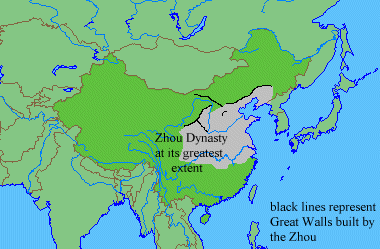
Zhou Dynasty at its greatest

The Zhou Dynasty attached great importance to agriculture and a large number of bronze farming tools were extensively used.

The Zhou Dynasty continued to expand as other states were slowly absorbed.  The Zhou also fought the nomads to the north and northwest.

Return to Emperor Wu of Zhou Dynasty – Part 3 or start with Part 1

______________

Lloyd Lofthouse is the award-winning author of The Concubine Saga. When you love a Chinese woman, you marry her family and culture too. This is the love story Sir Robert Hart did not want the world to discover.

To subscribe to “iLook China”, sign up for an E-mail Subscription at the top right-hand side of this page and then follow directions.