In China, where do you think most or all of the money from those 30% to 60% down payments mentioned in Part 2 go? For a first-time property sale, the government owned banks loan the money to private citizens or businesses to buy property owned by the government. Once the loan is complete, the down payment and the amount of the loan flows to the same or another government owned bank and then the buyers make payments with interest to the government owned bank that holds the loan.
When re-sales of these properties take place, the first mortgage on the leased property is paid off and the second loan is either 70% (for a buyer’s first home) or 40% (for a second home).
Thirty percent of property in China is bought with cash.
Due to the high required down payment, the risk to China’s government owned banks is much less than the risk in the US private sector banking system, which really has no risk, since the government often steps in to make up for the losses in the private sector while ending up increasing the national debt.
In China, even when property values drop, the bank, which the government owns, may repossess the property (that the government always owned) and resell it. This means after a property has dropped 50% of its value in China, the government may lose either 30% or 10% of the value of the loan. In the US, if a bank cannot re-sell the house at the current value, then it losses all of the value of the loan.
However, when the same property that was repossessed is sold again, the down payment will be between 30% to 60% in addition to the fact that 30% of property sold in China is bought with cash.
In the long run, will the government owned banks in China make a profit or a loss?
Lloyd Lofthouse is the award-winning author of The Concubine Saga. When you love a Chinese woman, you marry her family and culture too. This is the love story Sir Robert Hart did not want the world to discover.
Subscribe to “iLook China” Sign up for an E-mail Subscription at the top of this page.
“Tinpot dictator” are the two key words in the title of this opinion piece, as if the United States or the UK has never hosted and/or supported “tinpot” dictators. Before we discover China’s history with Burma/Myanmar, first we should look a little closer at the United States.
A well-written criticism of the U.S. government from Sri Lanka sets the record straight.
“I wish the spokesman of the (U.S.) State Department … would explain how Washington’s concern for democracy in Sri Lanka squares with US support for repressive regimes such as the one in Uzbekistan or the autocratic rule in Saudi Arabia, both countries in which the U.S. has military facilities.
“In post-World War II period, Washington has militarily propped up such dictators including several in South Korea, Ferdinand Marcos who was ousted by the Filipino people, Indonesia’s Suharto also thrown out by the people, Vietnam’s Dinh Diem, various military governments in Thailand, Singapore’s autocrat Lee Kwan Yew, the military dictators in Pakistan from Ayub Khan to Pervez Musharraf, all of them from our part of the world…” The Ugly Americans Once More (Lankaweb, Sri Lanaka’s first Social Media website)
The Economist only mentions a half century of history between China and Burma/Myanmar, yet, China’s history with Burma and then Myanmar goes back about two thousand years, and we will explore that later in this series.
The opinion piece also does not mention that China, since 1982, has not been into nation building as the U.S. has since 9/11, when President G.W. Bush launched wars against Iraq and Afghanistan with threats to Iran and North Korea.
Until doing research for this post, most of what I had read about China in The Economist had been educational, but this piece was stilted and biased—an example of China bashing.
What does the Beijing based unnamed critic writing in The Economist expect—that China, with its Communist, Taoist, Buddhist, Confucius culture, adopt America’s evangelical, neo-conservative role to spread “democracy” and “Christianity” to the world through nation building?
Correct me if I’m wrong, but didn’t the critic writing in The Economist suggest that he or she expects China to spread “democracy” to countries like Burma and North Korea, which are by definition dictatorships, which the U.S. has a long history of supporting. See Cold War Origins of the CIA Holocaust to learn more.
If you haven’t read this opinion piece in The Economist, I suggest you do before going on to Part 3. Did you know that at the same time that the United States sells or gives weapons to dictatorships and authoritarian governments, it also hasprograms through the U.S. State Department to support religious freedom in many of the same countries?
For instance, Saudi Arabia, a country that prohibits any religion other than Islam and has a long history of human rights violations (Human Rights Watch World Report 2013). On October 20, 2010, the US State Department notified Congress of its intention to make the biggest arms sale in American history—an estimated $60.5 billion purchase by the Kingdom of Saudi Arabia.
The IAGS says this about Saudi Arabia: “Much has been reported about the complex system of terrorist financing and the money trail facilitating the September 11 terror attacks. Individuals and charities from the Persian Gulf—mainly from Saudi Arabia—appear to be the most important source of funding for terrorist organizations like Al-Qaeda.”
Enough said about The Economist, Christianity and differences between dictatorships, democracies and republics, and back to the long history between China and Burma/Myanmar, which started during the Han Dynasty (206 B.C. – 220 A.D.).
Due to deposits of jade in Burma/Myanmar and that region, Chinese merchants have been involved in mining and trade there for more than two thousand years.
Then during the Qing Dynasty, there were four major invasions (1765-1769) of Burma by China’s Manchu leaders. In 1784, the long struggle between Burma and China ended and regular trade started up again.
In November 1885, Sir Robert Hart favored a proposal that China, as Burma’s overlord, stand aside and allow the British Empire to pursue her own course there provided that Britain allow Burma to continue her decennial tribute (once every ten years) missions to China. Source: The I. G. In Peking, Letters of Robert Hart, Chinese Maritime Customs 1868-1907, The Belknap Press of Harvard University Press, page 614, 1975.
Instead, the British Empire made Burma a province of India in 1886.
Since independence from the British Empire, Burma has generally been impartial to world affairs but was one of the first countries to recognize Israel and the People’s Republic of China.
Territories such as the autonomous regions of Tibet, Xinjiang and countries like North Korea, Manchuria, Mongolia, Burma, Vietnam and others along China’s long borders were considered vassal states by some Chinese dynasties, and these vassal states often sent lavish gifts and delegations to China’s emperors on a regular schedule.
_______________
Lloyd Lofthouse is the award-winning author of My Splendid Concubine [3rd edition]. When you love a Chinese woman, you marry her family and culture too. This is the love story Sir Robert Hart did not want the world to discover.
Subscribe to “iLook China”!
Sign up for an E-mail Subscription at the top of this page, or click on the “Following” tab in the WordPress toolbar at the top of the screen.
Three times George Washington acted in a way that would insure the newly born US Republic would survive.
His first act was in 1782, when Colonel Lewis Nicola wrote a letter to Washington suggesting that Washington should set up a constitutional monarchy because of the inefficiency of the Continental Congress.
Washington was offended at such a suggestion and wrote to Nicola telling him to banish such thoughts from his mind. George Washington – Legends and Myths
His second act took place in 1783, when he stepped in and saved the republic by ending the Newburgh Conspiracy, a plot in the military to seize power and create a military dictatorship. Source: Early America
The third act was when Washington stepped down as President (1789 – 1797) and returned to his farm.
When King George III asked his American painter, Benjamin West, what Washington would do after winning independence, West replied, “They say he will return to his farm.”
“If he does that,” King George said, “he will be the greatest man in the world.” Cato Institute
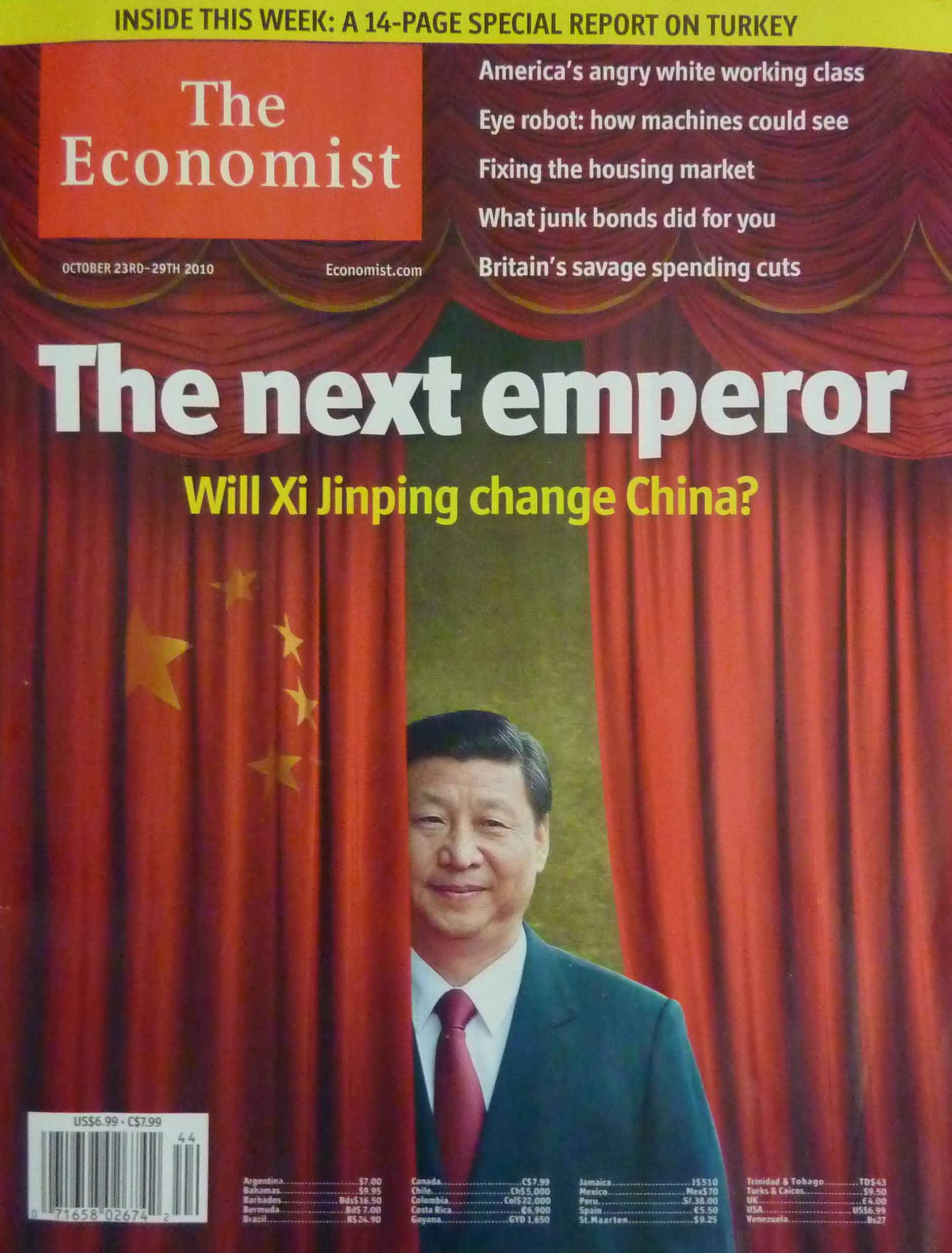
The cover of The Economist for October 23, 2010—in the best tradition of biased and Yellow Journalism— SHOUTED: “The next emperor – Will Xi Jinping change China?”
As I read the feature article on page 13, I laughed when I saw, “Mr. Xi’s appointment was eerily similar to the recent anointment of Kim Jong-un in North Korea.”
The reason I saw humor in this absurd statement was that there is nothing similar. Kim Jong Un inherited his for-life position as Supreme Leader of North Korea. He is the son of Kim Jong-il, and the grandson of Kim Il-sung, the founder of North Korea.
The Economist implied in the October 23, 2010 issue of the magazine, that China is a monarchy.
However, China is not a monarchy as the Kim Dynasty in North Korea has become or a dictatorship-monarchy as many in the West think.
In North Korea, what started as a Socialist Dictatorship modeled on Maoism has become a Socialist Maoist Monarchy.
China, on the other hand, started as a Socialist Dictatorship under Mao (1949 to 1976) and is becoming a fledgling republic with Western critics looking for cockroaches and slugs under rocks.
In fact,Dr. Sun Yat-sen, the father of China’s Republic, wrote that he wanted to model China’s government after America but by combining Western thought with Chinese tradition.
He didn’t say he wanted China to be a clone of America’s Republic.
America was still a Republic prior to World War II. The US wouldn’t become a full-fledged democracy until the 1960s.
Unfortunately, Dr. Sun died in 1925 before he could finish what he started.
It wouldn’t be until after Mao died in 1976, that the leaders of the Communist Party under Deng Xiaoping would start the long journey to implement Sun’s dream of a Republic against great pressure from Western democracies to copy them.
Before we move on, let’s take a brief look at the Athenian democracy that was developed around the 5th century B.C. in the Greek city-state of Athens. Even though there is evidence that democratic forms of government existed before the 5th century, ancient Athens is generally believed to be the first democracy.
What did that democracy look like? Athens had a system of direct democracy, in which participating citizens voted directly on legislation and executive bills. But participation was not open to all residents: to vote, one had to be an adult, male citizen, and the number varied between 30,000 and 50,000 out of a total population of around 250,000 to 300,000—about 150,000 were slaves.
In comparison, the membership of the Chinese Communist Party (CCP) is now 86.7 million—men make-up 77 percent of CP’s membership, while woman make up 23 percent—making the CCP the world’s largest political party representing more than 6 percent of China’s population, and slavery is illegal just like it is in the U.S.
Regardless of what critics claim, China is becoming more like the republic Dr. Sun Yat-sen might have imagined by combining Western thought with Chinese traditions.
After Mao died, The Communist Party worked for several years to draft the 1982 Constitution, which included term limits of two five-year terms for elected government officials.
If you have read the Chinese Constitution carefully, it is obvious that the U.S. Constitution was used as a model. However, these two documents are not the same.
If the Party leadership is not happy with China’s president, he can be removed after one five-year term. There is even an article of impeachment in China’s Constitution.
China’s first president was Li Xiannian (1983 to 1988). He served one, five-year term, and then he stepped down.
From 1988 to 1993, Yang Shangkun would be China’s president for one five-year term. Deng Xiaoping (born 1904 – died 1997) was the Chairman of the Communist Party from 1983 to 1993, which was ten years—what China’s 1982 Constitution calls for, but Deng never served as the country’s president.
Due to how the Tiananmen Square incident in 1989 was handled, President Yang had to step down at the end of his first, five-year term. The only other way to remove him would have been through impeachment.
In 1993, Jiang Zemin became President and Chairman of the Communist Party. Then in 2003, Hu Jintao became President and Chairman of the Party. His term ended in 2012 when Xi Jinping became president of China.
Deng Xiaoping was China’s George Washington. What he did was what Dr. Sun Yat-sen wanted. China is a republic that combines Western thought with Chinese tradition.
However, the task to create China’s Republic fell to the Communist Party so China is a Socialist Republic with capitalist tendencies.
In China, Piety is important and advice from elders is often followed as if it is the law. Due to this, elder statesmen such as Jiang Zemin have great power in the government even after he no longer has a political title. After all, this is a Chinese tradition.
The Economist mentioned disagreements within the CCP among China’s leaders over what the country’s priorities should be—both on the economy and on political reform.
Whatever the final decisions will be, the consensus of the CCP will be guided by Chinese tradition and not Western thought.
The changes that “some” want to see take place in China will probably not arrive in a hurry if the wisdom of the I-Ching, The Book of Changes, is followed, which says change should come slowly.
In fact, China has proven it is a republic because none of China’s first four presidents are the sons of previous presidents and eventually death removes the elders. China’s presidents did not inherit that title due to heredity as kings do or the leader of North Korea did.
_______________
Lloyd Lofthouse is the award-winning author of My Splendid Concubine [3rd edition]. When you love a Chinese woman, you marry her family and culture too. This is the love story Sir Robert Hart did not want the world to discover.
Subscribe to “iLook China”!
Sign up for an E-mail Subscription at the top of this page, or click on the “Following” tab in the WordPress toolbar at the top of the screen.
Before I introduce the topic of China’s war on pornography, I felt it necessary to first mention the scope of this crime in America. If I didn’t, I think China’s critics/enemies would go out of the way to accuse the Chinese of being perverts and criminals—or something worse for China’s Communist Party, the CCP.
In 1982, the U.S. Supreme Court added child pornography as another category of speech excluded from First Amendment protection. The other categories excluded were obscenity, defamation, incitement, and fighting words.
However, for the last 15 years, the distribution of on-line child pornography has been the fastest growing crime in America (it has grown 100% annually). –kens5.com
The U.S. Justice Department says, “Congress recently significantly increased the maximum prison sentences for child pornography crimes and in some instances created new mandatory minimum sentences. These prison terms can be substantial, and where there have been prior convictions for child sexual exploitation, can result in a life sentence.”
Fifty-five percent of global child pornography comes from the US.
Family Safe Media.com says, every second, more than $3 million is spent on pornography; every second, more than 28,000 Internet users are viewing pornography and every 39 minutes a new pornographic video is being created in the United States.
US porn revenue exceeds the combined revenues of ABC, CBS, and NBC. In fact, the world’s top video porn producers are in the United States.
In 2006, Family Safe Media.com reported that revenue from worldwide pornography reached almost $100 billion—$27 billion in China and more than $13 billion in the United States.”
Before you conclude that China is more perverted than the United States, because $27 billion is more than twice #13 billion, stop and consider that China has more than four times the population. To match the US average per person, China’s share for buying porn would have to total more than $54 billion.
I’ve also read complaints about China’s control and attempt at censorship over the Internet and media. The Western media and China’s critics/enemies love to hate the CCP’s attempt to control content on the Internet. Imagine, not being able to practice Yellow Journalism with a potential audience of 1.3 billion people. Think of all the newspapers and magazines that could be sold to such a vast audience if the CCP would relax its controls over the media in China.
In early 2010, in the war against pornography, China recruited moms. Who better to protect children? Even most Westerners should agree that child pornography is not a good thing. Polluting the minds of and abusing children to make money off them should be ranked alongside heroin or crack with a death sentence or at last a life sentence after surgery to become a eunuch.
Child Porn on Facebook
Since I’m married to a Chinese mother, and I know how dedicated Chinese moms are to their children, I’d rather have a U.S. Marine parked on my butt, and I thought: “Beware pornographers. You may have met your match.”
However, while doing research on this topic, I learned that even China’s famous tiger mothers may not be enough to stem the tide of pornography.
China’s war on pornography was launched in 2004, and in July of that year, Danwei reported, “Xinhua quotes an unnamed official who says China is going to wage a ‘people’s war against porn’: Pornographic activities have been rampant online in recent years, and have severely damaged social style, polluted the social environment, and harmed the physical and psychological health of the young people, said the official, who is also a state councilor and minister of public security.”
In 2005, Arts Technica.com reported, “The Chinese government regularly censors Internet content in an effort to diminish the distribution of politically subversive material, but now the communist state is expanding its control and targeting Internet pornography web sites as well. According to a Chinese government official, 221 people have been arrested, and almost 600 web sites have been shut down since March in a crackdown on ‘obscene’ Internet content.”
In 2006, Why We Worry.com reported, “Chen Hui was sentenced to a life in jail on Wednesday for having created the largest porn site in China … Xinhua News Agency said judges at the Taiyuan Intermediate People’s Court in Shanxi province gave the life sentence to Chen Hui and handed down terms of 13 months to 10 years to eight others after they were convicted of profiting from pornographic dissemination.
“Chen, 28, and his accomplices started the Qingseliuyuetian (Pornographic Summer) Web site in 2004, and opened a further three porn Web sites, attracting more than 600,000 users.”
In 2007, Spam Fighter.com reported, “Virtually, 5,000 websites were shut down, 270 culprits detained, and more than 160,000 of harmful materials was seized in the one month long assault that China made on online pornography, as reported by state media.
“Despite a drastic drop, cyber porn is still a concern,” Public-Security Vice Minister Zhang Xinfeng said this while calling for extra efforts for bringing the domestic cyber porn under control, and blocking its overseas sources.
In 2008, the Financial Times reported, “China has vowed to drive on with its multi-ministry crackdown on online pornography until after the Beijing Olympics, extending a campaign that last year led to the detention of 868 people and the deletion of 440,000 prurient postings.
“Publicly prudish Communist party leaders bill the action as a vital part of a wider drive to ‘purify’ the internet by eliminating immoral or politically dangerous content.”
In 2009, English People.com reported, “China shut down or blocked more than 140,000 mobile WAP sites offering pornography for mobile phone users in a five-month crackdown, an official said Monday.”
In 2010, Natural Order Guild.com reported, “China’s anti-pornography campaign shut down more than 60,000 pornographic websites this year, with police investigating almost 2,200 criminal cases, the state-run Xinhua news agency reported Thursday. Wang Chen, director of the Information Office of the State Council, said at a news conference that some 350 million pieces of pornographic and indecent internet content were eliminated, according to the Xinhua report.
“Overall, the campaign included 2,197 criminal cases involving 4,965 people who violated Chinese law by disseminating pornography via the internet or mobile phones, the news agency said. Of those, 58 people received prison sentences exceeding five years, the report said.”
Then in August 2011, The Wall Street Journal reported, “Beijing’s war against pornography is infamous for producing an inordinate amount of collateral damage … Despite the sledge-hammer strategy, sex scholar Katrine Jacobs says in an interview published Tuesday by the Web magazine Danwei, China’s guardians of public morality are losing, badly.”
Is anyone surprised?
As a comparison — since 1990 (a period of more than twenty years compared to the eight for China’s war on porn), China arrested 30 high profile democracy advocates with others on watch lists similar to America’s list of state enemies, which has about 21,000 names of known or suspected terrorists on it. “Both U.S. intelligence and law enforcement communities and foreign services continue to identify people who want to cause us harm.” – CBS News.com
China’s list has nineteen names of people to be arrested on entry to China; fourteen that are to be refused re-entry and nineteen to be dealt with “according to the circumstances of the situation”.
Compare those numbers with the numbers of China’s losing war being waged on pornography, and what does that tell us? From the numbers, it appears that the Chinese people have spoken with their actions that say pornography is desired more than democracy.
And let’s not forget that in 1982, the U.S. Supreme Court added child pornography as another category of speech excluded from First Amendment protection. In addition, the US Congress made this a crime that might lead to a life sentence in jail.
________________________________
Lloyd Lofthouse is the award-winning author of My Splendid Concubine [3rd edition]. When you love a Chinese woman, you marry her family and culture too. This is the lusty love story Sir Robert Hart did not want the world to discover.
Finalist in Fiction & Literature – Historical Fiction
The National “Best Books 2010” Awards
Honorable Mentions in General Fiction
2012 San Francisco Book Festival
2012 New York Book Festival
2012 London Book Festival
2009 Los Angeles Book Festival
2009 Hollywood Book Festival
Subscribe to “iLook China”!
Sign up for an E-mail Subscription at the top of this page, or click on the “Following” tab in the WordPress toolbar at the top of the screen.


 Posted by Lloyd Lofthouse
 iLook China