War with North Korea and What China wants: part 2 of 2

November 1, 2017

North Korea is frozen in time, but South Korea and China have evolved and adapted to the global economy.  It is in China’s interest to see North Korea merge with South Korea and become a capitalist nation, but achieving that goal will not be easy and a nuclear war with North Korea is not the answer.

The Independent, another publication in the UK, explains what nuclear war between the U.S. and North Korea might look like. “The most immediate reaction would likely be massive artillery fire on Seoul and its surroundings. North Korean artillery installations along the border can be activated faster than air or naval assets and larger ballistic missiles that can target South Korean, Japanese or American bases in the region with nuclear, chemical and biological weapons. Those countries have ballistic-missile-defence systems in place but can’t guarantee they will shoot down everything. Japan has begun offering advice to its citizens on what to do in the event a missile lands near them — essentially try to get under ground — and US firms are marketing missile shelters. While it’s unclear if North Korea can successfully target US cities like Denver and Chicago with a nuclear ICBM, it’s similarly unknown if US defence systems can strike it down — adding to American anxieties.”

The New Yorker reports, “The Obama Administration studied the potential costs and benefits of a preventive war intended to destroy North Korea’s nuclear weapons. Its conclusion, according to Rice, in the Times, was that it would be ‘lunacy,’ resulting in ‘hundreds of thousands, if not millions, of casualties.’ North Korea likely would retaliate with an attack on Seoul. The North has positioned thousands of artillery cannons and rocket launchers in range of the South Korean capital, which has a population of ten million, and other densely populated areas. (Despite domestic pressure to avoid confrontation, South Korea’s President, Moon Jae-in, has accepted the installation of an American missile-defense system called Terminal High-Altitude Area Defense, or thaad.)”

And we shouldn’t forget this fact also reported by The New Yorker. Some two hundred thousand Americans live in South Korea.

The New Yorker correctly called this lunacy the Madman Theory, but isn’t that who Donald Trump is: a madman, a serial liar, a failed businessman, and a bully?

Who do you think China fears more Donald Trump or Kim Jong-un and his brutal regime? And the answer is simple. All you have to do is compare how many nuclear weapons the U.S. has vs North Korea. The Independent reports North Korea has 60 compared to 6,800 for the United States.

If you have watched the two videos in Part 1 and 2, you will know what is at risk for all of us on this planet called Earth. There is hope. Trump might also be a barking dog that doesn’t bite.

UPDATE

The Telegraph reports, “China ‘detains North Korean assassins seeking Kim Jong-un’s dissident nephew Kim Han-sol’

“It is possible that Kim Han-sol and his family remained in China under the protection of Beijing, which also extended protection for his father when he was in the country. There have been suggestions that Beijing saw Kim Jong-nam as as a potential North Korean leader should his half-brother be overthrown.”

Return to or start with Part 1

Lloyd Lofthouse is the award-winning author of My Splendid Concubine, Crazy is Normal, Running with the Enemy, and The Redemption of Don Juan Casanova.
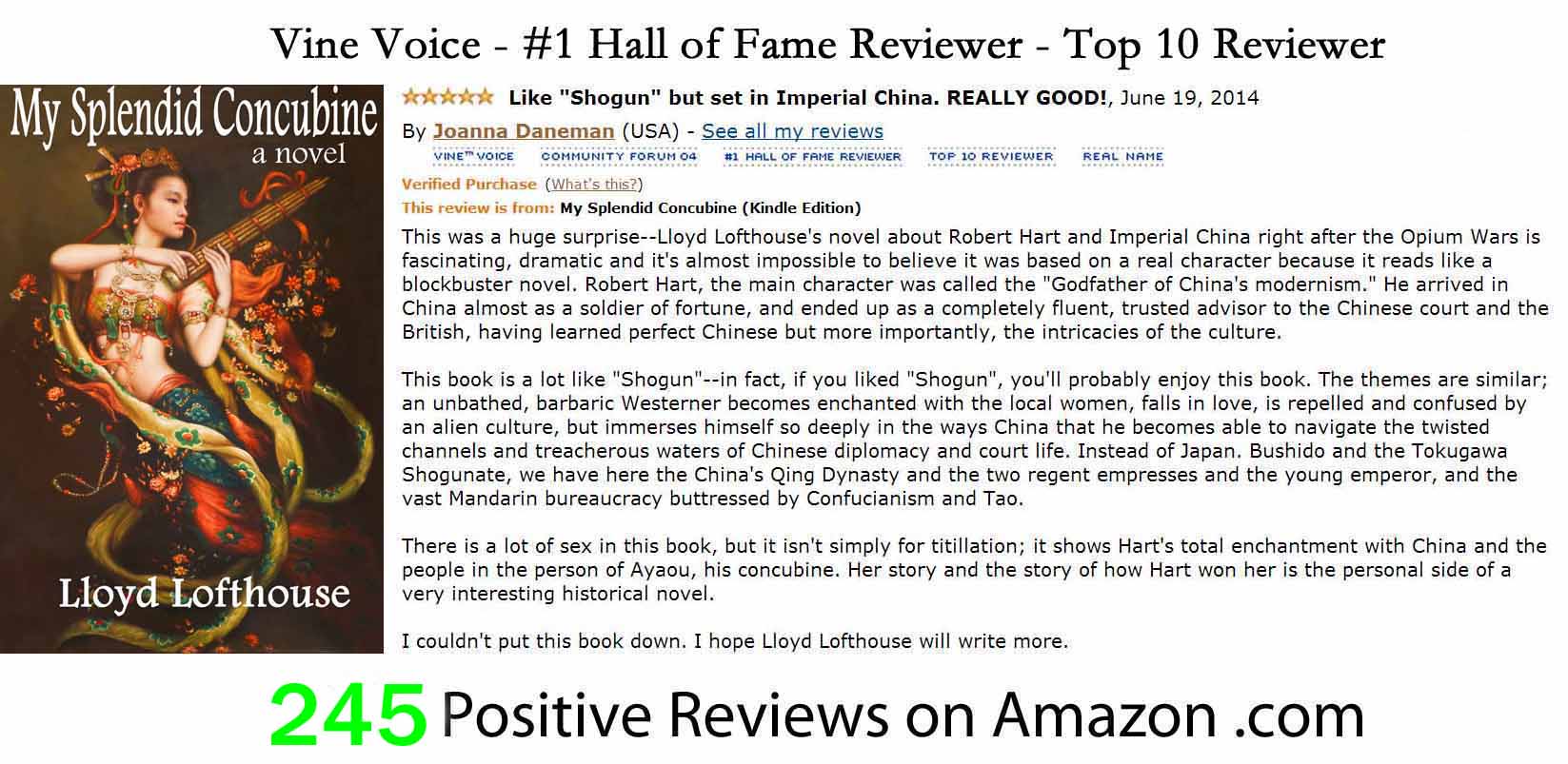
Where to Buy

Subscribe to my newsletter to hear about new releases and get a free copy of my award-winning, historical fiction short story “A Night at the Well of Purity”.

About iLook China

China’s Holistic Historical Timeline


War with North Korea and what China wants: part 1 of 2

October 31, 2017

The Telegraph in the UK asked, “Did Kim Jung-un kill his uncle and brother over a ‘coup plot involving China’?” From what I’m hearing from my sources in China, the answer is yes. China did try to get rid of Kum Jung-un. For more details about this alleged and failed coup attempt, click the link in this paragraph and read what The Telegraph says.

In the past, when the United States and North Korea threatened each other, China’s response has been for the “relevant parties” to “calmly and properly handle the issue and avoid escalation of tension.”

What has changed? The answer is simple. The current president of the United States is a serial liar, a racist, a bully, a malignant narcissist and a psychopath-sociopath (if it is possible to be both at the same time). Donald Trump is clearly more dangerous, unstable, and insane than Kum Jung-un is. Kim Jung-un is more like the barking dog who might never bite, because he knows if he bites, he will die and so will most of the people that live in his little kingdom.

In the past, China has been reluctant to be sucked into North Korea’s problems with the United States, because China has a history with Korea going back to the Tang Dynasty in 688 AD, when there was an alliance with Silla, a Korean state.

It’s also because Chinese culture, written language, and political institutions have had an influence in Korea since the 4th century and in the 14th century, Korea came under the influence of Confucian thought influenced by Buddhism and Daoism (Taoism). Even today, China has more in common with the people of North Korea and their culture than China has with the United States.

But that 1,700-year old relationship between China and Korea might not be enough to protect North Korea now that the United States has an unpredictable madman and lunatic for its president.

Why did China allow itself to be bullied by Trump to tame a beast it cannot control? The answer is simple and it is Donald Trump and his insane tweets threatening to nuke North Korea.

In an essay written by Sung-Yoon Lee in Hillsdale College’s Imprimis newsletter, he discussed Keeping the Peace: American in Korea 1950 – 2010.

Professor Lee is an adjunct assistant professor of international politics at the Fletcher School of Law and Diplomacy at Tufts University and an associate in research at the Korea Institute at Harvard University.

Professor Lee says, “It is important for Washington to hold quiet consultations with Beijing to prepare jointly for a unified Korea under Seoul’s direction, a new polity that will be free, peaceful, capitalist, pro-U.S. and pro-China.”

But Donald Trump has clearly demonstrated that he doesn’t have the patience or intelligence to be part of a quiet consultation with Beijing to fix the North Korean problem. Even after the alleged and failed plot that China was willing to risk to get rid of Kim Jong-un, Donald Trump’s lunatic Twitter raving hasn’t stopped.

When Mao ruled China, North Korea and Communist China looked like evil twins, but today that is not the case because Mao died in 1976 and so did the China he was building. In the 1980s, China emerged as a hybrid one-party republic with term and age limits for its political leaders, so one man would never rule China like Mao did for 26 years.

In fact, China has a lot to lose because China’s middle class is more than 300-million people with an estimate that by 2030 that number will be more than 700-million.

Continued in Part 2 on November 1, 2017

Lloyd Lofthouse is the award-winning author of My Splendid Concubine, Crazy is Normal, Running with the Enemy, and The Redemption of Don Juan Casanova.

Where to Buy

Subscribe to my newsletter to hear about new releases and get a free copy of my award-winning, historical fiction short story “A Night at the Well of Purity”.

About iLook China

China’s Holistic Historical Timeline


How are women doing in China compared to the United States?

October 10, 2017

In 1949, Mao announced that women hold up half the sky. In one day they went from being the property of men to being equal. Sixty-eight years later, how are women doing in China?

China’s women make up 48.1 percent of the population, but Catalyst.org reports, “In 2016, only 17.5 percent of firms in China have women as top managers. … Less than one-quarter (24.2%) of all positions in China’s single-house parliament are held by women.”

When we isolate China and report these facts, China looks bad, doesn’t it?

But how does China compare to the United States when it comes to women reaching the top?

In the United Staets women make up 50.8 of the population.  American Progress.org says, “They are only 14.6 percent of executive officers, 8.1 percent of top earners, and 4.6 percent of Fortune 500 CEOs.” In addition, Rutgers.edu reports, “21 women (21%) serve in the United States Senate, and 84 women (19.3%) serve in the United States House of Representatives.”

The Harvard Business Review says, “In the decades since Deng Xiaoping instituted market reform, millions of women have profitably followed Deng’s dictate that “to get rich is glorious.”

Quartz.com tells us “No country comes even close to China in self-made female billionaires.” China has 56 self-made female billionaires; The United States only has 15. China has almost four times as many self-make female billionaires.

Discover Wu Zetian, China’s only female emperor

Lloyd Lofthouse is the award-winning author of My Splendid Concubine, Crazy is Normal, Running with the Enemy, and The Redemption of Don Juan Casanova.

Where to Buy

Subscribe to my newsletter to hear about new releases and get a free copy of my award-winning, historical fiction short story “A Night at the Well of Purity”.

About iLook China

China’s Holistic Historical Timeline


China is Leading the World in Alternative Energy

August 23, 2017

The United States Congress passed the Clean Air Act in 1970 because of polluted rivers, lakes, and dense, visible smog in many U.S. cities and industrial centers.  I grew up in the Los Angeles basin in the 1950s – 60s and was a witness and victim of that air pollution.

A 2016 Report of the Trends in Global CO2 Emissions said, “top emitters China (1st place) and the United States (2nd place) set an example by effectively reducing their CO2 emissions over 2015 by 0.7% and 2.6%, respectively, compared to 2014 levels. … The largest decreases in coal consumption were seen in the United States and China.”

But all of the gains made by the United States since the 1970s are being reversed by #FakePresident Donald Trump and his extremist administration.

Yes, the United States is listed as the second largest producer of carbon dioxide emissions in the world, but if the U.S. had China’s population, the pollution generated would dwarf China. In 2015, China’s global share of emissions was 29 percent vs 14-percent in the United States, but if both countries had equal populations, the U.S. share would be almost twice China’s.

China’s first Clean Air Act was signed into law in 1987. In 2006, Greenpeace was consulted by China’s CCP on an early draft of a renewable energy law by China’s National People’s Congress. Now China is the world’s leader in the production of renewable energy. DW.com reports, “China is one of the driving forces behind the solar power boom. Last year, around 45 percent of the world’s new solar installations were built there. The United States, Japan and India were also top adopters of the technology, albeit significantly behind China.”

China’s one-party system has demonstrated the ability to get things done quickly and, yes, mistakes are made but so are course corrections.  For instance, I witnessed China’s ability to get things done in Shanghai. At the time, we were staying in what was once the French concession. The stately mansions that once housed wealthy French families and their Chinese servants had been converted to communal multi-family homes still surrounded by high walls.  When we went to sleep one night, the walls were there. In the morning, the walls were gone.

An army of workers arrived at night, took down the walls and trucked out the debris without making enough noise to wake people.

History already shows us that when China’s leaders set a goal to achieve something, they get it done even if it takes centuries.

Need proof? China is responsible for two of the largest engineering projects of all time: The Great Wall and the Grand Canal.

China Highlights reveals that “Over 2,000 years, many imperial dynasties and kingdoms built, rebuilt, and extended walls many times that subsequently eroded. The latest imperial construction was performed by the Ming Dynasty (1368–1644), and the length was then over 6,000 kilometers (3,700 miles). This is the wall often referred to when we talk about the Great Wall.”

Britannica.com says, “The Grand Canal was built to enable successive Chinese regimes to transport surplus grain from the agriculturally rich Yangtze (Chang) and Huai river valleys to feed the capital cities and large standing armies in northern China.”

Global Securtiy.org says, “The Grand Canal is composed of the Beijing-Hangzhou Canal, Sui-Tang Canal and Zhedong Canal, and is over two thousand years old. It starts in Beijing and passes through Tianjin and the provinces of Hebei, Shandong, Zhejiang, Henan, Anhui and Jiangsu. It is 21 times longer than the Panama Canal, and surpasses the Suze Canal by 10 times … the Grand Canal of China is the longest waterway in existence and one of the most ancient.”

When someone thinks China can’t replace coal with renewable green energy sources, remind them of The Great Wall and the Grand Canal. All China needs is time to get the work done. Want another example?  About thirty years ago, China decided to seriously deal with poverty and led the world by reducing global poverty by 90-percent but only in China. The rest of the world was only responsible for 10-percent of that reduction.

Discover China’s First Emperor Qin Shi Huangdi, the man that unified China more than 2,000 years ago.

Lloyd Lofthouse is the award-winning author of My Splendid Concubine, Crazy is Normal, Running with the Enemy, and The Redemption of Don Juan Casanova.

Where to Buy

Subscribe to my newsletter to hear about new releases and get a free copy of my award-winning, historical fiction short story “A Night at the Well of Purity”.

About iLook China

China’s Holistic Historical Timeline


Who does a better job fooling the people – America’s private sector media or China’s state owned media?

August 15, 2017

In China, the people know who controls the media and its message, and that makes it easy for many to doubt news reports since they know the source is the government. In the United State, the opposite is often true. About half of the people trust the traditional media because it isn’t controlled by the government, and too many Americans follow the racist Alt-Right social internet media that invents alternative facts (lies) and manufactures fake evidence to spread unproven conspiracy theories.

This means that in China, the government is behind the fake news, but in the United States individuals like Steve Bannon and his billionaire backer Richard Mercer are behind it.

The BBC reports “China is the largest media market in the world, and has the world’s largest online population. … Beijing tries to limit access to foreign news by restricting rebroadcasting and the use of satellite receivers, by jamming shortwave broadcasts, including those of the BBC, and by blocking websites.

“Overseas Chinese-language news outlets that are not state-owned are blocked in mainland China. However, international English language websites like the BBC are often available to view. … State-run Chinese Central TV (CCTV) is China’s largest media company. … There are around 1,900 newspapers. Each city has its own title, usually published by the local (CCP branch) government, as well as a local Communist Party daily.”

Before we move on, it helps to know that there are more than 85-million members in the Chinese Communist Party (CCP).  If the CCP were a country, it would be ranked close to Egypt (#16) on Nation Master’s countries comparison list that has 249 entries with populations to rank, and China’s government controlled media reflects the majority view of more than 85-million Chinese who belong to the CCP. This means that what’s reported is often considered to be in the best interests of keeping harmony in China instead of allowing turmoil caused by public dissension.

What about the media in the United States?


“In the early 1980s, roughly fifty-different companies owned 90-percent of the American media. … In recent years that same 90-percent is now owned by six conglomerates.”

Back to China. The New York Times reports on China’s media: “Another strategy is manipulation. In recent years, local and provincial officials have hired armies of low-paid commentators to monitor blogs and chat rooms for sensitive issues, and then spin online comment in the government’s (China’s) favor.

“Mr. Xiao of Berkeley cites one example: Jiaozuo, a city southwest of Beijing, deployed 35 Internet commentators and 120 police officers to defuse online attacks on the local police after a traffic dispute. By flooding chat rooms with pro-police comments, the team turned the tone of online comment from negative to positive in just 20 minutes.”

Isn’t this similar to what America’s Alt-Right media does except the Alt-Right media is run by individuals like Steve Bannon while the corporate traditional media is run by 6-corporate CEOs instead of the majority consensus of more than 85-million members of the CCP?

Is America really that different from China, but are Americans easier to fool and manipulate because they think the media is free and that makes them mostly trustworthy depending on who you listen to?

By now, you might understand why so many overseas news outlets that are not state-owned are blocked in mainland China. It’s obvious to me that China’s government doesn’t want to risk a future with its own version of a #FakePresident Donald Trump leading that country spreading lies and causing disharmony that might bring on the apocalypse and a collapse of civilization.

Discover Anna May Wong, the American actress who died a thousand times.

Lloyd Lofthouse is the award-winning author of My Splendid Concubine, Crazy is Normal, Running with the Enemy, and The Redemption of Don Juan Casanova.

Where to Buy

Subscribe to my newsletter to hear about new releases and get a free copy of my award-winning, historical fiction short story “A Night at the Well of Purity”.

About iLook China

China’s Holistic Historical Timeline