China’s Oldest Known Dynasty

October 15, 2013

At one time, the Xia Dynasty (2205 – 1783 BC) was a myth as the Yellow Emperor still  is. Then in 1959 AD, scientists excavated the city “Yanshi”, which contained large palaces, making some archaeologists think that Yanshi was the capital of the Xia Dynasty. Source: Hanna Shakeri

Chinese archaeologists recently found a large-scale building foundation in the Erlitou Ruins of Yanshi in Henan Province, which belongs to the later period of Xia Dynasty. The discovery, the first of its kind, causes great concern because it was founded at the key moment when the Xia Dynasty was replaced by the Shang Dynasty (1783 BC – 1123 BC),” said Dr. Xu Hong, head of the Erlitou Archaeological Team under the Chinese Academy of Social Sciences. “Was it built by people of the Xia or the Shang? Further excavation will help discover the final resolution….


Chinese language with English subtitles

“The discovery of the Yin Ruins astounded the world in the 20th century,” Dr. Xu Hong said. “We believe the Erlitou Ruins will lead the study of Chinese ancient civilization to a new stage in the 21st century.” Source: China.org

Who knows? Maybe archaeologists will discover that the myth of the Yellow Emperor, who tradition says ruled China from 2697 – 2597 BC, is true.

Discover Qin Shi Huangdi, the Emperor who made China

_______________

Lloyd Lofthouse is the award-winning author of My Splendid Concubine [3rd edition]. When you love a Chinese woman, you marry her family and culture too. This is the love story Sir Robert Hart did not want the world to discover.

His latest novel is the multiple-award winning Running with the Enemy.

Subscribe to “iLook China”!
Sign up for an E-mail Subscription at the top of this page, or click on the “Following” tab in the WordPress toolbar at the top of the screen.

About iLook China

China’s Holistic Historical Timeline


In China, when there is a subway, use it.

August 1, 2013

Believe me when I say to avoid driving in Beijing—or taking a taxi—unless it is midnight and the city is slumbering. Beijing is one of the worst cities in the world to drive in.

For example, we’ve been stuck in Beijing traffic breathing toxic fumes and watching the taxi’s meter adding numbers when we could have walked faster for free.

The other choice is Beijing’s subway system built for the 2008 Beijing Olympics (and still growing), which we prefer. It’s fast and efficient, but wear a money belt because it can become sardine-can crowded—perfect for pickpockets. I don’t even wear my backpack on my back. I wear it on my chest where I can see it.

Beijing Subway Map

Guangzhou (once known as Canton by the West) subway map

Shanghai Subway Map

Information about getting around in Xian

Last time we were in Xian, the subway system was still under construction. Several lines are open for business and fifteen are planned.

According to Michael Wurth’s Blog, Xian was boring and “very” hot. Wurth talks about renting a tandem bike and riding it on the wide, ancient Xian city wall claiming to make the ride in under 4 minutes, which is surprising since the wall runs about 17 kilometers.  That’s some really fast peddling. And yea, there are pickpockets but every major city in the world has them—like New York.

Personally, when we were on Xian’s wall, I enjoyed the experience but we were on foot and visited in the Fall and the weather was perfect.  If you want to visit China, plan for the Fall or Spring and avoid China’s national holidays when it seems like everyone is traveling.

Discover Visiting Xian

_______________

Lloyd Lofthouse is the award-winning author of My Splendid Concubine [3rd edition]. When you love a Chinese woman, you marry her family and culture too. This is the love story Sir Robert Hart did not want the world to discover.

His latest novel is the multiple-award winning Running with the Enemy.

Subscribe to “iLook China”!
Sign up for an E-mail Subscription at the top of this page, or click on the “Following” tab in the WordPress toolbar at the top of the screen.

About iLook China

China’s Holistic Historical Timeline


Li River Cruise 2008

June 27, 2013

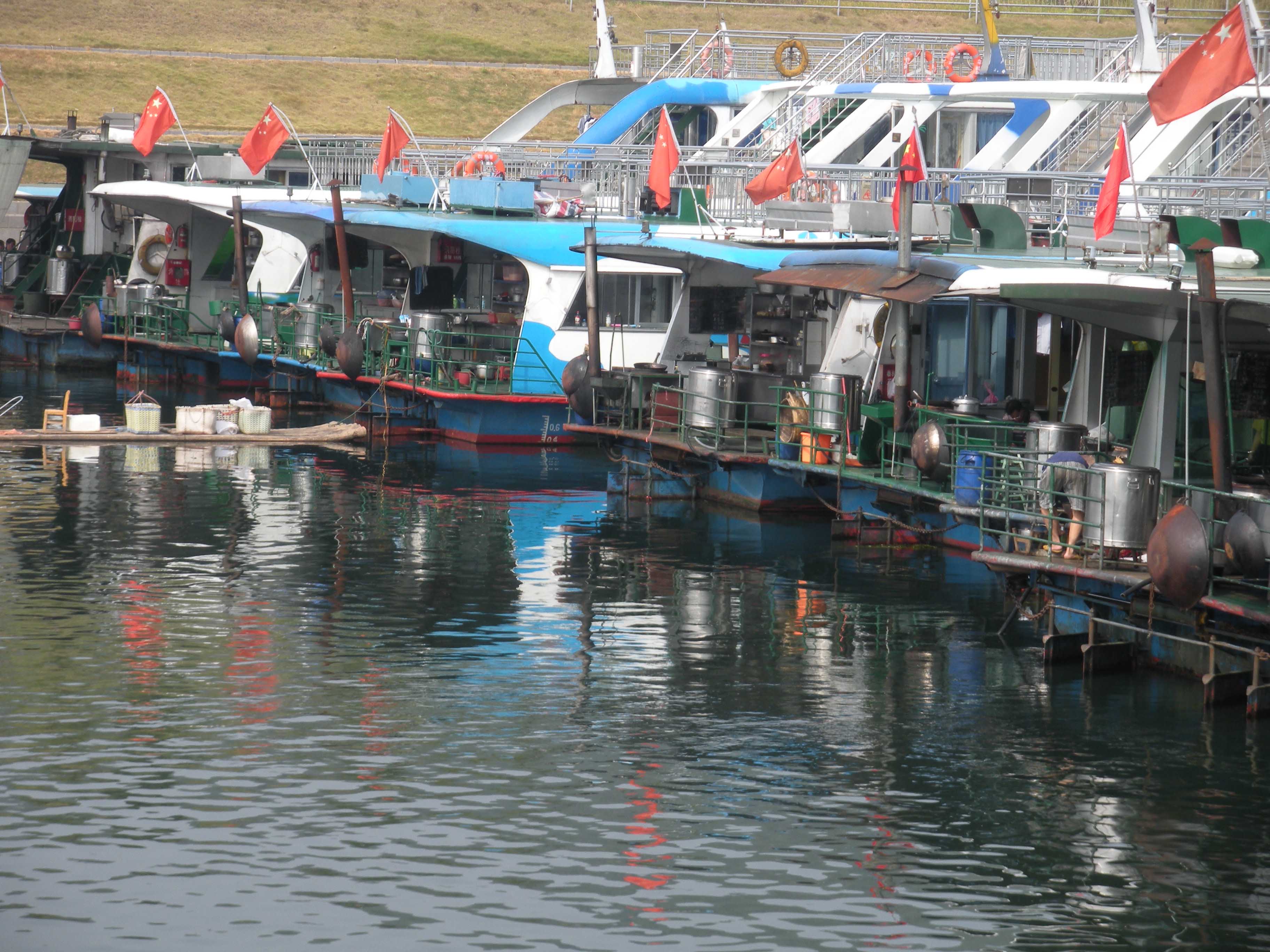
Southeast China near Vietnam and Laos is a beautiful area to visit.  The air is clean. The sky blue. One morning, we left the hotel early to join a river cruise along the Li River. Click on the photos for a larger view.

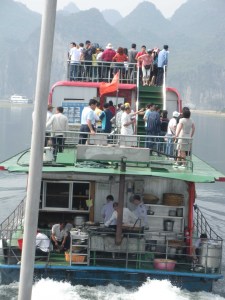
Soon after leaving the dock, I snapped this shot of the boat in front of ours. While the tourists were on the upper decks, the cooks were preparing lunch.  The dinning room is in the large, first-deck cabin.

Cruising the Li River will carry you past one of the ten places to see in China.

I couldn’t resist taking a picture of water buffalo eating the plants that grow under the water.  They would dip their heads under and come up with a mouthfull of green.

Small boats and villages are scattered along the river.

I wasn’t the only tourist taking pictures.  Most of the tourists were from the Chinese middle class.

If you enjoyed this post, you may enjoy Shanghai Huangpu River Tour

Lloyd Lofthouse is the award-winning author of My Splendid Concubine [3rd edition]. When you love a Chinese woman, you marry her family and culture too. This is the unique love story Sir Robert Hart did not want the world to discover.

#1 - Joanna Daneman review posted June 19 2014

Where to Buy

Subscribe to “iLook China”!
Sign up for an E-mail Subscription at the top of this page, or click on the “Following” tab in the WordPress toolbar at the top of the screen.

About iLook China

China’s Holistic Historical Timeline


China’s Tiger Farms: Part 2/2

May 21, 2013

Tourists may buy live animals for the tigers to kill and eat. Chickens are the best price.

Allowing the tourists to buy live food for the tigers has to do with money – but money is not the key factor.

In artificial breeding, the park feeds the tigers a fixed diet using artificial or processed food. This diet might eventually lead to malnutrition. The most important thing for the tourists is that they are helping feed the cats.

Feeding the tigers live animals is also part of a long-term project with a goal of releasing tigers back into the wild.

There is another park near Changbai Mountain that has about fifteen specially selected tigers.

These tigers still live behind a fence. However sending tigers to the Changbai Mountains allows them to be more experienced with the natural environment.

The Hunchun Nature Reserve was established in 2001 for the protection of wild Siberian tigers and leopards.

Before releasing the tigers into the wild, the big cats must be given the appropriate wild-habitat training. The first step is for the tiger to adapt to the climate changes of the four seasons. Next, the tigers’ hunting ability must be improved.

Since the Changbai Mountains share a border with North Korea, the big cats are allowed to travel between countries. In the past, the border was divided by iron and wire mesh fences, which blocked the tigers. Now the fence is gone.

It is believed that with wild training over time and with the efforts of several generations of scientists, the tigers will finally return to nature.

Return to China’s Tiger Farms: Part 1

_______________

Lloyd Lofthouse is the award-winning author of My Splendid Concubine [3rd edition]. When you love a Chinese woman, you marry her family and culture too. This is the love story Sir Robert Hart did not want the world to discover.

Subscribe to “iLook China”!
Sign up for an E-mail Subscription at the top of this page, or click on the “Following” tab in the WordPress toolbar at the top of the screen.

About iLook China


China’s Tiger Farms: Part 1/2

May 20, 2013

Steven McDonald reports from the Chinese North Korean border. Siberian tigers once roamed this area in the thousands, but as the forest disappeared so did they.

In 2007, it was estimated that 12 wild tigers remained in China’s northeast. This small gene pool has led to genetic deficiencies. The Associated Press reported the tiger could be extinct in a dozen years if left unprotected.

Individual tigers once roamed over a territory of 50 square kilometers or more, but today there isn’t much forest left to support even a few hundred in the wild.

Today, visiting the Siberian tiger park 37 km north of the city of Harbin is recommended unless you are squeamish since live animals are fed to the tigers.

Big Cat News reports that the tiger park sits on almost 400 acres of land and is one of the largest tiger refuges in the world.

A group of Chinese scientists is attempting to save the Siberian tiger and captive breeding has been successful.

The Harbin Tiger Park has more than four hundred. A sister park has about three hundred. In all of China, there are about 2,000 in captivity.

With such a small population, a DNA database is used to avoid losing genetic diversity. Tigers discovered to have flaws are not allowed to mate.


Feeding Time

However, the park has a shortage of money. China’s government provides some funding, but the park relies mostly on tourism and ticket sales. It costs more than four million dollars annually to feed the 700 tigers in the two parks.

Continued on May 21, 2013 in China’s Tiger Farms: Part 2

_______________

Lloyd Lofthouse is the award-winning author of My Splendid Concubine [3rd edition]. When you love a Chinese woman, you marry her family and culture too. This is the love story Sir Robert Hart did not want the world to discover.

Subscribe to “iLook China”!
Sign up for an E-mail Subscription at the top of this page, or click on the “Following” tab in the WordPress toolbar at the top of the screen.

About iLook China