Misconceptions of China – The Chinese Government

August 20, 2010

This three-part series comes from a young Chinese man speaking on YouTube about Western misconceptions of China.

Larry says that one of the greatest misconceptions about China’s government is that people outside China believe it is completely Communist—a machine that gets rid of what it doesn’t like.  Even Larry’s Chinese-American friends feel this way.  That opinion is wrong.

Larry says that China does censor a few things like Facebook, Twitter and YouTube. The reason for that are because of Falun Gong, and Tibetan or Muslim (in Xingjian province) separatists.

Source: ShiWoLarry

Larry says many Westerners believe if you say bad things about the Chinese government, you will be arrested. The only instance where that might be true is if you used a loud speaker in the center of Tiananmen Square.  

Larry then talks about the few human rights violations Westerners hear so much about. The central government reacts the way it does toward the Falun Gong, Tibetan Separatists and the Muslims in Xingjian province because the Communists came to power through rebellion and want to avoid the same thing happening to them.  

After the Qing Dynasty collapsed in 1911, China went through chaos and anarchy for decades—millions suffered and died.  Any rebellion would mean a return to those horrible times and regardless of any negativity one hears or reads about China, there is a lot of good things going on that we don’t hear about in the West.

_______________

Lloyd Lofthouse is the award-winning author of the concubine saga, My Splendid Concubine & Our Hart. When you love a Chinese woman, you marry her family and culture too. 

Sign up for an RSS Feed for iLook China


Big Brother is Watching — Who?

July 13, 2010

There are more than 4 million security cameras in the UK—one for every fourteen people. Many have been installed by businesses but more than a million are cameras controlled by the government and/or police. Source: London Evening Standard

Recently, I read a piece from Voice of America about China Tightens Xinjiang Security, Targets Tibetan Environmentalist.

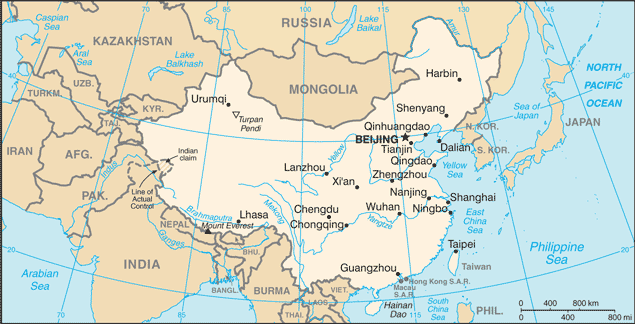
CIA Map of China

The lead paragraph says, “China has installed 40,000 security cameras throughout the capital of Xinjiang region days before the first anniversary of the country’s worst ethnic violence in decades.”

As usual, there is no mention that next-door a war is raging against the Taliban and Al-Qaeda. There is no mention of Pakistan’s struggle with the same enemy that NATO and US forces are fighting.

In fact, if you look at a map of the region, you will see that Urumqi, the capital of Xinjiang province, is close to KyrgyztanKazakhstan, Afghanistan and Pakistan, all areas having trouble with Islamic fundamentalists but in China, the Muslims are a peaceful ethnic group according to the Western media. That’s interesting.

If Britain, a democracy, puts up more than 4 million security cameras to deal with crime and unrest in the UK, why can’t China do the same without being criticized? Did you know that local governments in the US are installing these cameras too? Source: MSNBC

Learn more about Minority China

_________________________

Lloyd Lofthouse is the award-winning author of the concubine saga, My Splendid Concubine & Our Hart. When you love a Chinese woman, you marry her family and culture too. 

Sign up for an RSS Feed for iLook China


China’s Water Woes

June 16, 2010

A man or woman can survive for weeks without food but only days without water. Knowing that, it shouldn’t come as a surprise that Tibet will stay in China for some time and water is the reason.

The Yellow River and Yangtze start in Tibet serving more than a third of China’s population. It’s possible that Mao realized the importance of water from Tibet when he sent 40,000 PRC troops into Tibet to reoccupy the former troublesome province/tributary that at the British Empire’s urging broke from China in 1913.
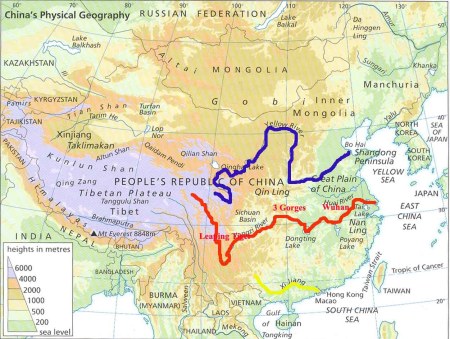
Tibet has an area of about 1.3 million square kilometers (about 5 million square miles) and it is estimated that there are less than 3 million people living in Tibet. China, on the other hand, serves 1.3 billion people, so who benefits the most from water that starts its journey in Tibet?

Rajendra K. Pachauri, chairman of the Intergovernmental Panel on Climate Change and winner of the 2007 Nobel Peace Prize, said, “At least 500 million people in Asia and 250 million people in China are at risk from declining glacial flows on the Tibetan Plateau.” Source: Circle of Blue Waternews

If Tibet’s water were in the hands of anyone else like a free Tibet that might favor other nations over China, China’s future would be dim at best and dire in a worst-case scenario. As it is, China is one of the earth’s driest areas and the challenge to supply 1.3 billion people with water is a daunting task. In fact, China is in a race with disaster and the finish line will be reached in a few decades.

In 1999, Wen Jiabao, a deputy prime minister, warned of looming water shortages. When he became prime minister, he promised to provide clean water for the people. Today, water and waste pollution is the single most serious issue facing China.

However, China has a large and cumbersome bureaucracy.  Different ministries compete with each other meaning little cooperation, which has led to a growing crisis that must be dealt with for China to avoid the suffering, chaos and anarchy that plagued the nation between 1835 and 1950. See China, The Roots of Madness

While replacing thousands of older, coal-burning power plants with cleaner technologies, building more hydroelectric dams, and constructing nuclear reactors, China is also adding desalinations plants to ease the growing water crises. In 2005, a desalination facility south of Shanghai started producing about 375,000 gallons of fresh water an hour, with a goal to build more plants and produce 250 million gallons of water per day by 2010. Source: Environmental News Network

In fact, to achieve this, China contracted with IDE Technologies in Kadima, Israel to build four new desalination units and the first will go on line near Beijing in 2010. These plants are designed to provide desalinated seawater for a power plant’s steam boilers as well as drinking water for local residents. Source: Water and Wastewater.com

According the Global Water Intelligence and the International Desalination Association, as of June 30, 2008, China was ranked 7th among the top ten desalination countries on the planet and that was before the IDE contract. Source: Water Webster

It doesn’t help China’s growing water shortage when mineral resources and a majority of its arable land exist where water is scarcest. Pollution and dealing with human waste are other challenges. Source: Mongabay.com

______________

Lloyd Lofthouse is the award-winning author of the concubine saga, My Splendid Concubine & Our Hart. When you love a Chinese woman, you marry her family and culture too. 

If you want to subscribe to iLook China, there is a “Subscribe” button at the top of the screen in the menu bar.


Politically Correct Outside Tibet but Historically Wrong

May 31, 2010

In the “Contra Costa Times” this morning, I read Tibetan leaders seek East Bay help by Doug  Oakley, a politically correct news piece that’s partially accurate because Oakley only shares part of the history between China and Tibet—the part that favors Tibet’s so-called government in exile, which represents about 1% of all Tibetans—the rest still live in China.

Oakley writes that, “Tibet was invaded by the Chinese army in 1950. After the Tibetan army was defeated, both sides signed a 17-point agreement in 1951 recognizing China’s sovereignty over Tibet.” These facts are correct, but they do not tell the whole story.

Tibet, China

Any historian who checks primary sources that exist outside of Communist China will discover that Tibet was ruled by three Chinese dynasties: The Yuan, Ming and Qing Dynasties from 1277 – 1911.  Even after Sun Yat-Sen’s so-called Republic replaced the Qing Dynasty in 1911, Tibet was considered part of China.

Primary sources like the October 1912 issue of The National Geographic Magazine and more than fifty letters written by Sir Robert Hart during the 19th century support the fact that Tibet was part of China for more than six centuries prior to 1913 when the British Empire convinced Tibet to break free for political reasons.

The so-called Tibetan government in exile says they are seeking autonomy within China. In fact, China does offer a form of autonomy to the 56 minorities that live in China, but this isn’t the level of autonomy that the Dalai Lama demands, which is a return to the old Tibetan ways described in that 1912 issue of National Geographic, which is unacceptable to China.

Discover more about today’s Tibet by reading Chinese Gold from Dead Tibetan Caterpillars, Buddhism in China, The Tea Horse Road, Water – Two Countries Tell a Tale and About Tibet.

_____________________

Lloyd Lofthouse is the author of the award winning novels My Splendid Concubine and Our Hart. He also Blogs at The Soulful Veteran and Crazy Normal.

Sign up for an RSS Feed for iLook China


Gold from Dead Tibetan Caterpillars

May 26, 2010

In the May 2010 National Geographic, Mark Jenkins writes about Tibetan cowboys and Chinese-made motorcycles in his Tea Horse Road piece unwittingly revealing more about Tibetan life under Chinese rule.

The Tibetan cowboys, who once used horses, now use motorcycles to tend their flocks. On the way to 17,756-foot Nubgang Pass, Jenkins passes the black yak-hair tents of Tibetan nomads, and sees big Chinese trucks or Land Cruisers parked outside. He wonders how poor Tibetans can afford such luxuries. Aren’t they supposed to be suffering?

I think, “Maybe they are smuggling drugs into China from India”.  As I read on, I learn I’m wrong.

Photo by Tom Carter, author of China: Portrait of a People

On his way back from the pass, Jenkins discovers these Tibetan cowboys have found wealth in their high grasslands from parasite infected caterpillars called “Yartsa Gompo” in Tibet and “Chong Cao” in China.  These dead caterpillars sell to Chinese medicine shops throughout Asia for as much as 80 dollars a gram—more than the price for a gram of gold.

Why? The Chinese and Tibetans believe these dead caterpillars are a cure-all medicine that also acts as an aphrodisiac.

Discover more about Tibet on The Tea Horse Road

______________

Lloyd Lofthouse is the award-winning author of the concubine saga, My Splendid Concubine & Our Hart. When you love a Chinese woman, you marry her family and culture too. 

If you want to subscribe to iLook China, there is a “Subscribe” button at the top of the screen in the menu bar.