Yes, China is a Republic

February 27, 2019

The first thing we should know is what a republic is, and the oldest known republic is the Netherlands (July 26, 1581).

The Urban Dictionary says a republic is “A system of government ran by elected officials. Not a rare system of government at all. Republic by definition does not imply a concern for human rights or an inclusive democratic system. It just means that a governing body (aristocracy, military, general population, etc.) elected a head of state.”

The Oxford English Dictionary that was first published in 1857 is considered by many the last word on words for over a century. The Oxford says a republic is, “A country that is governed by a president and politicians elected by the people and where there is no king or queen.”

By definition, that makes China a republic. China has its own Constitution, and there are more than 80-million members in the Chinese Communist Party (CCP) that vote for the country’s elected national leaders, and that includes China’s president. At the village level hundreds of millions of rural Chinese elect their village leaders, and the villagers do not have to be members of the CCP to vote.

China is not the only republic in East Asia.

South Korea started out as an autocratic state with limited political freedom (fancy words for a dictatorship) from 1948 to 1987. There was a military coup in 1961 and General Park ruled until he was assassinated in 1979.

In 1980, martial law was declared in South Korea after the army killed 200 during student demonstrations. Recently, South Korea’s constitutional court upheld a controversial military ban (censorship) on twenty-three books considered subversive. Source: Time

It wouldn’t be until 1986 that South Korea’s constitution was changed and in December 1987, Roh won the first direct presidential election since 1971. The first free parliamentary elections took place in 1988.

Another Asian Republic is Thailand. A Blog about Political Prisoners in Thailand claims that there is no freedom of speech. They claim what you feel or think can get you thrown in jail.

Thailand also passed a Computer Crimes act in 2007. The language in one section sounds similar to language in China’s Constitution that U.S. critics of China often complain about.

In May 2010, Reuters reported that Bangkok was being cleaned up after the worst riots in modern history. “At least 54 people were killed and more than 400 injured in the latest bout of violence which began on May 14. Almost 40 buildings in the city were set on fire and the tourism and retail sectors have been devastated.”

The 1997 Thai Constitution increased legal protections for women and persons with disabilities, but some inequities in the law remained and some protections were not enforced. Violence and societal discrimination against women are still problems. Societal discrimination against hill tribes and religious and ethnic minorities continues. There have been reports of forced labor and child labor. Trafficking in women and children, coerced prostitution and labor are still serious problems. ­­– U.S. Department of State

Then there is Singapore that is also a republic by definition. In fact, Singapore is considered a model republic respected around the world.

However, Human Rights Watch reports, “Singapore remains the textbook example of a politically repressive state,” said Phil Robertson, deputy Asia director at Human Rights Watch. “Individuals who want to criticize or challenge the ruling party’s hold on power can expect to face a life of harassment, lawsuits, and even prison.”

Then there is the United States, a Constitutional Republic where people elect officials that are responsible to run the government according to the U.S. Constitution, a document that was designed by its original authors to be changed through an amendment process.

When the United States became a country on July 4, 1776, there were no political parties and the U.S. Constitution only allowed white men that owned poverty (about 10-percent of the free population in 1776) and were not Jewish to vote for the elected officials that ran a country that had a population of about 2.5 million people (about a half million were slaves). Over time, the U.S. evolved into a multi-party republic that now has almost 330-million people without any legal slaves.  Today, women and minorities are allowed to vote for the elected officials that run the country and its states.  But back in 1776, about two hundred thousand men could vote. The other 2.3 million could not vote and that included the half million slaves.

Fast forward to today: Southeast Asian Refugees Are the Latest Victims of Trump’s Deportation Crackdown. These refugees have been in the United States since the end of the Vietnam War (1955 – 1975), because they fled to survive when the United States pulled its military out of Southeast Asia and left these people stranded after almost twenty years of warfare. If they had stayed, many if not all of these refugees risked execution or prison, because they were Christians and/or supported the United States during the Vietnam War.

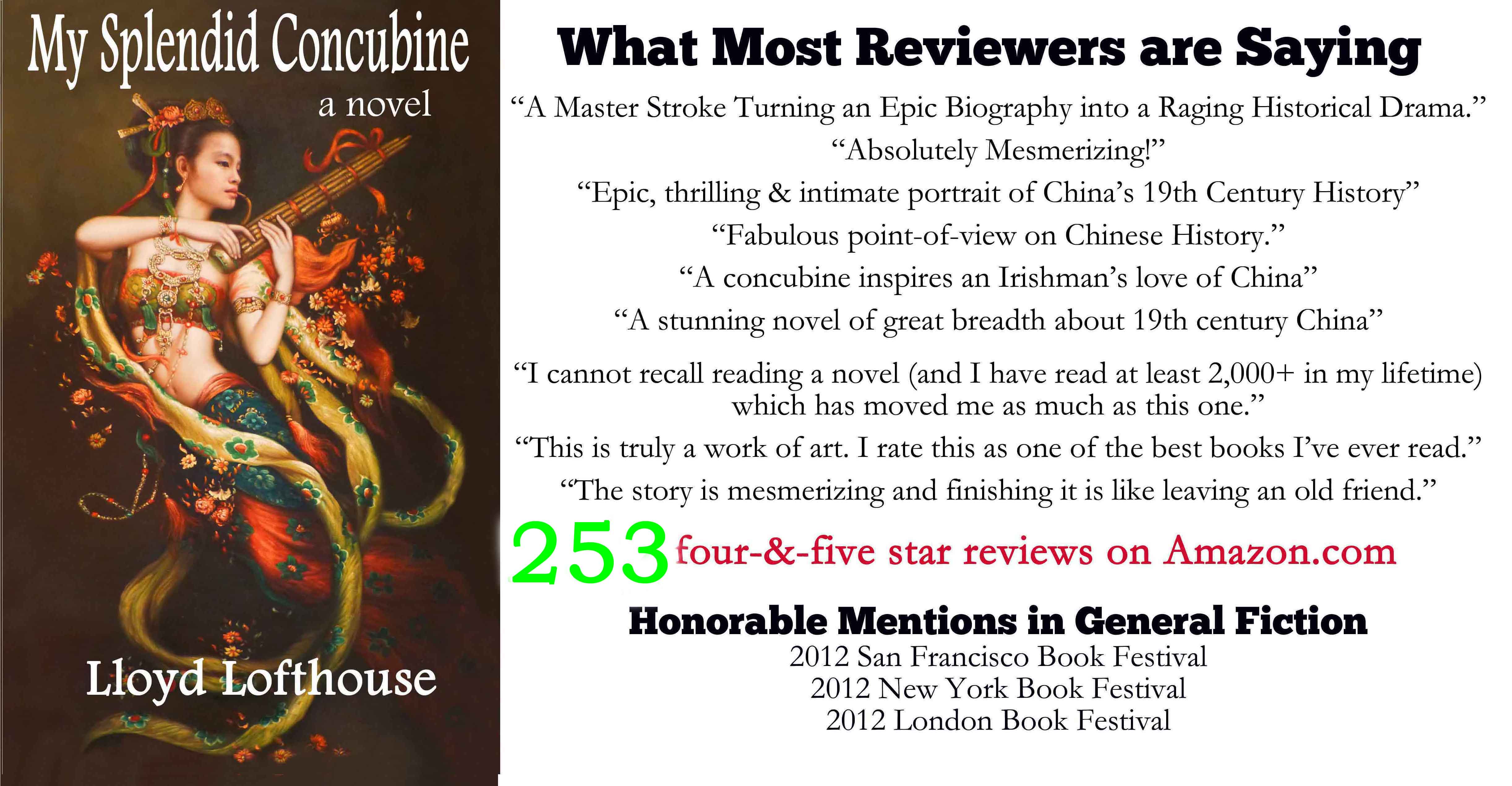
Lloyd Lofthouse is the award-winning author of My Splendid Concubine, Crazy is Normal, Running with the Enemy, and The Redemption of Don Juan Casanova.
Where to Buy

Subscribe to my newsletter to hear about new releases and get a free copy of my award-winning, historical fiction short story “A Night at the Well of Purity”.

About iLook China


Power Corrupts and Great Wealth buys that Power

February 20, 2019

In the United States, autocratic billionaires are destroying the country. For instance, since 1973, the Koch brothers have systematically and deliberately built a machine to subvert America’s Constitutional Republic. Charles and David Koch are not alone. They have at least 2,000 other wealthy allies that belong to an organization the Kochs launched in 1973. It is called ALEC, The American Legislative Exchange Council, a non-profit, private sector organization with one goal, to subvert the U.S. Constitution and strip the federal and state governments of their power.

But in China, the Chinese Communist Party is attempting to limit the power of that country’s billionaires. For instance, in 2013, The Atlantic asked, Why Do Chinese Billionaires Keep Ending Up in Prison?  The subtitle says, “In China, the rich get poorer.”

The Atlantic continues: “In the last fifteen years, China has produced greater overall wealth than any other country. The number of its billionaires has gone from a mere 15 to around 250 in just six years, but for a number of these people this vaulted status is short-lived. According to one study, 17 percent of those on the list end up squealing their way to court or end up in jail. If they’re lucky, those who are caught are investigated and jailed. Some are even executed.” …

“What accounts for the sharp rise and fall of China’s wealthiest? In a business environment in which personal connections and favors — referred to as guanxi in Chinese — predominate, many tycoons have amassed large fortunes without concern of rules and regulations. However, such a fast and loose atmosphere can cut both ways.”

That piece in The Atlantic appeared in 2013. Five years later according to Business Insider (December 27, 2018), China now has 373 billionaires, a 5% increase in billionaires since the previous year (2017) while the US, where billionaires run rampant spreading corruption with their great wealth, and seldom if ever end up in prison, there are 585 with an increase of 4% from the previous year.

Lord Acton, a member of Parliament in the UK (in office 1859 – 1865), wrote, “Power tends to corrupt, and absolute power corrupts absolutely. Great men are almost always bad men, even when they exercise influence and not authority, still more when you super-add the tendency or the certainty of corruption by authority.”

While the United States is drowning in the corruption Lord Acton mentions, China is struggling to contain the abuse of that power.  For instance, the Los Angeles Times ran this piece in 2017: “Some of China’s richest and most powerful men have mysteriously vanished.”

If U.S. citizens Charles and David Koch had been Chinese citizens, they would have probably vanished a long time ago and the world would be better place without them.

Beware, China, great wealth can become a terminal cancer and it will eventually eat you too no matter how hard your leaders try to stop it.

Lloyd Lofthouse is the award-winning author of My Splendid Concubine, Crazy is Normal, Running with the Enemy, and The Redemption of Don Juan Casanova.

Where to Buy

Subscribe to my newsletter to hear about new releases and get a free copy of my award-winning, historical fiction short story “A Night at the Well of Purity”.

About iLook China


Who Will Survive the Next Big Global Economic Crises

February 13, 2019

When the next global economic crises hits — not if, but when — how will China deal with it compared to the United States?

First, as of October 2018, the U.S. government owes China $1.138 trillion dollars.  That’s 29 percent of the $3.9 trillion in Treasury bills, notes, and bonds held by foreign countries. The rest of the $21 trillion U.S. national debt is owned by either the American people or by the U.S. government itself. That is equivalent to about 47.6% of GDP.

On the other hand, the national debt of the People’s Republic of China is the total amount of money owed by the government and all state organizations and government branches of China. As of October 2018, it stands at approximately CN¥ 36 trillion (US$ 5.2 trillion),

In 2007, the United States federal government was only $9-trillion in debt. Today, it is $22.7 trillion in debt and with Trump cutting taxes and spending more; it is going to grow much bigger. The United States recorded a government debt equivalent to 105.40-percent of the country’s Gross Domestic Product in 2017, and there is no end in sight.

After 2008, almost nine-million Americans lost their jobs, and there were more than 3.1 million foreclosure filings issued during 2008, and that was just for that one year. That can’t happen in rural China and most of China’s factory workers have homes in rural China. When a job is lost in an urban city, the government gave the unemployed workers a free train ticket to go home to the countryside where the family home was not at risk of being taken away since there was no mortgage or property tax to worry about.

What happened in China after 2008 reveals how the Chinese will survive the next global financial disaster.

“The lack in demand from abroad meant factory closures, resulting in high job losses all over China. Guangzhou, a major manufacturing town, lost tens of thousands of workers in 2008, forcing citizens to return to their home in the countryside.”  Along with being forced to go home, most if not all of those Chinese citizens were allowed to retire early and collect Social Security. Younger workers were put to work in state owned factories and sent to work on infrastructure projects.

HROne says, “China’s Social Security System consists of 5 mandatory insurance schemes (pension fund, medical insurance, industrial injury insurance, unemployment insurance and maternity insurance) + a housing fund (only applicable to Chinese employees).” … “An individual can receive a pension based on the amount accumulated in his/her individual fund after retirement.”

“In general, individuals need to pay at least 15-years of contributions prior to receiving a pension in China. Some industries have different retirement ages, but mainly men are 55 years old, women are 50 years old (blue-collar work), men are 60 years old, and women are 55 years old (white-collar work). The amount of retirement benefits depends on local regulations. Due to China’s population problems, these ages may soon change.”

The difference between the United States is China incorporates the characteristics of socialism, capitalism, and communism. China is not a pure communist or socialist or capitalist state. It is a hybrid and the CCP holds the reins of power.

As a socialist-capitalism country, all of China’s land is owned by the government. In urban China, the government leases homes and businesses but doesn’t sell the land. In most of if not all of rural China there is no mortgage or property tax, so losing your urban job and returning to your rural village home in the countryside doesn’t mean you are going to lose your home and become homeless. China also launched a $586 billion stimulus package designed to encourage more consumer spending and build new infrastructure putting people to work.

The United States is one of the most capitalistic countries in the world. Capitalism is an ideology where the means of production is controlled by private business. This means that wealthy, powerful individual citizens run the economy without government interfering in production or pricing.

What did the United States do in 2008?  President G. W. Bush, not President Obama, signed TARP’s 700-billion dollar bailout program. The initial purpose was to save the banks … not the people. The TARP program quickly turned around the banking industry but the U.S. didn’t do what China did to generate consumer spending and create infrastructure jobs. Yet infrastructure in the US is in horrible shape from its electric grid, its highway system, to its railroad network and bridges. G. W. Bush never intended the banks to pay the government back. When Obama became president, he changed that and most of that public money was paid back to the government.

While China used its government bailout money to help its people, the United States did nothing for its working-consumer class and more than a decade later many Americans are still struggling to survive financially.  When the next global economic crises hits, no one knows what will happen in the United States, because that depends on who is president at the time and what political party controls one or both Houses of Congress

For instance, instead of improving the social safety net in the United States, MarketWatch.com reports, “Why the latest warnings about cuts to Social Security and Medicare are a reason to worry.”

Here’s how bad: “Unless something’s done to shore up Social Security, monthly checks could get cut 23% by 2034.”

I think it’s a safe bet that China’s government will do something similar to what it did in and after 2008.

The United States will probably also do the same thing it did last time: bail out the banks and big corporations while continuing to keep cutting taxes for the wealthiest one-percent of Americans. As for the social safety net that’s supposed to be there for most U.S. citizens, who knows how it will weather another economic crises since it is already at risk.

Lloyd Lofthouse is the award-winning author of My Splendid Concubine, Crazy is Normal, Running with the Enemy, and The Redemption of Don Juan Casanova.

Where to Buy

Subscribe to my newsletter to hear about new releases and get a free copy of my award-winning, historical fiction short story “A Night at the Well of Purity”.

About iLook China


Cradle to Grave – The Surveillance State: China vs the United States

February 6, 2019

It’s no secret that China monitors its citizens, internet activity, and battles pornography, and China is working to improve those methods to make them more effective and efficient.

But when it comes to the United States, what seems to be ignored is the fact that America is also a surveillance state.  The difference is in who is behind that surveillance. In China, it is the government. In the United States it is mostly private sector corporations that are owned and controlled by the 0.1-percent wealthiest citizens, or, to be more precise, the real Deep State that goes to extremes to manipulate the other 99.9 percent of US citizens to do what the autocratic billionaires in charge want them to think and do.

In China, there is no Deep State because the Chinese Communist Party with more than 80-million Party members spread across the country in every city and province rules the country as a team with a primary goal to hold on to power and increase the quality of every citizen’s lifestyle while insuring harmony.

Understanding what that harmony means to most Chinese helps explain one of the reasons for China’s surveillance state, but what is the reason behind America’s corporate surveillance state that monitors our lives and gathers data on every citizen that will follow us from cradle to grave?

In China, the state owned media is self-censored to the point that sometimes China’s president or a member of the Politburo, decisions are made through consensus, makes a phone call and requests that Xinhua covers an issue in more depth that has been ignored. In China, there is one unified message reported to the people and it is no secret that the people know the news is censored and can be misleading.


The U.S. is the only Western Country that doesn’t have a law that allows its citizens to know what information corporations have collected on them.

However, in the United States, the media is in bedlam and disarray. President Donald Trump repeatedly calls media reports he doesn’t like or disagrees with as “Fake News” while the media he supports and watches (since Trump has said more than once that he is proud he doesn’t read books), like Fox News, is spreading misinformation and lies to support a political agenda from one political and/or religious sect.

The reason behind China’s surveillance state is different. In China, the surveillance state keeps watch so it is almost impossible for an individual or group to sabotage the Party’s plans to continue to modernize China and improve the lifestyles of its citizens — even if the Chinese do not have the freedom to speak out on political issues and attempt to shake up the establishment.


In the United States people are products when it comes to information gathered without their knowledge and permission.

In the United States the media is in chaos, and that chaos is spreading throughout the country.

But China has already lived through more than a century of chaos until Deng Xiaoping ended the last element of that suffering, the  insanity of Mao’s Cultural Revolution. I think it is safe to say that the majority of Chinese citizens will support a surveillance state that focuses on promoting peace and harmony instead of insanity and chaos.

This blog post wouldn’t be balanced without mentioning that Actually, Most Countries Are Increasingly Spying on Their Citizens, the UN Says. “Today’s news shows that massive surveillance can no longer be said to be the realm of authoritarian regimes, and is part of an alarming trend worldwide,” reported Privacy International, a group that supports limits on surveillance.

Lloyd Lofthouse is the award-winning author of My Splendid Concubine, Crazy is Normal, Running with the Enemy, and The Redemption of Don Juan Casanova.

Where to Buy

Subscribe to my newsletter to hear about new releases and get a free copy of my award-winning, historical fiction short story “A Night at the Well of Purity”.

About iLook China


In 1823, the United States Decided the Outcome of China’s claims in the South China Sea

January 9, 2019

China’s claims and actions in the South China Sea look similar to what the U.S has done with the Monroe Doctrine since 1823.

History.com teaches us that “on December 2, 1823, President James Monroe used his annual message to Congress for a bold assertion: ‘The American continents … are henceforth not to be considered as subjects for future colonization by any European powers.’

Ducksters.com spells out the Effects of the Monroe Doctrine:

The Monroe Doctrine had a long lasting impact on the foreign policy of the United States. Several U.S. presidents have invoked the Monroe Doctrine when intervening in foreign affairs in the Western Hemisphere. Here are some examples of the Monroe Doctrine in action.

1865 – The U.S. government helped to overthrow Mexican Emperor Maximilian I, who was put in power by the French. He was replaced by President Benito Juarez.

1904 – President Theodore Roosevelt added the “Roosevelt Corollary” to the Monroe Doctrine. He used the doctrine to stop what he called “wrongdoing” in several countries. It was the beginning of the U.S. acting as an international police force in the Americas.

1962 – President John F. Kennedy invoked the Monroe Doctrine during the Cuban Missile Crisis. The U.S. placed a naval quarantine around Cuba to prevent the Soviet Union from installing ballistic missiles on the island.

1982 – President Reagan invoked the Monroe Doctrine to fight communism in the Americas including countries such as Nicaragua and El Salvador.

And, according to international law, the jurisdiction of a country only extends no more than 3 nautical miles into the ocean.

However, on “March 10, 1983, President Ronald Reagan signed a Presidential Proclamation (5030) which set up the U.S. Exclusive Economic Zone (EEZ). The EEZ consists of those areas adjoining the territorial sea of the United States, the Commonwealth of Puerto Rico, the Commonwealth of Northern Mariana Islands, and U.S. overseas territories and possessions. The EEZ extends up to 200 nautical miles (370 km) from the coastline.”  – Bureau of Ocean Energy Management

With America’s Monroe Doctrine and Reagan’s Presidential Proclamation used as a precedent, it appears that China is doing the same thing in East Asia.

In April of 2018, China’s proposed a new boundary in the South China Sea. The South China Morning Post reported, “The new boundary will help to define more clearly China’s claims in the contested region, but it is not clear whether or when it will be officially adopted by Beijing, the scientist said.”

However, China’s claims over East Asia and its seas stretches as far back as the Western Han Dynasty (221 BC) up to the end of the Qing Dynasty in 1912 with China’s long history with tributary states.

Historically, a tributary state is a term for a pre-modern state in a particular type of subordinate relationship to a more powerful state which involved the sending of a regular token of submission, or tribute, to the superior power. This token often took the form of a substantial transfer of wealth, such as the delivery of gold, produce, or slaves, so that tribute might best be seen as the payment of protection money.

What China is doing today in the South China Sea is similar to what it was doing more than two-thousand years ago, and  what the United States has done since 1823’s  Monroe Doctrine and Reagan’s 1983 Presidential Proclamation (5030).  If the United States can do it and get away with it for almost two hundred years, why can’t China do something similar in East Asia?

To make it official, maybe China might consider copying U.S. President James Monroe, but call it the Xi Jinping Doctrine. That will make it official and Xi will join Monroe and Reagan in the history books.

Lloyd Lofthouse is the award-winning author of My Splendid Concubine, Crazy is Normal, Running with the Enemy, and The Redemption of Don Juan Casanova.

Where to Buy

Subscribe to my newsletter to hear about new releases and get a free copy of my award-winning, historical fiction short story “A Night at the Well of Purity”.

About iLook China