The list of Chinese democracy activists that have been arrested is not long considering there are more than 1.3 billion people in China. Wiki lists 30.
I studied the list of Chinese dissidents and saw that none was executed although there were several alleged to have committed treason and revealing state secrets: Bao Tong (1989), Shi Tao (2004), Wang Bingzhang (2002), and Wei Jingsheng (1979).
Unless I missed something, no dissidents was in jail at this time and a few had been kicked out of the country. Wei Jingsheng, an electrician accused of passing military secrets, was deported to the US in 1997 after spending some time in prison.
If found guilty of these crimes in the United States, the result may have led to a death sentence or life in prison. When I checked the list of people convicted of treason in the US, I saw that 10 have been executed. The United Kingdom had a longer list of executions for treason, while China’s list has only three names on it, which were Zhou Fohyai (executed 1948), Chen Gongbo (executed 1946), and Wang Jingwei (executed 1944).
However, when it comes to environmental activists, such as members of Greenpeace being detained in China, the list is short, while in the West the list of environmental activists being arrested is long.
In 2007, six Greenpeace protesters were arrested for breaking into the Kingsnorth power station in southeast England.
June 2008, two Greenpeace activists were arrested in Japan for exposing a whale meat scandal involving the government sponsored whaling program.
May 2010, seven Greenpeace activists were arrested in Port Fourchon, Louisiana in an anti-drilling protest.
In May 2011, six Greenpeace campaigners were arrested in Durban, South Africa.
June 2011, eighteen Greenpeace activists were arrested after climbing aboard an oil rig off Greenland’s coast to protest deepwater drilling in the Arctic.
August 2011, Daryl Hannah and 70 other environmental activists arrested at a Tar Sands Pipeline protest outside the White House in Washington D.C.
In November 2011, three Greenpeace activists were arrested in South Africa over coal power plant protests.
However, in China in 2006, Greenpeace East Asia was the only NGO to be consulted on an early draft of a renewable energy law by China’s National People’s Congress. In fact, before Greenpeace opened offices in Guangzhou and Beijing in 2002, activists from the Hong Kong office ran several campaigns on the Chinese Mainland and have even been interviewed on CCTV.
In addition, Greenpeace activists have recently gone undercover in China to catch industrial polluters, and it appears that this operation may have had the blessing and support of the CCP’s Central Committee.
Lloyd Lofthouse is the award-winning author of The Concubine Saga. When you love a Chinese woman, you marry her family and culture too. This is the love story Sir Robert Hart did not want the world to discover.
Subscribe to “iLook China” Sign up for an E-mail Subscription at the top of this page.
Note from Blog host — another example of East meets West through business and trade: Higher education is a business, and the number of international students at U.S. colleges and universities reached 723,277 during the 2010-11 academic year. China, the top country of origin for international students, sent 157,558 undergraduate and graduate students to America, up 23% from the previous year.
International students and their dependents contributed more than $20 billion to the U.S. economy that academic year. For Chinese students, that means about $4.4 billion came from China.
Ann Stock, assistant secretary of the US State Department says, “Young people who study abroad gain the global skills necessary to create solutions to 21st-century challenges. In turn, international students globalize our campuses and communities.” SOURCE: USA Today
_____________________
Guest Post by Bob Grant — publisher/editor for Speak Without Interruption, an international online magazine.
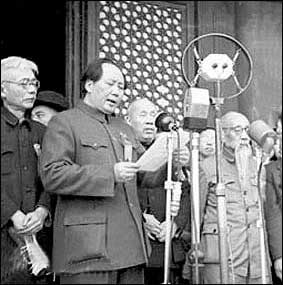
On October 1, 1949 the People’s Republic of China was formally established in a speech given by Mao Zedong from the Imperial Gate at Tiananmen Square. I stood at the very spot where Mao gave his speech and took a photo. From speaking with people – in China – who lived through his reign it was beyond believable. What he put his people through is an unforgivable act of power and brutality.
However, it is images from Mao’s era that some – outside of China – still have of the Chinese people. Nothing could be farther from the truth!
I never met a Chinese government official – did not even see one at least that I can recall. What I did meet were the people of China – the people with whom I had my business and personal interactions. I did not ask them questions about their government nor did they ask questions of mine.
The only political statement that I ever heard was a reference that China’s policy would probably change when the younger generation came into power, someday.
In meetings, over two years ago, I heard about the oil pipeline being built directly from Iran to China. None of the people in that meeting expressed an opinion one way or the other regarding this pipeline. It was a decision the Chinese government made.
Maybe my associates did not approve of dealing with Iran—maybe they did? The point being here is their government made this decision—not my associates.
Whether the officials in power in the US are republican or democrat, they have all made decisions of which I don’t agree. They did not consult me or ask my opinion—am I my government in these situations?
The point I am trying to make is that I found the Chinese people I met just like me in a lot of respects. I enjoyed doing business with them – learning their culture – and becoming their friend. No government – or its actions – is ever going to change that for me!
Note from Blog host – If you plan to do business in China, I recommend visiting the China Law Blog first.
Lloyd Lofthouse is the award-winning author of The Concubine Saga. When you love a Chinese woman, you marry her family and culture too. This is the love story Sir Robert Hart did not want the world to discover.
Subscribe to “iLook China” Sign up for an E-mail Subscription at the top of this page.
I find it difficult to believe that a disabled American vet calling himself Chicomaniac would be posting comments from a remote location in China’s poorest province. However, that’s where two comments from this second cyber-bully assault (in recent months) may have come from.
I deleted the two comments from the posts they were intended for and added them to the appropriate location on this Blog – where the first cyber-bully attack is posted.
In fact, if you compare Chicomaniac’s two comments with those from the first cyber-bully assault, you may recognize similarities in the writing style and use of language, which is why I have posted them as a comment on the same page under the heading of Another Cyber Bully. If you visit this page, you may scroll up to see the comments from the first assault. This second cyber bully may be a copy cat.
Bully Online says, “The stalker exhibits a familiar pattern of behaviour. Stalking often starts as a result of rejection; rejection rage and abandonment rage motivate the stalker to seek revenge through a predictable pattern of stalking behavior. The stalker, usually a loner and socially inept, becomes obsessed with their target and bombards them with messages, emails, gifts, or abuse. The stalking behaviour can last for years and the intensity of abuse increases over time. The abuse, initially consisting of psychological violence, often escalates and culminates in physical violence…
“The Vengeful stalker is the most dangerous type whose mission is to get even and/or take revenge. Mostly male, he has a grudge and he’s going to do something about it…”
Chicomaniac said, “As a disabled vet I would like to add that the wrong guys made it out of ‘Nam and I hope when your time comes those who believe in America and what We stand for are allowed to have a chat with you.”
In an attempt to identify this cyber bully, I conducted several IP searches and traced the location to where those comments may have originated, and it turned out to be an organization that calls itself Xin Xin Ling located in northwest China.
The coordinates for the IP address were at Latitude 35 and Longitude 105 located near Lanzhou between Dingxi and Tianshui in the Ningxi Hui Autonomous Region northwest of Xian in a desolate region.
“This sparsely settled mostly desert region lies in the vast plain of the Yellow River in the north, which has been irrigated for centuries. Over the years, an extensive system of canals was built. Extensive land reclamation and irrigation projects have made increased cultivation possible.” Source: Wiki-Ningxia
Chicomaniac’s IP address was 118.194.218.153. The host, Yin Yin Ling, also used the same IP address, and I used My IP Test.com to trace the location.
To learn more about the people that live in the region, I did a bit of research and learned that the Ningxia Hui Autonomous Region covers an area of 51,800 square kilometers.
Ningxia Hui Autonomous Region is the unique provincial Hui autonomous region in China, and it had a population of 6.1265 million in 2007, among which, about 1.5 million were from the Hui, Muslim ethnic group — therefore, Ningxia Hui Autonomous Region is often called the “Province of Islam” and “Province of Muslims” by foreign travelers.
I learned that among the Hui, local activists have not called for complete separatism or absolute independence, but generally express concern over environmental degradation, which may explain the motivation behind the comment that mentioned Bosshard.
In addition, I traced Bosshard’s IP address [207.204.249.151] to California at an address off Oscedia Lane, Whitfield Ct., and George Ct. near Adam Roger’s Park in San Francisco at Latitude 37.7312 and Longitude -122.2836. Bosshard’s host is Reliable Hosting.com. Bosshard may be a conservative, evangelical Christian that spent some time in China.
This is what I discovered about Chicomaniac. He or she may live in the Ningxia Hui Autonomous Region in China and might be a Muslim. There may be a connection to one of the Islamic separatist movements in China and/or with a group that is concerned about environmental pollution.
I doubt if Chicomaniac is a disabled American veteran that fought in Vietnam, Iraq or Afghanistan. However, maybe he or she is a disabled Chinese veteran that fought in Korea, Vietnam, India, Tibet or against Uyghur separatists in Xianjiang.
The reason I say this is that a disabled American veteran would have his or her medical care through the United States Department of Veterans Affairs (VA) as I do, which is only available in the US and its territories but not in China. The VA provides patient care and federal benefits to veterans and their dependents.
Chicomaniac also said, “ps Archie Bunker inc. just like they told you on the chinadaily forums, shorten your prolonged missives they do nothing but put us to sleep.”
I recall that the only person that said this was the first cyber bully , and he wrote it on this Blog.
I’ve never left a comment on the China Daily Forums. In fact, I cannot recall leaving any comments on any Blog forums in China. In addition, Archie Bunker was a character in a TV sitcom that went on the air in 1971 and went off the air in 1983.
Archie was a complex character. Along with his overt bigotry and ignorance – he had a paranoid fear of Black Power; Communists, and the Mafia. He was also portrayed as hardworking, a loving father and husband — basically decent and, rather than being motivated by genuine malice (as cyber bullies are), was merely a product of the era and working-class environment in which he had been raised.
Most Americans at least 35 or older should have known these facts.
I suspect that Chicomaniac was born after Archie Bunker went off the air and/or may never have seen the show. He may also be disappointed that Bosshard’s comment appeared in the previous series of posts several times, which focused on global environmental soil and water pollution instead of specifically on China.
If you decide to compare the two cyber bullies, you may find them at Another Cyber Bully.
I wonder what members of Al-Qaeda say about the United States on Internet forums. I doubt that there is much of a difference between them and this Chicomaniac. After all, Al-Qaeda’s goals are to destroy anyone that does not agree with them using any means possible.
______________
Lloyd Lofthouse is the award-winning author of The Concubine Saga. When you love a Chinese woman, you marry her family and culture too. This is the love story Sir Robert Hart did not want the world to discover.
Subscribe to “iLook China” Sign up for an E-mail Subscription at the top of this page.
Starting with the I Ching, The Book of Changes, almost five thousand years ago, the central focus of Chinese philosophy was how to live an ideal life and how best to organize society.
When the Chinese Communist Party gained power in 1949, previous schools of Chinese philosophy, except Legalism, were denounced as backward and purged during the Great Leap Forward and the Cultural Revolution.
However, the influence of China’s five-thousand year old culture did not vanish as China’s Central Committee continues to plan and modernize while leading China into the future.
Most Chinese believe that true advancement and growth should only happen slowly, at a steady, measured pace, which means to grow but grow slow like a tree while following a well thought out plan to bring about changes.
Even the United States doesn’t change quickly.
In fact, it took almost ninety years to free the slaves, and women first sought the right to vote in 1848 at the Seneca Falls Woman’s Rights Convention.
Then seventy-two years later in 1920, American women finally earned the right to vote when the Nineteenth Amendment was adopted by Congress and was ratified by the states becoming a national law.
The last time women had relative freedom in China was in the seventh century during the Tang Dynasty when Emperor Wu Zetian, a woman, ruled the country.
Since 1982, when China ratified its Constitution, women in China have gained more freedom, power and rights than at any time in China’s history including the Tang Dynasty.
Critics in the West might point out that under the Communists, no woman has ruled China, but we could say the same of the United States and many other countries.
Today, Liu Yandong, a senior Party official, serves on China’s Politburo [a group of 24 people that oversees the CCP]. She is from Nantong in Jiangsu Province and graduated from Tsinghua University in 1970 with a degree in chemistry.
In fact, Chinese women today account for 40% of government officials. At least 21.3% of National People’s Congress delegates in 2008 were women (about 636 — the latest available data, according to the All China Women’s Federation).
Another example is Li Bin, acting governor of Anhui Province. In addition, 87.1% of China’s provincial regions have female vice governors. Women are also represented in the leadership of 89.4% of the country’s municipal governments. Source: Global Times
For comparison, in the United States, 79 women (of 435 representatives or 18%) serve in the House and 17 [of 100 or 17%] in the Senate. In addition, six women serve as governors [that’s 12% of the total].
Then, ipu.org’s “Women in national parliaments” ranks China 52 [tied with Italy] of 188 countries. The United States is ranked 71, Thailand 75, South Korea 81, Japan 96 and India 99.
“Chinese women leaders have much in common. They generally all have a good education background, being mainly science majors, and solid experience in government. They are of a caliber equal to that of their male counterparts,” an All-China Women’s Federation expert said.
Why do so many of China’s critics expect China to change faster than the US did?
______________
Lloyd Lofthouse is the award-winning author of The Concubine Saga. When you love a Chinese woman, you marry her family and culture too. This is the love story Sir Robert Hart did not want the world to discover.
Subscribe to “iLook China” Sign up for an E-mail Subscription at the top of this page.
Dramatic changes in women’s rights have been achieved in a culture where for millennia women were stereotyped as inferior to men, had no rights and served as slaves, concubines and prostitutes. Marriages were arranged—sometimes at infancy.
In 1949, foot binding was abolished; the All-China Women’s Federation (ACWF) was formed and supported by China’s Communist Party (CCP). Change in China, as in the United States, has been a painful evolutionary process. However, the struggle for women to gain equality appears to have moved faster in China since the CCP came to power.
After the CCP was established in 1949, it took less than a year to liberate women and pass laws to speed this process along.
For a comparison, after the United States was established in 1776, it took one hundred and forty-four years until August 26, 1920 when the Congress voted in the 19th Amendment to the US Constitution giving women the right to vote.
At the 10th National Women’s Congress in the Great Hall of the People in Beijing, in 2008, Deputy-Chairwoman HuangQingyi said, “Sex discrimination in employment should be eradicated and the income gap between men and women should be further narrowed.”
It was also been reported that domestic violence is a severe threat to women. Chinese authorities reported 50,000 complaints annually, according to figures released by the ACWF. The domestic violence fact sheet shows this is also a problem in the United States.
Role of Women in China Then and Now
Sexual discrimination was supposed to have been abolished in China back in 1949, when Chairman Mao Zedong famously announced, “women hold up half the sky”, but it wasn’t. It has only been a few years since China outlawed sexual harassment. Laws may be written to bring about change but change comes slowly.
Today, statistics show China has about 27,000 women and children’s rights protection agencies. However, China’s critics and enemies will only point out what they believe is wrong without giving credit to what has changed for the good of women in China.
______________
Lloyd Lofthouse is the award-winning author of The Concubine Saga. When you love a Chinese woman, you marry her family and culture too. This is the love story Sir Robert Hart did not want the world to discover.
Subscribe to “iLook China” Sign up for an E-mail Subscription at the top of this page.


 Posted by Lloyd Lofthouse
 iLook China