Tolerance to Infinity Guest Post by Bob Grant

March 13, 2010

Originally published at Speak Without Interruption on February 17, 2010 by Bob Grant — publisher/editor for Speak Without Interruption. Posted on iLook China, 3/13/10 at 08:00

(Note: There are more photos at the original site. The Nanjing Road photo here does not appear at Speak Without Interruption.)

Wherever people normally congregate in groups—shopping areas, elevators, subways, airports, city streets, and the like—there are a lot more people in China congregating in those same places.  Again, I can only use my own experiences – in these types of crowds in China – but I was amazed how tolerant people were of each other.  In some cases I was squeezed to the people next to me so closely that I could almost feel their hearts beating.  In these situations – personal space was at zero.  I was crammed into a subway once and could literally stand – without holding on to anything – because we were packed so close together (not that I really had anything to hold on to anyway).  The exit from this subway was orderly and people were polite to each other – and me.  At our stop, we had to ask people to move, which was difficult for them, but we got off with no problems or delays.

Nanjing Road, Shanghai - this is the normal crowd

 I am not certain the Chinese people have a choice living – and working – among that many other people.  However, I saw it as another attribute of China and its people.  As a “Westerner” I could have easily been accosted by anyone in these large crowds as most of the time I was the only non-Chinese among them.  But this never happened.  No one stared at me or otherwise acknowledged me as anything other than one of them.  Perhaps I am reading too much into these situations, but I will go with my feelings here and believe this is a nation of extremely tolerant individuals. 

 Places I went did not always have these types of crowds, but in the locations where large crowds congregated, I was always impressed by the politeness of my fellow “Crowdies”.  I can’t say the same for other crowds, in which I have found myself, in the US and other parts of the world.  I think China is unique in this area and its people have Tolerance to Infinity.

 Read China Trip 2008 at  http://wp.me/pN4pY-c


International Women’s Day

March 12, 2010

March 8, marks the 100th anniversary of International Women’s Day. Nations that officially honor women, range from China and Russia to Macedonia and Vietnam.

In Imperial China, women could not hold positions of power. They were considered “objects” to be sold into marriage or to serve men as concubines or prostitutes. However, while men ruled the world outside, women ruled the home. The head wife dictated who went where, how much money was spent on household needs, what education the children received, and ultimately the fate of the lives of the other wives and concubines beneath her.

When the Kuomintang ruled China, rural women were expected to stay home and care for the family, while women in the major cities were given a chance to have a formal education. When Mao came to power, he eliminated these differences between men and women. Afterwards, many women marched beside their fellow comrades in the same uniforms. They went to school and worked at jobs.

Today, Chinese women can be seen in all aspects of life. They are famous actors, accomplished musicians and skilled scientists. They are award-winning writers and politicians. Two successful Chinese women will be speaking at the Women in the World Summit  (starting the evening of March 12 to 14). The schedule of speakers and events shows that these two notable Chinese women will be speaking Saturday afternoon, March 13.

Wei Sun Christianson

Wei Sun Christianson, head of Morgan Stanley China manages all aspects of the firm’s China business. She has helped start many of the landmark privatizations critical to China’s economic progress.

Anchee Min

 Anchee Min is the author of the bestselling memoir Red Azalea, the story of her childhood in communist China. At age 17, Min was sent to a labor camp during Mao’s Cultural Revolution. In 1984, with help from a friend, Min went to America. At the time, she spoke no English, but within six months taught herself the language. Her next novel, Pearl of China, is a fictional account covering the 40 years Pearl S. Buck lived in China. The novel will be released in April by Bloomsbury.

Hillary Clinton will also appear. She said, the world “can’t solve problems of financial crisis, climate change, disease and poverty if half of the population is left behind.” The International Women’s Day doesn’t get much attention in the United States.

Discover China’s Modern Women

______________

Lloyd Lofthouse is the award-winning author of the concubine saga, My Splendid Concubine & Our Hart. When you love a Chinese woman, you marry her family and culture too. 

If you want to subscribe to iLook China, there is a “Subscribe” button at the top of the screen in the menu bar. 


Morality in China

March 10, 2010

I find it interesting when the Western media talks about how Communist China prevents or represses freedom of religion as if that were unique to today’s China. The truth is, China has a history of intolerance toward God based religions that tend, by their nature, to interfere with Chinese culture and family based morality. 

Religions like Buddhism and Taoism, which are similar, are not as aggressive as Christianity or Islam. That explains why Buddhism is the dominant religion in China today. Maybe that is why China’s top political advisor Jia Qinglin recently called on the country’s Buddhists to contribute to ethnic unity, social stability and national unification.

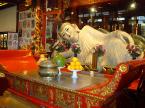
Reclining Buddha In Shanghai

Buddhist and Taoist influence on art and poetry have been a powerful influence on Chinese culture and entered mainstream Chinese tradition more than two thousand years ago.

Estimates say that about one hundred million Chinese follow Buddhism while the second largest religion is Taoism. A few million followers of Islam live in the northwest. Christians claim to be the fastest growing religion, but there are no facts to support this.

On the other hand, a recent survey found that eight hundred million Chinese say they belong to no religion. That does not mean that these Chinese have no morality since Confucianism is not a religion but is a lifestyle.

Discover Barbarians – a Matter of Opinion

______________

Lloyd Lofthouse is the award-winning author of the concubine saga, My Splendid Concubine & Our Hart. When you love a Chinese woman, you marry her family and culture too. 

If you want to subscribe to iLook China, there is a “Subscribe” button at the top of the screen in the menu bar.


One Child

March 7, 2010

China’s one-child policy is due to a population of 1.3 billion people in a country where food crops may be grown on only sixteen percent of the land. What isn’t well known is that the one-child policy applies only to the Han majority. That policy does not apply to the hundred million people that belong to the fifty-six minorities in China. That means Tibetans may not be able to worship and maintain the feudal, nomadic lifestyle like they had before Mao’s reoccupation of Tibet in 1951, but they can have as many children as they want.

Crowded China

The biggest challenge is growing enough food to feed the bulging Chinese population of 1.3 billion people.  The Chinese government says if it weren’t for the one-child policy, there would be another four-hundred million mouths to feed and provide shelter for.

Meanwhile, Christians in the West (people who believe abortion is wrong) criticize China for this policy. If China did not have the one-child policy, I doubt if these antiabortion voices would have stepped up to feed four-hundred million people. How many would have starved if a famine struck?

There are other exceptions to the one child policy, and you may read about them at the Asian Correspondent .

You may also learn more about China from Tom Carter’s Book, China: Portrait of a People

_______________

Lloyd Lofthouse is the award-winning author of My Splendid Concubine [3rd edition]. When you love a Chinese woman, you marry her family and culture too. This is the love story Sir Robert Hart did not want the world to discover.

His latest novel is the multiple-award winning Running with the Enemy.

Subscribe to “iLook China”!
Sign up for an E-mail Subscription at the top of this page, or click on the “Following” tab in the WordPress toolbar at the top of the screen.

About iLook China

China’s Holistic Historical Timeline


Who is Doing the Talking

February 24, 2010

I wrote about China’s assault against pornography in an earlier post, and I liked the concept. Now, I’ve discovered a discussion on the topic. After I read the comments/complaints, I wondered whom these people were and what countries they lived in.

The site is called Global Voices Online—Maybe it should be Global Vices.  Could this be a campaign by the pornographers to drum up support so they can stay in business without trouble?  After all, if one of the Chinese mother’s blocks their smut, they will have to work harder to sneak past the censors.  Some of this grumbling was funny, some of it made sense, and some made no sense. If you read the comments, tell me what you think?