The Diary of a Wimpy Catholic gives a brief history of London Riots, and what he says may be applied to most countries, even China, which has more to do with anarchy and chaos than a desire to have a multi-party democracy.
The London “unrest” flared on Saturday, August 7, 2011 and the latest headline (as I’m writing this post) says, “London under siege as violence spreads across UK. Ugly scenes of violence, rioting and looting have spread across the length and breadth of London and beyond since trouble began three days ago.”
This latest “unrest” in England started in the low-income, multiethnic district of Tottenham where many are unemployed. By August 9, sixteen thousand police had been deployed on the streets of London, and Prime Minster David Cameron said, “People should be in no doubt that we will do everything necessary to restore order to Britain’s streets and to make them safe for the law-abiding.” Source: Yahoo.com
The correct way to handle this sort of “unrest” may be how quickly the US ended the Rodney King Riots of 1992 in Los Angeles, which started on Wednesday, April 29, 1992 and officially ended on May 4 — six days later.
On the second day, the state’s governor sent in 2,000 California National Guard troops.
On the fourth day, President H. W. Bush ordered 4,000 heavily armed US Marines and Army troops to quell the riots, martial law was declared, roadblocks were set up and there were firefights between the military and the looting rioters that were setting fire to the city.
Although LA’s Mayor Bradley lifted the curfew on May 4, signaling the official end of the riots, sporadic violence and crime continued for days afterward. Federal troops did not stand down until May 9, and the National Guard remained until May 14 with some troops staying as late as May 27
The LA riots caused more than $1 billion in damage and saw 53 people killed and thousands injured.
“Contrary to what has become conventional wisdom outside China, the protesters were not demanding Western style politics and an end to Communist Party Rule.”Source:BBC DocumentaryProduced and Directed by Rob Coldstream(2009), which I wrote about on this Blog June 30, 2010 asChina’s Capitalist Revolution – Part 1 of 9
However, when unrest takes place in China and the Chinese react as the United States did in 1992 and England’s government today, the Western media, Blogs and Internet Forums often claim the unrest was caused by the fact that China is not a multi-party democracy.
Explain why China’s people should want a multi-party democracy since many democracies are broke, in debt and mired in wars in Iraq and Afghanistan?
In fact, in the last few decades, China has reduced severe poverty more than any country, increased literacy from 20% to more than 90%, increased the lifespan from age 35 in 1949 to more than 70 today, and created a modern consumer middle class approaching the size of the US population, while poverty, unrest and unemployment has increased in England and the United States.
In addition, in contrast to the 6 days it took to end the violent unrest in Los Angeles in 1992, The Tiananmen Square protests in the People’s Republic of China occurred between April 15, 1989 and June 4, 1989 (seven weeks — not six days), centered in Tiananmen Square in Beijing, China. If you Google this unrest, most likely you will read the lie that it was a democracy movement, which it wasn’t (watch the embedded BBC video with this post to discover the facts).
When troops of the People’s Liberation Army arrived in Beijing to deal with the unrest, they were “actively opposed” by protesters. There were “battles” during the entry of the troops into the city with military casualties, and extensive roadblocks constructed by the protesters slowed the army’s progress.
How is this different from America in 1992 and London in 2011 except that the Chinese had a lot of patience to let the unrest go on for seven weeks before applying force?
More Western riots to explore, which took place in freedom loving, multi-party democracies.
1981 England riots – West Indian race riots across London, Birmingham, Leeds and Liverpool
2001 England riots – South Asian race riots in Oldham, Burnley and Bradford
2010 Berkeley California riot – protesters damaging UC Berkeley’s Durant Hall and then spilling over into the city streets, igniting trash cans and Dumpsters, smashing windows and clashing with police.
1934 San Francisco Riot – Two men were killed by bullets, another by injuries, 31 others were shot and an untold number, including police, were clubbed, gassed, beaten and stoned.
Recent Oakland Riots – On January 7, 2009 a protest march in Oakland involving about 250 people became violent. Demonstrators caused over $200,000 in damage while breaking shop and car windows, burning cars, setting trash bins on fire, and throwing bottles at police officers.
Lloyd Lofthouse is the award-winning author of The Concubine Saga. When you love a Chinese woman, you marry her family and culture too. This is the love story Sir Robert Hart did not want the world to discover.
To subscribe to “iLook China”, look for the “Subscribe” button at the top of the screen in the menu bar, click on it then follow directions.
Today, Mao is judged by a Western value system that did not exist during his lifetime. His world was a place and time that molded him to be a survivor in a brutal world where failure often meant death.
It is now accepted that who individuals grow up to become as adults is partially due to genetics but mostly from the environment and lifestyle one experiences.
Mao grew up in another world nothing like most experience in the West, but he has been judged by Western humanitarian beliefs known today as “political correctness” that did not exist when he was born into China’s collective culture where the reverse was true and the individual was not more important than the whole.
There is a strong possibility that Mao also suffered from Post Traumatic Stress Disorder (PTSD) and this may have influenced his behavior and decisions during the years he ruled China.
Helping Psychology says, “PTSD victims tend to be in a continuous state of heightened alertness. The trauma that precipitates the disorder essentially conditions them to be ever-ready for a life threatening situation to arise at any moment … But the continuous releases of brain chemicals that accompany this reaction time – and their inability to control when this heightened reactivity will occur – take psychological and biological tolls on PTSD victims over time.”
Before I continue, I want to say that American troops are not the only humans on this planet to suffer from PTSD. Every person is susceptible to the ravages of violent trauma and if we examine Mao’s life, it would be impossible to deny that PTSD may not have played a role in the decisions he made in old age.
In fact, Medicine Net.com says, “Complex posttraumatic stress disorder (C-PTSD) usually results from prolonged exposure to a traumatic event or series thereof and is characterized by long-lasting problems with many aspects of emotional and social functioning.”
After examining Mao’s long history with violence and war, it is safe to say that he may have been a candidate for C-PTSD.
Lloyd Lofthouse is the award-winning author of The Concubine Saga. When you love a Chinese woman, you marry her family and culture too. This is the love story Sir Robert Hart did not want the world to discover.
To subscribe to “iLook China”, look for the “Subscribe” button at the top of the screen in the menu bar, click on it then follow directions.
Mao’sLong March is considered one of the most significant military campaigns of the 20th Century and one of the most amazing physical feats ever attempted.
Surrounded by hostile armies, 87,000 Communist troops escaped and started walking. It was a retreat that covered nearly 6,000 miles in one year.
It was a desperate retreat for Mao’s Communist Chinese Army (PLA) from the Nationalist forces (theKMT) of General Chiang Kai-shek . The KMT had a huge advantage with a much larger military force big enough to surround their enemy.
Many say The Long March was a brilliant military maneuver. Others claim it was a series of strategic blunders. However, most historians agree that what was accomplished was astounding. In this documentary, the survivors reveal what happened.
In the 1920s, eighty percent of the 450 million Chinese people were poor peasants who lived in the countryside. Over half owned no land and often worked for little more than food for an absentee landlord.
The difference between the Communists and Nationalists was vast. The Communists wanted to give the land to the peasants while the Nationalists wanted to maintain the old social order.
The US and Great Britain supplied bombers, fighters and reconnaissance aircraft to Chiang Kai-shek’s troops and wanted Chiang to attack the Japanese. Instead, he went after the Communists and signed a truce recognizing a Japanese government in Northeast China.
Chiang wanted to fight the PLA the old fashioned way, army to army.
However, Mao had his forces avoid a direct assault and fought using hit and run tactics. Advisors from Soviet Russia pressured Mao to be bolder but he refused, while Chiang was getting advice from a Nazi General from Hitler’s Germany.
When the Red Army finally stood their ground as the Soviets urged, the Communists lost sixty-thousand troops. They could not hold the lightly fortified positions they had built, because Chiang’s KMT were better armed.
In October 1934, Mao’s forces streamed out of their territory after suffering horrible losses. The Long March had begun. Nearly 87,000 troops moved in two main columns to the West and to the South.
It would be several weeks before Chiang learned the PLA had retreated. At the time, Mao came down with a severe case of malaria and had to be carried most of the time.
During the retreat, the PLA brought along the machinery for their government—printing presses, typewriters, etc. The Party’s leaders argued about what to do. Mao wanted to break through the Nationalist lines and attack from the rear but was voted down.
Instead, the decision was for a full-scale retreat and to link up with another Red Army in its stronghold deeper in China. The Nationalists used hundreds of aircraft to bomb and strafe the PLA columns.
As much as one-third of the Communist forces were killed by air attacks. To avoid this, the PLA started to move at night and hide during the day.
A new obstacle, a rugged river, stood in the PLA’s path, and a brutal battle was fought to cross the river. After a small force reached the far side, the survivors were ferried across on bamboo rafts. It took eight days for the army to cross.
The biggest problem was the heavy supply column with the machinery of government, so the Communists left the printing presses and coin minting machines behind along with the government’s records. After suffering horrible losses and not knowing what to do, Mao argued for a change of tactics saying they didn’t have to win every battle.
Mao argued that the most important rule for a military commander was to preserve and strengthen his forces. He had never been to Russia for military training but had read the Chinese military and literary classics.
Since most of the other leaders had been to Moscow to be indoctrinated in Communist ideology, they considered Mao’s thinking dangerous. However, he came out of the conference co-commander of an army that had lost two-thirds of its troops. Meanwhile, the Japanese were expanding their territory in Northeast China, while Chiang Kai-shek was still determined to destroy the Communists.
Mao changed plans and decided to move west toward the fourth Communist army. He took a route so rugged that no one had ever tried it before.
He also broke the army into smaller units and scattered them over the countryside so they would be harder to spot from the air. For a time, this fooled the Nationalists.
While moving across the rugged terrain, it was difficult to stay in touch with all the scattered units so Mao used teenagers as couriers. He also had spies keeping track of the Nationalist army’s movements.
Mao’s first significant battle was for control of an important mountain pass and his troops defeated two Nationalist divisions. It was Mao’s first victory as a commander, which helped him gain the trust of the troops.
Mao’s army began to win more battles. One of Mao’s battalions marched 85 miles in one day and night to seize a Nationalist fort without firing a shot. The fort commanded an important river crossing. When Chiang Kai-shek discovered what Mao’s forces had achieved, he was furious. Meanwhile, Mao was gaining new recruits and support from the peasants.
Chiang Kai-shek’s Nationalist army had a proven reputation for dishonesty, corruption and heavy taxation — the same policies that contributed to the collapsed of the Qing Dynasty in 1911, and the KMT was the faction the United States supported.
Most peasants trusted the Communists, who treated them with respect and refused to take any food while Nationalist troops confiscated the food and supplies they wanted without paying.
One challenge stood in Mao’s way—the Yi minority, who had stayed free of Chinese rule for decades due to their fierceness. Mao sent an envoy to negotiate and an agreement was reached.
In fact, many Yi warriors joined Mao’s army.
However, there was another river to cross and Chiang’s army was moving to trap the Communists. A bridge built in 1701 was the key. The race toward this bridge would lead to the most important battle of the Long March.
In the race to the bridge, advanced elements of the PLA arrived first.
The bridge was about 100 yards long and nine feet wide. Thirteen chains held up the side supports along with the bridge’s flooring. The troops for a local warlord guarded the bridge, and they had removed the flooring. Only the chains were left since the local people refused to cut them.
The battle for the bridge began. Volunteers from the Red Army started to crawl along the chains while covering fire was focused on the warlord’s troops on the other side.
The warlord’s troops used mortars and machine guns shooting at the Red Army volunteers as they crawled toward them. After fierce fighting, Mao’s troops took the bridge and the Red Army crossed.
The Nationalists had made a mistake by not cutting the bridge’s chains.
However, The Long March was not over. The Red Army was heavily outnumbered, and they had some of the highest mountains in the world to cross before reaching the Fourth Red Army and safety deep in Western China.
In June 1935, eight months and over three-thousand miles into the Long March, Mao’s Red Army moved into Western Sichuan Province. For a time, Mao’s troops were safe from Chiang Kai-shek’s Nationalists.
Meanwhile, the Japanese launched an attack on another northern Chinese province. The Japanese now occupied most of Northern China and the Chinese living there knew little about the struggle between Mao and Chiang Kai-shek.
Feeling abandoned, they were alienated from the Nationalist government.
Meanwhile, the PLA had to cross the Snowy Mountains with peaks as high as 15,000 feet. Because these mountains were so rugged and dangerous, the Nationalist Army stopped the pursuit and waited for the mountains to kill Mao.
Some historians believed crossing these mountains was a blunder, but Mao had no choice. Only defeat waited behind him, and there was no turning back.
The thin air and the steep, snow-covered mountains exhausted the troops. A shortage of food, lack of firewood, and snow blindness all contributed to the challenge. While crossing the mountains and linking up with the Fourth Red Army, thousands were lost.
Once joined, the combined PLA armies numbered 100,000 troops.
The next challenge was the deadliest obstacle of all—a high-desert grassland. There was no choice. All the easy routes were controlled by Chiang Kai-shek’s troops.
Then heavy rains came, which turned the grassland into a swamp.
There was no drainage in the grasslands. As it rained, the water saturates the soil and turned it into a swamp. Beneath the flowers and grass were hidden bogs that swallowed men and animals whole.
With temperatures were slightly above freezing, food became scarce and was rationed.
When there was no food, the troops boiled the grass and added a touch of salt. Everyone was weak. Those who collapsed were left to die, because the survivors did not have the strength to help.
The Red Army lost more troops in the grassland than from the Snowy Mountains. A Nationalist army followed the Communists into the grasslands but turned back because of the difficulty and risks.
One reason the Nationalists turned back was that Chiang Kai-shek suffered from a lack of loyalty among his troops and generals. He even feared that one of his generals might kill him.
On the other hand, the loyalty of Mao’s troops was unquestioned.
However, the general of the Fourth Red Army argued with Mao and the two armies split.
Mao’s army was weak and still had hundreds of miles to go to reach safety. One obstacle remained—the dangerous Lazikou pass, which had been fortified by Nationalist troops.
To survive, Mao’s troops would have to take the pass or return through the grassland.
Not wanting to return through the grassland, Mao issued orders to take the pass. The fighting was fierce and the PLA took heavy losses without success.
Then Mao stopped the direct assaults and sent skilled climbers up one of the canyon’s walls. From the high ground, they shot down at the Nationalist fortifications blocking access to the pass.
One volunteer wrapped his body in explosives, leaped from the cliff into the middle of the Nationalist fortifications and blew himself up opening the pass.
Mao’s First Red Army finally reached desolate and rugged Shaanxi Province. The Long March was over, and Mao’s troops linked up with other Red Army elements that already had a base there.
Of the original 87,000 that started the Long March, fewer than 6,000 survived. These survivors would recruit and train a new army.
The Long March turned Mao into a leader with a following from the common people of China.
Eventually, the Fourth Red army arrived, but two-thirds had been killed in battles.
Chiang Kai-shek planned a new campaign to defeat Mao, but Chiang’s supporters and generals forced him to cooperate with the Communists to defeat the Japanese.
After World War II, the Chinese Civil War resumed, and in 1949, Mao won China and Chiang Kai-shek, distrusted by most rural Chinese and still supported by America, fled to Taiwan with the remnants of his army.
Meanwhile, Mao’s six thousand survivors from the First Red Army ruled a country of a half-billion people. Most of the Communist government’s highest-ranking officials from the 1950s through the 70s were the survivors of The Long March.
In one year and one day, the First Red Army covered six-thousand miles, the distance between New York and San Francisco and back again. They averaged about 24 miles a day, climbed 18 major mountain ranges and crossed 24 rivers.
The First Red Army wasn’t the only Communist army to make this march. Two other Red Armies followed and overcame the same obstacles to join Mao’s forces in Shaanxi Province.
Many outside China see Mao as a ruthless dictator, without realizing that his sworn enemy, Chaing Kai-shek, was a brutal dictator too.
However, few can deny what Mao achieved as the commander of the First Red Army during the Long March.
Mao could not have succeeded without the loyalty of the common people and his troops, and loyalty must be earned and maintained, which is something that Chiang Kai-shek never accomplish.
In fact, to rule Taiwan after losing the mainland to Mao, Chiang Kai-shek imposed a brutal and harsh military imposed martial law on the island’s people.
______________________________
Lloyd Lofthouse is the award-winning author of My Splendid Concubine [3rd edition]. When you love a Chinese woman, you marry her family and culture too. This is the unique love story Sir Robert Hart did not want the world to discover.
Subscribe to “iLook China”!
Sign up for an E-mail Subscription at the top of this page, or click on the “Following” tab in the WordPress toolbar at the top of the screen.
On October 30, 1938, H.G. Wells’ The War of the Worlds was broadcast in the style of a radio news story with bulletins from reporters played by actors in the Mercury Theater, which resulted in hundreds if not thousands believing the earth was being invaded by Mars.
The excuse used to invade Vietnam and escalate the Vietnam War was the Tonkin Gulf Incident, which never happened as President Johnson claimed. This hoax led to the long war in Vietnam (1955 – 1975) with millions of troops and civilians killed and injured. Sources: The National Security Archive, Shakesville, and American USSR
Since 1950, when the People’s Liberation Army (PLA) of China invaded and reoccupied Tibet, we have been told repeatedly by our leaders, Hollywood celebrities and the Western media that Tibet was never a part of China before 1950, which was proven to be a lie by letters written in the 19th century by Sir. Robert Hart.
More evidence (that we do not hear of in the media) was published in the October 1912 National Geographic Magazine.
Now, Wiki Leaks reveals that the Tiananmen Square incident may be one of the biggest hoaxes in Western Media history or manipulation of the media by the U.S. government on a grand scale.
This revelation of the Tiananmen Square slaughter “that never happened” is big news in China, but in the West it is almost non-news.
After doing a Google search, it appears that only one Western media source published this story on June 4, 2011, and that was the UK’s The Daily Telegraph (to read the story click on the link).
To learn of this, I had to receive an e-mail from friends (American citizens) visiting China as tourists.
Wiki Leaks obtained cables that originally came from the US embassy in Beijing during the Tiananmen Square Incident, which partially confirms the Chinese government’s claim that PLA troops did not massacre demonstrators inside Tiananmen Square.
I wonder how many more Western media and U.S. government lies will be discovered in the future.
______________
Lloyd Lofthouse is the award-winning author of The Concubine Saga. When you love a Chinese woman, you marry her family and culture too. This is the love story Sir Robert Hart did not want the world to discover.
To subscribe to “iLook China”, look for the “Subscribe” button at the top of the screen in the menu bar, click on it then follow directions.
Professor Jeffrey Riegel, of the University of California, Berkeley traveled to China to unlock the truth behind one of the earth’s greatest legends, a man larger than life, the first emperor of China, Shi Huangdi (259-210 BC). This post comes from the documentary film of China’s first emperor.
The first time we visited his tomb was December 1999.
Shi Huangdi was barely thirteen when his father died (246 BC) after being king of Qin for three years. The legends say Shi Huangdi was a tyrant driven mad by power.
He had a tomb built the likes of which humanity has never seen. When the first emperor died, he was the most powerful man on earth. He created an empire that outlasted Rome by a thousand years, he ruled ten times the population of ancient Egypt, and today’s China owes its existence to this man.
Months after becoming king at thirteen, Shi Huangdi overcomes his mother’s desire to rule in his name and took his nation to war. He was the youngest king to wage war and soon proved he was also the greatest warrior.
He soon becomes known as the Tiger of Qin.
Shi Huangdi wages war against his enemies for ten years. At the time, there were seven countries in China besides Qin. The seven countries in what we know as China today were Zhao, Yen, Wei, Han, Chi, Chu and Qin.
During the war to conquer Zhao, Shi Huangdi’s army took ten thousand prisoners. The rules of war say these prisoners must be fed and sheltered. However, Shi Huangdi changed the rules.
He shows his troops what to do by beheading an enemy troop and calls on his army to do the same.
He says, “There is only one way to treat weakness and that is to exploit it. There is only one way for Qin to survive, and that is to conquer.”
All 10,000 Zhao prisoners were beheaded.
By the time Qin Shi Huangdi turns twenty, he had captured thirteen cities from the state of Han and twenty from the other states. Huangdi’s rival countries send a combined army to stop him but they are repelled.
Some of Huangdi’s success is because of the precision weapons Qin craftsmen make for his loyal, highly trained army. Discover more of China’s Warrior King
However, while the king of Qin is conquering China, there is an enemy scheming to replace him.
His mother, the dowager queen, has taken a lover, who masquerades as a eunuch. The queen has had two illegitimate sons with this lover, who steals two royal seals that gives him authority to mobilize troops in an attempt to replace Shi Huandgi with one of the king’s half brothers.
Qin’s prime minister discovers the plot and a trap is set to destroy the rebel army. The dowager queen’s lover is captured, tortured and his mangled body pulled apart by four horses while the queen mother is forced to watch.
While the death sentence is being carried out, Huandgi has his two half brothers strangled to remove this threat to his throne.
With this challenge to the throne removed, Shi Huangdi has learned a lesson. He is ruthless and rids himself of his mother and his prime minister.
There is a dramatic scene where the prime minister asks for forgiveness for letting the queen mother do what she did.
The prime minister is exiled and not allowed to see the queen mother again. Within a year, the disgraced prime minister kills himself.
A scholar, who believes in harsh laws, becomes Huangdi’s closest advisor.
By 227 BC, the Qin state has conquered the states of Han, Wei and Zhao.
The state of Yen knows it is next and sends professional assassins disguised as peace emissaries to kill Shi Huangdi. The emissaries arrive in Xian with gifts and an assassin strikes.
Since no weapons are allowed in the throne room, there are no armed guards to protect the king. Only the king has a weapon and only the king can call the troops to save him.
By 223 BC, Shi Huangdi is ready to unify China. Only the states of Chi and Chu are left, but the Chu army destroys his first invasion force.
Shi Huangdi raises another army and invades again. A million troops face each other and it becomes a standoff. To win, Shi Huangdi tricks the Chu generals to make a mistake, and the last great obstacle to the unification of China falls.
Chi is the last country that has not been defeated. To avoid the slaughter, Chi joins Shi Huangdi without a fight.
Qin is now China.
At the age of 34, Qin Shi Huangdi was crowned with a veil of stars as the first god emperor of the Qin people and China.
The system of governance put into place will long outlast the emperor.
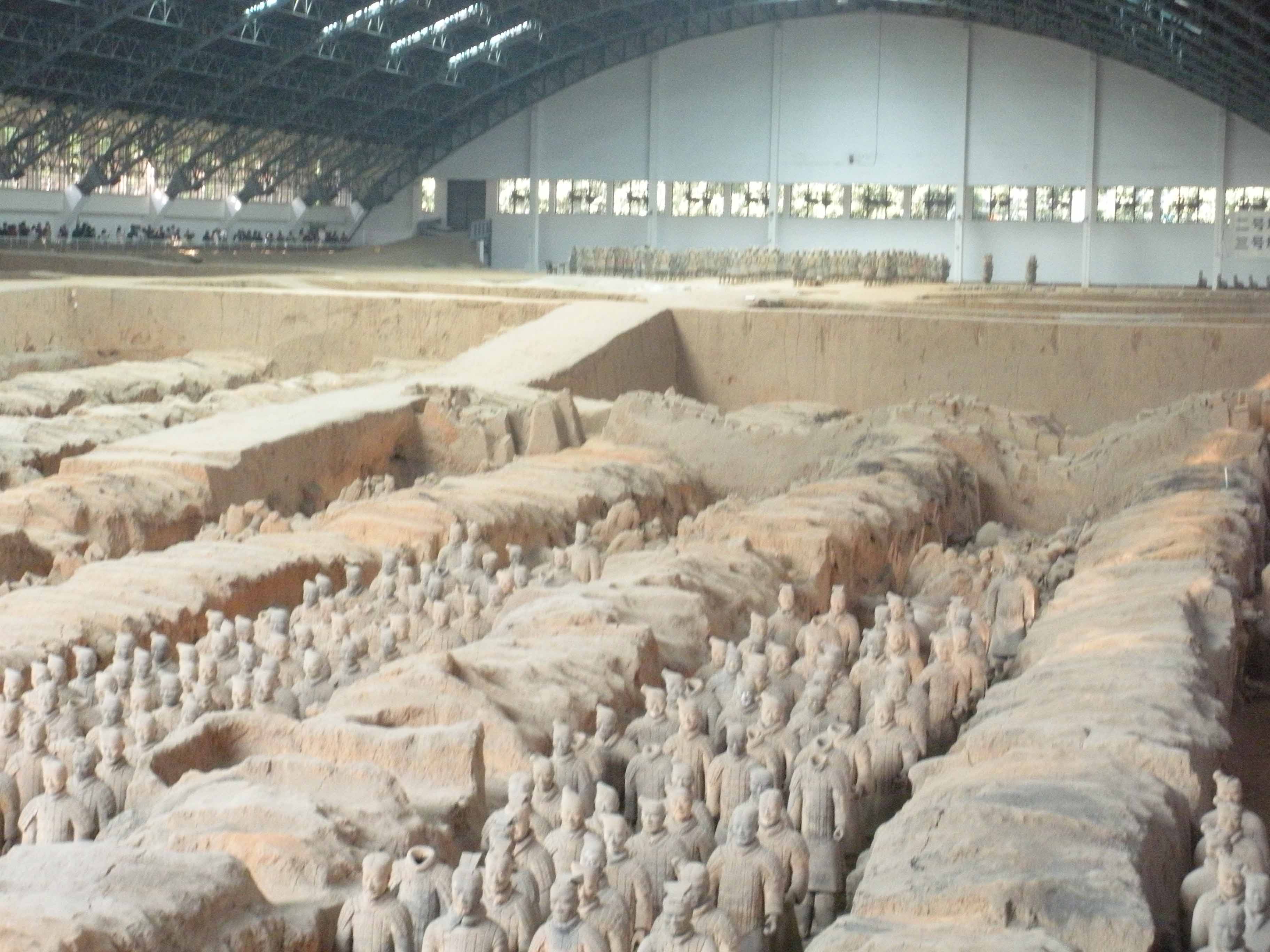
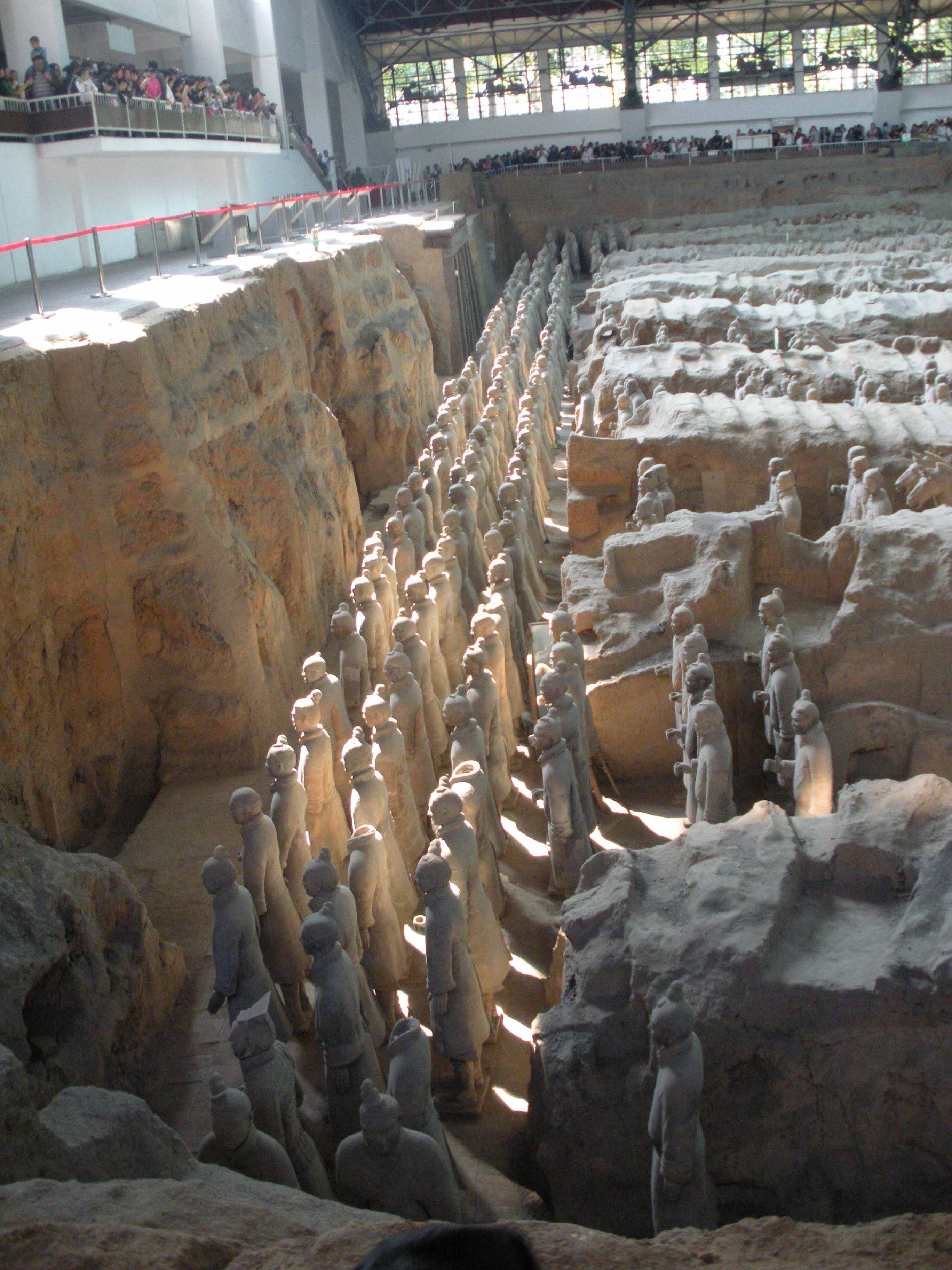
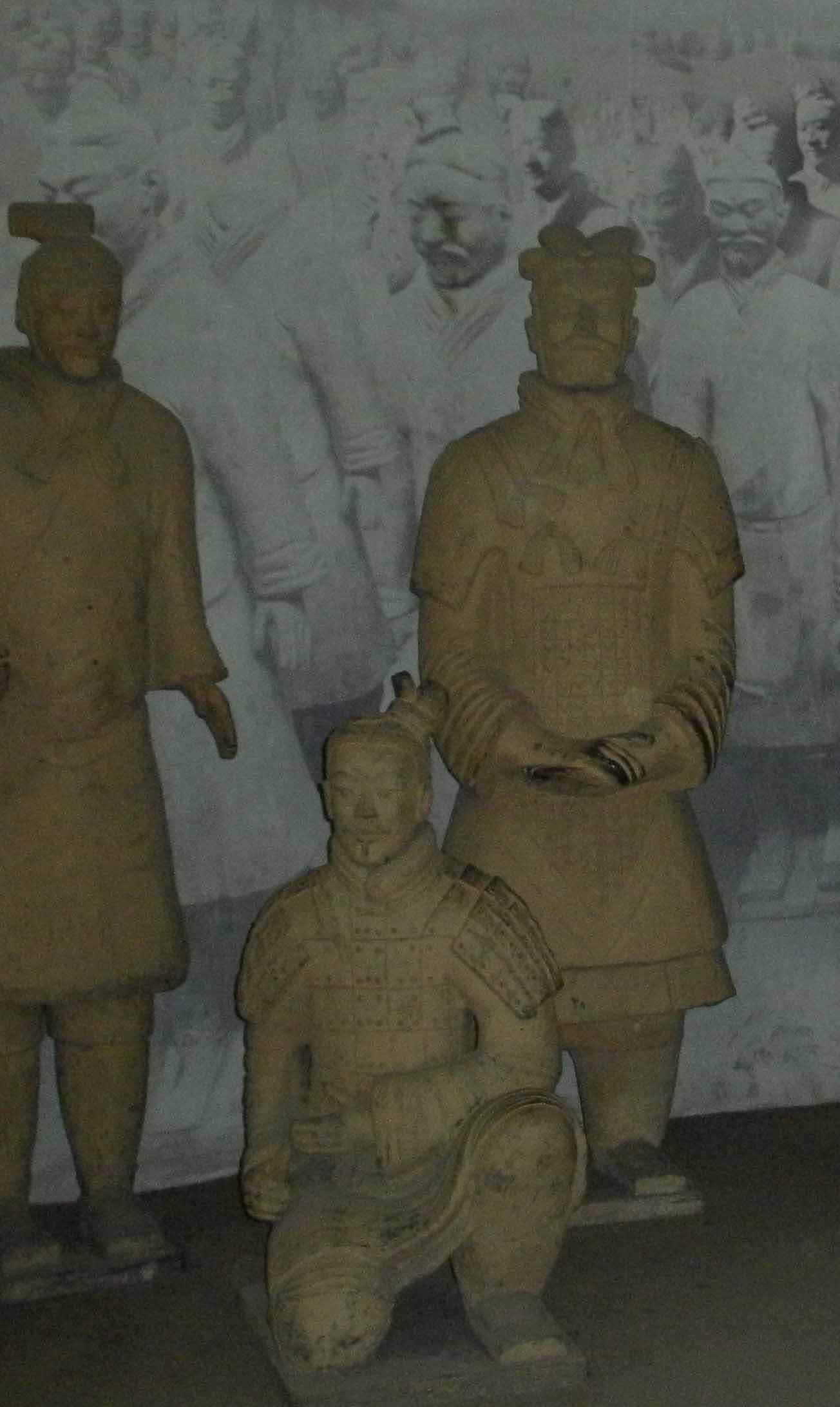
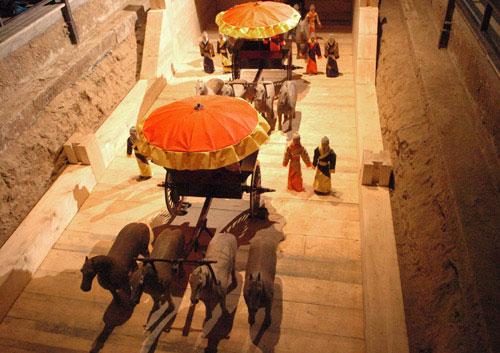
Qin Shi Huangdi commissions a Terra Cotta army that will guard him in death, and the troops are larger than life. In one pit, more than two hundred sets of armor made of stone have been found with no bodies to wear them.
It is believed that the armor may have been made for the spirits of dead soldiers who suffered violent deaths in combat so the dead would not become vengeful spirits.
The totalitarian philosophy in the new Chinese empire was called legalism.
Rules govern every part of every citizen’s daily life with the punishment spelled out. Physical punishment could mean mutilation.
For example, if two are caught having sex, they will be beheaded. Every aspect of private life is part of Qin law.
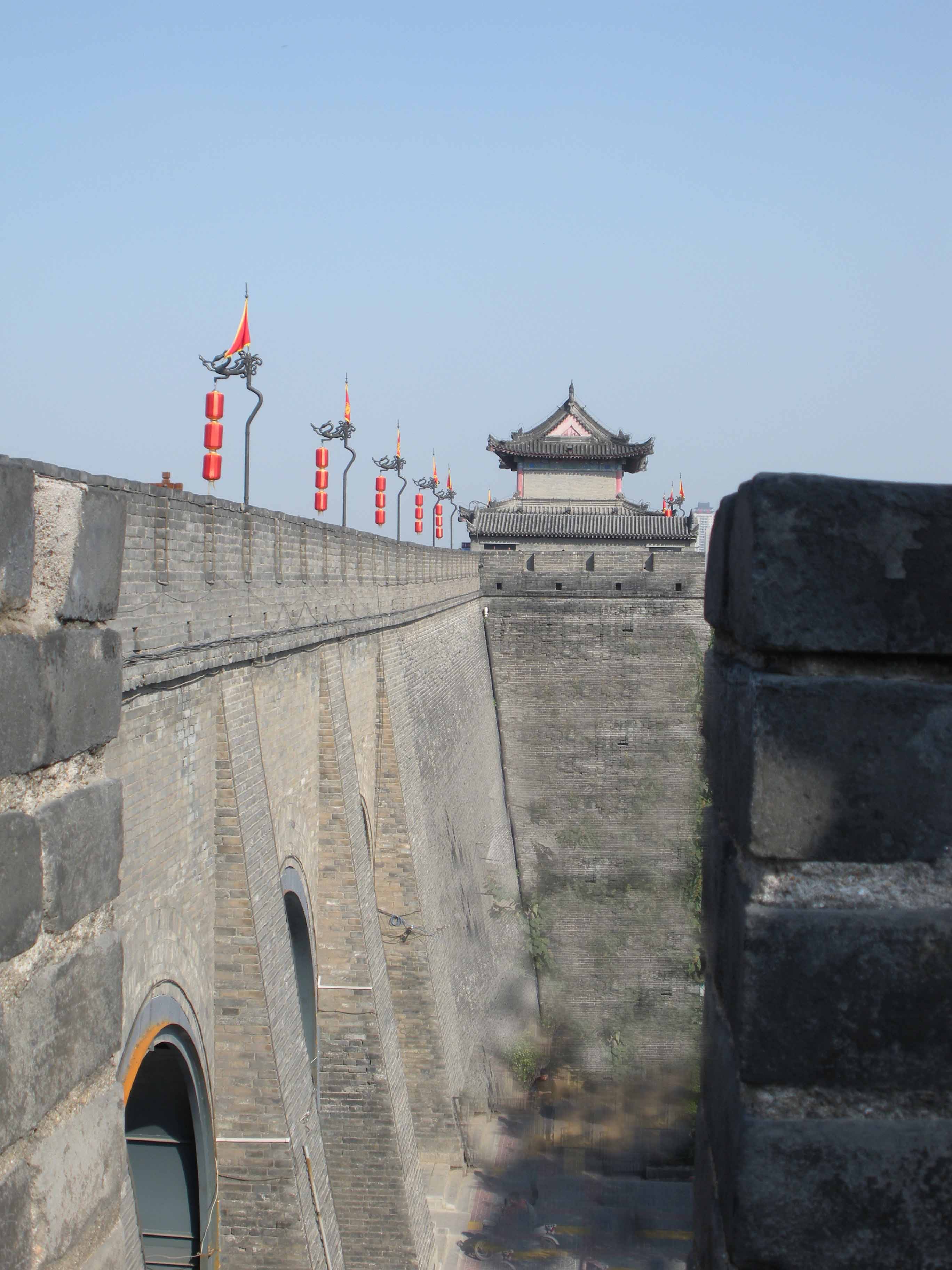
In 220 BC, Emperor Qin Shi Huangdi goes on an inspection tour of his empire. With the major wars over, millions of troops are put to work finishing the Great Wall of China, which was designed to stop the nomadic tribes to the north from raiding into China, which they have done for centuries.
The Great Wall is the greatest engineering project of the ancient world. It is thirty feet high and more than three thousand miles long. At one point, over a million people worked on the wall and about a quarter died.
The emperor makes more demands. He sends hundreds of thousands to build a tomb that fits his rank as the first divine emperor of China.
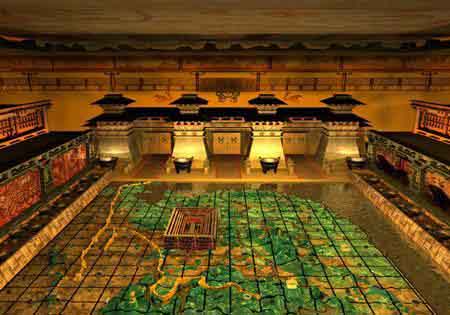
The burial mound, larger than the largest pyramid in Egypt, is at the center of an above ground and underground city. His tomb is made of bronze surrounded by
mercury rivers and oceans.
Recently, using ground penetrating radar and other instruments, a three dimensional model is built of this underground complex.
By 215 BC, Emperor Qin Shi Huangdi’s tomb is almost finished. The chamber where his body will rest is the size of a football field and will be hermitically sealed.
Then the tomb will be covered with a million tons of earth creating the hill we see today.
However, the Emperor doesn’t plan to die. Seeking advice from his doctor, he is given mercury capsules. At the time, it was believed that mercury would increase longevity.
Having lots of sex with multiple partners was also considered another way to increase life. The emperor follows the doctor’s advice and sends his doctor on an expedition to find an elixir for immortality.
The emperor isolates himself and delegates the power to rule the empire to those he trusts most. These men suppress free thought.
Entire libraries are burned. Those who try to hide documents are branded on the face and sentenced to a life of force labor — mostly on The Great Wall. Anyone who resists is buried alive.
Professor Jeffrey Riegel, of the University of California, Berkeley, says that Chinese archeologists have no immediate plans to unearth the tomb, because there is no way to safeguard the contents from decay.
Chinese alchemists knew liquid mercury as the only substance that could dissolve gold. To the ancient mind, that meant mercury had power that might prolong life.
However, the human body cannot absorb pure mercury so the Chinese alchemists made a compound the emperor could digest.
As the mercury is absorbed, it slowly destroyed his nervous system and brain.
Emperor Qin Shi Huangdi becomes aggressive, argumentative and paranoid. He goes into hiding. Anyone revealing his location is killed. His kidneys’ are failing and he starts talking to the gods.
Thirty-five years after becoming the king of Qin at thirteen, he goes on another Imperial tour. But this time, he is blind to a nation that is bankrupt and near famine.
All the emperor can think about is living forever.
He’s told that giant fish guards the island of the immortals. The emperor dreams that he is a sea god who will kill the giant fish.
Near the end of 210 BC, he visits the ocean hunting the giant fish with a crossbow while wading in the surf.
His advisors plan what to do with China once the emperor dies. On the return to the capital, the emperor falls ill and the Imperial convoy stops.
In the seventh month of 2010 BC, the first emperor’s search for immortality ends. At the age of fifty, Qin Shi Huangdi is dead.
While China’s first emperor is being buried according to his wishes, a power struggle rages outside the tomb.
By tradition, the oldest son should have become the emperor but several ministers want a younger son on the throne. The others are assassinated and there is a slaughter.
The emperor will also not go alone to the afterlife.
While his chosen successors are being assassinated, hundreds of his favorite concubines will stay with their master and die with him.
The tomb’s designers and builders will be sealed in the tomb too. Everyone who knows the way dies.
Qin Shi Huangdi left a legacy—a unified nation with a single written language and a system of administration that is still in use today.
_______________
Lloyd Lofthouse is the award-winning author of My Splendid Concubine [3rd edition]. When you love a Chinese woman, you marry her family and culture too. This is the lusty love story Sir Robert Hart did not want the world to discover.


 Posted by Lloyd Lofthouse



 iLook China