Goodbye traditional China — Hello New-world Glamour

July 10, 2010

About China’s TV Program, Red Mansion
Guest Post by Hannah in China

These days, Chinese TV is showing the all-new version of Red Mansion (Hong Lou Meng, which is directed by Li Shaohong). Red Mansion is based on the well-known Qing Dynasty novel (also known as Dream of Red Chamber) written by Cao Xue Qin. The story is about the feudal noble family’s rise and fall from prosperity to decline. But to the Chinese, the most fascinating parts of the book are the sad love story, which happens to the three main characters: Jia Baoyu, Lin Daiyu and Xue Baochai.

Lin Daiyu

Red Mansion is one of four Chinese classic novels. The other three are the Journey to West, Water Margin and Romance of the Three Kingdoms. So, these four stories are constantly made and remade into Chinese TV shows or movies since television first became popular in China in 1980s.

Jia Baoyu

Before this new version of Red Mansions, there’s the most popular one made in 1987, which is the best accepted and beloved by all the Chinese people from young to old (Find the 1987 version of A Dream of Red Mansions at Amazon.com). Even till now, when people talk about the Red Mansion, all we can think of is the 1987 version. These original actor and actress really conveyed the souls of the book’s character and never can be performed or interpreted by anyone else as well as they did. The producers from 1987 spent YEARS to pick out from millions of people in the country these actors and also took a year to train them and naturally develop into the characters, then took another year to film the show. That’s why the 1987 production is the best and the classic.

Xue Baochai

Now China has new technologies and enough material to make all the beautiful scenes for the same shows. But are we Chinese still pure enough to make the real GREAT shows?

There are hidden rules in all the entertainment these days—talent does not matter anymore. So new actors must have connections or money. Maybe that’s why the first director left the new production of Red Mansions and was replaced by Li Shaohong. Truthfully, I like Li Shaohong a lot because of the great show Palace of Desire (Da Ming Gongci) about Tang Dynasty. Dream-like beautiful scenes are the trademark of Li Shaohong, but in the new version of Red Mansion, all the actors are too young and glamorous compared with the original, traditional cast from 1987.
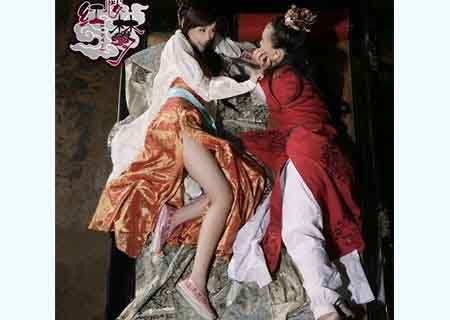
naked legs in the modern TV production

Viewers of the new version comment on their blogs that the new show sometimes feels like a ghost show because it tries to shock us so often. And they say the new female leads dress and wear makeup more like girls from a modern brothel than an ancient royal court. They show too much of their legs and thighs in every scene. They are liked whores.
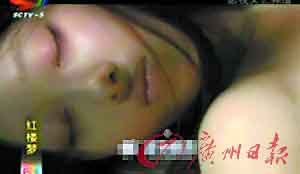
Lin Daiyu - naked and dead in the modern production

And it seems even the director Li Shaohong cannot understand the true meaning of the Red Mansion story. First, she doesn’t like the book (she admitted this in an interview). Second, she made Lin Daiyu naked in her dying scene, explaining that she aimed to shock the audience by doing this. This is an insult. The Qing Dynasty was very conservative and women were not allowed to show skin. How can a noble, elegant young girl be naked?

Also, there’s a funny mistake in a scene on the Qing-era boat. There are rubber tires on the boat!!!

rubber inner tubes on an 18th century Chinese boat

I don’t know when or where rubber was invented, but certainly not in ancient China.

 (Note from this Blog’s host: The invention of rubber has been traced to the ancient Mayans of central America to 1600 BC. There is no record of rubber tires reaching China at the time “A Dream of Red Mansions” was written by Cao Xueqin [1715-1763]. In fact, Charles Goodyear invented the first vulcanized rubber in 1844 and it wouldn’t be until 1888, that John Dunlop invented air-filled tires for bicycles.)
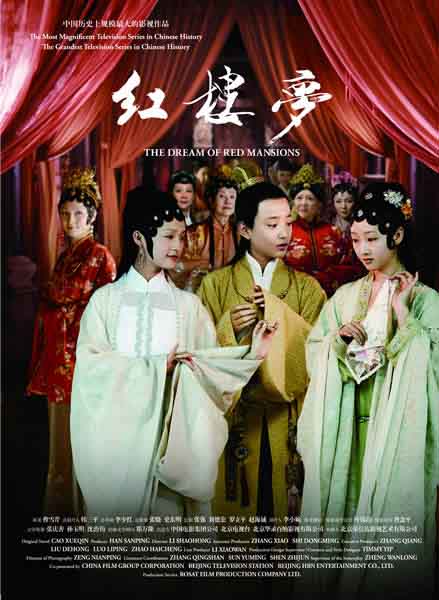
modern production - the one with nudity

So, on and on are my criticisms of the new Red Mansion TV show. It’s more like watching the new world, but maybe that’s what China’s government-run media wants—everything new and glamorous. 

See Hannah Travel Adventure (Chinese) or Hannah China Backpacker (English)

_________________________

Lloyd Lofthouse, the host of the Blog, is the award-winning author of the concubine saga, My Splendid Concubine & Our Hart. When you love a Chinese woman, you marry her family and culture too. 

Sign up for an RSS Feed for iLook China


Invented in China—Printing

July 9, 2010

Six hundred years after paper was invented, the Chinese invented printing and the first printed work was Buddhist scripture during the Tang Dynasty (618 – 906). The most basic printing techniques are older. Engraving came later. The carving, printing technique originated during the Tang Dynasty

When we talk about paper and printing, it is to collect knowledge, preserve and share it.

Once there were paper books being printed to share Buddhist ideas, the religion spread through China into Korea and Japan. Over a thousand years printing techniques continued to improve until there were multi-colored printings.

Then during the Sung Dynasty, the printing board was invented, which used clay characters. One character was carved into a small block of clay. Then the clay was put in a kiln to heat into a solid block. This method was efficient for printing thousands of sheets. These blocks would be placed together to create sentences and paragraphs of Chinese characters.

Later, the characters were carved into wood. Over time, printing was developed into an art.  In fact, Ancient Chinese culture was preserved due to the invention of paper and these printing methods, which wouldn’t reach Europe until after 1300 AD, almost 800 years later.

Without the Chinese invention of printing, Christianity, Islam and Buddhism may not have spread to the extent that they have.

See With or Without Paper

_________________________

Lloyd Lofthouse is the award-winning author of the concubine saga, My Splendid Concubine & Our Hart. When you love a Chinese woman, you marry her family and culture too. 

To subscribe to “iLook China”, look for the “Subscribe” button at the top of the screen in the menu bar, click on it then follow directions.


Facts Prove Foxconn a Better Place to Work and Live

July 6, 2010

The Huffington Post published another piece about Foxconn, a Taiwan based company, and mentioned, once again, the recent suicides among workers at their south China facility. The Post also reported that Foxconn might be planning to build a new factory in the city of Hebei in Henan province and hire another 300,000 workers. 

Since Foxconn already has about 800,000 workers in China, that would bring the total above a million. Does that mean more suicides are on the horizon? The answer may surprise you.

China already has one of the highest suicide rates in the world at 230 per million, while the global average is 100 per million. Source: Association for Asian Research

There were ten suicides at Foxconn in five months and several attempts were stopped proving that Foxconn has preventative measures in place. Since the suicide rate at Foxconn was 1.25 suicides per 100,000, the evidence suggests a much safer, healthier environment than outside Foxconn’s walls—including the US with 10.9 suicides per 100,000. Source: NIMH

In fact, I’m not alone in my opinion. Tom Foremski, writing for zdnet, says that the World Health Organization suicide figures for China show 18 male and 14.8 female suicides per 100,000.

The media is misrepresenting the facts about Foxconn.

Why?

A) Yellow Journalism
B)  It happened in China
C) Both A & B

See Roughed Up

_________________________

Lloyd Lofthouse is the award-winning author of the concubine saga, My Splendid Concubine & Our Hart. When you love a Chinese woman, you marry her family and culture too. 

Sign up for an RSS Feed for iLook China 


China’s Capitalist Revolution (Part 4 of 9)

July 2, 2010

When the first US businessmen arrive in China, they complained. It took years to gain approval to open manufacturing plants in China. Then the trickle of investors turned into a flood as foreigners scrambled to cash in on a cheap and willing workforce.

The new industrial zones were sealed behind fences from the rest of China. The economies in the industrial zones doubled every three years. Wages were higher than the rest of China and people came looking for work. Investments poured in.

Deng’s popularity was at an all time high. He says, “We have given the highest priority to modernization. Our economy has grown more vigorously than ever.”

However, high ranking Maoists fear a capitalist country with a Communist flag. In 1983, the hardliners start a campaign against spiritual pollution—code for Western ideas.

The hardliners attack journalists who write for the People’s Daily. Top editors are fired for being corrupted by Western values.  The hardliners now control the media.  If you don’t follow the party line, your future becomes grim.

Next, the hardliners pressured the banks to stop lending money to the industrial zones.  Deng has to force the banks to loan the money.

Return to China’s Capitalist Revolution Part 3 or go to Part 5

_________________________

Lloyd Lofthouse is theaward-winning author of The Concubine Saga. When you love a Chinese woman, you marry her family and culture too.This is the love story Sir Robert Hart did not want the world to discover.

To subscribe to “iLook China”, look for the “Subscribe” button at the top of the screen in the menu bar, click on it then follow directions.


Learning from Sherlock Holmes

June 26, 2010

I was shopping at Costco and saw a piece in The (June 19) Economist about China’s secret media.  I bought a copy and read it when I got home. One of the major reasons that the Qing Dynasty collapsed in 1911 was because the Manchu leaders were out of touch with what was going on. The royal princes lived behind high walls in a fantasy world of opulent gardens. The young Emperor and the Empress Dowager lived inside the Forbidden City or The Summer Palace—surrounded by ministers who filtered the news.

Sherlock Holmes

In Chinese whispers, The Economist reveals the different layers of news in today’s China. One layer is the cleansed version for the people then there are other layers depending on how high one is in the government. Each layer appears to have less censorship. What this piece reveals is that China’s top leaders wants to know what’s going on before anyone else does.

One example would be the SARS outbreak in 2003. According to the Economist, by the time China’s leaders learned about SARS, there had already been 300 cases and 5 deaths. Two days after learning about SARS, China’s leaders told the World Health Organization. Since Xinhua’s reporters and editors do such a great job filtering the news for mass consumption, it seems that China’s top leaders have to become sleuths to discover the missing facts.

See The Collective Will

________________________

Lloyd Lofthouse is the author of the award winning concubine saga. When you love a Chinese woman, you also marry her family and culture.

Sign up for an RSS Feed for iLook China