The Fear of Mao Buying the World

November 22, 2010

The cover of The Economist’s November 13 issue plays on fear to sell magazines.

I haven’t read Buying up the world, The coming wave of Chinese takeovers yet, which is the feature piece. I’ll probably write another post about that once I do.

Instead, I’m writing about the magazine’s cover, which is taking advantage of the West’s PTCSD (Post Traumatic Chinese Stress Disorder) that has roots in the “history” of a fear of the word “Communist”, the Korean Conflict and the Cultural Revolution.

I’m sure most Sinophobes that see this cover will have flashbacks of the People’s Liberation Army (PLA) and the rest of China dressed in drab Mao jackets marching across the world to take possession of everything China buys.
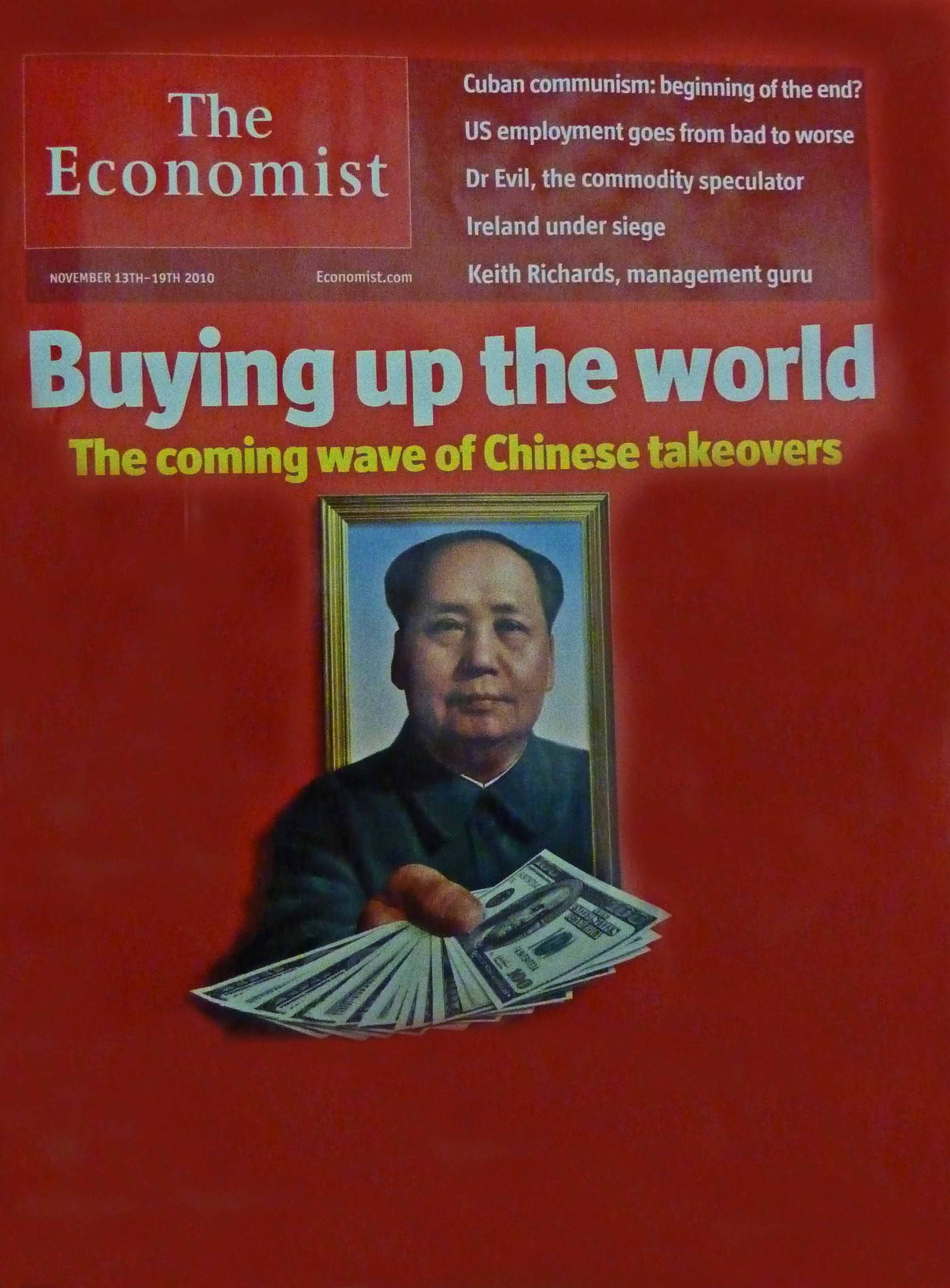
However, Mao isn’t the proper man to adorn The Economist’s cover.

Deng Xiaoping or one of China’s recent presidents (there have been four since the 1982 Constitution) would have been more appropriate.

Why? Because after Mao died in 1976, Deng Xiaoping and his allies rejected Maoist Revolutionary thought and embraced CAPITALISM in a very big way.

In fact, surviving Maoists consider the Party that rules China today to be traitors to Mao and the revolution.

Do you remember the 1980s, when wealthy Japanese spent billions buying property in America then a real estate bubble burst, Japan lost a lot of money, and its economy has been limping since?

If anyone should be afraid, it should be the Chinese fearing spending habits in the US, Canada and Europe where debt and plastic rule.

______________

Lloyd Lofthouse is the award-winning author of the concubine saga, My Splendid Concubine & Our Hart. When you love a Chinese woman, you marry her family and culture too.

To subscribe to iLook China, look for the “Subscribe” button at the top of the screen in the menu bar, click on it then follow directions


Beijing Must Maintain Tight Control

November 18, 2010

My wife and I went to see Inside Job, and I returned home thinking that China should maintain tight control over its financial sector and continue to keep out disruptive elements such as the Tibetan and Islamic separatists and the Falun Gong Religious Cult.

In addition, China must keep locking up dissidents that want China to become a full-blown, so-called democracy as the US claims to be.

In fact, I suspect the same people (named in the documentary) that produced the 2008 global economic crises want to have their go at China’s money to see how much of that they may legally steal once they change Chinese laws for their purposes.

I seriously question that America is still a democracy or a republic.

Instead, America seems controlled by a few huge US banks and Wall Street. The rest of us peasants are being relegated to the position of modern-day debt serfs who must pay for the greed and mistakes of a few.

Anyone that believes that China is more corrupt than America, think again. I’d rather deal with China’s corruption challenges than the moral and ethical corruption that plagues America’s financial sector.

If you know how much the 2008 economic crisis cost the globe, you will know the extent of that American corruption. Global Issues pegs that global loss at about 62 trillion.


“Inside Job” Trailer

For those who continue to blame China for stealing US jobs, the Pew Economic Policy Group says the 2008 economic crises that started in the US cost 5.5 million Americans their jobs and another 4 million jobs that would have been created.

In China, about 15 million jobs were lost resulting in more than 80,000 demonstrations and riots across the country.

Millions more jobs were lost outside China and the US.

Reuters says, “Inside Job … is a must-see for pretty much everybody.”

“This is not a piece of ragged muckraking or breathless advocacy,” the NY Times says. “It rests its outrage on reason, research and careful argument.”

The sad fact is that this documentary was only in the art house that shows films in our area that do not have the popularity of a “Megamind” or a “Harry Potter” film.

We were part of an audience of five.

It doesn’t matter if US citizens vote Republican or Democratic. It is obvious that President Reagan let the sociopathic foxes into the hen house and both Bushes, Clinton and now President Obama are feeding our chickens to those foxes.

Unfortunately, I agree with the comments I’ve read on the Internet that say no matter how many people see Inside Job nothing will change. This malignant cancer has spread too far.

______________

Lloyd Lofthouse is the award-winning author of the concubine saga, My Splendid Concubine & Our Hart. When you love a Chinese woman, you marry her family and culture too.

If you want to subscribe to iLook China, there is a “Subscribe” button at the top of the screen in the menu bar.


Power of the Peasant

November 14, 2010

Corruption is a fact-of-life in Asia and China may be one of the few country in Asia doing something about it.  Country rankings in Asia are dismal compared to Western democracies and Singapore.

The Corruption Perception Index of 2010 says most of Asia is “very” corrupt—the smaller number is better and 178 is the worst global rank.

Of 178 countries ranked for corruption, Myanmar (Burma) scores 176 and is tied with Afghanistan as two of the most corrupt countries on the planet.

Iraq is 175. Laos and Cambodia are 154. Vietnam is 116, and Indonesia is 110.

Even India, the world’s largest democracy, is ranked 87. Singapore, for comparison, is tied for first place as one of the least corrupt countries.

In fact, two of the least corrupt countries in Asia are Thailand and China tied at 78.

The power of the Chinese peasant demonstrated in this video may have something to do with China’s improved score as one of the least corrupt nations in Asia.

It may come as a surprise to many Western critics but in rural China, democracy’s ballot box has been active at the village level since the mid 1980s.

In 1997, The Independent reported that China’s rural peasants were discovering the power of the ballot box.

“Under Communist Party rule, village elections are the only example of one-person, one-vote democracy in China. Launched in the mid-eighties, they were originally introduced to replace the village communes that were dissolved after the Cultural Revolution.”

Few outside China paid much attention to this move toward China’s rural democracy. Nearly one million villages hold elections and each time there is an election, the peasants learn more about democracy in action.

______________

Lloyd Lofthouse is the award-winning author of the concubine saga, My Splendid Concubine & Our Hart. When you love a Chinese woman, you marry her family and culture too.

If you want to subscribe to iLook China, there is a “Subscribe” button at the top of the screen in the menu bar.


Republics of Asia — Part 3/3

November 14, 2010

I’ve written about the Republic of Singapore before in The Reasons Why China is Studying Singapore.

Singapore is a model “republic” respected around the world. In fact, Singapore is tied for number one in the Corruption Perception Index for 2010 with a score much better than the U.S. Source: Transparency.org

Focus Singapore says, “It is interesting to note that Singapore laws are very strict with harsh punishments for smoking and littering in public places.”

For example, “A drug offence in Singapore can attract severe penalties including a death penalty.… Homosexual acts, including kissing between men, are illegal in Singapore and penalties include imprisonment.”

Human Rights Watch reports, “Singapore officials should cease using criminal defamation and contempt laws to silence government critics.… “Free speech is an endangered species in Singapore.”

In fact, “Singapore remains the textbook example of a politically repressive state,” said Phil Robertson, deputy Asia director at Human Rights Watch. “Individuals who want to criticize or challenge the ruling party’s hold on power can expect to face a life of harassment, lawsuits, and even prison.” Source: Human Rights Watch

However, the Western media often ignore human rights violations in Singapore, because, “The United States has maintained formal diplomatic relations with Singapore since it became independent in 1965. Singapore’s efforts to maintain economic growth and political stability and its support for regional cooperation harmonize with U.S. policy in the region and form a solid basis for amicable relations between the two countries.”

About religion — “Singapore generally allows religious freedom, although religious groups are subject to government scrutiny, and some religious sects are restricted or banned. Almost all Malays are Muslim; other Singaporeans are Taoists, Buddhists, Confucianists, Christians, Hindus, or Sikhs.” Source: U. S. Department of State

Lee Kuan Yew was Prime Minister from 1959 to 1990. He was the world’s longest serving prime minister and was elected seven times. His son Lee Hsien Loong has been PM since 2004. When he ran for office, there was no competition.

Singapore sounds similar to China except for China’s policy that leaders may only serve two five-year terms and must retire at sixty-seven. Oh and there hasn’t been any nepotism as in North Korea and Singapore.

Return to Republics of Asia — Part 2

______________

Lloyd Lofthouse is the award-winning author of the concubine saga, My Splendid Concubine & Our Hart. When you love a Chinese woman, you marry her family and culture too.

If you want to subscribe to iLook China, there is a “Subscribe” button at the top of the screen in the menu bar.


Republics of Asia — Part 2/3

November 13, 2010

Thailand will be the next democracy compared to China.

Transparency.org ranks Thailand’s corruption at 78 — tied with China.  India, which I have written about before, ranks 87th — worse than China.

A Blog about Political Prisoners in Thailand claims that there is no freedom of speech in Thailand. Saying what you feel or think can get you thrown in jail.

Thailand also passed a Computer Crimes act in 2007. The language in one section sounds similar to language in China’s Constitution that Western Critics often complain about

The Asian Human Rights Commission writes that Thailand chained wounded detainees recently under an Emergency Decree. “For many years, the AHRC and other concerned organizations and individuals have voiced outrage at the shackling and otherwise barbaric treatment of accused criminal prisoners in Thailand.”

In May 2010, Reuters reported that Bangkok was being cleaned up after the worst riots in modern history. “At least 54 people were killed and more than 400 injured in the latest bout of violence which began on May 14. Almost 40 buildings in the city were set on fire and the tourism and retail sectors have been devastated.”

In fact, analysts reported, “The political problems are not over….”

About women in Thailand, the 1997 Constitution increased legal protections for women and persons with disabilities. However, some inequities in the law remained and some protections were not enforced. Violence and societal discrimination against women were problems. Societal discrimination against hill tribes and religious and ethnic minorities continued. There were reports of forced labor and child labor. Trafficking in women and children, coerced prostitution and labor were serious problems. Source: U.S. Department of State

We seldom hear about Thailand in the Western media for problems that don’t exist in China. Even when there is turmoil and unrest in Thailand, the news reports in the West are friendlier compared to the language used to report any incident that happens in China.

However, the reason for this soft treatment is obvious since Thailand has had close relations with the United States since the end of the Second World War. Threatened by communist revolutions in neighboring countries such as Vietnam, Cambodia, and Laos during the Cold War, Thailand actively sought U.S. assistance to contain communist expansion in the region. Source: U.S. Department of State

Return to Republics of Asia — Part 1

______________

Lloyd Lofthouse is the award-winning author of the concubine saga, My Splendid Concubine & Our Hart. When you love a Chinese woman, you marry her family and culture too.

If you want to subscribe to iLook China, there is a “Subscribe” button at the top of the screen in the menu bar.