China’s Translation Sensation

March 19, 2012

On March 14, I published a post about Premier Wen Jiabao’s farewell speech to China’s National People’s Congress before he steps down later this year and retires from political office.

China is a land of many spoken languages and one written language. In fact, Chinese movies often have subtitles flowing across the bottom of the screen in Mandarin for the hundreds of millions of Chinese that do not speak Mandarin but only read it. To understand how complex this mix of languages is, Mandarin by itself has more than 50 dialects and there are 56 different minority languages.

I suggest you see Wikipedia’s list of Chinese dialects and languages for a better understanding of how complex China is and how amazing it is that this nation has been a unified country for more than two millennia.

After Wen Jiaboa’s speech, I read the media translations in English from several sources and had no idea that in his speech he quoted original poetry dating back to one of ancient China’s greatest and earliest recognized poets, Ch’u Yu (343 – 289 BC). Since Wen’s speech, the micro-Blog debate and criticism in China have been intense, which demonstrates that in China, expressing an opinion is not forbidden.

How would Americans react if an American President gave his State of the Union address laced with quotes from Latin or Old English?

In Latin, The Lord’s Prayer starts, “PATER noster, qui es in caelis, sanctificetur nomen tuum.” In Old English, it starts with, “Fæder ure þu þe eart on heofonum…”

In China, the response to Wen Jiabao’s use of an ancient and dead Chinese language mostly focused on the translator, Miss Zhang Lu (in Chinese the last name comes first, which emphasized the importance of the family over the individual and demonstrates a major difference between the West and Asia).  Zhang majored in international law and graduated from China’s Institute of Diplomacy. She then became a translator for top ranking Chinese Communist Party officials.

Zhang was praised by many for translating Wen Jiabao’s “I’d not regret dying nine times,” to “For the ideal that I hold dear to my heart, I’d not regret dying a thousand times.”

I printed 14 pages of comments from a Chinese language micro Blog that was part of the national debate, which started with comments by Chinese professors from different universities in China including Fudan University, Tsinghua University and Shanghai’s Foreign Language Institute correcting and offering suggestions for Miss Zhang’s translation.


Sexy Beijing: Lost in Translation

I’m going to focus on one example of one of the ancient Chinese poems Wen Jiabao quoted when he said, “知我罪我,其惟春秋”, which in proper English translates into “History will judge what I have done.”

Miss Zhang’s translation said, “There are people who will appreciate what I have done but there are also people who will criticize me. Ultimately, history will have the final say.”

One professor’s suggested translation said, “What I have done may be appreciated and criticized by the people, yet ultimately history will give me a fair assessment (or judgment).”

In addition, here are several typical comments from the same micro Blog:

Comment A

What’s wrong with Premier Wen acting like he was competing in a poetry contest? He ought to earn credit for doing a good job managing the country, not to impress with his skill of reciting ancient Chinese poetry.

Comment B

It goes to show how difficult it is to be a leader of Chinese today. Wen should not be criticized for incorporating in his speech a couple of lines from ancient poems. Americans didn’t criticize their President W. Bush for saying things that didn’t make sense or made the wrong sense. Instead, they thought him cool and a “man of his-true-self”.

Comment C

For Heaven’s sake Wen represents the face of China. Americans don’t have trouble with Obama’s talent in speaking beautifully. Instead of ridiculing, they appreciated him.

Comment D

Oh, come on, don’t be so naive. Every question at Wen’s last press conference was pre-selected. Premier Wen must have communicated with his translator prior to show-time. He would never risk the young translator’s misunderstanding or misinterpreting his use of ancient poems.

___________________________

In conclusion, the alleged reason Premier Wen Jiabao used passages from ancient Chinese poems may have been to not only demonstrate the beauty of the Chinese language and his knowledge of it, but to infer that China does not need to bend to the rest of the world and do things as a foreign leader might do but as a Chinese leader.

In fact, it is Chinese tradition for scholars and government officials in China to quote ancient poetry and literature in speeches. In addition, the beauty of language is valued highly in China. The use of spoken and written language to many Chinese is not just getting a meaning or emotion across, it is also considered a form of art.

Meanwhile, in the West/America, we read an English translation of his speech, which is a translation of a translation and walk away thinking we know what one of China’s leaders meant, which brings me to a final question.

What happens when there is a mistake in translation during sensitive political negotiations between countries such as China and America?

______________

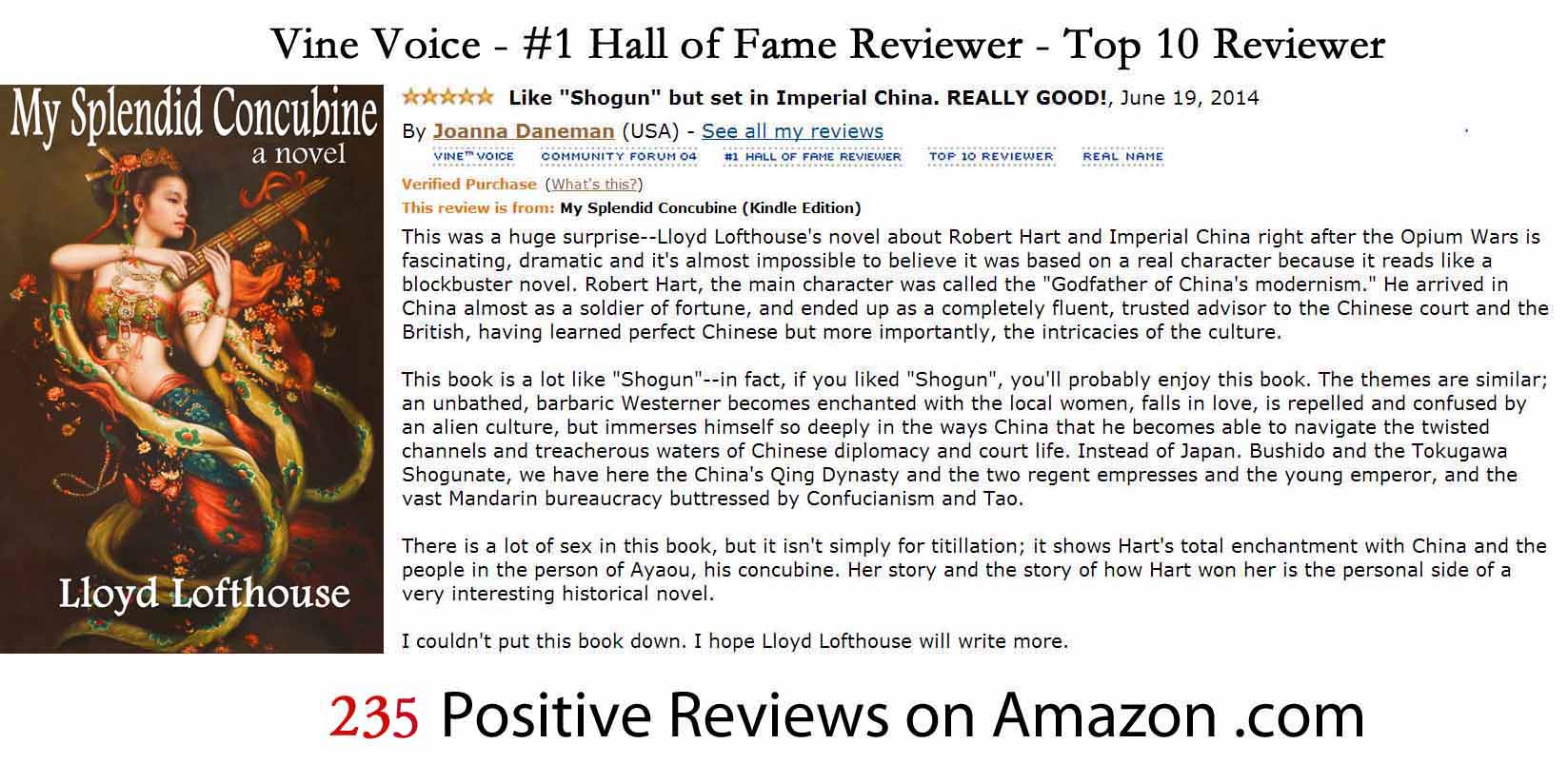
Lloyd Lofthouse is the award-winning author of The Concubine Saga. When you love a Chinese woman, you marry her family and culture too. This is the love story Sir Robert Hart did not want the world to discover.

Subscribe to “iLook China”!
Sign up for an E-mail Subscription at the top of this page, or click on the “Following” tab in the WordPress toolbar at the top of the screen.

About iLook China


Greenpeace and the growth of environmentalism in China – Part 3/3

March 10, 2012

In another post at Greenpeace.org, we learned that Greenpeace activists went undercover in China up to a year to infiltrate and investigate factories that were releasing hazardous chemicals into China’s waterways.

Greenpeace said, “Two weeks after we released our report, Puma came out with its promise to eliminate toxic substances from its supply chain. When we heard that, we were overjoyed. Since then Adidas, H&M, Nike and Li-Ning have all followed suit.”


Climate Voices from China

“More than 3,500 environmental organizations now have legal status in China,” Andrew Grant said. “While activists there are not as vocal as their counterparts in Europe or the United States, they have made an impact by encouraging transparency and pressuring local governments and industries to adhere to (China’s) new national regulations.

“Through a program called the Green Choice Alliance, environmental groups publish lists of companies in violation of environmental regulations and offer to conduct a third-party audit if a company chooses to clean up its act.

“Last year, under the supervision of environmental groups, independent auditors found that Fuguo’s Shanghai leather factory had rectified its major violations and reduced gas emissions.”


Yangtze River, China

“The local and national Chinese press has been very aggressive in uncovering environmental problems and mobilizing forces to go after polluters. Local newspapers have broken stories about cancer villages, which have been picked up by television networks and broadcast nationwide. In some cases, the revelations have been praised by government officials. In other cases the revelations have been embarrassing or hurt investments by officials, and the sources of the stories have been harassed or jailed.” Source: Andrew Grant, Discover magazine, March 18, 2011

Return to Greenpeace and the growth of environmentalism in China – Part 2 or start with Part 1

______________

Lloyd Lofthouse is the award-winning author of The Concubine Saga. When you love a Chinese woman, you marry her family and culture too. This is the love story Sir Robert Hart did not want the world to discover.

Subscribe to “iLook China”
Sign up for an E-mail Subscription at the top of this page.

About iLook China

Note from Blog Post — This post is iLook China’s fifteen-hundredth (1,500) post, and with it this Blog will be cutting back from posting daily to two or more days a week. The next post (1,501) will appear March 12.


Greenpeace and the growth of environmentalism in China – Part 2/3

March 9, 2012

When The Diplomat.com asked Li Yan, head of Greenpeace in East Asia’s Climate and Energy Campaign about China, Li Yan replied, “China has made impressive efforts to cut back its carbon emission growth, and it’s fair to say that China is doing much better than many other countries, including industrialized ones. However, with the rapid growth of emissions, China needs – and has the capability – to do more…”

“According to a recent U.N. Environment Program report, China has surpassed the United States in renewable energy investment in 2010, making it now the world’s largest… In 2010, China’s wind power installation capacity was about 42GW, which places China as the biggest installation country globally.”

In addition, a recent post by Ma Tianjie on the Greenpeace East Asia Blog said, “As early as 2009, after a series of lead pollution cases, the Ministry of Environmental Protection (China) had called for a ‘blanket inspection’ of heavy metal pollution facilities. This means, in theory, local governments should already have an inventory of local industrial facilities that release heavy metals, with basic information on who is discharging what…”


Gloria Chang is Greenpeace China’s key campaigner on climate change – June 2007

“It is clear that the government’s environmental protection apparatus, low in capacity and short in manpower, cannot fight this battle alone,” Ma Tianjie said. “The public, especially non-governmental organizations (NGOs) working for the protection of the environment, has a role in contributing to such efforts.

“In August 2011, the ministry (in China) made an unprecedented move by releasing detailed pollution information on more than 1,900 lead-acid battery facilites across the country. It was the first time that information on an entire industry’s environmental performance was made public.

“Reactions to the initiative were overwhelmingly positive. A close scrutiny of the data by the media, environmental NGOs and the public resulted in corrections and a dataset of improved quality, which would only help the ministry to better supervise the listed facilities.”

Ma Tianjie recently appeared on China’s CCTV news program “China 24” to discuss the recent toxic metal contamination of water supply in Guanxi Autonomous Region. You may learn more of this CCTV appearance at Greenpeace.org.

However, China is often criticized by its critics/enemies for censorship and controlling what the state owned media reports without any mention of broadcasts such as this one on CCTV with Ma Tianjie of Greenpeace East Asia.

Continued March 10, 2012 in Greenpeace and the growth of environmentalism in China – Part 3 or return to Part 1

______________

Lloyd Lofthouse is the award-winning author of The Concubine Saga. When you love a Chinese woman, you marry her family and culture too. This is the love story Sir Robert Hart did not want the world to discover.

Subscribe to “iLook China”
Sign up for an E-mail Subscription at the top of this page.

About iLook China


Greenpeace and the growth of environmentalism in China – Part 1/3

March 8, 2012

The list of Chinese democracy activists that have been arrested is not long considering there are more than 1.3 billion people in China. Wiki lists 30.

I studied the list of Chinese dissidents and saw that none was executed although there were several alleged to have committed treason and revealing state secrets: Bao Tong (1989), Shi Tao (2004), Wang Bingzhang (2002), and Wei Jingsheng (1979).

Unless I missed something, no dissidents was in jail at this time and a few had been kicked out of the country. Wei Jingsheng, an electrician accused of passing military secrets, was deported to the US in 1997 after spending some time in prison.

If found guilty of these crimes in the United States, the result may have led to a death sentence or life in prison. When I checked the list of people convicted of treason in the US, I saw that 10 have been executed. The United Kingdom had a longer list of executions for treason, while China’s list has only three names on it, which were Zhou Fohyai (executed 1948), Chen Gongbo (executed 1946), and Wang Jingwei (executed 1944).

However, when it comes to environmental activists, such as members of Greenpeace being detained in China, the list is short, while in the West the list of environmental activists being arrested is long.

In 2007, six Greenpeace protesters were arrested for breaking into the Kingsnorth power station in southeast England.

June 2008, two Greenpeace activists were arrested in Japan for exposing a whale meat scandal involving the government sponsored whaling program.

May 2010, seven Greenpeace activists were arrested in Port Fourchon, Louisiana in an anti-drilling protest.

In May 2011, six Greenpeace campaigners were arrested in Durban, South Africa.

June 2011, eighteen Greenpeace activists were arrested after climbing aboard an oil rig off Greenland’s coast to protest deepwater drilling in the Arctic.

August 2011, Daryl Hannah and 70 other environmental activists arrested at a Tar Sands Pipeline protest outside the White House in Washington D.C.

In November 2011, three Greenpeace activists were arrested in South Africa over coal power plant protests.

However, in China in 2006, Greenpeace East Asia was the only NGO to be consulted on an early draft of a renewable energy law by China’s National People’s Congress. In fact, before Greenpeace opened offices in Guangzhou and Beijing in 2002, activists from the Hong Kong office ran several campaigns on the Chinese Mainland and have even been interviewed on CCTV.

In addition, Greenpeace activists have recently gone undercover in China to catch industrial polluters, and it appears that this operation may have had the blessing and support of the CCP’s Central Committee.

Continued March 09, 2012 in Greenpeace and the growth of environmentalism in China – Part 2

______________

Lloyd Lofthouse is the award-winning author of The Concubine Saga. When you love a Chinese woman, you marry her family and culture too. This is the love story Sir Robert Hart did not want the world to discover.

Subscribe to “iLook China”
Sign up for an E-mail Subscription at the top of this page.

About iLook China


Anna May Wong – the Woman that Died a Thousand Times

February 10, 2012

Almost half a century after her death, Anna May Wong (1905 to 1961) has not been forgotten.

As a child, Anna loved going to the movies and even cut school to go.

Between 1919 and 1961, she acted in 62 films. The Internet Movie Data Base says she was the “first Chinese-American movie star”.

To act, Anna had to play the roles she was given. The Western stereotype cast her as a sneaky, untrustworthy woman that always fell for a Caucasian man. The dark side of achieving her dream of acting in movies was that Anna had to die so the characters she played got what they deserved.

Anna often joked that her tombstone should read, “Here lies the woman who died a thousand times.”

Until Chinese started to emigrate to the U.S. in the mid-19th century, they had never encountered a people who considered them racially and culturally inferior.

However, the discrimination against the Chinese in America was only exceeded by the racism and hatred directed at African-Americans.

In fact, in the 1960s, many of the anti racist laws enacted during the Civil Rights era focused on protecting African-Americans, which created a protected class, and since the Chinese—due to cultural differences often did not complain—they were left behind.

In many respects, this racism toward the Chinese still exists in the US today and manifests itself through the media as China bashing, which supports the old stereotype.

When Anna May Wong visited China in 1936, she had to abandon the trip to her parent’s ancestral village when a mob accused her of disgracing China.

After her return to Hollywood, she was determined to play Chinese characters that were not stereotypes, but it was a losing battle. To escape the hateful racism, she lived in Europe for a few years.

Since U.S. law did not allow her to marry the Caucasian man she loved, and she was afraid that if she married a Chinese man he would force her to give up acting since Chinese culture judged actresses to be the same as prostitutes, she never married.

Anna May Wong smoked and drank too much. She died of a heart attack in Santa Monica, California at age 56.

Lloyd Lofthouse is the award-winning author of My Splendid Concubine [3rd edition]. When you love a Chinese woman, you marry her family and culture too. This is the unique love story Sir Robert Hart did not want the world to discover.

1-joanna-daneman-review-updated-sept-21-2016_edited-3

Where to Buy

Subscribe to “iLook China”!
Sign up for an E-mail Subscription at the top of this page, or click on the “Following” tab in the WordPress toolbar at the top of the screen.

About iLook China

China’s Holistic Historical Timeline