Will China rebuild its cities so they become people friendly?

June 12, 2019

Most cities were built to be friendly to cars and not people, but there is a growing movement to change that. The April 2019 issue of National Geographic Magazine (NGM) published “To build the cities of the future, we must get out of our cars”

Countries across the world, including the United States and China, or starting to build and/or rebuild cities to turn them people friendly.

The first page of the 20-minute read NGM piece started with, “SHANGHAI, CHINA Near the center of this city of 24 million, China’s largest, the Yanan expressway crosses under the North-South Expressway. The country has gained half a billion city dwellers since 1990—and nearly 190 million cars. ‘It’s truly almost incomprehensible what happened in China,’ says American urban designer Peter Calthorpe, who has worked there extensively. With nearly 300 million more people expected in cities by 2030, Chinese planners say they’re changing course, prioritizing walkable streets and public transit over cars. …

Chinese planners say they’re changing course, prioritizing walkable streets and public transit over cars.

“The key test may come in Xiongan, a 680-square-mile stretch of swampy land, including a heavily polluted lake, about 65 miles southwest of Beijing. In April 2017 President Xi Jinping announced, again to general surprise, that he wanted to build a new city there. Ultimately it could house five million people and relieve congestion and pollution in Beijing.”

The guide for building these people-friendly cities is the Emerald Cities Rule book, and China is in the best position to build these cities.

“Emerald Cities: Planning for Smart and Green China,” published in 2017 lays out green building and sustainability practices for low-carbon city planning and construction in China and abroad. Emerald Cities proposes 10 principles to help set a new development direction for Chinese cities: from urban growth boundaries and transit-oriented development, to small blocks with accessible public space and car control, to green buildings and sustainable infrastructure at constructive detailed planning and community levels. The 10 principles aim to establish green, healthy and economic vibrant cities, while solving pollution and livability challenges faced by China’s cities. Emerald Cities was jointly published by China Sustainable Transportation Center and Glumac with support from Energy Foundation and Energy Innovation.”

What do U.S. President Donald Trump and his administration want to build? Trump wants to build a wall that will divide people and promote hate and segregation while he holds rallies across the U.S. promoting hate and segregation.

However, the U.S. also has the possibility offered by Alexandria Ocasio-Cortez’s Green New Deal that is similar to what Xi Jinping wants to do in China, so there is still hope for America to join China in making the world people friendly instead of focused on hate, segregation, and greed.

中

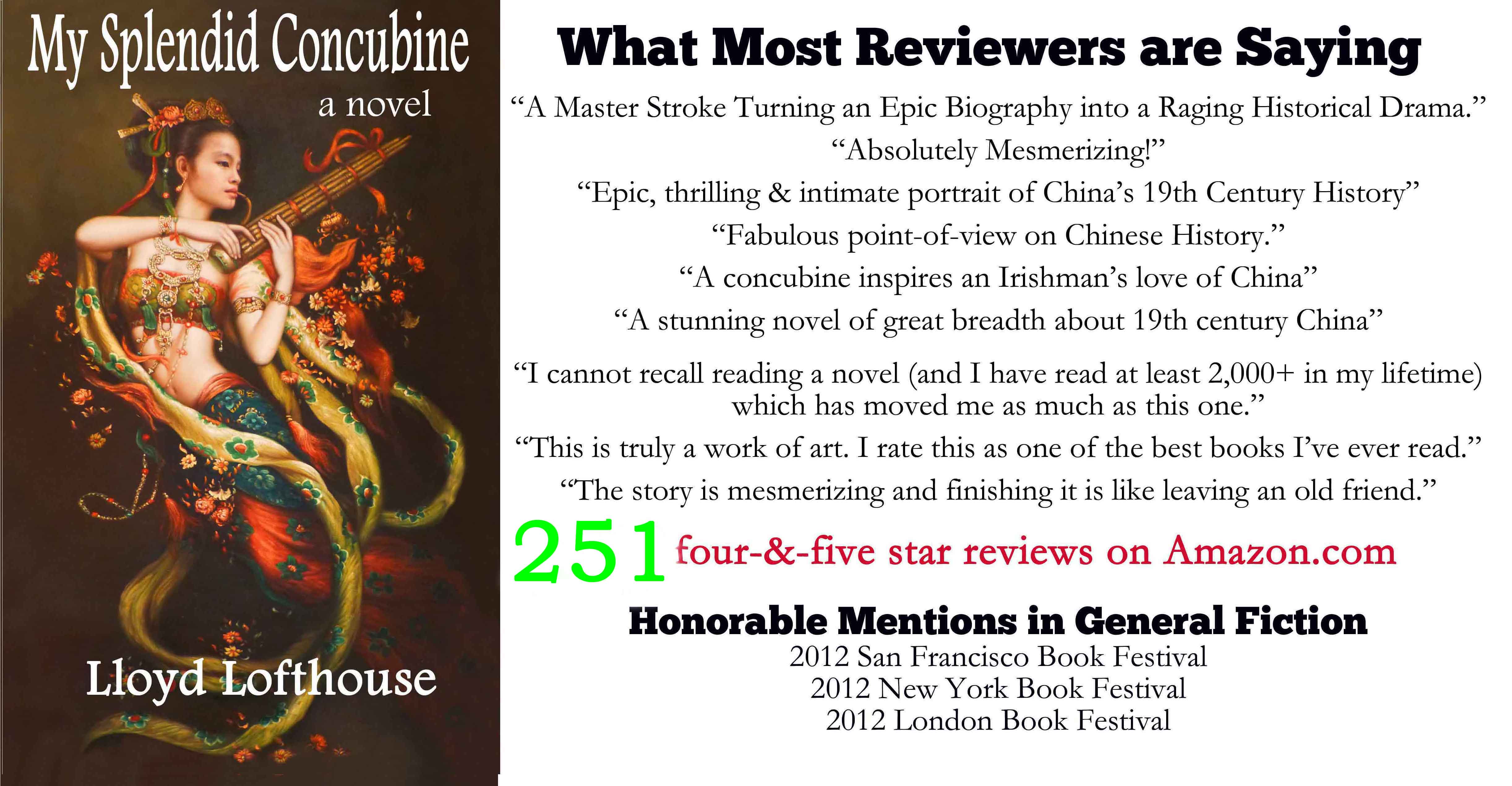
Lloyd Lofthouse is the award-winning author of My Splendid Concubine, Crazy is Normal, Running with the Enemy, and The Redemption of Don Juan Casanova.

Where to Buy

Subscribe to my newsletter to hear about new releases and get a free copy of my award-winning, historical fiction short story “A Night at the Well of Purity”.

About iLook China


Donald Trump will lose his Great Tariff War with China

June 5, 2019

Trump recently doubled down on his tariff war with China, but China is in a much better position to win this economic war with the United States.

First, as of October 2018, China owned $1.2-trillion of America’s national debt and the United States has five times the national debt that China does and the U.S. doesn’t own any of China’s debt.

Politico.com reports, “China could fire back by dumping its vast holdings of U.S. government debt. Flooding the market with treasuries would push down US bond prices and cause the yields to spike. That would make it more costly for U.S. companies and consumers to borrow, in turn depressing America’s economic growth.”

Trump cannot do the same thing to China.

Second, China exports $2.41 trillion worth of goods to other countries around the world including the United States, but China exports only $557.9 billion worth of goods to the United States — 23 percent of all Chinese exports sold to the rest of the world. That means China exports $1.8521-trillion in goods to other countries, 77-percent of all Chinese exports are sold to the rest of the world.

Third: China has a workforce of almost 800 million people, but only 150-million work in the manufacturing sector. How many of those workers jobs depend on products sold to the United States?

 The answer is, not as many as you might think.

That is because China’s manufacturing sector also makes and sells good in China. In fact, its manufacturing sector’s total value is 96-trillion yuan, according to Interact Analysis, or 14-trillion US dollars.  That means after we subtract the $2.41 trillion in goods sold to other countries that leaves $11.59-trillion in goods that are made and sold in China to Chinese consumers. If we crunch the numbers that means only about 4-percent of China’s manufacturing sector jobs depends on sales to the United States. That translates to about 6-million jobs, or 0.0075% of the total number of jobs in China.


“In the long-run, the United States will Lose.”

And does it really matter how many manufacturing jobs in China will be at risk vs lost jobs in the US caused by Trump’s great tariff war with China?

The answer to the last question is no because China’s financial system is different than the one in the United States.

China will repeat what it did after the global financial crises in 2007-08, when twenty million Chinese factory workers lost their jobs. China allowed factory workers nearing the mandatory retirement age ( at the time 60 for men and 55 for female civil servants and 50 for female workers) to retire early and moved most younger workers to state-owned industries and/or infrastructure projects across the country. For instance, to fast track building what has become the largest high-speed rail network in the world today. China will not let that many younger workers remain unemployed for long compared to a Trump administration that will do little or nothing to help Americans find new jobs once they are unemployed thanks to Trump’s ignorance and arrogance.

The result, China’s labor force did not suffer compared to the suddenly unemployed in the United States where millions of families lost their homes. Remember what the U.S. Government did back then? Let me refresh your memory: President G. W. Bush signed TARP and started to give away $700 billion to banks and corporation so they would not go bankrupt and there was no plan for the government to get paid back while millions of working Americans still lost their jobs and houses.

Unlike the United States, in China, most factory workers migrate to the cities to work and come from family homes in rural China that have no rent, no mortgage payment, and no property tax. Few if any Chinese workers in the manufacturing industry will be at risk of losing their homes, becoming homeless and starving like workers in the United States.  China’s government also gave/offered workers that lost their jobs during the 2007-08 global financial crises a free train ticket to return to their rural family homes.

According to AXIOS, 11-million U.S. workers are at risk of losing their jobs thanks to Trump’s Great Tariff War with China.

How many American workers are one paycheck away from losing their homes and becoming homeless?

According to Fortune.com,  “40% of American households are ‘liquid asset poor,’ meaning that they don’t have enough money put away to make ends meet at the poverty level should their income be suddenly interrupted.”

What does that mean?

Statista.com says, “In 2018, there were about 127.59 million households in the United States. According to the U.S. Census Bureau, a household consists of all the people who occupy a housing unit.”

Crunch the numbers and that means about 131-million Americans (40-percent of the total population) is one paycheck away from poverty and/or homelessness while few if any Chinese will lose their homes and become homeless. They might become poor without much cash but they will still eat and have a roof over their heads. China is not a purist capitalist country like the United States is. China is a hybrid socialist-capitalist country and the socialist element will not let the Chinese people suffer like that — but the socialist hating capitalists that control the United States will.

If China wants to do the United States a favor and help evict Donald Trump from the U.S. White House, all China’s leaders have to do is what they do best, while they let Trump do what he does best, and that is to fail like he has done so many times with one business venture after another. The only reason Trump still has enough money to support his lavish lifestyle is because he laundered money for Russian thugs, and Trump helped his favorite drug trafficker smuggle cocaine into the United States.

中

Lloyd Lofthouse is the award-winning author of My Splendid Concubine, Crazy is Normal, Running with the Enemy, and The Redemption of Don Juan Casanova.

Where to Buy

Subscribe to my newsletter to hear about new releases and get a free copy of my award-winning, historical fiction short story “A Night at the Well of Purity”.

About iLook China


China does not need MAGA Man’s United States

May 22, 2019

Once MAGA Man, the Deplorable Serial-Liar Donald Trump declared a tariff war with most of the world, China started looking for other markets to buy the same products it has always bought from the United States.

For instance, “China’s soybean imports from the United States plunged to zero in November, marking the first time since the trade war between the world’s two largest economies started that China has imported no U.S. supplies,” CNBC said, “Instead, China has leaned on Brazilian imports to replace the U.S. cargoes, customs data showed on Monday.”

About 120-million Chinese work in manufacturing but China’s total workforce is estimated to be almost 800-million and a lot of what is made in China is also sold to Chinese consumers, and Industry Week says, “China’s export share of its gross domestic product has fallen from 37 percent in 2007 to slightly less than 20 percent today, an important outgrowth of a decade-long rebalancing.” (reported on April 2018)

Because of the explosive growth of China’s middle-class over the last thirty years from no middle class to more than 400-million, China doesn’t have to rely on the U.S. market as much as it once did. That’s why China is in a stronger position to give MAGA Man the middle finger and tell him to “F” off.

In fact, China is already doing it by being passive aggressive. To achieve this, China is punishing his supporters by threatening their businesses and/or jobs.

“Over the summer,” The New York Times reported, “the Chinese took aim at Mitch McConnell, the Senate majority leader. In his home state, Kentucky, 18,000 jobs depend on whiskey. So they (China) put a 25 percent tariff on it. Representative Paul D. Ryan, the House speaker, is from Wisconsin, a leading producer of cranberries. So cranberries were added to the list, for good measure. And China went after pork and soybeans, two of the leading farm products in Iowa, home of Charles E. Grassley, a powerful member of the Senate Agriculture Committee.”

The Financial Times also reports, “China is shifting its growth model to one relying more on consumption … In 2000, US consumption levels were 13-times larger than China’s but are now only three-times larger and the gap is closing. … The plausible assumption, however, is that over the next decade a mass consumer society will emerge in China. This will begin to approach that of the US in scale …”

In addition, The Chicago Tribune says.  “A Chinese-owned pork producer is eligible for federal payments under President Donald Trump’s $12 billion farm bailout, a program that was established to help U.S. farmers hurt by Trump’s trade war with China.” That means when China buys American pork, they are really buying Chinese pork raised and butchered in the United States. And that isn’t the whole story. According to AXIOS, “Chinese investors and firms own (the) majority of 2,400 U.S. companies.”

Oh, and MAGA Man means Moscow’s Agent Governing America. MAGA has nothing to do with Making America Great Again and everything to do with destroying the United States. Since that is obvious to China’s leaders, they are already adapting by finding goods in other countries that they once bought from the U.S.

中

Lloyd Lofthouse is the award-winning author of My Splendid Concubine, Crazy is Normal, Running with the Enemy, and The Redemption of Don Juan Casanova.

Where to Buy

Subscribe to my newsletter to hear about new releases and get a free copy of my award-winning, historical fiction short story “A Night at the Well of Purity”.

About iLook China


The Great Fire-Wall and China’s Social Media Giants

April 17, 2019

When you read that China’s government monitors and censors that country’s social media, you might think the Chinese Communist Party is dealing mostly with YouTube, Twitter, Facebook, Amazon, and Google. If that’s what you think, you would be mostly wrong.

China’s version of YouTube is YouKu Tudou that serves about 500-million users a month, half of YouTube’s reach. “YouTube says more than 1-billion unique visitors visit its site each month, but don’t forget, YouKu Tudou caters to a much smaller net of Chinese-speaking audiences only.”

However, few if any of YouTube’s billion visitors are in China since YouTube is banned/blocked in China along with popular websites such as Google, Gmail, and Facebook.  If you live in China and you want to use those sites, you have to find a way to bypass the internet blocking by the GFW by using a web proxy or VPN, but in spite of the ban, Alexa ranks YouTube as the 11th most visited website in China.

Twitter is also banned in China and if you have had your fill of the Twitter maniac in the U.S. White House, who can blame the CCP? Twitter’s equal in China is called Weibo.  Nearly 25-percent of China’s population uses Weibo, and they are free of Donald Trump’s Twitter trolling, endless lies, and rants. Recently Trump has been bullying and insulting John McCain, a man that’s been dead for months. With more than 1.4 billion people in China, that means Weibo has more than 354.6 million users.

“Weibo has evolved into an entertainment platform that encompasses the features of Twitter, Pinterest, Instagram, reddit and YouTube rolled into one,” eMarketer forecasting analyst Shelleen Shum said.

China’s Google is Baidu. Once a popular search engine, most services offered by Google China were blocked by the Great Firewall in the People’s Republic of China. In 2010, searching via all Google search sites, including Google Mobile, were moved from mainland China to Hong Kong.  Baidu remains focused on the local Chinese market while Google is global and continues to expand. While Google has long been the market leader in search in most countries, when it exited China, it was the runner-up. It held roughly 30% of the sector, with domestic rival Baidu capturing most of the remainder.

China’s Facebook is Tencent with almost one billion users mostly in China.  According to CNN Business, “This Chinese tech giant could soon be worth more than Facebook. … But it isn’t just social networking that has gotten investors excited about Tencent. The company has been expanding deeper into other areas including smartphone games, mobile payments and streaming music. All that has helped fuel record profits this year.”

Alibaba is China’s Amazon and India, Australia, and Singapore are becoming key battlegrounds for Amazon and Alibaba, says, cbinsights.com. According to a February 2018 SEC filing, Alibaba had 617 million monthly mobile users and 552 million active users on its China retail marketplaces, and Forbes says, “For Brands, Alibaba is The Gateway to China and Chinese Customers. … Amazon’s market cap is about 70% larger than Alibaba’s yet China’s e-commerce market alone is going to be larger than the rest of the world… by 2020, Asia is projected to account for 66% of global e-commerce sales with China accounting for 58%.”

“Alibaba has a more dominant e-commerce business than Amazon … though Amazon claims about 40-50% of all online US retail sales, Alibaba claims about 80% of all online Chinese retail sales.”

中

Lloyd Lofthouse is the award-winning author of My Splendid Concubine, Crazy is Normal, Running with the Enemy, and The Redemption of Don Juan Casanova.

Where to Buy

Subscribe to my newsletter to hear about new releases and get a free copy of my award-winning, historical fiction short story “A Night at the Well of Purity”.

About iLook China


Cyber Warfare is Evolving and China is taking the Soft approach while Russia follows the Hard path

September 18, 2018

The Washington Post reported, “Our research shows that nations such as the United States and Israel prefer to infiltrate enemy networks and precisely target and attack key military and government systems.” …

“China also primarily hacks other nations’ systems for military and industrial espionage purposes.”

Former President Obama said, “Every country in the world, large and small, engages in intelligence gathering.”

Russia, however, “stands out from other nations in uniquely using cyber methods to distort, gaslight and alter the views of the target population. Other authoritarian states use cyber methods to rig their own elections. But Russia remains rare among great powers in its targets and methods.” …

“U.S. intelligence services have concluded that Russia is conducting political warfare to alter the hearts and minds in its rival power’s population. That’s a far cry from what any other nations are attempting.”

Even China isn’t doing what Russia is doing to manipulate democratic elections and brainwash a rival country’s people unless we count “Crazy Rich Asians” a film financed by a US-based Asian film investment group Ivanhoe Pictures that partnered with Nina Jacobson to product the film that became #1 at the U.S. box office in August, 2018.

However there is a vast difference between Russia deliberately invading a democracy’s election system and programing voters to not vote and/or vote and elect liars, frauds and criminals like Donald Trump and what the Chinese are doing through major films to change the perception of China and its people from a negative bias to a positive one.

The Economist reports, “China is spending billions to make the world love it.”

“The (Chinese Communist) party borrowed the idea of soft power from an American academic, Joseph Nye, who coined the term in 1990. Mr. Nye argued that hard power alone was not enough to wield influence in the world. It had to come from ‘the soft power of attraction’, too. China was acutely conscious that it lacked it.”

Meanwhile, Russia under Putin continues to use a virtual sledge hammer in an attempt to end democratic freedoms.

中

Lloyd Lofthouse is the award-winning author of My Splendid Concubine, Crazy is Normal, Running with the Enemy, and The Redemption of Don Juan Casanova.

Where to Buy

Subscribe to my newsletter to hear about new releases and get a free copy of my award-winning, historical fiction short story “A Night at the Well of Purity”.

About iLook China