What Came First, the Blog or the Book?

April 29, 2020

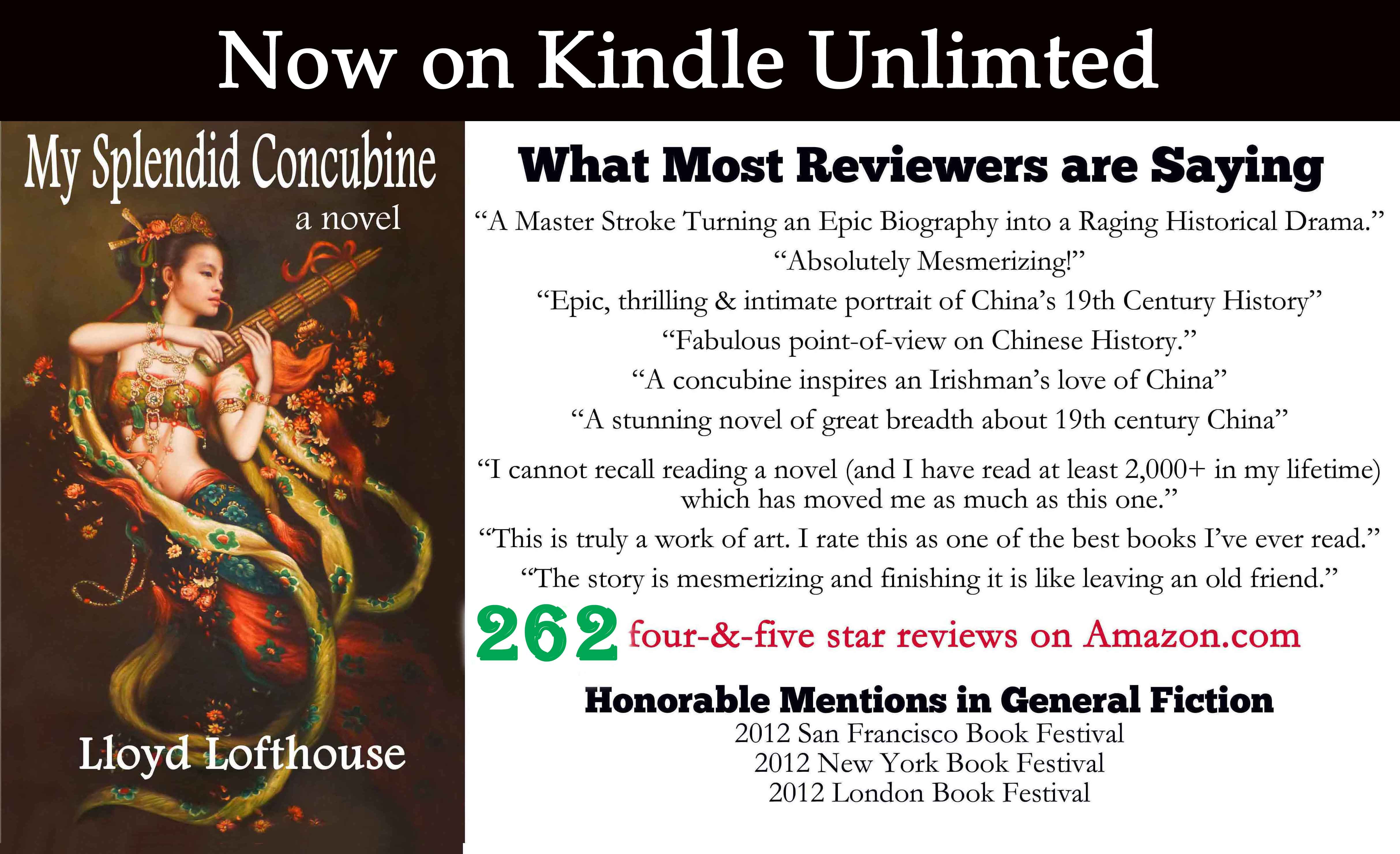
The reason I launched iLookChina in January 2010, was to build a social media platform to attract readers for “My Splendid Concubine”, my first published novel, and it worked. The 1st edition of the book was released in December 2007 and two years later the novel had sold 562 copies. By New Years of 2010, another 2,375 copies had been sold thanks to the blog. Fast forward a decade to February 2020, and Concubine has reached 64,399 readers (more if their copies were loaned to friends and family), and that is not counting the near quarter-million page reads through Kindle Unlimited.

This journey did not start in 2007. It started December 1999, when Anchee and I visited China together for the first time on our honeymoon. By then, I had already I started the nine years of research, writing, editing and revisions that led to the novel.

By the end of 2007, I thought I knew a lot about China. I could not have been more wrong. The truth was I didn’t know much at all as I was soon to discover.

That brings me to 2009, when I was a member of the California Writers Club (the 2nd oldest writers club in the United States), and I took an all-day workshop through the South Bay Branch of the club where we learned what we had to do to attract interested readers for our books.

Without word-of-mouth, readers are not going to find our books. We had to find the readers first.

In that workshop, we were told not to write about being writers as many authors do, but to write about something our book was a small part of. For me, that meant China. The instructor said if we wanted to be found on the first page of a Google search we had to publish 1,000 posts in the first year. I went home and did everything I had learned in that workshop and started posting three times a day until I hit the one thousand mark. Good thing I was a retired teacher by then, because that turned out to be more than a full-time job. After reaching 1,000 posts, I slowed down to one new post a day for the next few years before I ended up where I am now, once a week.

The first post was American Hypocrisy published on January 28, 2010. The first paragraph says, “Why am I writing about China? Simple—many Americans do not respect the differences between cultures. They say they do, but I don’t believe them. During the 2008-2009 school year, our daughter returned home one day to tell us that her history teacher talked about China and said the people had to be very depressed to live under a totalitarian government like the Communists.”

While China has an authoritarian one-party government, it isn’t a totalitarian state like North Korea, not even close, and I never met any Chinese depressed by their government during my trips to China. In fact, Shanghai turned out to be the Paris of Asia, a colorful, thriving city filled with life.

The day I launched the blog, I had been married to Anchee Min for a decade and had visited China nine times with my family to learn more about the country, its culture, and people, and even that wasn’t enough.

Long before the end of 2010, I ran out of stuff to write about by the time I reached the hundredth post. Most of what I knew about China was what I had learned while writing that historical fiction novel set in the middle of the 19th century. It was based on a true story and the main character was an Irishman named Robert Hart who was 19 when he arrived in China in 1854. Beginning as a student interpreter in the consular service, Hart arrived in China at the age of 19 and stayed for 54 years, except for two short leaves in 1866 and 1874. Hart has been credited as the most important and most influential Westerner in Qing dynasty China.

I had to learn more about China, or the blog was going to die a slow death. I started studying China’s history going back thousands of years. I wrote about the Great Wall, the Grand Canal, the first emperor, the different dynasties, the best emperors, the worst emperors, the inventions that came out of China, Chinese medicine, Daoism Confucianism, Buddhism, and the food, et al.

I also learned about China’s 1911 revolution, and Dr. Sun Yat-sen, known today as the Father of the Nation, both in Taiwan and Mainland China. Sun had been sent by his family to go to school in Hawaii as a boy where he learned about the U.S. Constitution. He returned to China as a young man and joined the revolution to replace the Qing Dynasty with a republic modeled on the United States but adapted to fit Chinese culture.  After several failures, Sun successfully recruited the Chinese Communist Party (CCP), the Nationalist Party, and other smaller parties to work together and form a multi-party republic.

Then Dr. Sun Yat-sen died unexpectedly in 1925 before the job was done, and the alliance he had built fell apart starting China’s long and brutal Civil War (1927 – 1949). The CCP did not start that Civil War. Chiang Kai-shek did that when he formed an alliance with the criminal triad gangs in Shanghai to destroy the newly forming labor unions and the young Chinese Communist Party that was organizing the unions. Without warning, Chiang Kai-shek’s troops, with help from Shanghai’s ruthless criminal triads, hunted down and executed, without trials, every member of the Communist Party they could find and the leaders of the labor unions along with the workers that had joined the unions.

To keep publishing posts and attracting readers interested in learning more about the real China, I had to keep learning, but I couldn’t do that by turning to the misleading, biased propaganda that often gets published and broadcast about China in the U.S. media. I had to find material published before 1911 and from other academic sources like from Australia, and the media from other countries like the BBC, France 24, and Al Jazeera English, headquartered in Doha, Qatar.

Since iLookChina’s launch, there have been more than 2,434 posts (most of them researched and written by me), 4,966 comments, and 802,366 hits (visitors). Sometimes I have paid a price when a China hating American accuses me of being an evil Communist and a traitor to the United States, because I strive to reveal the real China and not the fabricated one we often read about in the U.S. Media.

Lloyd Lofthouse is the award-winning author of My Splendid Concubine, Crazy is Normal, Running with the Enemy, and The Redemption of Don Juan Casanova.
Where to Buy

About iLook China


Who Deserves Credit for the First Vaccine?

April 1, 2020

Worst Pandemics in History reports that “25 million died from Bubonic Plague in 541-542 AD, and 75-200 million died from the Black Death in 1346-1353.” … The next huge death toll from a pandemic equal to the first two was Influenza in 1918 killing “20 – 50 million people.”

Because of these earlier pandemics, eventually, the first successful vaccines were created, and as the COVID-19 pandemic continues to spread around the world, a global race is on to create a vaccine to protect us from this one, too.

While Edward Jenner, an English physician, developed the first successful smallpox vaccine in 1796, did you know that he wasn’t the first one to inoculate for a viral disease?

The history of vaccinations started centuries before Jenner was born.

“Several accounts from the 1500s describe smallpox inoculation as practiced in China and India (one is referred to in volume 6 of Joseph Needham’s Science and Civilisation in China). Glynn and Glynn, in The Life and Death of Smallpox, note that in the late 1600s Emperor K’ang Hsi, who had survived smallpox as a child, had his children inoculated. That method involved grinding up smallpox scabs and blowing the matter into nostril. Inoculation may also have been practiced by scratching matter from a smallpox sore into the skin. It is difficult to pinpoint when the practice began, as some sources claim dates as early as 200 BCE.” — History of Vaccines.org

However, Britannica.com tells us “China has one of the world’s oldest medical systems. Acupuncture and Chinese herbal remedies date back at least 2,200 years, although the earliest known written record of Chinese medicine is the Huangdi neijing (The Yellow Emperor’s Inner Classic) from the 3rd century bce.”

“Newly discovered documents reveal that 2,200 years ago, Qin Shi Huangdi, China’s first emperor, put out an executive order to search for a potion that would give him eternal live.” — Live Science.com

Is it possible that the first emperor of China’s search for immorality might have also led to those alleged early inoculation attempts as early as 200 BCE? After all, the same desperate search by Huangdi’s alchemists accidently led to the discovery of gunpowder.

Lloyd Lofthouse is the award-winning author of My Splendid Concubine, Crazy is Normal, Running with the Enemy, and The Redemption of Don Juan Casanova.

Where to Buy

About iLook China


Remote Southwest China

March 4, 2020

Far from the Great Wall and the Grand Canal are the remote villages and towns of Southwest China.

Post Magazine reports, “Historically, this area, which spans the provinces of Guangxi, Guizhou, and Yunnan, was a hotbed of ethnic insurrection and separatist movements. The region proved so difficult to pacify that the Chinese have long dubbed it ‘the land of a hundred barbarians’ and even today, ethnic minorities, as well as local Han, eke out lives as removed from mainstream affairs as one can be in today’s China.”

While I have never visited Southwest China, a few years ago when my daughter was a student at Stanford University, she volunteered to travel to this area with a nonprofit that provided heart-related health care for poor children. The closest I came was when we flew to Southeast China and visited the Dragon’s Back and cruised along the Li River.

Southwest China is also where Pu’erh tea originated, and the beginning of the Tea Horse Road to Tibet.

In 225 A.D., when China was divided into the three kingdoms of Wei, Shu, and Wu, the prime minister of Shu led a military expedition to Yunnan. Historical records say that many of the Shu troops came down with eye diseases.  After they drank boiled Pu’erh tea, the troops recovered.

Wild China reports, “Deep in the heart of Southern Yunnan there exist tea trees unlike any other on Earth. The jungles of Xishuangbanna Dai Autonomous Prefecture and the districts of Simao and Lincang are home to the oldest tea trees in the world. In these regions grow tea trees that range in age from several centuries to over a millennium, and the tea that is made from their leaves is called Pu’er.

“Over the past 30 to 50 years, however, the number of these ancient trees has steadily decreased. Since China’s reform and opening-up policies were implemented in 1978, the Chinese tea industry has grown rapidly.” …

Lloyd Lofthouse is the award-winning author of My Splendid Concubine, Crazy is Normal, Running with the Enemy, and The Redemption of Don Juan Casanova.

Where to Buy

About iLook China


Frozen in China but the sky is Blue

January 1, 2020

Tourism is an important industry in China and if you prefer colder weather, like me, the place to go for winter fun is Harbin.

CNN Travel reports, “China has invested heavily in bringing commercial and tourist traffic to more remote regions of the country. ……… The city of Harbin hosts the annual Harbin International Ice and Snow Sculpture Festival, the biggest of its kind in the world. Every winter, visitors come from across China and the world to see the mammoth creations, which this year included a Buddha statue made from 4,500 square cubic meters of snow, and a 3-D light show reflected against the ice for dramatic effect.”

The festival originated in 1963. … In 2001, the Harbin Ice Festival was merged with Heilongjiang’s International Ski Festival and got a new formal name, the Harbin International Ice and Snow Sculpture Festival.


Sneak Preview of Harbin Snow and Ice World 2020

“More than 100 activities and events will be held in Harbin … The activities and events fall into several categories, namely ice and snow tourism, ice and snow culture, ice and snow fashion culture, ice and snow trade, and ice & snow sports.” ꟷ Ice Festival Harbin.com

The Atlantic reports that more than a million tourists visit Harbin to see the massive ice and snow sculptures.

China Daily.com reports, “The festival officially starts in January 5th every year, but the locals begin to celebrate the festival in the third week of December of the previous year because most of the ice lanterns, ice and snow sculptures are completed by this time. Depending on the weather conditions and activities, the festival usually last until the end of February.”

As of 2015, China is the fourth most visited country in the world, after France, the United States, and Spain, with almost 57 million international tourists per year. In 2017, tourism resulted in revenue of about USD 1.35 trillion, 11.04% of the GDP, and contributed to direct and indirect employment for more than 28-million Chinese.

The Chinese also like to travel outside of China. According to The Telegraph, in 2018, almost 150 million Chinese visited other countries. But domestic tourism adds up to almost 5.5 billion trips annually.

Lloyd Lofthouse is the award-winning author of My Splendid Concubine, Crazy is Normal, Running with the Enemy, and The Redemption of Don Juan Casanova.

Where to Buy

About iLook China


The Accident that led to Fireworks, Rockets, Cannons, Bullets, and Bombs

December 25, 2019

Do you know who is responsible for discovering what led to the fireworks we enjoy in the night sky on major holidays, like New Year’s Eve or the Lunar New Year?

Smithsonian says, “Around 200 BC, the Chinese unintentionally invented firecrackers by tossing bamboo into the fire, but it took another thousand years before true fireworks came alive. … Like many inventions, firecrackers fireworks were created by accident … and by the search for immortality.”

It would take more than a thousand years before this modern technology of war that was invented by accident ended up in the west.

Smithsonian also tells us in another piece, “The first known use of the military rocket occurred in 1232 when the Chinese used fei huo tsiang (flying fire lances) against Mongols besieging the city of Kai-fung-fu.”

If you Google ‘who invented the rocket,’ you will discover that Google gives credit to American Robert Hutchings Goddard, who did not invent the rocket. Goddard only improved on what the Chinese had already created almost seven hundred years earlier. The Chinese invented the first rocket that was powered with gunpowder. Goddard invented the world’s first liquid-fueled rocket in 1926, a different type of propellant that was easier to control.

After those ancient Chinese alchemists accidentally discovered gunpowder, “Centuries of trial and error refined the gunpowder formula, and alchemists likely stumbled upon the property of propulsion.”

When the fireworks soar into the sky around the world this New Year’s Eve, you will be witnessing “over 2000 years of danger, invention, and beauty wrapped into a simple package.”

When the sky lights up in splashes of color remember to give credit to “Emperor Wu Di of Ancient China’s Han Dynasty (156-87 B.C.).” Antiquitynow.org

Emperor Wu Di wanted to live and rule forever like many powerful men with a god complex, so he ordered his Taoist alchemists (the religious scientists of his empire) to research and discover a potion or elixir for eternal life. During that search for immortality, they discovered gunpowder.”

[yotube=https://www.youtube.com/watch?v=FkaxdGRgQgA]

A god complex is an unshakable belief characterized by consistently inflated feelings of personal ability, privilege, or infallibility.

Answer this question if you can: What modern-day world leader claims he is the “Chosen One”?

Often mentioned in science fiction and fantasy films and novels, the Chosen One is allegedly the sole person chosen by destiny to stop an impending disaster that threatens all life, save the world from a supervillain, and stop corruption.

If you have correctly answered the last question, you should know what the Bible says about God’s Chosen One: Timothy 2:5: “For there is one God, and there is one mediator between God and men, the man Christ Jesus …”

Modern-day mortal supervillains that have a god complex share characteristics of real-world dictators, gangsters, and terrorists, with aspirations of world domination or universal leadership.

Lloyd Lofthouse is the award-winning author of My Splendid Concubine, Crazy is Normal, Running with the Enemy, and The Redemption of Don Juan Casanova.

Where to Buy

About iLook China