I mentioned Hsuan-tsang (Xuanzang) when I wrote about China’s Three “Journey’s to the West”. However, in that post I did not go into detail about the real Buddhist monk who made the journey.
While doing some research about his life, I discovered an intellectual discussion at Philosophy and Marxism Today. If this topic interests you and you want to learn more about Buddhism I recommend reading this conversation between Thomas Riggins and Fred.
Thomas starts with, “I’ll start with background based on Chan’s introductory remarks.
“Hsuan-tsang (596-644) was quite a character. He entered a Buddhist monastery when he was thirteen. Then moved around China studying under different masters. Finally, he went off to India to study Buddhism at its source and with Sanskrit masters.
“He spent over ten years in India, wrote a famous book about his journey, and returned to China with over six hundred original manuscripts.
“He spent the rest of his life with a group of translators rendering seventy five of the most important works into Chinese. All of this work was sponsored by the Emperor of the newly established T’ang Dynasty (618 – 906 AD).”
The book I have on Hsuan-tsang says he lived from 602 to 664 AD.
_______________
Lloyd Lofthouse is the award-winning author of the concubine saga, My Splendid Concubine & Our Hart. When you love a Chinese woman, you marry her family and culture too.
The National Geographic special issue, “Water, Our Thirsty World” (April 2007) compares the world’s largest democracy, India, with China. In “The Big Melt” by Brook Larmer, we see a convincing reason why China’s mix of socialism and capitalism may be the world’s answer to avoid future calamities. Where Western style democracies stall due to partisanship, special interests, religious beliefs and political agendas, China’s government, ruled by engineers and scientists, appears to be planning decades ahead.
The claims by Tibetan separatists and their supporters that China rules over Tibet with an iron dictatorial fist also appears to be wrong when Larmer visits a family of Tibetan nomads. He writes, “There is no sign of human life on the 14,000 foot high prairie that seems to extend to the end of the world.” Larmer sees “the NOMADS’ tent as a pinprick of white against a canvas of brown.”
Tibetan Nomads
We meet Ba O, a Tibetan nomad. In Ba O’s tent, “there is a small Buddhist Shrine: a red prayer wheel and a couple of smudged Tibetan texts…” A few years earlier, Ba O had several hundred sheep and the grass was plentiful. Now the Tibetan nomad has about a hundred left and fears this way of life is ending.
Ba O says, “This is the way we’ve always done things. And we don’t want that to change.”
However, change is coming, and there is nothing Ba O can do to stop it. The change is not from China’s government. It is from global warming. The Tibetan grasslands are dying and a way of life that has existed for thousands of years may be dying too.
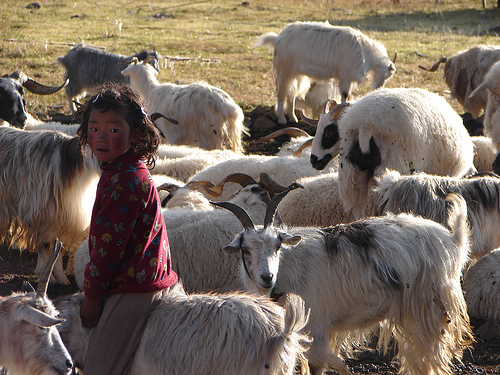
Tibetan girl tending sheep
To insure that the Tibetan nomads will have a place to live, China’s government has been building resettlement villages. The “solid built” houses are subsidized. When the Tibetan nomads can no longer survive on the open Tibetan prairie, it is the nomad’s choice to move into the new villages. The government does not force them to give up their old way of life. Nature does that.
Along with the house comes a small annual stipend for each family so they can eat as they find another way to earn a living. The home Larmer visited had a Buddhist shrine and a free satellite dish for a TV and maybe an Internet connection. In addition, the one child policy does not apply to the Tibetan people since they are a minority in China.
To make sure there will continue to be water to drink, China is planning to build 59 reservoirs in Tibet to capture and save glacial runoff.
In India, the young wife of a fortuneteller spends hours each day searching for water. She lives with her husband and five children in Delhi, India‘s capital. There are fights over water. In a nearby slum, a teenage boy was beaten to death for cutting into a water line. The demand for water in Delhi exceeds the supply by more than 300 million gallons a day.
Lloyd Lofthouse is the award-winning author of the concubine saga, My Splendid Concubine & Our Hart. When you love a Chinese woman, you marry her family and culture too.
If you want to subscribe to iLook China, there is a “Subscribe” button at the top of the screen in the menu bar.
Most people outside China only know of Beijing (once known as Peking) as the capital of China. However, another city was China’s capital for more than a thousand years.
In fact, Chang’ an (Xi’an) served as the capital for twelve dynasties, including the Western Zhou, Qin, Western Han, Sui and Tang dynasties, spanning more than eleven hundred years. It was also the cultural center of the Silk Road.
In 2008, the last time we visited Xi’an, subway construction was running behind schedule due to a law that does not allow the destruction of historical sites such as the tombs of emperors. There are so many of these tombs below ground that the subway tunnels must be diverted to avoid them resulting in delays.
With such a long history, the Discovery Channel produced a documentary of Xi’an (Chang’ an) called China’s Most Honourable City.
To discover Xi’an’s long history also teaches us much about China’s civilization. Discovery Channel’s Neville Gishford will take us on this historical journey leading to the present.
Gishford says, “It (Han Chang’ an) was more powerful than Rome. If any Roman army had actually gone there, they would have been absolutely annihilated.”
Han Chang’ an (Xi’an) was larger than Constantinople and richer than Egypt’s Alexandria. It was a fortress so powerful that even 20th century artillery could not knock its walls down.
In addition, the massive city wall is more than six hundred years old and longer than 12 kilometers. Cracks are appearing and an engineering team keeps close watch and makes repairs
However, the Xi’an of today was first build over two thousand years ago and has been three cities—not one. The Han Dynasty built the first city (Chang’ an), which is close to the modern city of Xi’an and the old eroding walls are still visible.
At 36 square kilometers, Han Chang’ an was more than one and a half times the size of Rome.
Earlier, I mentioned the subway system that was under construction in modern Xi’an.
For an update, Travel China Guide.com says, “The Xi’an subway system is scheduled to have 6 lines, with a total length of 251.8 kilometers… While the first phase of subway Line 2 has been in use since Sep 16, 2011, the other five lines are designed to be finished in 2018 in sequence.”
When the second phase is completed, the full length of Line 2 will be 26.64 kilometers (about 16.5 miles).
The population of Xi’an has also increased since Neville Gishford hosted the documentary for China’s Most Honourable City. Today, there are more than 8 million people living there.
This segment of Gishford’s documentary starts with Archaeologist Charles Higham, a world famous authority on ancient Asian cities.
Higham says, “A delegation of jugglers from Roman Emperor Marcus Aurelius (161-180 AD, who is regarded as one of the greatest emperors in Roman history) traveled and performed in the Han Court of Chang’ an.”
More than two thousand years ago, the walls of Chang’ an (Xi’an) were made of rammed (compressed) earth and much of the city from kiln fired clay bricks, which was a revolutionary building material at the time that changed the history of architecture.
The builders of Han Chang’ an (Xi’an) used this new technology in revolutionary ways such as building an underground sewer system connected to the moat that surrounded the city.
From the Qin to the Tang Dynasty, 62 emperors ruled China from Chang’ an (Xi’an). The China Daily says in and around Xi’an, there are about 500 burial mounds where the remains of emperors and aristocrats rest.
The largest tombs mark the passing of Emperors Qin Shi Huangdi (259 – 210 BC), Tang Gaozong (628 – 683 AD), and his wife Empress Tang Wu Zetian (624 – 705 AD).
When we left Neville Gishford‘s documentary, China’s Most Honourable City, in Part 2, Chang’ an was the capital of the Tang Dynasty (618 – 907 AD) with a population of over a million — six times the size of ancient Rome.
The Daming Palace, where the Tang Emperors ruled China, was 800 years older and nearly five times larger than Beijing’s Forbidden City. This huge palace was built in one year.
However, it wasn’t the Daming Palace that made Chang’ an (Xi’an) powerful. Long before Manhattan, Hong Kong, Paris and Dubai, Chang’ an was where the world came to shop.
Over a thousand years ago, the wealth of the West poured into China (and it is happening again) and arrived at Chang’ an over the Silk Road.
But wealth wasn’t the only thing China gained. Major religions also arrived in China at this time.
Islam was barely a century old, when Silk Road traders brought this religion to Chang’ an. In another post, A Road to the Hajj from China, I wrote, “The ancient city of Xi’an in Shaanxi province is home to about 60,000 ethnic Chinese Muslims.”
Xi’an claims it has a Muslim history going back thirteen hundred years when Islam was first introduced to China in 650 AD.
In fact, the oldest mosque in China was built in 685-762 AD in Chang’ an during the reign of Emperor Xuanzong of the Tang Dynasty.
Although Christianity and Islam were both introduced to China during the Tang Dynasty, Buddhism had deeper roots in the culture since it first arrived in China from India about 200 BC.
Christianity arrived in China in 635 AD (more than eight centuries after Buddhism and only a decade before Islam), when a Nestorian monk named Aluoben entered the ancient capital city of TangChang’ an.
Then in 629 AD, the Buddhist monk Xuanzang left Chang’ an against the emperor’s orders to travel the world in search of enlightenment. He went west toward India along the Silk Road with a goal to find original Buddhist scriptures. He traveled 10,000 miles over three of the highest mountain ranges in Asia and was gone 16 years.
When Xuanzang returned in 645 AD, he had 1,300 scrolls of Buddhist Sutras, and requested the building of a pagoda, which became the Giant Wild Goose Pagoda—nearly 65 meters tall (more than 213 feet). It was made of rammed earth, and the pagoda would collapse more than once and be rebuilt. No one knows exactly how the Tang Dynasty engineers managed to build a structure that tall of rammed earth.
Neville Gishford‘s Discovery Channel documentary, China’s Most Honourable City, reveals the answer to a mystery when a hidden crypt beneath the Giant Wild Goose Pagoda is discovered using ground based radar. When The Tang Dynasty collapsed due to rebellion, the city was destroyed, but the Giant Wild Goose Pagoda was left untouched.
Gishford reveals that even though TangChang’ an was destroyed, the city was copied throughout Asia and one city in Japan, Kyoto (formally the imperial capital of Japan – 794 to 1869 AD), was a scaled replica of Tang Chang’ an.
In fact, in 1974, the modern city of Xi’an and Kyoto formally established a sister-city relationship.
However, this was not the end of Chang’ an (Xi’an). It would be rebuilt a third time. In 1368, nearly five hundred years after the fall of the Tang Dynasty, the Ming Dynasty (1368 – 1643 AD) would rebuild the Great Wall in addition to Xi’an as a defense against the Mongols that had conquered and ruled China during the Yuan Dynasty (1277 – 1367 AD).
During the Ming Dynasty (1368 – 1643 AD), China mostly isolated itself from the world by rebuilding the Great Wall and a string of impregnable fortresses to protect China’s heartland from Mongol invasion.
One of those fortresses was a new military city built on the ruins of Tang Chang’ an, and the Ming named this city “Western Peace”—which in Chinese/Mandarin is “Xi’an”.
Xi’an was one-sixth the size of Tang Chang’ an, but nearly six hundred years later, its walls are still standing.
Charles Higham says these walls are the most extraordinary, largest, best-preserved set of defensive walls in the world.
The last segment of Neville Gishford‘s Discovery Channel documentary, China’s Most Honourable City, introduces Zheng Canyang, the engineer responsible for preserving Xi’an’s walls, and Zheng explains how the walls would have been defended.
History records that when the walls of this third city faced its first attack, they stood firm, but the attack did not come during the Ming or Qing Dynasties. It came five hundred years later from April to November 1926.
As China bled from the Civil War between warlords, the CCP and the KMT, a powerful Chinese general by the name of Liu Zhenhua attacked Xi’an with a large army and modern artillery.
However, the 20th century artillery rounds only dented the walls, and after months, Xi’an’s walls still stood and Liu Zhenhua’s army retreated.
The siege was part of an anti-Guominjun campaign lasting from late 1925 to early 1927, which raged across North China and had nothing to do with the civil war between CCP and KMT, explaining why this military campaign received no coverage in the popular media or academic circles. Source: A Study of the Siege of Xi’an and its Historical Significance by Kingsley Tsang
The newest enemy to Xi’an’s ancient walls comes from modernization and the millions of inhabitants of the city. As the water table below the city is sucked dry from so many people, this has caused the earth to sink, which is pulling down the walls, and engineers and scientists work to discover ways to save them.
______________
Lloyd Lofthouse is the award-winning author of The Concubine Saga. When you love a Chinese woman, you marry her family and culture too. This is the love story Sir Robert Hart did not want the world to discover.
Subscribe to “iLook China” Sign up for an E-mail Subscription at the top of this page.
I have an “old” friend who often takes conservative theories, opinions and conjecture fueled by emotions, and believes in them as if God wrote them with His own hand.
In addition, many people believe any claim if it supports their own biased opinions and will attack anyone that disagrees with them no matter how valid the evidence presented. However, when it comes to China, that reaction is understandable due to Western democracies partnership with capitalism, which is the polar opposite of communism/socialism.
It makes sense that many in the West will bend over backwards (even fabricate evidence) to demonize anything from a rival seen as evil that was already demonized for decades during the West’s Cold War with global communism. In addition, the West fought three wars with communism in Korea, Cuba and Vietnam. The first ended in a stalemate and the other two were lost.
In other words, prejudice in the West of any country linked to socialism/communism is hardwired to be biased.
In this case, Mao has been tried and convicted in the court of public opinion of the crime of mass murder based on exaggerated theories and opinions supported by inflated evidence.
I wrote on this topic before in China’s Great Famine (1959-1961) Fact of Fiction. That doesn’t mean I was finished with it. If you shake a few trees, something falls out and you learn something new and compelling on a controversial topic, it’s time to return to the subject.
This time, I went looking for recent books about China and ran into several titles that perpetuated the myth that thirty to forty-five million (or more) people died during the Great Leap Forward (GLF) when in fact there may have been no massive loss of life due to the GLF — at least not in the numbers the mostly biased Western theorists and sources keep inflating higher in book after book, which is an example of the old saying that if you tell a lie enough it grows like cancer into a malignant ruth.
droughts cause famines, people starve and die
In Hungry Ghosts: Mao’s Secret Famine (April 1998), Jasper Becker claimed, “Population statistics made public since 1979 reveal that at least 30 million people starved to death in the wake of Mao’s Great Leap Forward.”
However, in one sentence the US National Library of Medicine National Institutes of Health reveals that Becker’s claim is a fraud. “Though population, disease and mortality statistics of modern China are spotty and sometimes questionable, common consensus among the researchers is that since 1949 the public health situation in China has improved tremendously.”
Then in Catastrophe and Contention in Rural China (May 2005), Ralph A. Thaxton Jr. says, “This book documents how China’s rural people remember the great famine of Maoist rule, which proved to be the worst famine in modern world history.”
If we examine “modern world history”, Thaxton’s claim is easily dismissed.
To claim this famine on Mao’s watch was the worst in “modern world history” is false once we learn more of global famines and what “modern history” means.
In the West, “modern history” may describe the beginning of a new era, such as the European Renaissance (about 1420-1630).
The term “modern history” may also be marked by the beginning of the Industrial Revolution. If so, then “modern history” started between 1760 and 1830.
If we use 1760 as the beginning of “modern history”, then there are other famines that may claim the title of worst famine in “modern world history.” [Note: only famines with one million or more verified deaths will be listed here — there were many more than what’s on this page.]
In 1769 to 1773, there was the Bengal famine with 10 million deaths while India was part of the British Empire. To understand the British corruption that led to these deaths, I suggest reading Three Episodes in the Criminal History of the British Empire
In 1883-84, the Chalisa famine in India killed 11 million while India was still part of the British Empire.
Between 1810 and 1849, there were a series of four famines in China that took an estimated 45 million lives.
In 1845 – 1849, the Great Irish Famine killed more than one million people while Ireland was part of the British Empire.
Then in 1850 to 1873, because of the Taiping Rebellion in China, drought and famine caused the population of China to drop by over 60 million people. (Note: the Taipings were converted Christians influenced by Western religious beliefs and one goal of the rebellion was to convert China into a Christian nation.)
The Great Irish Famine manufactured by the economy of the British Empire
In 1866, the Orissa famine in India led to one million deaths from starvation, while India was still part of the British Empire.
Three years later in 1869, the Rajputana famine in India took another 1.5 million lives when India was part of the British Empire.
In Persia in 1870-71, famine took two million lives.
Between 1878 – 1880, there were famines in India, China, Brazil, Northern Africa and other countries. Thirteen million died in Northern China and more than five million in India, which was still part of the British Empire.
In 1921, famine in Russia took 5 million, while in 1937 another famine in China took the lives of another five million and then the Soviet famine of 1947 added one million more to the death toll.
The last major famine during British rule in India was the Bengal famine of 1943. It has been estimated that some three to five million people died. [Note: at this point, almost 60 million died of famines in the British Empire—You may want to read How the British Empire Starved Millions… to learn more.]
Then, when we look at the number of major famines that have hit China since 108 BC, there were 1,828 or one nearly every year in one province or another and the famines varied in severity (except for the last fifty years while China’s Communist Party has governed the nation).
Moreover, in 1958-61, not all of China suffered from the so-called great famine. The provinces that suffered were Shandong, Henan, Shanxi, Anhui, Jaingsu and Sichuan — six of the twenty-three provinces in China.
To blame the famine and all loss of life due to starvation on Mao and the Maoists during the Great Leap Forward (1958 -61) and claim it was murder is a false accusation and an injustice. Mao was not a saint, but he was not guilty of this.
Before I reveal new evidence to cast doubt on the claims of Mao’s Western critics, two more books blame Mao for the loss of life due to the famine.
In Mao’s Great Famine (September 2010), Frank Dikotter claimed, “that as many as 45 million Chinese died from starvation, execution, and maltreatment under forced labor.”
Then, in Eating Bitterness (February 2011), two editors that compiled this book claimed that some “30 million peasants died of starvation and exhaustion during the GLF”.
I find it interesting how two editors claim the loss life was from starvation and exhaustion while another author claimed it was from starvation, execution, maltreatment and forced labor with a difference of 15 million deaths, which is a huge disparity.
In addition, In Henry Kissinger’sOn China (pg 184), he says, “The Great Leap Forward’s production goals were exorbitant, and the prospect of dissent or failure so terrifying that local cadres took to falsifying their output figures and reporting inflated totals to Beijing.”
Kissinger says this led to the deaths of over twenty million people from starvation—twenty-five (25) million less than Dikotter’s inflated claim. Other’s have estimated the loss of life closer to 15 million and even as low as 3 million or less.
Famines throughout the Ages: 19th to 21st Century
It appears that as the false accusations and the fraud grows, so does the emotional language.
There is a name for books of this sort, and it is “Yellow Journalism” where writers take advantage of popular opinions and without valid evidence spread lies and exaggerations as if they were the truth. I’m sure those authors also laugh all the way to the bank.
Before I continue, I want to mention that in 1949, the average life expectancy in China was 36 and in 1960, it was 36.3 years of age, as you shall eventually see from a reliable source. It has been estimated that it took at least a decade for the Chinese Communist Party to establish a political/governmental infrastructure in all or most of China, which means goals to develop the country and improve health were not in full swing until about 1959. However, impelling evidence shows they were improving from the beginning.
As for how many starved, opinions abound and cover a wide spectrum and all the deaths above 20 million are easily challenged as two Amazon reviewers of Dikotter’s flawed and biased book demonstrate with impressive facts.
From these two Amazon reviewers, I learned something new.
Amazon reviewer W Y Lu of Hong Kong said, there is absolutely no evidence the atrocities Dikotter mentions were ordered from the top. In fact, quite the opposite – they were often uncovered, even by Dikotter’s own admission, by investigatory teams sent out by the central authorities (Note — and later by members of Mao’s personal bodyguard sent to verify the claims of starvation Mao was hearing from Party members, which he doubted at first, since “local cadres took to falsifying their output figures and reporting inflated totals to Beijing”.)
Lu says, the fact is, even using Dikotter’s figures (grossly inflated as they are), China’s mortality during the Great Leap Forward (GLF) was in fact slightly lower than that of India’s at the end of British rule – just 9 years earlier.
“The calculation is very simple,” Lu says. ‘Excess’ deaths are calculated by counting all the deaths that happen in one year, and subtracting them from a mortality the researcher assumes would have been the case had the GLF not happened. ”
Dikotter adopts a ‘normal’ crude mortality in China of 10 per 1000 people annually. He then counts deaths above this number as the excess deaths caused by Mao’s GLF.
facts about extreme poverty and hunger
Lu then points out that Dikotter also increased (inflated) the mortality numbers by 50% to allow for under-reporting (assuming there was any) and came up with an average annual mortality of around 27.3 per 1000 during the GLF.
However, Lu then says, “A crude mortality of 27.3 per 1000 in the late 50s & early 60s was in fact quite typical for developing countries. ”
Lu then points out that India and Indonesia’s mortality rates were 23 and 24 per 1000 respectively, and China’s mortality in 1949, just 8 years before the Great Leap Forward was 38 per 1000 (Source: China’s Changing Population by Judith Banister published by Stanford University Press).
In her well researched work, Banister mentions evidence that a famine did take place in China at this time due to reduced fertility rates but says the fertility rate rebounded at least one year earlier than would be expected on the basis of grain production statistics, which can only be explained if supply and distribution of food improved considerably during 1961 as the government imported grain (from Canada and Australia—both allies of the US that broke ranks with the complete American embargo of China) and tried to ensure minimum supplies in famine areas.
In addition, Banister’s data makes it clear that the death rates for China in the years 1958, 1959, and 1961 were certainly far below anything known in China previously and loss of life from famine took place only in 1960 and was dealt with in 1961 once Mao and Beijing recognized the truth.
To wrap up his rebuttal, Amazon reviewer W Y Lu of Hong Kong says, Dikotter gets his 45 million by (a) inflating mortality rates gleaned from the archives by 50%, and (b) assuming a ridiculously low ‘normal’ death rate (the same as developed countries in the West) – even though China throughout the 1950s was one of the most wretchedly poor countries on earth.
A second review by M Chen uses similar evidence to refute Dikotter’s bogus claims of what happened in China during the GLF as mass murder.
Chen says 10 per 1000 deaths annually was the mortality rate in the advanced industrialized West in 1960, while mortality rates for the other big Asian countries in 1960 for India was 24 per 1000, Indonesia 23 per 1000, and Pakistan 23 per 1000
Chen says, “Dikotter claimed the GLF started early 1958 and ended in late 1962.” However, Judith Banister proved that theory false showing that the famine ended as early as 1961, while other valid evidence proves the droughts and floods that caused the famine and loss of life didn’t hit until 1959.
If China lowered the mortality rate between 1949 and 1958 from 38 per 1000 to 10 per 1000, a miracle must have taken place because the mortality rate Dikotter claims as normal for China was lower than the UK (11.5 per 1000) and France (11.4 per 1000) in 1960.
In addition, World Life Expectancy.com shows that in 1960, life expectancy in China was 36.3 years while India was 42.3 and Indonesia 41.5, which supports the higher mortality rate in China that Lu and Chen defend.
World Life Expectancy.com (WLE) shows that in one decade between 1960 and 70 (Mao did not die until 1976), life expectancy in Indonesia was 47.9, India 49.3 and China 61.7.
Did you do the math and see the results of Mao’s policies regardless of the suffering during the GLF and the Cultural Revolution? From 1960 to 1970, China added 25.4 years to life expectancy while Indonesia only added 6.4 years (six “point” four in case you missed the dot) and India seven years.
Then by 1980, Indonesia was 54.8, India 55.7 and China 65.5.
In 1990, Indonesia was 61.7, India 59.7 and China 68.3.
In 2000, Indonesia was 67.5, India 62.5, and China 71.4
In 2010, Indonesia was 71.1, India 66.5 and China 74.5
NCBI.gov (the US National Institute of Health) says, “Since the establishment of a new social order in 1949, China’s attempts to feed and nurture its large population has been a topic of serious study in many disciplines… In 1949, the life expectancy in China was only 36 years. By the early 1980s, it increased to 68 years.”
Since the NCBI says life expectancy in 1949 was 36 years and in 1960, it was 36.3 years (according to WLE), it is safe to say that the mortality rate in China in 1960 was still closer to 38 per 1000 and not 10 per 1000 as Frank Dikotter, the author of “Mao’s Great Famine” claims.
This increase in life expectancy is attributed mostly to improved nutrition and lowering of mortality rates due to decreases in infectious diseases. In fact, during the most dramatic gains in life expectancy, Mao ruled China (1949 – 1976).
Overwhelming facts from reliable sources show that Mao’s policies increased life expectancy and decreased mortality rates during the era he ruled, which included the Great Leap Forward and the Cultural Revolution.
That does not mean suffering did not take place but it does prove that even during hard times, life expectancy in China (on average) improved dramatically while mortality rates dropped.
mentions the British caused famines in India/Ireland and who really managed the Great Leap Forward in China
In addition, this video makes a case that only three million may have died from the famine.
After reading Lu and Chen’s figures, which were supported by Judith Banister’s scholarly and well researched work, China’s Changing Population (Stanford University Press – 1987), along with facts from the WLE and NCBI.gov, I sat down with my wife, who as a child grew up in Shanghai during the GLF and experienced the Cultural Revolution first hand. She lived with hunger but only remembers hearing of a few people that died of starvation in rural China and never saw anyone starving to death in Shanghai.
When I asked my wife her opinion, she doubted if the number of people that died of starvation in China during the GLF were anywhere near the massive numbers Western authors such as Frank Dikotter claims.
My wife then mentioned a few memoirs (published in Mandarin) she had read of troops from Division A-341 of the People’s Liberation Army (PLA), which guarded Mao, the Forbidden City (where Mao lived) and Beijing during the GLF.
The memoirs of a number of Mao’s personal PLA bodyguards from Division A-341 revealed that when Party members told Mao that rural Chinese in a few provinces were starving due to droughts and low crop yields, Mao did not believe what he was told.
However, to verify these claims, Mao sent people he trusted [troops from PLA Division A-341 that came from rural China] to their villages to investigate the claims of famine.
one in eight children in the United States go to bed hungry daily
When Mao’s trusted bodyguards returned in late 1960 or early 1961 and reported that the claims were true, Mao acted swiftly, cancelled the GLF several years early sending the peasants back to their villages from the larger collectives, and directed the Party to seek help from other countries to feed the people.
As my wife said, (due to Piety—considered the First of all Virtues, which I wrote of here) the Party would never have ordered an end to the GLF without Mao’s permission. The orders had to come from Mao and according to the memoirs of his personal bodyguards, he was the one that made the decision to end the GLF, five-year plan early and have China ask for outside help, which started to arrive from Canada and Australia in 1961.
In fact, Roderick MacForquhar wrote in his book, The Origins of the Cultural Revolution, that in May 1961, China entered into long-term arrangements with Canada and Australia to insure grain supplies until production in China recovered in addition to imports of American grain laundered through France to avoid the complete American embargo.
MacFarquhar makes it clear that drought, typhoons, plant disease and other forms of natural disaster were the principal cause of the famine of 1960.
More than one book has examined this topic from a scholarly perspective (instead of inflammatory unsubstantiated claims), but Mao’s Western critics have mostly ignored this work.
In China: Land of Famine (published in 1926 by the American Geographical Society) by Walter H. Mallory , we have a book that casts doubt on the inflammatory claims, which have been popularized in the West about the post-1949 Mao era. Mallory offers another perspective for understanding what really may have happened during Mao’s GLF.
Then from Stanford University Press, in the Economic Cold War by Shu Guang Zhang (August 2002), “the author argues that while the immediate effects (of the complete American embargo of China) may be meager or nil, the indirect and long-term effects may be considerable; in the case he reexamines, the disastrous Great Leap Forward and Anti Rightist campaign (The Cultural Revolution) were in part prompted by the sanctions imposed by the United States and its allies.”
In other words, if the West had been supportive of China by ending its complete embargo after the Korean Conflict (1950-1953), these events may never have taken place.
Once all the facts are taken into consideration and weighed without bias and emotional baggage, there is only one conclusion to reach regarding the editors of “Eating Bitterness” and the authors of “Hungry Ghosts: Mao’s Secret Famine“, “Catastrophe and Contention in Rural China” and “Mao’s Great Famine“.
These books are frauds supporting a hoax.
It is also a fact that there are millions of people with closed minds that will refuse to accept this verdict that if Mao was guilty of anything, he was guilty of distrust and/or incompetence and not murder — at least not the deaths from the famine that took place during the GLF in the land of famines.
If you have watched the nine videos embedded with this series, ask yourself, who is guilty of murder by starvation today? That “old” friend of mine I mentioned earlier is against abortions and believes we should trust in God in all things, which is based on this “old” friend’s interpretation of the Bible.
World Hunger.org reports, “Poor nutrition plays a role in at least half of the 10.9 million child deaths each year, which is more than five million deaths.” This means every four years, the number of children that die from hunger in the world equals the number of people that died of famine and starvation in China during the GLF.
In fact, between 13 and 18 million men, women and children die of starvation each year, which is one person every three and a half seconds.
Nevertheless, World Hunger.org says, “The world produces enough food to feed everyone. World agriculture produces 17 percent more calories per person today than it did 30 years ago, despite a 70 percent population increase.”
Ask yourself, will God feed the thousands that starve in the world daily, while 75% of Americans are overweight and 25% are obese?
Meanwhile, a few well-fed authors are writing books that perpetuate a hoax about Mao, who has been dead for 35 years, so who will they blame next? Maybe they should look in a mirror.
From Griffith University, Australia, Poverty, by David C. Schak, Associate Professor
______________
Lloyd Lofthouse is the award-winning author of The Concubine Saga. When you love a Chinese woman, you marry her family and culture too. This is the love story Sir Robert Hart did not want the world to discover.
Subscribe to “iLook China” Sign up for an E-mail Subscription at the top of this page.


 Posted by Lloyd Lofthouse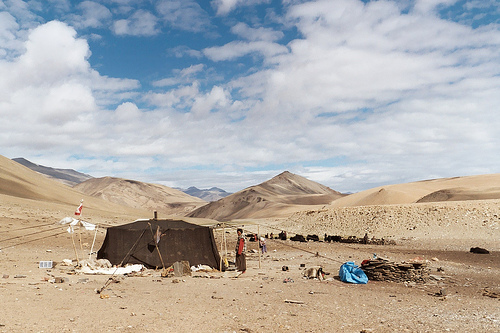
 iLook China