China’s Bloody History with Japan

September 19, 2010

For the second day in a row, I’ve read about the captain of a Chinese boat that collided with a Japanese patrol ship in waters both China and Japan claim they control. Source: Guardian.co.uk

Poor relations with Japan started as far back as 1840, when Japan joined the British, French and Americans during the Opium Wars to gain concessions from China.

In 1843, under the agreement of the Nanjing Treaty, Shanghai became one of five treaty ports to be turned into a colonial city that would be under control of foreign countries—Great Britain, France, America and Japan. Source: McGill.ca

Until 1871, the Japanese had never had much contact with the Chinese. Getting to know the Chinese led to a Japanese opinion that the Chinese were ethnically inferior since they were different from the Japanese and most Japanese haven’t changed their minds to this day.

In 1884, Japanese and Chinese troops faced off in Korea, which ended in a lopsided stalemate in Japan’s favor.

In 1894, Japan and China fought their first war over Korea. Like Tibet, Korea had been a tributary state of China for centuries.

China was defeated in 1895 losing Korea as a tributary and a large portion of Eastern Manchuria.

Then in 1870, Japan annexed the islands of the Ryukyu Kingdom, which had also been a tributary to China.

A Ryukyuan envoy even begged England for help but the British ruled that the islands should belong to Japan instead of China.

On July 7, 1937, Japan launched a war to conquer China. Over the next 8 years, Japan would occupy most of China.

In fact, Japan has never apologized for The Rape of Nanking and other atrocities during World War II that resulted in millions of Chinese deaths.

“The Chinese have resented the Japanese ever since Japan conquered and occupied China in the 1930s and 40s. The Japanese prime minister’s yearly visits to a Tokyo shrine for war veterans has always played in China as a reminder of Japan’s wartime brutality and continued lack of remorse.” Source: U.S. News & World Report

Long memoires and hard feelings still smolder and sometimes ignite into flames. Since China has risen from the ashes, Japan should walk softly around the mighty reborn dragon.

______________________________

Lloyd Lofthouse is the award-winning author of My Splendid Concubine [3rd edition]. When you love a Chinese woman, you marry her family and culture too. This is the lusty love story Sir Robert Hart did not want the world to discover.
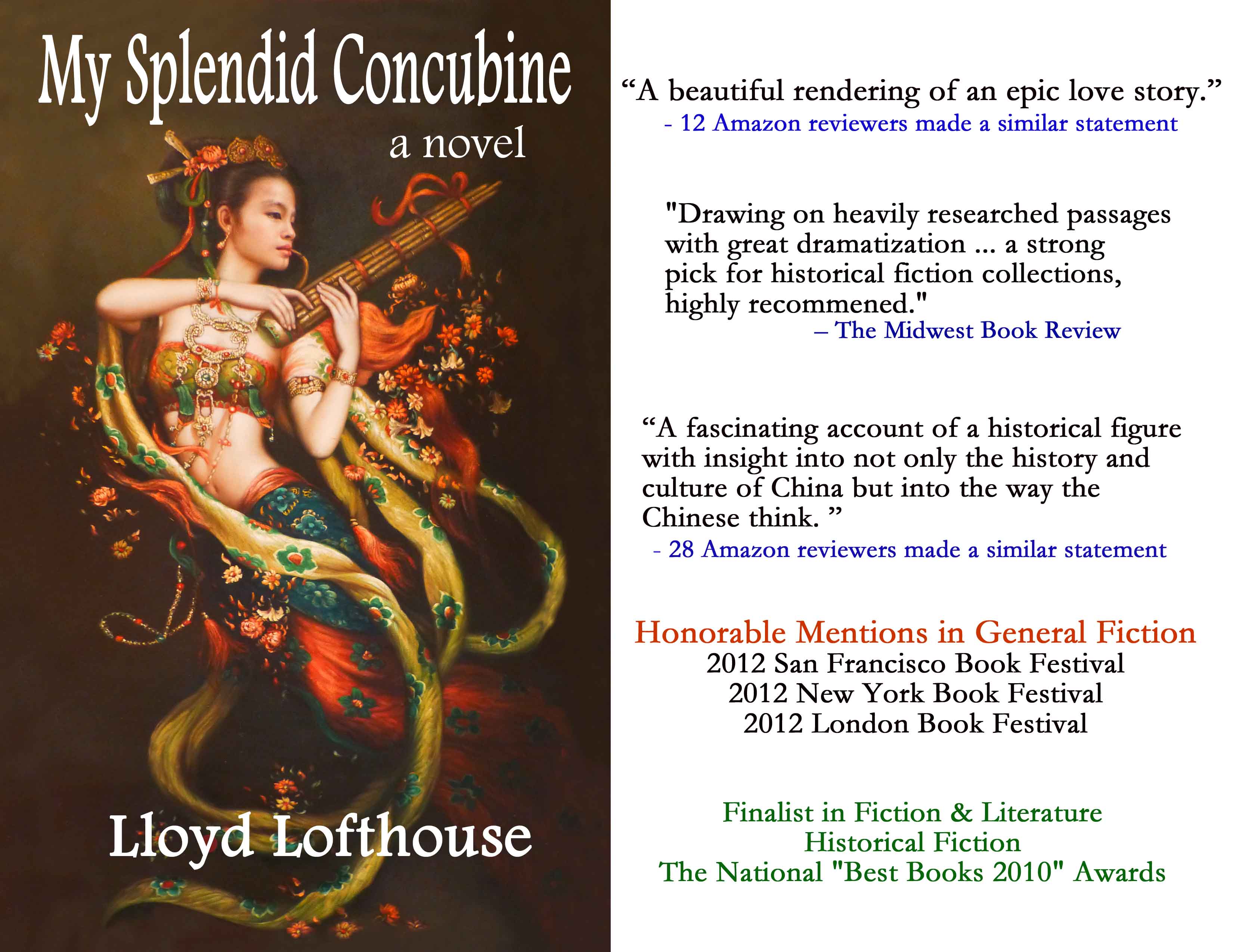
2015 Promotion Image for My Splendid Concubine

Subscribe to “iLook China”!
Sign up for an E-mail Subscription at the top of this page, or click on the “Following” tab in the WordPress toolbar at the top of the screen.

About iLook China

China’s Holistic Historical Timeline


In Search of the Tomb of Cao Cao – Part 1/3

September 19, 2010

Knowing the country’s history helps to understand China today. The Romance of the Three Kingdoms was a historical novel written by Luo Guanzhong in the 14th century. 

The novel is based on events in the turbulent years near the End of the Han Dynasty when China fell into chaos and anarchy. The Three Kingdom era of China started in 169 AD and ended with the reunification in 280 AD.

Similar events took place in China after the Qing Dynasty (1644 – 1911 AD) collapsed eventually ending in the Communists ruling the mainland in 1949. See The Roots of Madness

The man credited for reuniting China when the Han Dynasty ended was Cao Cao (155 – 220 AD).

According to the historical records, Cao Cao was a brilliant ruler and a military genius. However, in literature and opera, Cao Cao has often been portrayed as a cruel and despotic tyrant—an image of a Chinese ruler unique in history.

What was Cao Cao really like?

For centuries, the search for Cao Cao’s tomb was unsuccessful.

At the time, there was the Kingdom of Wei, Shuhan and Wu. Cao Cao ruled Wei in Northern China.

Soon after his death, Wei defeated the other kingdoms and reunified China establishing the Western Jin Dynasty (265 – 420 AD).

When the war to reunify China began, Cao Cao had the smaller force—10,000 troops against 100,000.

See The Han Dynasty

______________

Lloyd Lofthouse is the award-winning author of the concubine saga, My Splendid Concubine & Our Hart. When you love a Chinese woman, you marry her family and culture too. 

If you want to subscribe to this Blog, there is a “Subscribe” button at the top of the screen in the menu bar.


Careful Dreaming

September 17, 2010

Trying to understand our dreams is as old as history.

Three thousand years ago, Grandmaster Zhou Gong, who lived during the Zhou Dynasty, wrote the book of Auspicious and Inauspicious Dreams.

Freud-Sigmund.com says, Zhou Gong’s book “is a book that is commonplace in a lot of houses of Chinese people.” 

When someone wakes up and wants to know the meaning of a dream, he or she opens that book.

Zhou Gong wrote that there were seven dream categories. For example, if you dream of the sun or moon rising, your family will be prosperous, educated and have good jobs. 

However, if you dream of dirty clothing covered with mud, your wife’s pregnancy will be challenging.

This video is a short documentary about Chinese interpretations and the meanings of dreams in relation to past lives.

Selfgrowth.com has a post that goes into detail with examples of Zhou Gong’s categories.  The interpretations range from good luck to bad. 

There’s also a book on Chinese Medicine that has a section about how dreams help with a medical diagnosis. 

Sad dreams are due to a deficiency of ‘qi’ in the heart and liver or of ‘yin’ in the liver meaning, you might have liver disease and tuberculosis. Source: Absolutely Feng Shui

See Chinese Herbalism

______________

Lloyd Lofthouse is the award-winning author of the concubine saga, My Splendid Concubine & Our Hart. When you love a Chinese woman, you marry her family and culture too. 

If you want to subscribe to this Blog, there is a “Subscribe” button at the top of the screen in the menu bar.


The Challenge of Evolution – Adapt or Perish

September 17, 2010

I’m reading Living With Evolution by K. D. Koratsky.  It’s heavy reading and reminds of university textbooks that threatened to put me to sleep while words blurred and paragraphs become forgotten broken records.

My usual reading time is a half hour or so before sleep and I was getting nowhere.

Then I came up with a tactic that worked.

In the morning when I peddle three miles on the stationary bike during daily exercise, I read from Koratsky’s book and what he says is riveting even if it is like slogging through thick oatmeal.

Koratsky has done his homework and the in-depth weaving of details covers the beginning of life billions of years ago and builds to today.

Too bad for the devoutly religious, who firmly believe that the universe and all life started about six thousand years ago with the wave of God’s magic wand.

It baffles me how people hold onto such beliefs. It must be fear and/or denial.

There is too much evidence that says otherwise, and Koratsky’s book spells it out in excruciating detail.

In addition, idealists who believe humanity can evolve into a peace-loving global community where no one suffers or goes hungry while crime is nonexistent and everyone is having fun is in for a BIG disappointment.

In chapter five, Koratsky writes about what happened after North America and South America bumped into each other millions of years ago and fused.

South America has been isolated for millions of years and there hadn’t been much of a challenge for the species that developed there so they had not evolved.

However, life forms in North America had been forced to evolve to survive contact with Asia and Europe and were stronger because of it.

Evidence shows that life from South America couldn’t compete with life from a stronger North America and was all but wiped out.

What I read caused me to think of the West’s invasion of China, which started with the Opium Wars early in the 19th century. 

Then for more than a century, the Chinese struggled to survive as the British Empire, the French, Germans, Portuguese, Russians, Japanese and Americans poured in and waged war with Chinese Culture threatening it with extinction.

To survive, China had to evolve or be swallowed by Western culture becoming a second class citizen.

After the Communists won the struggle against Chiang Kai-shek’s nationalists in 1949, the metamorphosis began. Under Mao, China wove a cocoon around itself cutting off the world with the bamboo curtain.

During the Great Leap Forward and the Cultural Revolution, China went through drastic and painful changes to evolve into a different civilization—one strong enough to survive in a brutal, complex, competitive modern world.

Some will disagree.  He or she will ask, “How can the horrors that took place in China under Mao be called part of the evolutionary process of survival?”

However, once you read about how species that cannot adapt with drastic environmental changes perish, the skeptics might understand what happened. 

Evolution and Mother Nature do not care about humanity or how many suffer. 

When the global environment changes drastically, death, destruction and extinction are a byproduct and humanity is not exempt from that process. 

See The Roots of Madness

______________

Lloyd Lofthouse is the award-winning author of the concubine saga, My Splendid Concubine & Our Hart. When you love a Chinese woman, you marry her family and culture too. 

If you want to subscribe to this Blog, there is a “Subscribe” button at the top of the screen in the menu bar.


A Forbidden City Connection to Tibet Revealed

September 14, 2010

Since the Western media is often critical of China and often exaggerates events in Tibet to make China look bad, I was surprised while reading The Last Secrets of the Forbidden City Head to the U.S. by Auston Ramzy.

I was surprised that evidence like this slipped past the Western media censors—sorry, in the West they are called editors.

The TIME piece was about an exhibit traveling to the United States with treasures from the Forbidden City that have not been seen since 1924.

I read, “Many of the 18th century objects that will be displayed are symbols of the emperor’s devout Buddhism. They include a hanging panel filed with niches that hold intricate figurines of Buddhas, deities and historical teachers from the Tibetan Buddhist sect to which [Emperor] Qianlong belonged.” See Buddhism in China

I didn’t know the powerful Qianlong Emperor followed the teachings of Buddhists from Tibet. There are four Buddhist sects in Tibet. The Dalai Lama is the spiritual leader of one of the four, the Yellow Hat sect.

Why would the Qianlong Emperor belong to a Tibetan sect of Buddhism if Tibet were not considered part of China at the time? There is even evidence that Tibetan Buddhist monks traveled to the capital of China to serve the emperors.

I saw this as more evidence that proves China considered Tibet a vassal state or tributary.  In fact, Yuan, Ming and Qing Dynasty troops are known to have occupied Lhasa over the centuries.

I’ve written about primary evidence from the October 1912 National Geographic Magazine that described how the Imperial government in Beijing managed a difficult Tibet, and I’ve mentioned letters Sir Robert Hart wrote in the 19th century that also mention Tibet as part of China.

In 1890, a Convention between Great Britain and China was signed—more proof that China considered Tibet part of its realm and Great Britain agreed.

Yes, Tibet did declare freedom from China in 1913 soon after the Qing Dynasty collapsed and China fell into chaos and anarchy while warlords fought over the spoils.

The British Empire convinced Tibet to break from China. 

It is also a fact that in 1950, after World War II and the end of the rebellion between Chiang Kai-shek’s Nationalists and Chinese Communists that Mao invaded Tibet and reoccupied what the Chinese considered a breakaway province as mainland China still considers Taiwan.

_______________

Lloyd Lofthouse is the award-winning author of the concubine saga, My Splendid Concubine & Our Hart. When you love a Chinese woman, you marry her family and culture too. 

If you want to subscribe to this Blog, there is a “Subscribe” button at the top of the screen in the menu bar.