The Classical Gardens of Suzhou

March 18, 2020

UNESCO.org says, “Classical Chinese garden design, which seeks to recreate natural landscapes in miniature, is nowhere better illustrated than in the nine gardens in the historic city of Suzhou. They are generally acknowledged to be masterpieces of the genre. Dating from the 11th-19th century, the gardens reflect the profound metaphysical importance of natural beauty in Chinese culture in their meticulous design.”

The city of Suzhou has more than 2,500 years of history and was once part of the empire of Wu. The empire occupied the area in eastern China around Nanjing. Wu was one of the three major states that competed for supremacy over China after the Han Dynasty fell. The Three Kingdoms period of China took place between 220 – 280 AD.

Suzhou is located in the southern portion of Jiangsu province about fifty miles from Shanghai along the old Grand Canal. By the 14th century, Suzhou was established as the leading silk producer in China. Suzhou is also known for Kun Opera with roots in folk songs from the mid-14th century.

The Japanese art of bonsai originated in the Chinese practice of penjing (盆景). Penjing is known as the ancient Chinese art of depicting artistically formed trees, other plants, and landscapes in miniature.

Suzhou’s famous gardens were destroyed three times. The first time was during the Taiping Rebellion (1850 – 1864). Then the Japanese invaded China during World War II, and the gardens were destroyed a second time. During Mao’s Cultural Revolution, many of the gardens were destroyed a third time.

It wasn’t until 1981, several years after Mao’s death, when Deng Xiaoping ruled the Communist Party, that the gardens were rebuilt.

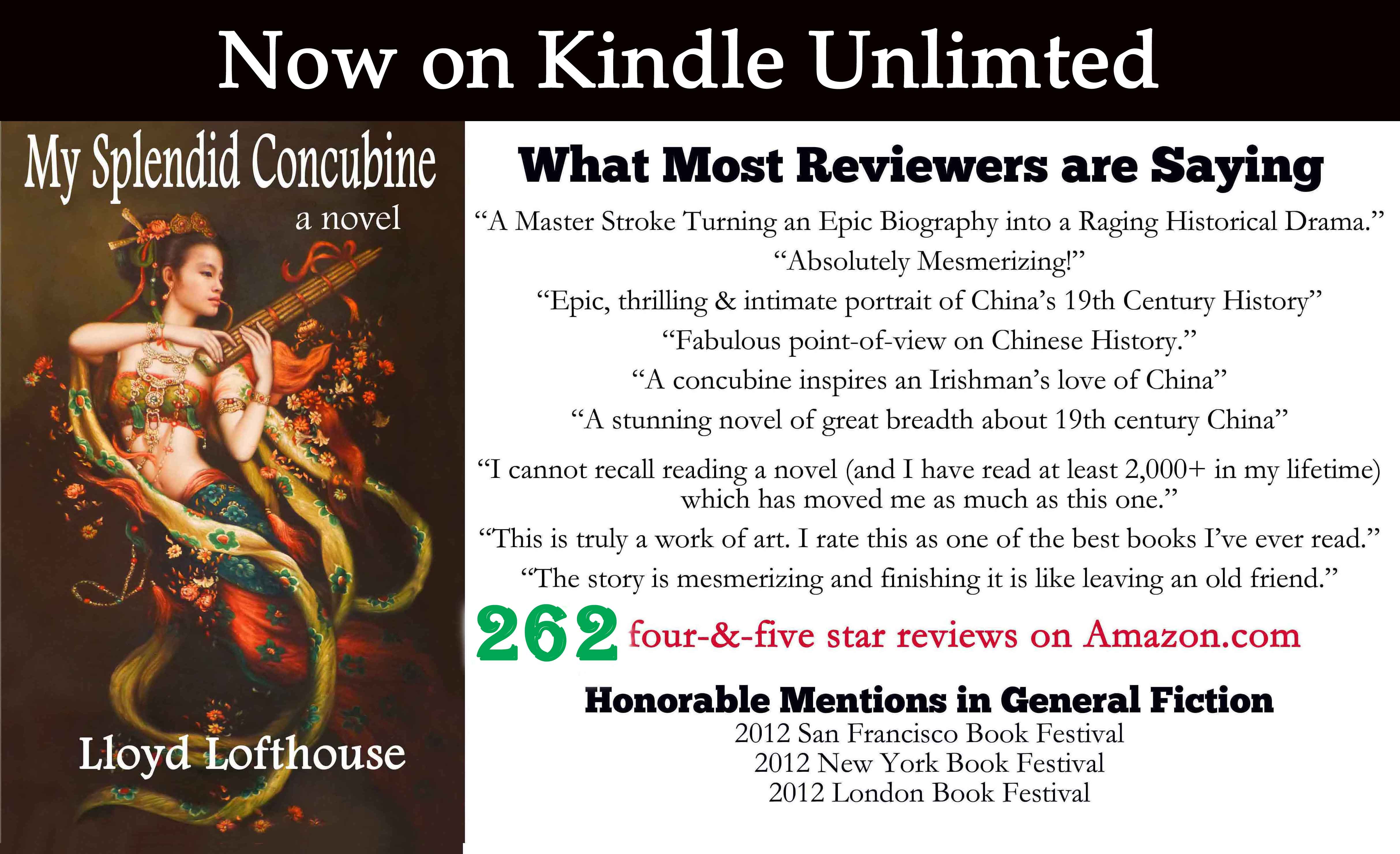
Lloyd Lofthouse is the award-winning author of My Splendid Concubine, Crazy is Normal, Running with the Enemy, and The Redemption of Don Juan Casanova.
Where to Buy

About iLook China


Remote Southwest China

March 4, 2020

Far from the Great Wall and the Grand Canal are the remote villages and towns of Southwest China.

Post Magazine reports, “Historically, this area, which spans the provinces of Guangxi, Guizhou, and Yunnan, was a hotbed of ethnic insurrection and separatist movements. The region proved so difficult to pacify that the Chinese have long dubbed it ‘the land of a hundred barbarians’ and even today, ethnic minorities, as well as local Han, eke out lives as removed from mainstream affairs as one can be in today’s China.”

While I have never visited Southwest China, a few years ago when my daughter was a student at Stanford University, she volunteered to travel to this area with a nonprofit that provided heart-related health care for poor children. The closest I came was when we flew to Southeast China and visited the Dragon’s Back and cruised along the Li River.

Southwest China is also where Pu’erh tea originated, and the beginning of the Tea Horse Road to Tibet.

In 225 A.D., when China was divided into the three kingdoms of Wei, Shu, and Wu, the prime minister of Shu led a military expedition to Yunnan. Historical records say that many of the Shu troops came down with eye diseases.  After they drank boiled Pu’erh tea, the troops recovered.

Wild China reports, “Deep in the heart of Southern Yunnan there exist tea trees unlike any other on Earth. The jungles of Xishuangbanna Dai Autonomous Prefecture and the districts of Simao and Lincang are home to the oldest tea trees in the world. In these regions grow tea trees that range in age from several centuries to over a millennium, and the tea that is made from their leaves is called Pu’er.

“Over the past 30 to 50 years, however, the number of these ancient trees has steadily decreased. Since China’s reform and opening-up policies were implemented in 1978, the Chinese tea industry has grown rapidly.” …

Lloyd Lofthouse is the award-winning author of My Splendid Concubine, Crazy is Normal, Running with the Enemy, and The Redemption of Don Juan Casanova.

Where to Buy

About iLook China


It takes Faith to believe in something Science cannot explain

February 12, 2020

It takes faith to believe in God because there is no hard evidence that He exists. Belief in astrology also takes faith. Berkeley.Edu’s Understanding Science reports, “Although astrologers seek to explain the natural world, they don’t usually attempt to critically evaluate whether those explanations are valid — and this is a key part of science.”

Astrology: East vs West

In the East, the Chinese Zodiac, known as Sheng Xiao, is based on a twelve-year cycle, each year in that cycle relates to an animal sign. These signs are the rat, ox, tiger, rabbit, dragon, snake, horse, sheep, monkey, rooster, dog and pig, and first appeared in the Zhan Guo period [5th century B.C.].

The Chinese zodiac was officially identified during the Han Dynasty [206 B.C.–9 A.D.]. “The zodiac was based on Chinese astrology and was used as a way to count years, months, days, and hours in the calendar. It was formed from two components: the Celestial Stem and the Terrestrial Branch. Each of the 12 animals stands for a year in a 12-year cycle, a day in a 12-day cycle, and for every two hours in a 24-hour day. These were used to name each year along with the animal signs, but now they mainly just use the dates.” – The Chinese Zodiac Washington.edu

My Chinese Zodiac Sign is the Rooster.

As a Rooster, it is alleged that I am “foresighted, ambitious, meticulous, and independent. The Rooster is the representative of confidence and intelligence. People who are born in the Years of the Rooster usually share lots of common personality traits such as being responsive, distinctive, smart, and earnest.”

In the West, the twelve astrological signs are Aries, Taurus, Gemini, Cancer, Leo, Virgo, Libra, Scorpio, Sagittarius, Capricorn, Aquarius and Pisces. These signs are based on the twelve 30° sectors of the ecliptic, starting at the vernal equinox (one of the intersections of the ecliptic with the celestial equator), also known as the First Point of Aries.

Alexander the Great [356 BC – 323 BC] is attributed with the spread of astrology to Egypt and India. He is known to have consulted astrologers and to have them counted among his entourage during his campaigns. Alexander is responsible for the cross-fertilization of Greek, Persian, Mesopotamian and Indian astrologies. He founded the city of Alexandria to become the ancient world’s center of learning and housed, among many things, the astrological knowledge of antiquity.

Popular astrology could be said to have had its beginnings in ancient Rome. The early Roman astrologers were commonly referred to as Chaldeans, as it was the Chaldeans coming into the Empire that promoted and practiced the art. Astrology immediately appealed to the general public and the priests and intellectuals alike. – Astrology House.com

Western astrology says I am a LEO.

It is alleged that “those born under the Western Zodiac sign of Leo have much to say about everything. Leos are strong, confident, and majestic. They are highly social individuals who are often heavily involved in pursuits that interest them.”

Lloyd Lofthouse is the award-winning author of My Splendid Concubine, Crazy is Normal, Running with the Enemy, and The Redemption of Don Juan Casanova.

Where to Buy

About iLook China


2020 is the Year of the Rat

February 5, 2020

China’s Lunar New Year officially started several days ago on January 24th and ended yesterday on February 4, 2020.

Webexhibs.org reports, “The beginnings of the Chinese calendar can be traced back to the 14th century B.C.E. Legend has it that the Emperor Huangdi invented the calendar in 2637 B.C.E. The Chinese calendar is based on exact astronomical observations of the longitude of the sun and the phases of the moon.”

But centuries passed before the Han Dynasty (206 BC – 220 AD) modernized the calendar and made it official. The first lunar calendar used 10 months with 36 days each, as calculated through observation of the night sky. “It didn’t take long, however, for them to make the switch to a lunisolar 12-month calendar – a system they stuck to ever since.” – Military Time Chart.com

The Han Dynasty was one of the longest of China’s major dynasties. In terms of power and prestige, the Han Dynasty in the East rivaled its almost contemporary Roman Empire in the West.

SupChina.com says, “One of the greatest joys of celebrating the new lunar year is the feast on the eve of the holiday. In Chinese culture specifically, superstitions intertwine with food to bring about special dishes intended to bring good luck. Auspicious meanings are represented by a food’s appearance or pronunciation, and common homophones include words for prosperity, success, and family togetherness. …

“A whole fish is a staple for New Year celebrations in China and is intended to welcome prosperity for the entire year. …

“Dumplings represent wealth because of their close appearance to Chinese gold ingots, which are oval, boat-shaped hunks of gold used as currency in imperial China. …

“A whole chicken is usually served to represent family togetherness. …

“Spring rolls … are also a traditional food of the Lunar New Year. … Like dumplings, spring roll filling can be made based on personal preference. …

“Exceptionally long noodles … represent a long, long life. It’s customary to slurp down the noodle without chewing so that the strands aren’t severed. …

“The star dessert is glutinous rice cake … the word for cake sounds like the word for ‘tall,’ or ‘to grow,’ so eating glutinous rice on Lunar New Year symbolizes growth, whether it be in career, income, health, or even height. …

“Following the circular concept, certain round fruits are eaten during Lunar New Year to encourage family unity. Oranges and tangerines are especially popular because their golden color is believed to attract wealth … ”


But this year, the BBC reports that Beijing has canceled Chinese New Year celebrations in some provinces to control the spread of the dangerous new coronavirus.

Lloyd Lofthouse is the award-winning author of My Splendid Concubine, Crazy is Normal, Running with the Enemy, and The Redemption of Don Juan Casanova.

ADD IMAGE

Where to Buy

About iLook China


Comparing Chinese Operas to Western Ones

January 29, 2020

San Francisco Opera.com reports that Western Opera was born in Italy more than 400 years ago during the Renaissance. Western Opera is a combination of vocal and orchestral music, drama, visual arts and dance. An opera, like a play, is a dramatic form of theatre that includes scenery, props, and costumes. However, in opera, the actors are trained singers who sing their lines instead of speaking them.

How about China’s opera?

“Since the time of the Tang Dynasty’s Emperor Xuonzong from 712 to 755—who created the first national opera troupe called the ‘Pear Garden’—Chinese opera has been one of the most popular forms of entertainment in the country, but it actually started nearly a millennium before in the Yellow River Valley during the Qin Dynasty (221 to 206 BC).

“Now, more than a millennium after Xuanzong’s death, it is enjoyed by political leaders and commoners alike in many fascinating and innovative ways, and Chinese opera performers are still referred to as ‘Disciples of the Pear Garden,’ continuing to perform an astonishing 368 different forms of Chinese opera.” ꟷ Thought Co.

Not only is Chinese opera almost 1,900 years older than Western Opera, it is also culturally different.

For instance, China Highlights.com lists 7 differences: The first being “Western operas focus on powerful singing and emotional expression during the performances. The acting is self-explanatory, fluid, and life-like.

“In Beijing opera, as well as the more stylized singing, each performer’s actions are important ways to tell the story.

“The performance style is more of a rigid, symbolic visual show. For example, a performer will tie a horsewhip on their wrist and when they wave the horsewhip it means they are riding a horse.”


If you live in the United States, you do not have to travel to China to see a Chinese Opera.

“Chinese Opera, a product of Chinese tradition and innovation spanning many centuries, is at the core of traditional Chinese art. The Confucius Institute of Rutgers University (CIRU), since its establishment in 2007, has been committed to the preservation and promotion of this traditional Chinese art. For over a decade, CIRU has been hosting events and providing platforms to showcase the exquisiteness of Chinese opera. This documentary features several renowned Chinese Opera performers and their stories.” ꟷ Rutgers University

Lloyd Lofthouse is the award-winning author of My Splendid Concubine, Crazy is Normal, Running with the Enemy, and The Redemption of Don Juan Casanova.

Where to Buy

About iLook China