Organized Religions in China

February 19, 2014

U.S. Supreme Court Justice Sandra Day O’Conner once said, “Those who would renegotiate the boundaries between church and state must therefore answer difficult questions: why would we trade a system that has served us so well for one that has served others so poorly?” Source: Theocracy Watch

The answer to Justice O’Conner’s question may be the reason why China’s government keeps such a close watch on religions and decides which ones may practice there. In fact, there’s plenty of historical evidence that China’s restrictions on religions may be justified.

For instance, Roman Catholic Popes influenced the kings of Europe leading to the Crusades (1095 – 1291) with 1 to 3 million dead; the persecution and eradication of the Cathars, and the Medieval, Spanish, Portuguese and Roman inquisitions.

Then there were the Protestant-Catholic Wars: the Thirty Year’s War (1618 – 1648) with 3 to 11.5 million dead and the French Wars of Religion (1562 – 1598) with 2 to 4 million dead.

Next there are the major modern Islamic-Christian wars: The Nigerian Civil War (1967 – 1970) with 1 to 3 million dead; Second Sudanese Civil War (1983 – 2005) with 1 to 2 million dead, and the Lebanese Civil War (1975 – 1990) with 120 – 250 thousand dead.

Last there’s China’s Taiping Rebellion (1850 – 1864) led by converted Chinese Christians against the Qing Dynasty with 30 to 100 million dead.

You may have noticed from the few examples that religions with too much political influence and power do not have a good track record.

Then consider how many major religions there are. Why does it have to be so complicated? After all, there’s only one God—I think.

As it is, “China is a country with a great diversity of religious beliefs. The main religions are Buddhism, Taoism, Islam, Catholicism and Protestantism… According to incomplete statistics, there are over 100 million followers of various religious faiths, more than 85,000 sites for religious activities, some 300,000 clergy and over 3,000 religious organizations throughout China. In addition, there are 74 religious schools and colleges run by religious organizations for training clerical personnel.” Source: Chinese Culture

If you visited the previous link, you discovered that China does allow people to worship God and join a few approved closely watched religions.

Reuters.com reports: “About half of China’s estimated 100 million religious followers are Christians or Muslims, with the rest Buddhists or Taoists, the government says, though it thinks the real number of believers is probably much higher.”

_______________

Lloyd Lofthouse is the award-winning author of My Splendid Concubine [3rd edition]. When you love a Chinese woman, you marry her family and culture too. This is the love story Sir Robert Hart did not want the world to discover.

His latest novel is the multiple-award winning Running with the Enemy.

Subscribe to “iLook China”!
Sign up for an E-mail Subscription at the top of this page, or click on the “Following” tab in the WordPress toolbar at the top of the screen.

About iLook China

China’s Holistic Historical Timeline


Looking at Sun Yat-sen’s vision of a republic in China: Part 1 of 2

January 21, 2014

China is often criticized for not being a democracy with the same freedom of expression that the 1st Amendment of the United States offers its citizens.

However, no one considers that the political structure of today’s China might be closer to Sun Yat-sen’s vision than the democracy we find in the United States. In fact, the China ruled by the Chinese Communist Party (CCP) may offer the Chinese people more of a voice than the republic Sun Yat-sen was building before his death.

Sun Yat-sen [1866 – 1925], considered the father of China’s republic both on the mainland and Taiwan, was introduced to the United States in 1882 when he attended a Christian school in Hawaii. That experience exposed him to American politics, and later he wrote that he wanted to model China’s government after America but by combining Western thought with Chinese tradition.

To learn about the United States that Sun Yat-sen discovered, we must step back and examine America’s political structure at that time.

“After the British were defeated a centralized, national government was seen by George Washington and company not as a method of extending freedom and the right to vote, but as a way of keeping control in the hands of rich. They wrote several anti-democratic provisions into the U.S. Constitution. Slavery was institutionalized. The Senate was not to be elected directly by the people; rather Senators were to be appointed by state legislatures. The President was not to be directly elected by the voters, but elected through an electoral college. The Supreme Court was to be appointed. Only the House of Representatives was elected directly.” (http://www.williampmeyers.org/republic.html)

In 1920, five years before Sun died, the right to vote was extended to women in the United States in both state and federal elections. Where was Sun when this happened? He was in China leading a rebellion and struggling to build a multi-party republic that included the Communist and Nationalist parties. His ideas of what a republic would look like in China had formed decades earlier.

The political climate that existed in the United States in the late 19th and early 20th centuries will show us what Sun learned about politics in the United States. For instance, there was the Chinese Exclusion Act passed by Congress in the spring of 1882 that was still in force. It wouldn’t be until 1942 that the act would be repealed.

In addition, in 1922, the US Supreme Court ruled that people of Japanese heritage could not become naturalized citizens. The following year the Supreme Court ruled that Asian Indians also could not become citizens, and the law that barred Native American’s from voting wasn’t removed until 1947.

How about the way children were treated in the United States?

It may shock some that children could be sold into slavery and end up working in factories, coal mines and whore houses as young as five. It wouldn’t be until 1938 that a federal law stopped this form of child slavery in the United States. America’s Civil War [1861 – 1865] may have ended black slavery but it didn’t free women and children of any race.

Continued on January 22, 2014 in Looking at Sun Yat-sen’s vision of a republic in China: Part 2

Discover three of China’s other republics; then decide how they are different from China.

_______________

Lloyd Lofthouse is the award-winning author of My Splendid Concubine [3rd edition]. When you love a Chinese woman, you marry her family and culture too. This is the love story Sir Robert Hart did not want the world to discover.

His latest novel is the multiple-award winning Running with the Enemy.

Subscribe to “iLook China”!
Sign up for an E-mail Subscription at the top of this page, or click on the “Following” tab in the WordPress toolbar at the top of the screen.

About iLook China

China’s Holistic Historical Timeline


Discover three of Asia’s Republics–South Korea: Part 1 of 3

January 14, 2014

This three part series will focus on three Asian Republics: South Korea, Singapore and Thailand. All three are staunch allies of the United States. I will also compare these Asian republics to China.

The first republic will be South Korea, and in 1998, the BBC News produced a special report on South Korea: A Political History.

With US support, Syngman Ree was the President of the “Republic” of South Korea in the 1950s until April 1960. His government was autocratic and the country had limited political freedom.

In fact, South Korea would be an autocratic state with limited political freedom (fancy language for a dictatorship) from 1948 to 1987.

Then there was a military coup in 1961 and General Park ruled until he was assassinated in 1979. Mao ruled China eight years longer than Park Chung Hee ruled South Korea.

In 1980, martial law was declared in South Korea after the army killed 200 during student demonstrations. Recently, South Korea’s constitutional court upheld a controversial military ban (censorship) on 23 books considered subversive. Source: Time

However, the Western media seldom reminds us of those democracy demonstrations in South Korea. Instead, we are annually reminded of the 1989 Tiananmen Square Incident in China that did not start and never was a democratic movement by the people of China.

It wouldn’t be until 1986 that South Korea’s constitution was changed and in December 1987, Roh won the first direct presidential election since 1971. The first free parliamentary elections took place in 1988.

China revised their Constitution in 1982. Instead of becoming a democracy, China remained a one-party Republic with tight controls over the political influence of religions, which remains very unpopular with Christians.

South Korea ranks 39th among 178 countries when measured for corruption. China is ranked 79th and we often hear about corruption in China but little about South Korea and the hundred countries with more corruption than China. Source: Transparency.org

Continued on January 15, 2014 in Discover three of Asia’s Republics: Part 2

_______________

Lloyd Lofthouse is the award-winning author of My Splendid Concubine [3rd edition]. When you love a Chinese woman, you marry her family and culture too. This is the love story Sir Robert Hart did not want the world to discover.

His latest novel is the multiple-award winning Running with the Enemy.

Subscribe to “iLook China”!
Sign up for an E-mail Subscription at the top of this page, or click on the “Following” tab in the WordPress toolbar at the top of the screen.

About iLook China

China’s Holistic Historical Timeline


Ancient Treasures from a Silk Road Oasis

December 17, 2013

The first time I heard about Dunhuang in China’s Gobi desert, I was attending a seminar conducted by Dr. Vincent Yip. Dr. Yip is an accomplished photojournalist who taught a Silk Road course at Stanford in addition to his courses about Marketing to more than 1.3 Billion Customers in China and Asia.

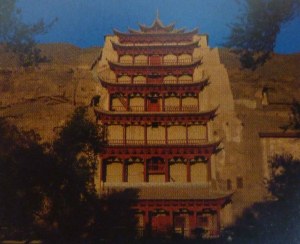
The June 2010 issue of National Geographic had a piece about the history of the Mogao caves near Dunhuang, a Silk Road oasis in northwestern China.


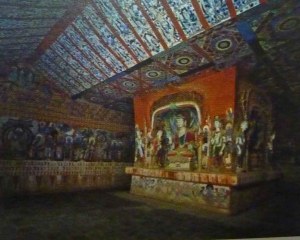
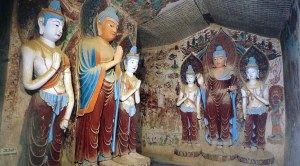
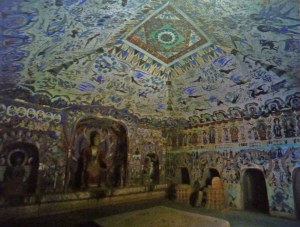
The Buddhist art found in almost 800 hand carved caves are considered among the world’s finest. There is nearly a half-million square feet of wall space decorated with these murals and more than 2,000 sculptures.


Between the fourth and 14th centuries AD—over a thousand years of history was documented on scrolls, sculptures and wall paintings revealing a multicultural world more vibrant than anyone imagined.


Contrary to popular belief and the Dalai Lama’s soft-spoken words of peace, Buddhism, like all large religious movements, has had a bloody and violent history depicted in the picture on page 145 of the National Geographic that shows an eighth-century heavenly armored guard with bulging eyes trampling a foreign demon.

_______________

Lloyd Lofthouse is the award-winning author of My Splendid Concubine [3rd edition]. When you love a Chinese woman, you marry her family and culture too. This is the love story Sir Robert Hart did not want the world to discover.

His latest novel is the multiple-award winning Running with the Enemy.

Subscribe to “iLook China”!
Sign up for an E-mail Subscription at the top of this page, or click on the “Following” tab in the WordPress toolbar at the top of the screen.

About iLook China

China’s Holistic Historical Timeline


Mao as Poet

December 10, 2013

Many outside China only think of Mao Zedong (1893 – 1976) as a brutal dictator. Yet, he was fifty-six when he became the ruler of China and seventy-two at the beginning of The Cultural Revolution.

In fact, while commanding the Red Army during The Long March (1934-1935), we see a man who respected China’s peasants proving he was more of a nationalist than a Communist.

Then there was the move away from Communist Russia after Nixon’s visit to China in 1972, when Mao said, “Our common old friend, Generalissimo Chiang Kai-shek, doesn’t approve of this.”

In 1935, Mao’s poem, “The Long March”, reveals an awareness of the sacrifice and the willingness to suffer to accomplish great things.

The Red Army fears not the trials of the March,
Holding light ten thousand crags and torrents.
The Five Ridges wind like gentle ripples
And the majestic Wumeng roll by, globules of clay.
Warm the steep cliffs lapped by the waters of Golden Sand,
Cold the iron chains spanning the Tatu River.
Minshan’s thousand li of snow joyously crossed,
The three Armies march on, each face glowing.

Mao was a complex man, and it wasn’t until after the failure of the The Great Leap Forward (1958 – 1961) that the fatal attraction and power of leadership corrupted him leading to the horrors of The Cultural Revolution (1966 – 1976), which Mao’s critics in the West use to define him.

Anyone who follows Mao’s life instead of relying on his last decade would understand that he cared deeply about the common people while punishing the landowners and wealthy, who abused them.  On the other hand, his foe, Chiang Kai-shek, supported the landowners and wealthy while crushing the peasants and workers.

There is a post on About China.info that says, “Mao’s poetry exhibits a spirit of boldness and power, weaving together history, reality and commitment… Bold transformation of myth and literary quotations are a distinct feature of Mao’s poetry.”

At Mao Zedong Poems, Two Birds” A Dialogue (1965), reveals what Mao may have been thinking about as President Johnson increased America’s involvement in Vietnam. Was Mao also warning us of what he was about to do in 1966, when he launched The Cultural Revolution?

Two Birds: A Dialogue (1965)

The roc wings fanwise,
Soaring ninety thousand li
And rousing a raging cyclone.
The blue sky on his back, he looks down
To survey Man’s world with its towns and cities.
Gunfire licks the heavens,
Shells pit the earth.
A sparrow in his bush is scared stiff..
“This is one hell of a mess!
O I want to flit and fly away.”
“Where, may I ask?”
The sparrow replies,
“To a jewelled palace in elfland’s hills.
Don’t you know a triple pact was signed
Under the bright autumn moon two years ago?
There’ll be plenty to eat,
Potatoes piping hot,
Beef-filled goulash.”
“Stop your windy nonsense!
Look, the world is being turned upside down.”

Through Mao’s poetry, we learn more about the man—not the modern emperor.

Discover China’s Privately Passionate Poetry

_______________

Lloyd Lofthouse is the award-winning author of My Splendid Concubine [3rd edition]. When you love a Chinese woman, you marry her family and culture too. This is the love story Sir Robert Hart did not want the world to discover.

His latest novel is the multiple-award winning Running with the Enemy.

Subscribe to “iLook China”!
Sign up for an E-mail Subscription at the top of this page, or click on the “Following” tab in the WordPress toolbar at the top of the screen.

About iLook China

China’s Holistic Historical Timeline