If China government isn’t a Monarchy or a Dictatorship, what is it—Viewed as a Single Page

January 30, 2010

Three times George Washington acted in a way that would insure the newly born US Republic would survive.

His first act was in 1782, when Colonel Lewis Nicola wrote a letter to Washington suggesting that Washington should set up a constitutional monarchy because of the inefficiency of the Continental Congress.

Washington was offended at such a suggestion and wrote to Nicola telling him to banish such thoughts from his mind. George Washington – Legends and Myths

His second act took place in 1783, when he stepped in and saved the republic by ending the Newburgh Conspiracy, a plot in the military to seize power and create a military dictatorship. Source: Early America

The third act was when Washington stepped down as President (1789 – 1797) and returned to his farm.

When King George III asked his American painter, Benjamin West, what Washington would do after winning independence, West replied, “They say he will return to his farm.”

“If he does that,” King George said, “he will be the greatest man in the world.” Cato Institute
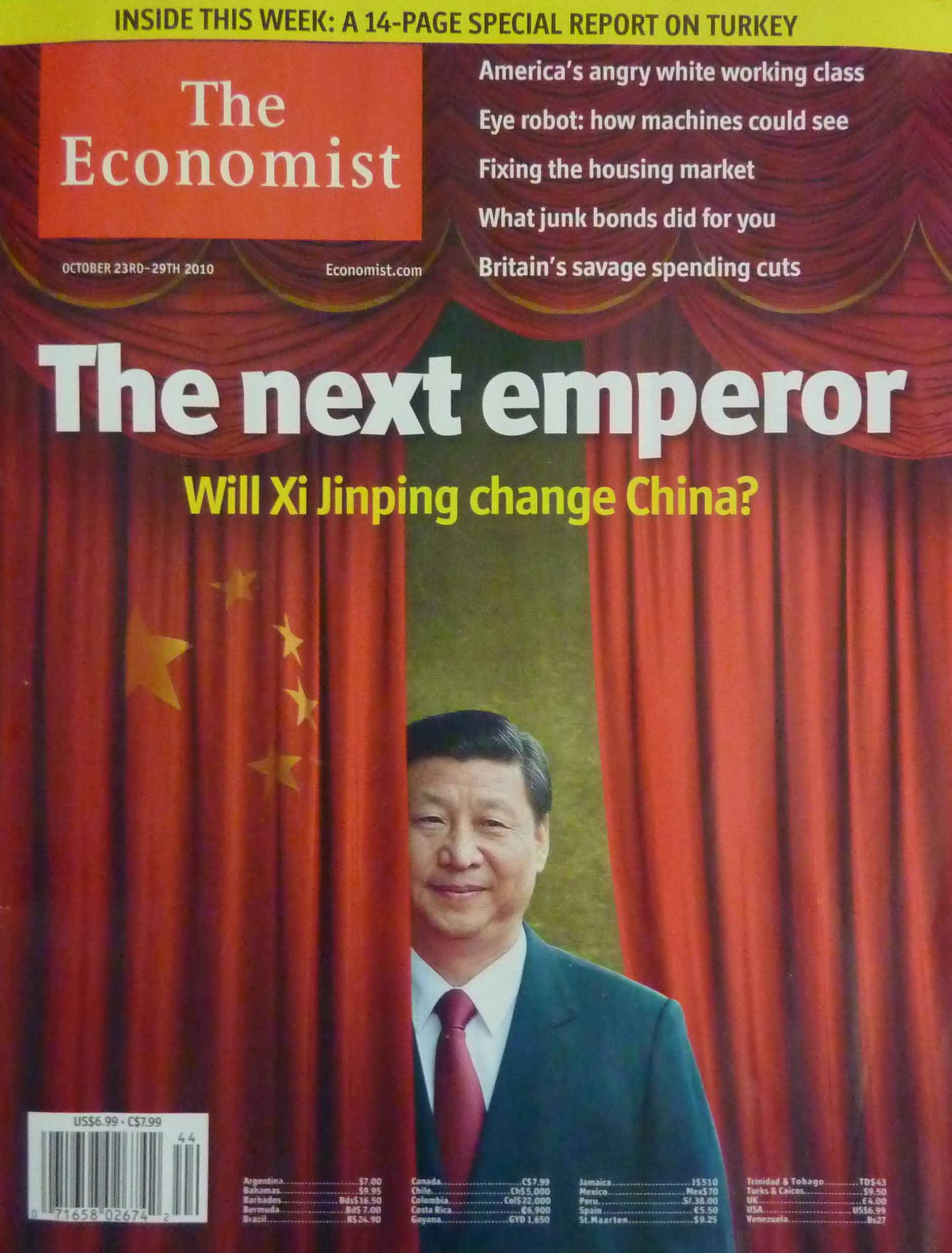
The cover of The Economist for October 23, 2010—in the best tradition of biased and Yellow Journalism— SHOUTED: “The next emperor – Will Xi Jinping change China?”

As I read the feature article on page 13, I laughed when I saw, “Mr. Xi’s appointment was eerily similar to the recent anointment of Kim Jong-un in North Korea.”

The reason I saw humor in this absurd statement was that there is nothing similar. Kim Jong Un inherited his for-life position as Supreme Leader of North Korea. He is the son of Kim Jong-il, and the grandson of Kim Il-sung, the founder of North Korea.

The Economist implied in the October 23, 2010 issue of the magazine, that China is a monarchy.

However, China is not a monarchy as the Kim Dynasty in North Korea has become or a dictatorship-monarchy as many in the West think.

In North Korea, what started as a Socialist Dictatorship modeled on Maoism has become a Socialist Maoist Monarchy.

China, on the other hand, started as a Socialist Dictatorship under Mao (1949 to 1976) and is becoming a fledgling republic with Western critics looking for cockroaches and slugs under rocks.

In fact, Dr. Sun Yat-sen, the father of China’s Republic, wrote that he wanted to model China’s government after America but by combining Western thought with Chinese tradition.

He didn’t say he wanted China to be a clone of America’s Republic.

America was still a Republic prior to World War II. The US wouldn’t become a full-fledged democracy until the 1960s.

Unfortunately, Dr. Sun died in 1925 before he could finish what he started.

It wouldn’t be until after Mao died in 1976, that the leaders of the Communist Party under Deng Xiaoping would start the long journey to implement Sun’s dream of a Republic against great pressure from Western democracies to copy them.

Before we move on, let’s take a brief look at the Athenian democracy that was developed around the 5th century B.C. in the Greek city-state of Athens. Even though there is evidence that democratic forms of government existed before the 5th century, ancient Athens is generally believed to be the first democracy.

What did that democracy look like? Athens had a system of direct democracy, in which participating citizens voted directly on legislation and executive bills. But participation was not open to all residents: to vote, one had to be an adult, male citizen, and the number varied between 30,000 and 50,000 out of a total population of around 250,000 to 300,000—about 150,000 were slaves.

In comparison, the membership of the Chinese Communist Party (CCP) is now 86.7 million—men make-up 77 percent of CP’s membership, while woman make up 23 percent—making the CCP the world’s largest political party representing more than 6 percent of China’s population, and slavery is illegal just like it is in the U.S.

Regardless of what critics claim, China is becoming more like the republic Dr. Sun Yat-sen might have imagined by combining Western thought with Chinese traditions.

After Mao died, The Communist Party worked for several years to draft the 1982 Constitution, which included term limits of two five-year terms for elected government officials.

If you have read the Chinese Constitution carefully, it is obvious that the U.S. Constitution was used as a model. However, these two documents are not the same.

If the Party leadership is not happy with China’s president, he can be removed after one five-year term. There is even an article of impeachment in China’s Constitution.

China’s first president was Li Xiannian (1983 to 1988). He served one, five-year term, and then he stepped down.

From 1988 to 1993, Yang Shangkun would be China’s president for one five-year term. Deng Xiaoping (born 1904 – died 1997) was the Chairman of the Communist Party from 1983 to 1993, which was ten years—what China’s 1982 Constitution calls for, but Deng never served as the country’s president.

Due to how the Tiananmen Square incident in 1989 was handled, President Yang had to step down at the end of his first, five-year term. The only other way to remove him would have been through impeachment.

In 1993, Jiang Zemin became President and Chairman of the Communist Party. Then in 2003, Hu Jintao became President and Chairman of the Party. His term ended in 2012 when Xi Jinping became president of China.

Deng Xiaoping was China’s George Washington. What he did was what Dr. Sun Yat-sen wanted. China is a republic that combines Western thought with Chinese tradition.

However, the task to create China’s Republic fell to the Communist Party so China is a Socialist Republic with capitalist tendencies.

In China, Piety is important and advice from elders is often followed as if it is the law. Due to this, elder statesmen such as Jiang Zemin have great power in the government even after he no longer has a political title. After all, this is a Chinese tradition.

The Economist mentioned disagreements within the CCP among China’s leaders over what the country’s priorities should be—both on the economy and on political reform.

Whatever the final decisions will be, the consensus of the CCP will be guided by Chinese tradition and not Western thought.

The changes that “some” want to see take place in China will probably not arrive in a hurry if the wisdom of the I-Ching, The Book of Changes, is followed, which says change should come slowly.

In fact, China has proven it is a republic because none of China’s first four presidents are the sons of previous presidents and eventually death removes the elders. China’s presidents did not inherit that title due to heredity as kings do or the leader of North Korea did.

_______________

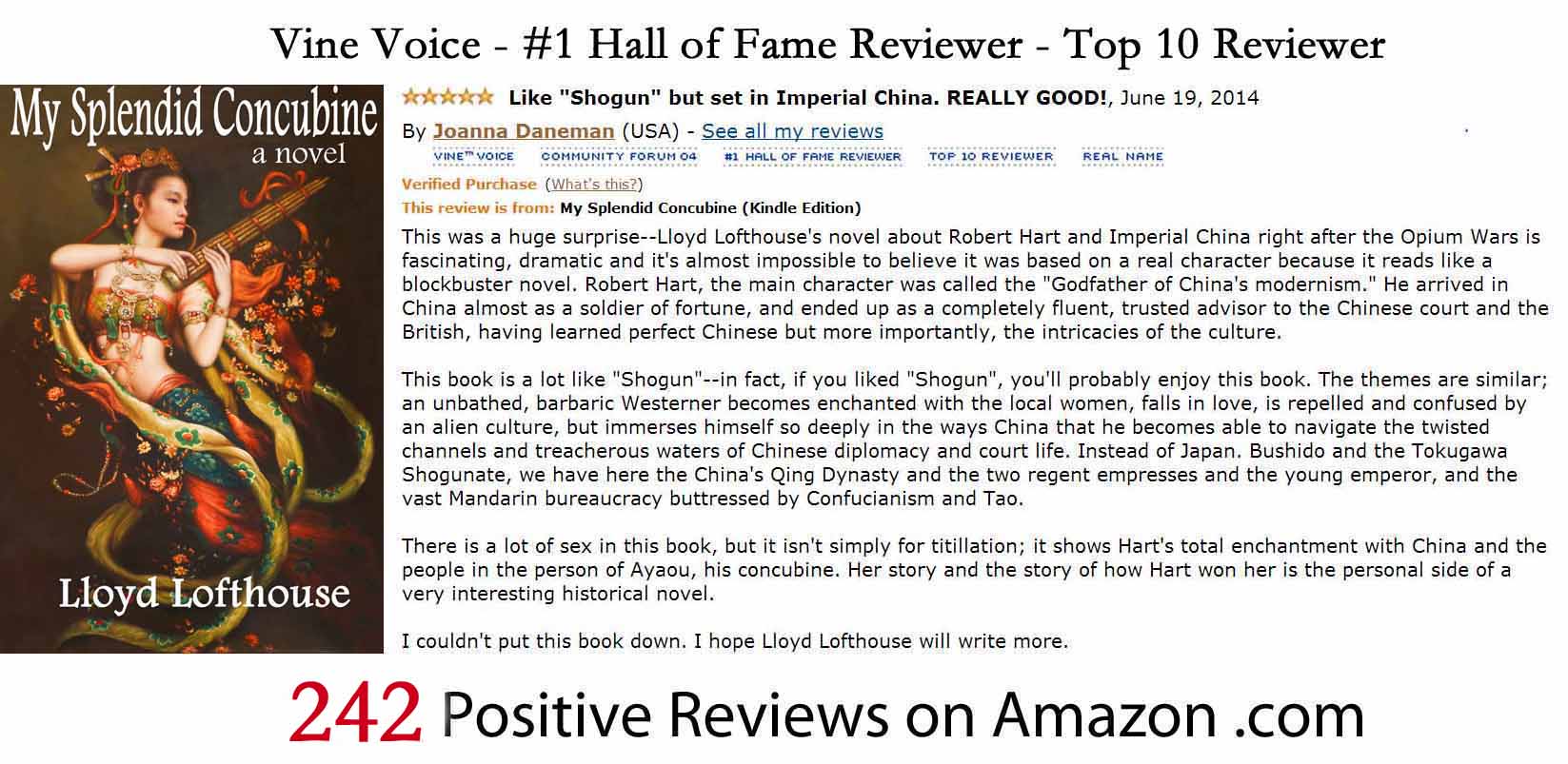
Lloyd Lofthouse is the award-winning author of My Splendid Concubine [3rd edition]. When you love a Chinese woman, you marry her family and culture too. This is the love story Sir Robert Hart did not want the world to discover.
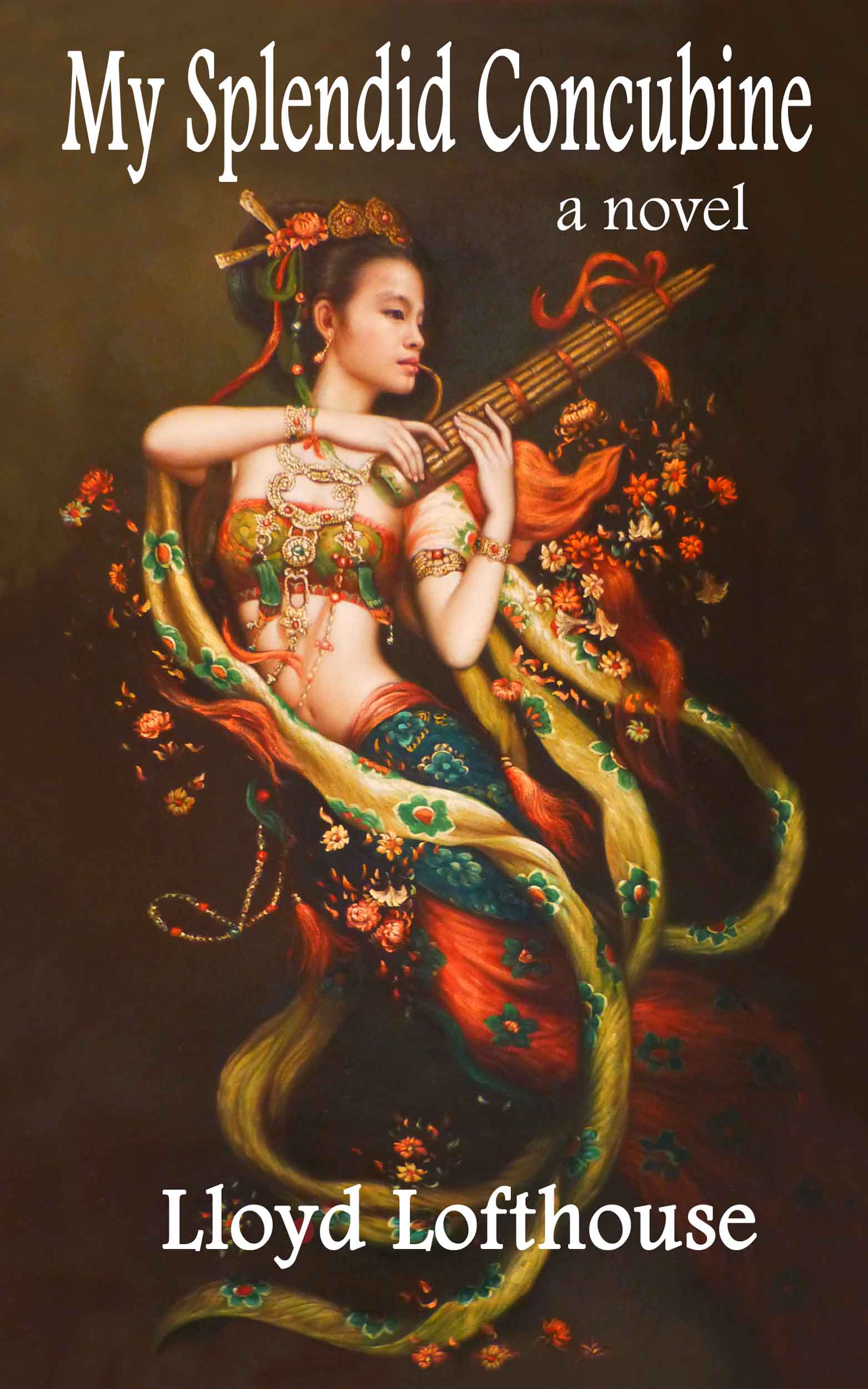
Kindle_LR_e-book_cover_MSC_July_25_2013

Subscribe to “iLook China”!
Sign up for an E-mail Subscription at the top of this page, or click on the “Following” tab in the WordPress toolbar at the top of the screen.

About iLook China

China’s Holistic Historical Timeline


The Roots of Madness (viewed as single page)

January 28, 2010

I found this information from a 1967 documentary conceived and written by Theodore H. White to have half-truths about Imperial China. It is understandable that any American film from that era would be flawed since McCarthyism’s Red Scare took place in the US the decade before. Even today, Sinophobia infects almost half of America.

Author Theodore White lived in China for seven years and said that foreigners who lived in China during the crises often remembered it differently as if his opinions were correct and they were wrong.

The Roots of Madness unwittingly documents the lies and deceit that demonized the Empress Tsu Hsi when the narrator calls the empress evil. To discover the truth about the empress, I suggest reading Dragon Lady by Sterling Seagrave, who revealed the lies and deceit of Western journalists.

Nothing in China’s ancient culture could guide the Chinese to become part of the modern world.

Instead, China would experiment with different forms of government—a process that is still going on.

Although “China: The Roots of Madness” is a flawed production, there is enough accurate history to show why China is the way it is today.

British and American power controlled the wheels of industry in Shanghai, Nanking, Hankow and Chunking. In the steaming south, peasants, working like beasts, plant rice and speak languages most Chinese do not understand.

At the turn of the century, a three-year-old child was the emperor and the throne sat empty. On October 10, 1911, a riot took place that couldn’t be controlled.

Five weeks later, the Imperial government collapsed. The Qing Dynasty vanished and two-thousand years of Imperial tradition was gone.

The Chinese call this time the “Double Death”.

The British and Americans could not control what replaced the Qing Dynasty.

Students without weapons rioted in the streets.

Warlords that controlled armies divided China and the chaos and anarchy grew worse.

Life became so cheap, that death was like a bloody circus.

However, while the Chinese people suffered and starved, the foreigners live in luxury and controlled China’s industry while being protected by the Western military.

Chinese students demanded a revolt and Sun Yat-sen called on China to slay the dragon of Imperialism. He said China must start with nationalism, then democracy and finally socialism. The only country that offered to help was Soviet Russia.

Death claims Sun Yat-sen (1866 – 1925) after he has accepted support from Soviet Russia. Soon, General Chiang Kai-shek (1887 – 1975), with help from the Communists, consolidates power in southern China.

Chiang is known to Westerners as a fiery nationalist and revolutionary. He mobilizes an army under Sun Yat-sen’s flag and marches north with a few divisions.

Meanwhile, the warlords have gathered half-a-million troops to stop him. Outnumbered, Chiang sends an advance group of nationalists and communists to call the peasants and workers to join his army.

Among those peasants and workers is Mao Tsetung (1893 – 1976).

While moving north, Chiang’s army raids foreign concessions, burns foreign buildings and tears down foreign flags.

Leftist leaders of the Kuomintang distrust Chiang Kai-shek and some want to assassinate him but others disagree.

In Shanghai, Chiang Kai-shek, now a dictator, strikes first on April 12, 1927. His troops kill anyone suspected of being a Communist.

In December, there is a Communist uprising in Canton. A battle rages for two days between the Communists and Kuomintang ending in the executions of most Communists, but Mao escapes and goes into hiding.

Chiang Kai-shek’s army is not ready when Japan invades Manchuria. He doesn’t have tanks, the artillery is old and the Chinese are learning about airplanes.

Meanwhile, the Communists that Chiang thought he had destroyed are back. Mao knew the peasants lived in horrible poverty. He promised land reforms and by 1932 has millions of supporters.

The language in this documentary describing Mao is not flattering.

Yes, when Mao ruled China, he was a dictator but that ended in 1976 when he died. Since then, China has had several presidents that the 1982 Chinese Constitution allows to lead China for two five-year terms and there is an impeachment clause.

However, Chiang Kai-shek was also a dictator. The only difference between Mao and Chiang is that Chiang converted to Christianity in 1929, and the West called him the president of China—not a dictator.  Chiang Kai-shek was never elected by the people of a democracy to rule China or Taiwan.

Instead, he ruled Taiwan under martial law until he died then his son became president without a popular vote by the people.

Instead of fighting Japan, Chiang’s army bombs villages that Mao controls killing tens of thousands of noncombatants. Mao takes his ninety thousand troops on the famous thousand-mile Long March.

A year later, only a few thousand remain. Mao calls for unity to fight Japan.

One of Chiang’s generals, Zhang Xueliang, forces the Nationalist dictator to sit down with the Communists where Chiang Kai-shek agrees to fight Japan. As soon as Chiang returns to his capital, he breaks the agreement and throws Zhang in prison.

Meanwhile, Mao’s troops in the hills of Yunnan grow their own food. His army, dressed in shabby clothing wearing straw sandals, doesn’t look like a fighting force. Mao says the people are the sea and guerrillas are like fish that swim in the sea. Within a year, Mao’s army grows to 200,000.

Chiang Kai-shek’s army loses battles and cities to the Japanese. To continue fighting, his government and army moves to the deep mountain city of Chongqing in Sichuan province.

In 1939, the Japanese start bombing Chongqing 24/7.

When asked about the Japanese threat, Chiang says that the Japanese are a disease of the skin, but the Communists are a disease of the heart.

Then on December 7, 1941, Japan bombs Pearl Harbor and America enters the war.

War supplies start to trickle to China through India and across the Himalayas to Chiang Kai-shek’s four-million-man army.

However, his government is corrupt, his troops are poorly fed and morale is low. In fact, the  peasants do not trust Chiang’s
troops or him.

Chiang Kai-shek is accepted as an equal among the West’s leaders while Mao works to keep up the moral of his Communist troops through political training—something Western leaders don’t understand and criticize.

Theodore H. White tells of an incident with Chiang Kai-shek’s troops when a Nationalist officer lies to peasants saying he belongs to Mao’s Communist army. When White asks why lie, he is told the peasants would not help if they knew the truth.

In fact, regardless of the suffering from Mao’s Great Leap Forward and the Cultural Revolution, this loyalty never wavers.

Joseph Stilwell, the commanding US general in China, is not happy with Chiang since he is not fighting Japan.

Chiang says he needs his troops to fight the Communists.

In 1945, America invites representatives from Chiang’s government to take part in Japan’s surrender on the battleship Missouri but ignores the Communists under Mao.

An American ambassador urges Mao to join Chiang in a unified government. To bring this about, America offers Mao protection and there are face-to-face negotiations between Mao and Chiang.

During the negotiations, in secret, Chiang moves his troops to launch an assault on the Communists in Manchuria.

America urges Chiang to win the people by implementing Sun Yat-sen’s promised reforms.

Instead, Chiang’s war to destroy the Communists causes run-away inflation. Essential goods become too expensive. The people want peace, and Mao offers the peasants what they want—land.

In 1948, Mao attacks when his army leaves the caves and captures Manchuria

When Chiang Kai-shek’s northern army surrenders, modern American weapons and equipment falls to Mao’s troops.

Mao demands total surrender, but Chiang’s army boards ships for Taiwan taking China’s wealth and historical treasures.

In fear, western businessmen and missionaries flee China.

By 1967, when this documentary was produced, Mao had ruled China for 18 years and was still an inigma to most in the West. Nixon wouldn’t visit China for several more years.

Protected by America’s military and navy, Chiang was still in Taiwan serving as president for life (a dictator). He also had six-hundred thousand Kuomintang troops armed by the US, and the island people lived under martial law.

Theodore H. White says America does not understand Communist China. America could not predict the “Great Leap Forward” or the purges that followed.

White says the quality of life for the peasants had not improved (which is not true since the World Bank has reported that even under Mao the quality of life improved over what it had been), but they still had to work hard.

White’s documentary ends with words of fear for the world’s future because China has nuclear weapons.

There is no mention that America has enough nuclear weapons to destroy the earth a hundred times over and used two of them on Japan killing hundreds of thousands.

This revised post first appeared as an eight-part series starting June 8, 2010 at Roots of Madness – Part 1

______________

Lloyd Lofthouse is the award-winning author of the concubine saga, My Splendid Concubine & Our Hart. When you love a Chinese woman, you marry her family and culture too.

To subscribe to iLook China, look for the “Subscribe” button at the top of the screen in the menu bar, click on it then follow directions.


China’s [Politically Motivated?] Science Fiction Craze – Viewed as Single Page

January 28, 2010

This Blog explored (with Tom Carter’s guest post) how Harlequin Romance Invaded China without mentioning that romance literature in China has a history reaching back before the Dream of the Red Chamber (1715-1763), which has a tragic Romeo and Juliet love story between its covers.

I’ve also written of the rise of China’s film industry in Hollywood to Bollywood to a Rising Chinawood, while exploring the folklore and films of China’s Vampires.

As a child, I read many historical texts on Genghis Khan, Alexander the Great, the Napoleonic Wars, the British Empire, and historical fiction on similar subjects.

Then as an adolescent in middle and then high school I devoured science fiction and fantasy novels often one or two a day.

Today, I mostly read mysteries and literature but find my science fiction fantasy fix from film productions such as The Lord of the Rings, TV’s Stargate and Star Trek franchises in addition to George Lucas‘s Star Wars Saga.

Recently, I’ve been watching the complete series of Earth 2 while reading mysteries and thrillers.

In fact, the future we live with today was predicted in the early pages of Western science-fiction literature and China has noticed that science fiction literature often predicts and precedes scientific innovations such as laptop computers, the Internet, the Amazon Kindle and even doors that open automatically.

The British Telegraph’s HG Wells on Google: which of his predictions came true? reminds us that H. G. Wells first mentioned genetic engineering in The Island of Dr. Moreau (1896), lasers in The War of the Worlds (1898), the first moon landing in The First Men in the Moon (1901), nuclear power and weapons in the World Set Free (1914), and the Second World War in The Shape of Things to Come (1933).

In addition, Computer Science Schools.net lists 15 Science Fiction Predictions that came True, while Blog Tutor.com lists eight.

Blog Tutor says, “At the time of their writing, these science fiction ideas often seemed impossible to fantastic to ever come true—and yet today’s technology seems to keep pace with the dreams of writers past.

Although Cyberspace hasn’t quite reached the level of technology William Gibson predicted in 1986’s Burning Chrome, no one can deny that the Internet’s alternative worlds … are working towards the virtual…”

With that introduction, it may not come as a surprise that science fiction fits with China’s goals to catch up with and possibly surpass the West and reclaim its heritage and history of being the most powerful and technological advanced country and culture on the planet as it was for more than two thousand years before the 19th century and the Opium Wars.

In fact, we learn from The Race is On that “China’s Government actively encourages its citizens to read Science Fiction… Mark Charan Newton calls this the “Cult of Science Fiction – that is, the faith in dreaming up Big Ideas… So perhaps the Chinese are onto something with their focus on science fiction: a genre that weds the scientific to the artistic.”

The history of science fiction in China predates the CCP’s encouragement today, and that interest started in the late nineteenth and early twentieth centuries — a cultural phenomenon that emerged from Western Europe’s Industrial Revolution. One site I visited while researching this topic even dated science fiction to ancient China.

In Sci-fi books? China’s got tons of those, Asia Obscura.com says, “When it comes to sci-fi movies, China’s really falling behind. One that really did impress me, though, was the very first to be produced in China: 1980′s gorgeous, fun, and campy ‘Death Ray on Coral Island’ (珊瑚岛上的死光).

“In ‘Death Ray,’ a good-hearted team of Chinese scientists, based in what appears to be San Francisco, finally succeed in completing their fabulous futuristic invention. That is, until the sinister back-stabbing Americans, played with Bond-villainous glee by Chinese actors in whiteface and prosthetic noses, decide to steal the invention for their evil plots…”, which reveals another perspective of the US.

Then Foreign Policy.com introduces us to The Prosperous Time: China 2013, written by 58-year-old Hong Kong novelist Chen Guanzhong, who has lived and worked in Beijing for much of his life.

China 2013 presents an ambivalent vision of China’s near future: outwardly triumphant (a Chinese company has even bought out Starbucks), and yet tightly controlled”, which may be a prediction that China’s one party republic is here to stay.

Even after 1949 with the founding of the People’s Republic of China, science fiction literature continued to flourish. During this period, the genre adopted a popular science approach and directed the majority of its stories towards younger readers.

However, during the Cultural Revolution (1966-1976), science fiction stagnated and then revived after March 1978 when the Central Committee of the Chinese Communist Party and the State Council convened a national scientific congress in Beijing, proclaiming to China, “Science’s spring has come.”

Scientific enthusiasm and popular science followed, greatly promoting the development of science fiction in China.

From China.org we learn, “The monthly circulation of Science Fiction World, one of China’s most popular magazines, has exceeded 500,000, dwarfing all international counterparts. Yang Xiao, head of the magazine’s editorial board, said 70 percent of its readers were students who shared single copies of the journal between dozens of friends because they could not afford their own. Millions of Chinese young people were affected by science fiction, said Yang, who hailed the rise of the modernist genre among the people who would decide the nation’s future.”

Another sign of the progress of science fiction literature in China first took place August 25, 2007 at the Chengdu International SF/F Conference. Over two days, authors from America, Canada, Britain, Russia, Japan, and China, and over twenty-thousand science fiction fans arrived in Chengdu for the event, which in turn increased the influence of SF in China due to media coverage.

Then from Chinese Science Fiction.org, we discover the second Chengdu Science Fiction and Fantasy conference was held November 12, 2011 in Chengdu.

Meanwhile, China continues with plans to build a space station, and then a productive mining colony of rare-earth minerals on the moon with a future exploration of Mars on the books, while the United States space program languishes.

The cause of this development is due to the US national debt and the costs of the war on Islamic terrorism, which may have been caused by what Henry Kissinger calls, “American exceptionalism is missionary. It holds that the United States has an obligation to spread its values to every part of the world” even if the world isn’t interested resulting in this resistance from the Middle East.

In addition, many young people in the United States with a high sense of self-esteem do not read books while watching too much TV has been scientifically linked to lack of a development in part of the brain where imagination blossoms.

Note: You may read more on this topic [written by British thriller writer O. C. Heaton] over at A Rush of Green.

Lloyd Lofthouse is the award-winning author of My Splendid Concubine, Crazy is Normal, Running with the Enemy, and The Redemption of Don Juan Casanova.

Where to Buy

Subscribe to “iLook China”!
Sign up for an E-mail Subscription at the top of this page, or click on the “Following” tab in the WordPress toolbar at the top of the screen.

About iLook China

China’s Holistic Historical Timeline