Shanghai Teahouse

June 20, 2012

This is where I enjoy shopping when in Shanghai.

It wasn’t crowded yet!

The Huxinting Teahouse has been around for awhile (several centuries–it was restored in 1784).  This pavilion was turned into the tea house in 1855. Nice place to stop and have a cup of tea.  Go early.  It gets crowded.


famous Shanghai tea house on the water

The area in Shanghai around the Huxinting Teahouse is a good place to shop. Many small shops. Do not pay asking price. Be willing to bargain.  Start low and meet in the middle. Don’t be too cheap either.

Shopping before it gets crowded.

The following video gives you a musical tour of the sights of Shanghai’s Old District including Yu Yuan Garden and Huxinting Tea House.

For more about Shanghai, also see:
Shanghai
Shanghai’s History & Culture
Shanghai Huangpu River Tour
Eating Gourmet in Shanghai
Chinese Pavilion, Shanghai World Expo

______________

Lloyd Lofthouse is the award-winning author of The Concubine Saga. When you love a Chinese woman, you marry her family and culture too. This is the love story Sir Robert Hart did not want the world to discover.

Subscribe to “iLook China”!
Sign up for an E-mail Subscription at the top of this page, or click on the “Following” tab in the WordPress toolbar at the top of the screen.

About iLook China

Note: This edited and revised post first appeared on February 20, 2010 (Note: the author took the photos but did not produce the video)


Americans doing Business in China – Part 10/16

March 1, 2012

Note from Blog host — another example of East meets West through business and trade: The Wall Street Journal reported, “Beijing Brews Up Its Own Craft Beers… With the recent opening of Slow Boat Brewery in Beijing, the city’s number of American-style microbreweries officially doubled — to two. Mr. Jurinka and Slow Boat co-founder Daniel Hebert are looking to open a tap room and sell their beer directly to local bars and restaurants… The other brewpub in town is Great Leap Brewing, set in a classic hutong in Beijing’s Gulou neighborhood… Great Leap’s owner, Carl Setzer, has been living in China and Taiwan for eight years… U.S. microbrew beer exports to China hit a record in 2010, with sales reaching $546,000, five times the level just five years ago…”

_____________________

Guest Post by Bob Grant — publisher/editor for Speak Without Interruption, an international online magazine.

As I write about my personal experiences in China, I again want to note that they are strictly that—my “personal” experiences. I am certain there are people, who have visited China who could contradict everything that I have, or will write. The products I imported perhaps did not lend themselves to the typical “Sweat Shop” stereotype in terms of the factories that produced them.

However, I never saw or visited any factory that, in my mind, would fit that definition.

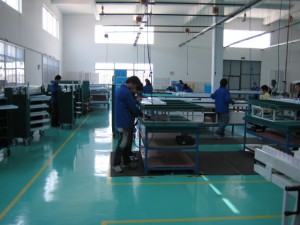
If the factories were not what I would call “modern”—they were certainly clean. The employees (factory workers) wore uniforms at most places I visited. They seemed proficient in their work and the products produced, and for the most part, were without quality problems—certainly no different from products produced in other countries.

Most of the factories tended to be in Industrial Parks that were quite large. Usually, the factories were a “small city” into themselves. There was housing provided for the employees on the factory grounds along with areas for recreation. I don’t suppose there was another way of doing it, but I saw a lot of laundry hanging from outside the housing units plus commercial apartments buildings I saw throughout China.

Most factories had certifications that were either the same or similar to those held by US factories. I saw elaborate R&D sections in most of the factories I visited. The office space was usually as modern and pleasant as any I had visited in the US.

A ritual that I truly enjoyed was at every meeting when hot tea was served. Sometimes the owner or general manager had tea to make in their office and other times it was brought in. However, I can’t recall a meeting where tea was not offered.

Being a non-smoker, another ritual I did not enjoy was in almost every meeting I attending most of the parties present smoked. I heard a figure once that 85% of Chinese men smoked. I can attest that this is probably a good estimate. Once inside the office or meeting room, the smoke became quite thick and uncomfortable for me; however, I was their guest and felt I could put up with the discomfort in the course of conducting my business affairs.

I have fond memories of my factory visits and discussions. I think the fact that I came to China, and met with the factory personnel aided my business immensely versus doing business in name only.

Note from Blog host – If you plan to do business in China, I recommend visiting the China Law Blog first.

Continued March 2, 2012 in Americans doing Business in China – Part 11 (a guest post) or return to Part 9

______________

Lloyd Lofthouse is the award-winning author of The Concubine Saga. When you love a Chinese woman, you marry her family and culture too. This is the love story Sir Robert Hart did not want the world to discover.

Subscribe to “iLook China”
Sign up for an E-mail Subscription at the top of this page.

About iLook China

Note:  This guest post first appeared on March 5, 2010


Meet the Winemaker from Shanxi Province

February 11, 2012

In August 2010, the China Daily reported, “The number of private enterprises reached 7.5 million, accounting for half of China’s gross domestic product, 70 percent of the nation’s technical innovations and 60 percent of its patents.” In addition, “China’s top 500 private companies have surpassed State-owned enterprises in many indicators, especially tax payments and employment creation, according to a report from the All-China Federation of Industry and Commerce.”

In fact, Bloomberg.com says, “Many of the world’s richest self-made women are Chinese,” and Psychology Today.com tells us, “Women own more than 40% of private businesses in China.”

Meet one of those women. Judy Leissner was 24 when she became the CEO and President of 168-acre Grace Vineyard in Shanxi province, south of Beijing after she quit her job at Goldman Sachs.

The first grape-vine plantings were in 1997 and the first vintage in 2001. Judy started the winery because her father liked to drink. Today, Judy produces a quality wine—about 700,000 bottles annually.

Most people do not know that quality wine is produced in China. In fact, Judy has competition since there are about 400 wineries in China.

Judy says there is an opportunity in China to make a lot of money in a short period of time, because the country is developing and growing.

The difference between the wine market in China and the rest of the world is that most drinkers in China must drink because they have to. It’s part of the culture of doing business and developing guanxi.

In an update, Grape Wall of China.com visited Grace Vineyard in September 2011, and Jim Boyce says he visited Grace CEO Judy Leisser. He says, “About a week ago, she sent an email that the wines Grace bottled under screw cap earlier this year are doing fine and, if all goes well with final trials, the winery will switch closures this year for its entry level and premium level wines. Grace’s Premium Chardonnay ranks among the better Chinese wines and is found in top hotels and restaurants in Beijing and Shanghai.”

In addition, in an interview at 24×75.com with Judy Leissner October 17, 2011, she was asked how different the work environment for Grace Vineyard was compared to Goldman Sachs where she worked prior to becoming CEO of the vineyard in Shanxi Province. She said, “Goldman Sachs is a fast-pace, can-do, efficient place.” However, for the winery, she said, “The whole atmosphere was rather sleepy.”

In another question, Judy was asked about social responsibility and what those two words mean.  She responded with, “We guarantee our growers basic income… Grace is a perfect example of an environmentally friendly and sustainable business. We provide many jobs for people from nearby villages.”

______________

Lloyd Lofthouse is the award-winning author of The Concubine Saga. When you love a Chinese woman, you marry her family and culture too. This is the love story Sir Robert Hart did not want the world to discover.

Subscribe to “iLook China”
Sign up for an E-mail Subscription at the top of this page.

Note: This updated and revised post first appeared on November 08, 2010


Tea for Emperors and Tibet – Kombucha Fermented Tea – Part 5/5

January 21, 2012

Sometimes I wonder about the sanity of most Americans. It seems they will drink or eat anything that arrives on an attractive plate or in a fancy bottle. I read a piece recently that said Lindsay Lohan and other Hollywood types like Madonna, Kirsten Dunst and Halle Berry are into this new (but old) synergy drink called Kombucha.

No one knows for sure where this fermented tea originated but recorded history says it started in Russia during the late 19th century.

However, promotional material says the drink comes from ancient China or Japan. In fact, some say that kombucha, known as Godly Tsche, dates back to the Qin Dynasty (221-206 BC) and was “a beverage with magical powers enabling people to live forever”. Since the first emperor, Qin Shi Huangdi, didn’t live forever, we can discount that claim.

I asked my wife about this tea and she said that as a child she saw it being fermented and that the stuff floating around inside the jar reminded her of dead cockroaches.

Once someone like Pepsi or Coke gets hold of something old like this there is no telling what kind of chemicals will be added. If you want to make this tea, click Kombucha Tea for the home brew recipe.

If you believe the health claims of this tea, you may want to learn about the Chinese “Chong Cao“. Remember, the Food and Drug Administration (FDA) hasn’t evaluated any of these claims.

Return to Tea for Emperors and Tibet – Part 4 or start with Part 1

______________

Lloyd Lofthouse is the award-winning author of The Concubine Saga. When you love a Chinese woman, you marry her family and culture too. This is the love story Sir Robert Hart did not want the world to discover.

Subscribe to “iLook China”
Sign up for an E-mail Subscription at the top of this page.

About iLook China

Note: This five-part series of posts on “Tea for the Emperors and Tibet” first appeared May 2010, as The Magic of “Puer” Tea, The Tea Horse Road, and Kambucha Fermented Tea.


Tea for Emperors and Tibet – Part 4/5

January 20, 2012

After the “Puer” tea is ready, the journey begins.

For the Pu’erh that I buy, Emperor’s Pu’erh, it leaves Yunnan, reaches China’s coast and then crosses the Pacific to end on a shelf at a Whole Foods Market. However, before that, for centuries, Puer tea traveled to Tibet and China’s capital for the Emperor.


CCTV 9 Travelogue – Tea and Horse Road – Part 1 1/2

Most people have heard of or read about the Silk Road from China to Europe. I’m sure that few have heard of the Ancient Tea Horse Road, which I discovered in the May 2010 issue of National Geographic magazine.


CCTV 9 Travelogue – Tea and Horse Road – Part 1 2/2

Legend says that tea from China arrived in Tibet as early as the Tang Dynasty (618- 906 A.D.). After that, the Chinese traded tea for horses, as many as 25,000 horses annually.


CCTV 9 Travelogue – Tea and Horse Road – Part 2 1/2

But that isn’t what struck me the most about the piece. It’s the example that demonstrated why the peasants loved and possibly worshiped Mao Tse-Tung.


CCTV 9 Travelogue – Tea and Horse Road – Part 2 2/2

For more than a thousand years, men fed their families by carrying hundreds of pounds of tea on their backs across rugged mountains into Lhasa. Some froze to death in blizzards. Others fell to their deaths from the narrow switchbacks that climbed into the clouds.


CCTV 9 Travelogue – Tea and Horse Road – Part 3 1/2

This all ended in 1949 when Mao had a road built to Tibet and farmland was redistributed from the wealthy to the poor. “It was the happiest day of my life,” said Luo Yong Fu, a 92-year-old dressed in a black beret and a blue Mao jacket, whom the author of the National Geographic piece met in the village of Changheba.


CCTV 9 Travelogue – Tea and Horse Road – Part 3 2/2

Before ending the four posts on Puer [Pu’erh] tea and moving on to Kombucha Fermented Tea in Post 5, Numi Organic tea, Emperor’s Pu’erh, the one I buy at Whole Foods, says, “These old-growth rare Pu’erh trees are communally owned by the local villagers who pick them for their livelihood, ensuring that they continue to grow for generations to come… Pu’erh is an ancient healing tea picked from 500-year-old organic wild tea trees in Yunnan, China. Pu’erh has more antioxidant than most green teas.”

Continued on January 21, 2012 in Tea for Emperors and Tibet – Kombucha Fermented Tea – Part 5 or return to Part 3

______________

Lloyd Lofthouse is the award-winning author of The Concubine Saga. When you love a Chinese woman, you marry her family and culture too. This is the love story Sir Robert Hart did not want the world to discover.

Subscribe to “iLook China”
Sign up for an E-mail Subscription at the top of this page.

About iLook China

Note: This five-part series of posts on “Tea for Emperors and Tibet” first appeared May 2010, as The Magic of “Puer” Tea, The Tea Horse Road, and Kambucha Fermented Tea.