China’s Changing Face – Farmers’ Friend the Organic Way – Part 1/3

August 29, 2010

China uses more pesticides than any other country. 

To prove a point, Greenpeace conducted an experiment and sent 45 samples of fruits and vegetables from rural Chinese peasant farmers to an independent laboratory to find out how serious the problem was.

Five of the samples had no pesticides on them. The other 40 samples had 50 different kinds of pesticide on them.  Source: Greenpeace

This video is about a group called “Farmers’ Friend”, professional urbanites from Liuzhou City in Guangxi Province, who wanted to have healthier food to eat that was pesticide free. 

To achieve this, these Chinese professionals connected with peasants in rural China with goals to encourage organic farming that would offer higher incomes to the peasants and healthier food to urban people.

“Farmers’ Friend” wanted to work with the poorest peasants in the poorest rural areas.

Since 1980, hundreds of millions of rural people had moved to urban China to work in factories. This resulted in demands on peasant farmers to grow more food to feed the country, which results in heavy pesticide and chemical fertilizer use.

In 2006, the central government announced a policy of urban support for rural development. However, by then, “Farmers’ Friend” had already taken its first step in 2005 to encourage organic farming in rural areas.

See Women in Science & Business

_______________

Lloyd Lofthouse is the award-winning author of the concubine saga, My Splendid Concubine & Our Hart. When you love a Chinese woman, you marry her family and culture too. 

Sign up for an RSS Feed for iLook China


Deadly Fat Profits

July 24, 2010

CNNMoney.com reports in China: The new fast food nation, that Yum Brand, the parent company of KFC, Pizza Hut and Taco Bell, has seen its profits in China jump 33% in the second quarter.… In fact, American fast food is very popular in China.  Yum opens one new KFC every day in China with nearly 3,000 and a long-term goal to have 20,000 fast-food outlets in Chinese cities.

Keeping pace with fast food consumption is the increase in obesity, diabetes and cancer rates in China.  Bullfax.com reports that the growing popularity of Western junk food is fueling a diabetes boom across Asia. In fact, China is facing a diabetes epidemic and 92 million Chinese men and women have diabetes and almost 150 million more are close to having it.

CBS News reports that China’s soaring cancer rates appear to be keeping pace with the increase in urban Chinese eating Western fast food. When Deng Xiaoping said, “Getting rich is glorious,” did he mean that business people should become parasites causing this to happen?

See The Challenge of Rural Health Care in America and China

________________________

Lloyd Lofthouse is the award-winning author of the concubine saga, My Splendid Concubine & Our Hart. When you love a Chinese woman, you marry her family and culture too. 

Sign up for an RSS Feed for iLook China


China’s Great Leap Forward (1958 to 1961) – Part 4 of 6

June 23, 2010

Steel production had to double in one year.  Instead of producing steel from industry, Mao wanted the peasants to build small furnaces. Again, there was competition between teams of peasants.  Forests were cut down to fuel the crude peasant furnaces.

All over China, people were neglecting their other jobs to produce steel because the people had to obey Mao. All metal was melted—including cooking woks. The steel produced was useless.

While the peasants were producing steel, the crops rotted in the fields. In 1960, there was a drought and food production fell more than 25%. Twenty million or more died from the resulting famine.

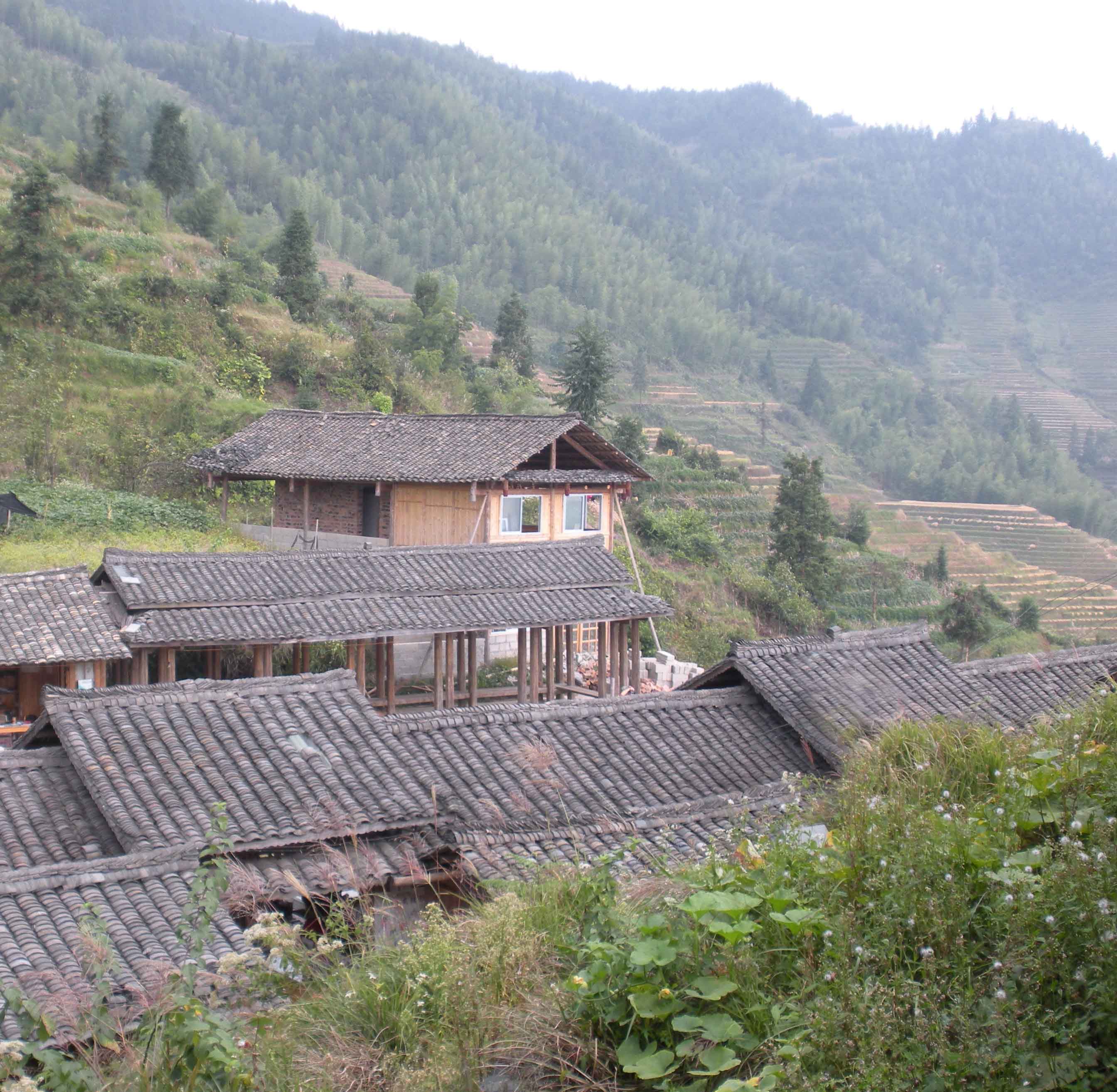
Village in Southeast China

Having failed, Mao stepped aside to let someone else run the nation. The large communes were abandoned. The peasants returned to their villages and were given land again.

Fearing the return of capitalism, Mao’s supporters printed a book with his slogans. Mao wanted to break the thinking and attitudes of old China. Using film, a propaganda campaign was launched so Mao could regain power. Then in 1966, he launched the Cultural Revolution.

Return to Part 3, China’s Great Leap Forward or go to Part 5

______________

Lloyd Lofthouse is the award-winning author of the concubine saga, My Splendid Concubine & Our Hart. When you love a Chinese woman, you marry her family and culture too.

If you want to subscribe to iLook China, there is a “Subscribe” button at the top of the screen in the menu bar.


China’s Water Woes

June 16, 2010

A man or woman can survive for weeks without food but only days without water. Knowing that, it shouldn’t come as a surprise that Tibet will stay in China for some time and water is the reason.

The Yellow River and Yangtze start in Tibet serving more than a third of China’s population. It’s possible that Mao realized the importance of water from Tibet when he sent 40,000 PRC troops into Tibet to reoccupy the former troublesome province/tributary that at the British Empire’s urging broke from China in 1913.
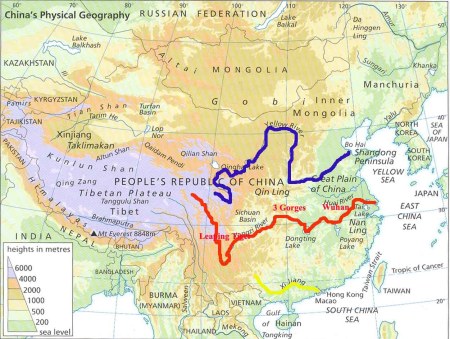
Tibet has an area of about 1.3 million square kilometers (about 5 million square miles) and it is estimated that there are less than 3 million people living in Tibet. China, on the other hand, serves 1.3 billion people, so who benefits the most from water that starts its journey in Tibet?

Rajendra K. Pachauri, chairman of the Intergovernmental Panel on Climate Change and winner of the 2007 Nobel Peace Prize, said, “At least 500 million people in Asia and 250 million people in China are at risk from declining glacial flows on the Tibetan Plateau.” Source: Circle of Blue Waternews

If Tibet’s water were in the hands of anyone else like a free Tibet that might favor other nations over China, China’s future would be dim at best and dire in a worst-case scenario. As it is, China is one of the earth’s driest areas and the challenge to supply 1.3 billion people with water is a daunting task. In fact, China is in a race with disaster and the finish line will be reached in a few decades.

In 1999, Wen Jiabao, a deputy prime minister, warned of looming water shortages. When he became prime minister, he promised to provide clean water for the people. Today, water and waste pollution is the single most serious issue facing China.

However, China has a large and cumbersome bureaucracy.  Different ministries compete with each other meaning little cooperation, which has led to a growing crisis that must be dealt with for China to avoid the suffering, chaos and anarchy that plagued the nation between 1835 and 1950. See China, The Roots of Madness

While replacing thousands of older, coal-burning power plants with cleaner technologies, building more hydroelectric dams, and constructing nuclear reactors, China is also adding desalinations plants to ease the growing water crises. In 2005, a desalination facility south of Shanghai started producing about 375,000 gallons of fresh water an hour, with a goal to build more plants and produce 250 million gallons of water per day by 2010. Source: Environmental News Network

In fact, to achieve this, China contracted with IDE Technologies in Kadima, Israel to build four new desalination units and the first will go on line near Beijing in 2010. These plants are designed to provide desalinated seawater for a power plant’s steam boilers as well as drinking water for local residents. Source: Water and Wastewater.com

According the Global Water Intelligence and the International Desalination Association, as of June 30, 2008, China was ranked 7th among the top ten desalination countries on the planet and that was before the IDE contract. Source: Water Webster

It doesn’t help China’s growing water shortage when mineral resources and a majority of its arable land exist where water is scarcest. Pollution and dealing with human waste are other challenges. Source: Mongabay.com

______________

Lloyd Lofthouse is the award-winning author of the concubine saga, My Splendid Concubine & Our Hart. When you love a Chinese woman, you marry her family and culture too. 

If you want to subscribe to iLook China, there is a “Subscribe” button at the top of the screen in the menu bar.


Food and China’s Eating Culture

May 10, 2010

China is an eating culture and always has been.  Although Today’s Chinese do not eat the quantities of meat the average American does, China accounts for half of global pig production because pork is the popular meat to eat.  Small farmer producers raise ninety-nine percent of pork in China. Source: China Translated

Chinese Farmer

Even when grain production falls in China that does not translate into a shortage since China has historically kept large food-grain stockpiles and those individual small farmer/producers help ensure food security. Source : China Through a Lens

As China’s economy continues to grow a spreading middle class with money to spend, food demand and eating habits are changing along with waistlines.  To meet this demand, Chinese have set up large pork and chicken operations in Australia to meet the growing demand for meat on the mainland. Source: Food Crisis

To insure a dependable supply of food to feed 1.3 billion people, Chinese companies have also bought or leased land in Africa sending Chinese laborers to produce crops for sale on the world market – and back home.  Source: Telegraph.co.uk

Discover Tofu

______________

Lloyd Lofthouse is the award-winning author of the concubine saga, My Splendid Concubine & Our Hart. When you love a Chinese woman, you marry her family and culture too. 

If you want to subscribe to iLook China, there is a “Subscribe” button at the top of the screen in the menu bar.