I walked to town recently to see the film of a book I read several years ago. The theater I saw it in was huge and there were only three of us there. Wolf Totem was in Mandarin with English subtitles. Fortunately for the audience, there isn’t much dialogue so there isn’t that much to read if you don’t speak the language but the story—through the panoramic visuals—had a powerful message about mankind meddling with nature. In China, this film has earned more than $110 million U.S. I couldn’t find out how much it has earned in the U.S. where I saw it.
Consider the fact that pollution is not exclusive to China, and the United States, for instance, has more than 1,300 superfund sites—Superfund sites are polluted locations requiring a long-term response to clean up hazardous material contaminations. – epa.gov
In addition, the book and the film also offer another way to learn about China, it’s people and their humanity.
Jiang Rong is the pen name for Lu Jiamin, the author, a Chinese citizen. Set during the Cultural Revolution, Wolf Totem describes the education of an intellectual living with nomadic herders in the grasslands of Inner Mongolia.
The publisher of Wolf Totem said the novel was an epic Chinese tale and that’s true. Wolf Totem taught me a lot about this almost extinct culture. I learned about the fascinating connection between wolves and Mongolians and why this connection may have been the reason why Genghis Khan was so successful in his conquests.
I recommend the film more than the novel to anyone who wants to learn about the life of the Mongols and another perspective of Mao’s Cultural Revolution. If you can’t see the film, then the book is worth reading too.
However, the theme that runs through the novel of maintaining a balance with nature is a bit overdone—I didn’t get this impression from the film. In the novel, I got the message the first time the characters talked about it but then the topic comes up repeatedly—a bit too much but an insignificant criticism of a book worth reading and a film that I think is even more powerful.
I won’t give away the ending, but don’t expect it to be happy. Most Chinese novels don’t end with happy endings. The ending for the film was different than the novel, and I actually liked it better—a powerful and breathtakingly beautiful film.
______________________________
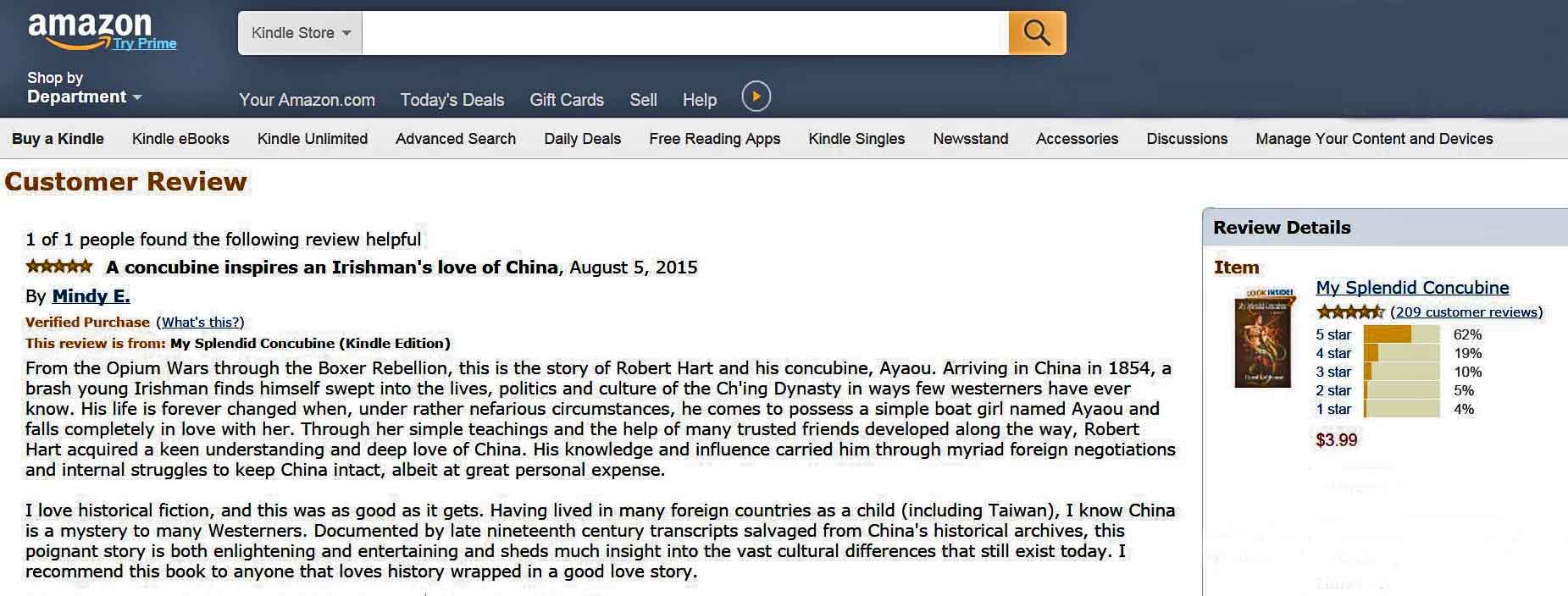
Lloyd Lofthouse is the award-winning author of My Splendid Concubine [3rd edition]. When you love a Chinese woman, you marry her family and culture too. This is the lusty love story Sir Robert Hart did not want the world to discover.
Subscribe to “iLook China”!
Sign up for an E-mail Subscription at the top of this page, or click on the “Following” tab in the WordPress toolbar at the top of the screen.
According to Jewish tradition, the Torah was revealed to Moses about the time of China’s Shang Dynasty (1766 – 1122 B.C.), more than three thousand years ago.
In fact, the Talmud is an organic interpretation through discussion and debate of what the Torah means and teaches.
In most of Asia, the perception of Jews as expert moneymakers does not have the religion-based antagonism that often accompanies the same stereotype elsewhere in the world. While both Christians and Muslims have persecuted Jews for religious reasons, China hasn’t done this.
Instead, South Korea and China respect what may be learned from the wisdom of Judaism.
The Muqata says, “Close to 50 million people live in South Korea, and everyone learns Gemara (Talmud) in school. ‘We tried to understand why the Jews are geniuses, and we came to the conclusion that it is because they study Talmud,’ said the Korean ambassador to Israel.”
“In my country we also focus on family values,” The South Korean Ambassador said. “The (Jewish) respect for adults, respect and appreciation for the elderly parallels the high esteem in my country for the elderly.”
Another significant issue is the respect for education. In the Jewish tradition, parents have a duty to teach their children and devote a lot of energy and attention to it.
For South Korean parents, their children’s education is also a top priority. For contrast, in the United States too many ignorant and lazy parents blame teachers when their children are not learning, but not in Asia.
How valuable is education to Jewish tradition? “Maimonides (1135 – 1204 C.E.) in his great code of Jewish law has an entire section devoted to teaching, teachers, students and the concept of knowledge and education. The basic value is that teachers are to be respected and given honor.
“One should rise before one’s teacher, speak respectfully to one’s teacher, and treat one’s teacher with greater probity than even one’s parent.” The Talmud teaches, “parents bring a child into this world but a teacher can bring a child into the World to Come” into a world of spirit, creativity, ideas and self-worth and ultimate immortality.
In fact, “the Talmud itself attributes to God, so to speak, the attribute of being a teacher. “He Who teaches Torah to His people Israel.” Even mortal teachers are viewed in Judaism as being engaged in holy work.
These ancient Jewish values have also found a home in China.
Newsweekreported, “The apparent affection for Jewishness has led to a surprising trend in publishing over the last few years: books purporting to reveal the business secrets of the Talmud that capitalize on the widespread impression among Chinese that attributes of Judaism lead to success in the financial arts.”
Newsweek said, “Titles such as Crack the Talmud: 101 Jewish Business Rules, The Illustrated Jewish Wisdom Book, and Know All of the Money-Making Stories of the Talmud share the shelves with stories of Warren Buffet and Bill Gates.”
“The admiration for Judaism stems from a history that goes beyond business,” Newsweek continues. “About half of the dozen or so Westerners active in Mao Zedong’s China were Jewish, and that also led to increased interest in Jewish culture among Chinese intellectuals,” says Xu Xin, professor of Jewish studies at Nanjing University.
______________________________
Lloyd Lofthouse is the award-winning author of My Splendid Concubine [3rd edition]. When you love a Chinese woman, you marry her family and culture too. This is the lusty love story Sir Robert Hart did not want the world to discover.
Subscribe to “iLook China”!
Sign up for an E-mail Subscription at the top of this page, or click on the “Following” tab in the WordPress toolbar at the top of the screen.
This post was inspired from Foreign Policy.com’s Meet China’s Pro-Life Christians. The subtitle of the piece ran with “Can they succeed in a country with the most abortions in the world?”
When I read that question, my first thought was to fact check and discover if this claim was true, because anyone who reads that question might conclude that China has the highest ratio of abortions on the planet—and, as I discovered, they would be wrong.
The result was that the claim in the U.S. media that China had the most abortions in the world spawned a protest from a small number of Christians in Chengdu, China (various statistical analyses have found that between 2% and 4% of the Chinese identify as Christian)—“Their faces downcast, they carried large posters with gruesome photos of aborted fetuses and headlines that read, ‘A fetus is a child too’.”
But a fetus is not a child. To compare a child to a fetus is deliberately misleading to cause an emotional reaction from ignorant people who are easily fooled. More on this later.
There is also a BIG difference between the number of abortions and the ratio of abortions. After all China has the largest population in the world. The country with the largest ratio of abortions in the world has a population of 56,483 compared to China’s almost 1.4 billion people.
The Foreign Policy piece started by mentioning the anti-abortion movement against Planned Parenthood in the United States, and then in the second paragraph said, “The news quickly reached China, and within days the video had been posted to Chinese video streaming site iQiyi, where it received more than 170,000 views (0.012% of total population). China has the highest number of abortions in the world, with an estimated 13 million performed annually.”
I’m curious what the other 99.988% of China’s people think about this issue. I mean, are they allowed to have an opinion or do only the Christians in China count—you know, the 2% – 4%?
But in countries where abortion is not available and/or is illegal, women who don’t want a child get an abortion anyway regardless of the pro-life, anti-abortion mob and their lies about fetuses being children. In fact, “Globally, approximately three births occur for every abortion performed, and half of all abortions are unsafe.” – Abortion Ratios Worldwide in 2008 and Abortion Laws Worldwide
How does China compare to other countries with the percent of known pregnancies ending in a legal abortion?
Greenland was #1 in 2012 at 49.9%. China was ranked #12 at 29.2%, and the United States was ranked #32 at 20.2%. – Johnston Archive.net (You might be interested in looking at the list to discover what country had the lowest number of legal abortions).
And according to Nation Master.com, “It is estimated that there are 44 million induced abortions annually, half of them in countries where abortion is illegal.”
In addition, the US National Library of Medicine reports that “Every year, worldwide, about 42 million women with unintended pregnancies choose abortion, and nearly half of these procedures, 20 million, are unsafe. Some 68,000 women die of unsafe abortion annually, making it one of the leading causes of maternal mortality (13%). Of the women who survive unsafe abortion, 5 million will suffer long-term health complications.”
Now, back to the Christian claim that “a fetus is a child too”
“The just-conceived prenatal life form is called a zygote (not a child). While migrating down the woman’s Fallopian tube to her uterus, it is named a morula (not a child), and from days five to 12 post-conception, a blastocyst (not a child). The blastocyst implants in the nutrient-rich lining of the mother’s uterus. From day 12 through week six, this being is termed an embryo (not a child or even a fetus).”
The rest of the description of the fetal development timeline may be found at baby center.com. For instance, during the first 3 weeks, “Your baby-in-the making is a ball of cells called a blastocyst (still not a fetus or a child).” … It isn’t until week ten that the embryo becomes the famous fetus that is still not a child.
In conclusion, back to that protest sign in Chingdu, China that said, “A fetus is a child too”. It‘s obvious from the facts that this cannot be true. It also helps to know the reasons why most women make the choice to have an abortion, and according to WebMD on Women’s Health, the most common reasons women consider abortion are:
Over half of all women who have an abortion used a contraceptive method during the month they became pregnant. (This means these women were not planning to get pregnant.)
Inability to support or care for a child. (often caused by poverty, and did you know that 1 of every 4 children the United States lives in poverty?)
To end an unwanted pregnancy
To prevent the birth of a child with birth defects or severe medical problem
Pregnancy resulting from rape or incest
Physical or mental conditions that endanger the woman’s health if the pregnancy is continued.
In addition, in the United States 9 out of 10 abortions are performed in the first 12 weeks of pregnancy while most are done within the first 9 weeks and technically the embryo isn’t even a fetus yet. In fact, very few abortions are done after 16 weeks of pregnancy when the fetus is a long way from becoming a baby or even a child.
Did you know that fetuses spend most of their time sleeping. At 32 weeks, the fetus sleeps 90% to 95% of the day and this is the result of an immature brain. To learn more about the development of the brain, I suggest you read this piece from Harvard.edu. For instance, “at 9 months (after birth), the human brain is too immature to firmly register experiences, while at 17-21 months it has developed enough to record and retrieve memories of single distinctive experiences,” Kagan says.
To the pro-life, anti-abortion people, how does a fetus become a child when 90% of abortions take place before the embryo becomes a fetus and a fetus is never a child?
And last but not least, why pick on China when there are eleven other countries with higher ratios of abortions?
By the way, I learned something in the last few weeks. While talking to a few members of pro-life, anti-abortion crowd outside of a Planned Parenthood clinic, I learned that Christians in the United States are just as ignorant as Christians in China when it comes to knowing the difference between a fetus, a baby and a child. Do you know the difference? If not, watch the first video in this post.
I think every woman should have the legal choice to a safe abortion as long as it is still an embryo or an early fetus and not a baby or child, but truth be told, you can’t abort a baby or child from a womb because a baby or child has already been born and has left the womb.
______________________________
Lloyd Lofthouse is the award-winning author of My Splendid Concubine [3rd edition]. When you love a Chinese woman, you marry her family and culture too. This is the lusty love story Sir Robert Hart did not want the world to discover.
Subscribe to “iLook China”!
Sign up for an E-mail Subscription at the top of this page, or click on the “Following” tab in the WordPress toolbar at the top of the screen.
In fact, at the time Schmitt was a Shanghai-based writer whose work had appeared in the Wall Street Journal, The Economist’s Business China, Marie Claire, World Hum, Afar Magazine, and Backpacker. I haven’t read all of her work, but this piece was worth sharing.
If you want to learn about China, you would have to travel to China often or live there as an expatriate as Schmitt did. Marrying into a Chinese family like I did also works.
While living in China, Schmitt moonlighted as a restaurant reviewer for City Weekend Shanghai. She went falcon hunting in Yunnan, drank fermented mare’s milk in a Mongolian yurt, and attended a mail-order bride’s wedding and donned qipaos with Shanghai’s senior citizens.
Another example of being young in urban China. The world this generation knows is not the world their parents grew up in.
Instead of playing it safe and staying primarily in modern China around other foreigners and expatriates as many do, Schmitt “tasted” what being Chinese really means, and she wrote often of China from Shanghai’s lesbian sub-culture to debates held at the 15th century Sera Monastery by Lhasa monks.
As for young love, Kellie Schmitt writes, “In Shanghai, teachers and parents widely prohibit dating in high school, urging students to study instead.”
But for Enid and Michael—the Chinese couple Schmitt writes about—their love was “worth a little sneaking around” when they were sixteen.
When they turned 22, they were still together and got married. When Schmitt wrote the post for CNN Go Asia, Enid and Michael were 26. Today, they would be in their thirties. As in all marriages, Enid and Michael have had challenges but it appears that love kept them together. I recommend Schmitt’s story to learn more about how China is changing.
Kellie Schmitt now lives in California’s Central Valley.
______________________________
Lloyd Lofthouse is the award-winning author ofMy Splendid Concubine [3rd edition]. When you love a Chinese woman, you marry her family and culture too. This is the lusty love story Sir Robert Hart did not want the world to discover.
Subscribe to “iLook China”!
Sign up for an E-mail Subscription at the top of this page, or click on the “Following” tab in the WordPress toolbar at the top of the screen.
It’s been more than four years since Amy Chua’s memoir Battle Hymn of the Tiger Mother launched a vicious tsunami of words that swept across the United States. Critics judged the book largely by asking the following questions: Should self-esteem come before accomplishment, or accomplishment before self-esteem? The logical answer, I think, is that a child’s self-esteem must develop naturally and organically and not through the efforts of helicopter parents pressuring teachers to dumb down the curriculum and inflate grades.
The bad news is that helicopter parenting might be getting worse if Psychology Today.com is right.
About the same time that Chua’s memoir came out, research into parenting styles revealed that “almost 49% of the European-American parents used authoritative parenting (alleged to be the best parenting style), as did about 46% of the Asian-American parents. Both groups revealed about the same number of parents using authoritarian (Tiger Mom-style) parenting (23% for European-Americans, and 26% for Asian-Americans). In other words, the number using authoritative parenting was virtually the same for both groups. – Psychology Today.com
In addition, Pew Research.org reported “Fully 94% of parents say it is important to teach children responsibility, while nearly as many (92%) say the same about hard work. Helpfulness, good manners and independence also are widely viewed as important for children to learn, according to the survey.”
But work by Eva Pomerantz suggests that Chinese mothers think differently. They think “my child is my report card,” and they see the academic success of their children as a chief parenting goal. But the reasons why a particular type of parenting works in one cultural group may not translate to another cultural group, partly because parenting goals are different in different groups.
In early 2011, we went to see Amy Chua in Berkeley when she was on tour for her memoir. The room was packed with several hundred people and there was standing room only due to all the controversial attention the book was getting.
At the times, I thought that Amy Chua looked as if she were expecting an eighteen-wheeler to crash through the wall and flatten her. That is probably because I’d read that she’d received death threats from across the U.S. for revealing in her memoir that she had said NO to activities such as sleepovers, play dates, acting in school plays, and did not allow her daughters to watch endless hours of TV and/or play computer games like so many American parents do.
Imagine getting assassinated, not by your child but by a stranger, because you wouldn’t let your kid have a sleepover.
To many, Chua did the unthinkable and demanded excellence. Time magazine said, “Most surprising of all to Chua’s detractors may be the fact that many (but not all) elements of her approach are supported by research in psychology and cognitive science.”
And as Amy Chua sat in that tall chair on stage above the audience with her feet dangling a foot from the floor, the audience laughed, applauded and treated her as if she were a hero—not someone to condemn or shun.
In the Time magazine piece, Chua said, “I know some Korean, Indian, Jamaican, Irish and Ghanaian parents who qualify too. The tiger-mother approach isn’t an ethnicity but a philosophy: expect the best from your children, and don’t settle for anything less.”
The American Psychological Association defines tiger parents as those who practice positive and negative parenting strategies simultaneously. Tiger parents are engaging in some positive parenting behaviors; however, unlike supportive parents, tiger parents also scored high on negative parenting dimensions. This means that their positive parenting strategies co-exist with negative parenting strategies.
Tiger parents and harsh parents are alike, in that both use negative parenting strategies. Unlike tiger parents, however, harsh parents do not engage in positive parenting strategies. Easygoing parents have a more hands-off approach, and do not engage as much with their children, either positively or negatively.
Another study out of the University of Michigan comparing U.S. and Chinese public school systems discovered parental involvement is a critical component to a child’s educational experience. If a child’s parents value education, then the child is more likely to value school as well. In China, parental involvement is higher than compared to the US, because Chinese parents accept the critical role of helping their students to learn concepts if they are lagging behind in school. Chinese parents also make sure that their children complete their homework. Parents in the U.S. typically play a more passive role in the education of their children. … It was also proven that greater involvement in a child’s education fosters more positive attitudes toward school, can improve homework habits, increase academic success and can reduce dropout rates.
What parenting style did your parents use on you? My parents were mostly hands off and that might explain why I barely made it through high school, but I did much better in college after the Marines applied their harsh methods of discipline.
______________________________
Lloyd Lofthouse is the award-winning author of My Splendid Concubine [3rd edition]. When you love a Chinese woman, you marry her family and culture too. This is the lusty love story Sir Robert Hart did not want the world to discover.
Subscribe to “iLook China”!
Sign up for an E-mail Subscription at the top of this page, or click on the “Following” tab in the WordPress toolbar at the top of the screen.


 Posted by Lloyd Lofthouse
 iLook China