Comparing India and China’s Economic Engines

October 13, 2010

The cover for The Economist of October 2 – 8, 2010, is betting on a race that cannot be won by India.
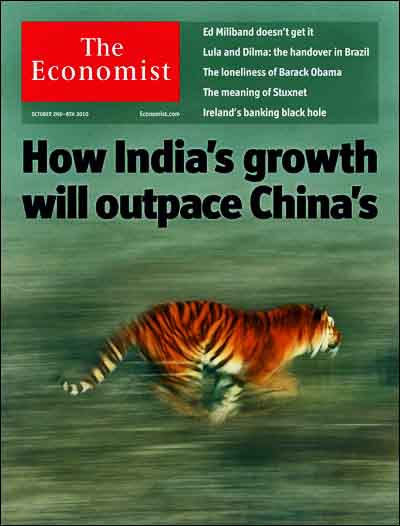

I opened the magazine and read the two pieces that the cover was about.  One is about India’s surprising economic miracle and the second piece was A bumpier but freer road.

On page 11, I read, “many observers think China has done a better job than India of curbing corruption…”

On page 77, a Western banker was quoted saying, “It’s much easier to deal with the well-understood ‘org chart’ of China Inc than the freewheeling chaos of India.”

After reading both pieces comparing China with India, it was obvious that India would never beat China economically.

The Economist wants India to win this race, because it is called a democracy as is the U.S., but what isn’t mentioned is that China is becoming a republic with a Chinese twist, which is what Dr. Sun Yat-sen wanted.

The reason The Economist is wrong about India is because America’s Founding Fathers hated democracy and they had a good reason.

The Live Journal goes into detail on this topic.  To quote the Live Journal, “It would be an understatement to say that the (U.S.) Founding Fathers hated democracy. They warned against it vehemently and relentlessly. They equated it – properly – with mob rule.

“in a democracy, two wolves and a sheep take a majority vote on what’s for supper, while in a constitutional republic (which China is becoming), the wolves are forbidden on voting on what’s for supper and the sheep are well armed.…

“The Founders, who hated democracy, gave us a free country (a republic). Our (meaning many Americans) ignorance of history, which has lead to a love of democracy, is causing us to surrender our freedoms at an alarming rate.”

Dr. Sun Yat-sen (1866 – 1925), known as the father of modern China, said he wanted to model China’s government after America but by combining Western thought with Chinese tradition.

When he said this, it was 1910, and America, by definition, was still a republic. Once you read the two pieces in The Economist, you may understand why India’s democracy cannot beat China’s evolving republic.

This topic is continued (with more details and facts) at India Falling Short

_______________

Lloyd Lofthouse is the award-winning author of My Splendid Concubine [3rd edition]. When you love a Chinese woman, you marry her family and culture too. This is the love story Sir Robert Hart did not want the world to discover.

Subscribe to “iLook China”!
Sign up for an E-mail Subscription at the top of this page, or click on the “Following” tab in the WordPress toolbar at the top of the screen.

About iLook China


Entitlement – One of the Cancers that Kills Empires

October 11, 2010

Although Deng Xiaoping was misquoted by the Western media for saying, “Getting Rich is Glorious”, he should have the credit anyway.

By opening China to capitalism and world trade and introducing competition at all levels of society and ending the Communist, socialist economic model, Deng Xiaoping saved China.

A return to the socialist economic model means China will fall into step behind America, which is on the fast track to failure “in part” due to entitlement programs for the disadvantaged that were launched during President Lyndon Johnson’s Great Society, which was designed to reduce poverty.

The government should not have played a role in lifting people out of poverty. Those who live in poverty should accomplish that for themselves.

After reading, editing and revising Escaping the Trap, K. D. Koratsky’s guest post, I believe I understand what he meant by following evolutionary principals to compete.


President Lyndon Johnson wanted to do something for everyone and America is still paying the price.

Although many in America blame China for lost jobs in the U.S., the fault belongs in America partially because of government programs like President Johnson’s Great Society.

Creating entitlements (preferences and favoritism) to minorities, single mothers or the handicapped was one of the mistakes that contributed to America losing its competitive edge in the global-market place.

Once discrimination is removed, socialist programs that create entitlements for individuals who cannot compete and win were wrong. 

The best qualified should win – not the other way around.

However, there is nothing wrong with a social-safety net designed to train individuals who lost jobs due to changes in the workplace so he or she may reenter society as a productive citizen, but only if he or she can compete without favoritism.

Evolution means competition at all levels where those who are the best qualified wins.

______________

Lloyd Lofthouse is the award-winning author of the concubine saga, My Splendid Concubine & Our Hart. When you love a Chinese woman, you marry her family and culture too. 

If you want to subscribe to iLook China, there is a “Subscribe” button at the top of the screen in the menu bar.


China questions the dollar’s value – Part 2/2

October 7, 2010

In the second half of Al Jazeera’s Inside Story, the commentator asks Max Keiser in Paris what it would take to replace the U.S. dollar with an IMF managed global currency.

Keiser says, doing this would cause risks for the U.S., which has extraordinary privileges–writing checks that are never cashed since the U.S. just prints new dollars to pay the bills. This has been going on since the end of World War II.

Because of this, Max Keiser says, America has everything to lose and will resist China’s proposal to have a more stable global currency managed by the IMF. 

He points out several instances of the U.S. using its military to solve these types of problems when another country wants out of the U.S. dollar.

Then Robert Scott in Washington D.C. was asked if this new global currency would work. He said the U.S. has the deepest financial markets in the world– about 40 trillion dollars making the dollar the currency of choice.

Andrew Leung said that a global currency managed by the IMF using SDRs would be more stable as a global currency. However, it is a bold vision that requires extraordinary political courage from Beijing. We can’t get there soon.

Back to Paris, Max Keiser gives an opinion that China doesn’t have enough gold to make this happen.

China has about 600 tons of gold while the U.S. has 8,000 tons.  To be taken seriously, China would need to buy more gold and boost its reserves.

See The Reasons Why China is Studying Singapore or return to China questions the dollar’s value – Part 1

______________

Lloyd Lofthouse is the award-winning author of the concubine saga, My Splendid Concubine & Our Hart. When you love a Chinese woman, you marry her family and culture too. 

If you want to subscribe to iLook China, there is a “Subscribe” button at the top of the screen in the menu bar.


China questions the dollar’s value – Part 1/2

October 7, 2010

I find Al Jazeera English, the 24-hour, Arabic-language satellite television news network, an interesting place to find an objective view of China.

The history of Al Jazeera is also interesting.

This Al Jazeera “Inside Story” from 2009 is about China questioning the value of the American dollar.

In fact, the Chinese prime minister blamed the U.S. financial system for the 2008 global recession and said a new world currency was needed to replace the dollar.

The Al Jazeera commentator questioned if China was just playing politics challenging U.S. dominance of the global financial system.

China suggested that it would be better if the dollar was replaced with the IMF’s (International Monetary Fund) Special Drawing Rights called SDRs.

The value of the SDRs would be based on a basket of currencies. China said that basing economic reserves on a group of currencies would prevent a financial crash like the 2008 economic meltdown from happening again.

Zhou Xiaochuan, the governor of the People’s Bank of China said, “The outbreak of the crises and its spillover to the entire world reflects the inherent vulnerabilities and risks in the existing system…”

There is a clip of President Obama speaking in defense of the U.S. dollar.

Al Jazeera’s “Inside Story” had a panel of guest experts from around the globe.  There was Robert Scott of the Economic Policy Institute in the U.S., Andrew Leung, an economist and a China specialist in London, and a Paris based financial analyst, Max Keiser, who writes for the Huffington Post.

Read about China’s economy

______________

Lloyd Lofthouse is the award-winning author of the concubine saga, My Splendid Concubine & Our Hart. When you love a Chinese woman, you marry her family and culture too. 

If you want to subscribe to iLook China, there is a “Subscribe” button at the top of the screen in the menu bar.


The Growing BRICs

October 7, 2010

Until recently, I didn’t know what the BRIC was.  Now, because I spend so much time researching topics about China, I often run into the BRIC.

The BRIC is Brazil, Russia, India and China. In the next few decades, these countries could become the wealthiest nations on the globe alongside America.

Jim O’Neill, who works for Goldman Sachs, talks about the BRIC in the embedded video.

In fact, O’Neill is the one who thought up the acronym for BRIC.

When he stepped into his position at Goldman Sacs, he wanted to know how the world might change economically by 2050.

They discovered that China would become the world’s largest economy before 2050 possibly reaching 45 trillion dollars–twenty times larger than today, and the rest of the BRIC economies would have a much larger share of the global economy too.

Projections also show that India, Russia and Brazil would become larger than the current G7 bypassing Canada, France, Germany, Italy, Japan and the United Kingdom.

Only the US would remain in the top five.

If you are a doubter, consider that the BRIC economies are already having a huge influence on the world, and the potential growth of the middle class in the BRICs could explode four hundred percent in the next decade, which would increase demand for cars, energy and oil.

See Business is a Global War

______________

Lloyd Lofthouse is the award-winning author of the concubine saga, My Splendid Concubine & Our Hart. When you love a Chinese woman, you marry her family and culture too. 

If you want to subscribe to iLook China, there is a “Subscribe” button at the top of the screen in the menu bar.