
Chinese in the Gold Rush – Part 1/2

June 5, 2011

Guest post by John Putnam

Of all the diverse peoples that poured into California after the discovery of gold, none stood out more than the Chinese. Radically different in dress, language and culture these new men were first welcomed because of their willingness to work hard for low wages at any task presented them.

John McDougall, the 2nd Governor of California, described them as “one of the most worthy of our newly adopted citizens.”

At the start of 1849 only 54 Chinese were in California. By1852 there were nearly 12,000 living here and only seven of them women. Because of turmoil in Canton another 20,000 would arrive that same year.
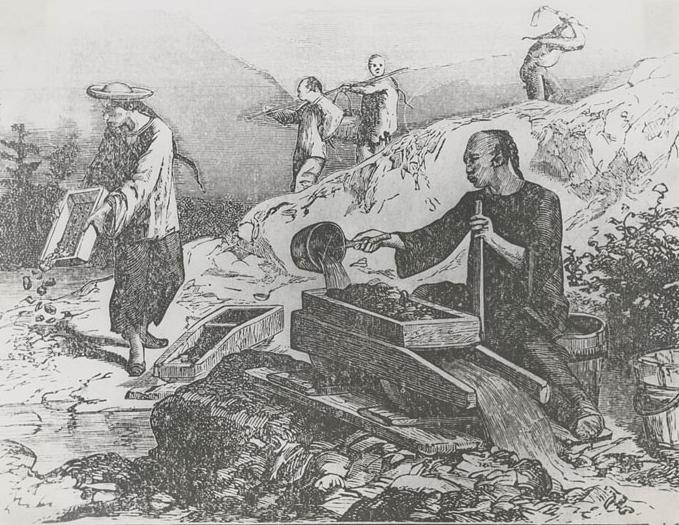
A community of Chinese Americans quickly grew in San Francisco. They marched in Fourth of July parades and rejoiced at California’s statehood, but celebrated their lunar new year in their traditional way.

In 1852 a Cantonese opera was performed at the American Theater and in 1854 a Chinese language newspaper began publishing.

The Kong Chow Association formed to help the new arrivals adapt to their new home. Then another, the Chew Yick, elected Norman As-sing, an English speaking owner of the Macao and Woosung Restaurant as their leader. Soon there were six associations called tongs that combined to form the Six Companies to better represent Chinese interest.

Continued on June 6, 2011 in Chinese in the Gold Rush – Part 2

____________________

Reprinted by permission. First published May 23, 2011 in My gold rush tales. John Putnam is the author of Hangtown Creek, a thrilling saga of the early California gold rush.

To subscribe to “iLook China”, look for the “Subscribe” button at the top of the screen in the menu bar, click on it then follow directions.


Modern Chinese Parents and Children – Part 3/3

May 31, 2011

Guest post from Hannah in China

In fact, in China, children should not argue with their parents and the child must do what the parents say.

When the child is good at studying, it means “Guang Zong Yao Zu”, (bring honor to your ancestors).

When you get the low score (100% score is best. 60% means you barely passed the exam. 90% is good. However, even just 1% lower and the child gets the “cold face”).

This not only means teachers calling parents endless times for meetings and punishment from the parents but it embarrasses your ancestors too.

This means when children are doing the homework, parents watch them until they finish to insure no mistakes.

Another recent review from Amazon.US points out an interesting thought. “The (Amy Chua) book raises an important question: Is America’s assumed educational mediocrity really the fault of our public schools (as some believe) or is it the fault of an epidemic of indulgent parenting (as others believe)? Asian kids seem to do remarkably well in the public schools… and raising little complaint about the quality of the schools.”

As for myself, Hanna writes, I think I’m the lucky one born in a family offering more freedom. Luckily I was a good student so my parents didn’t have to pay as much attention to me.

Did they spoil me? Sure. Did they care about my feelings? Yes, because they allowed me talk and argue with them.

If your child is no good at school, you must still love them. However, being strict so they have a good future is not worth it if they hate you later. No matter what kind of family you live in – strict or spoiled – the important thing is to love. Then the world can be better place.

(From the Blog’s host) Amy Chua was heard from again recently when she wrote for USA Today, Tiger Mom: Here’s how to reshape U.S. education.

Chua says, “My memoir — seen in the West as a story about “extreme” parenting — is being marketed the opposite way in China, as a story about the importance of giving kids more freedom. Amusingly, the book’s title in China is Parenting by a Yale Professor: Raising Kids in America, and I was asked by one Chinese women’s magazine to give its readers tips on “how to be friends with your kids.”

Return to Modern Chinese Parents and Children – Part 2 or start with Part 1

View as Single Page

Discover Hannah’s review of Red Mansion, a Chinese TV series, or visit her Blogs at Hannah Travel Adventure (Chinese) or Hannah China Backpacker (English)

______________

To subscribe to “iLook China”, look for the “Subscribe” button at the top of the screen in the menu bar, click on it then follow directions.


Modern Chinese Parents and Children – Part 2/3

May 30, 2011

Guest post from Hannah in China

In addition, modern Chinese are also having many new chances but this still won’t change the way most Chinese parents raise children, because China now has the “Gaokao”, which is the high school examination to get into a university or college.

Because of the competition, parents can’t afford or wouldn’t dare to let the child just play and have fun. Children don’t know what is best for them.

Parents must force them to study but spoil them at the same time. When the child gets the great score, that means everything to parents. The kids don’t have to do anything else in life but study. Therefore, the story is the boy went into a famous college but didn’t know how to peal the eggshell.

Note from Blog host: Another review from Amazon.UK supports what Hanna is saying. The reviewer wrote, “I know how appalling some of those things sound to many. Not me, since I am Chinese myself and I have been brought up that same way, if not more strict.…. However when I grow up (now 40), I see the vast difference of parenting among other people in different countries (I live in UK now with my English husband), and what repercussions it has on the kids when they grow up. I am glad I was brought up the way I was.”

Hanna says, “Chinese parenting is not about ‘feelings’, but it’s not to say that the parents do not care.”

The child has to finish the school homework to 10 pm at night five days a week. Then after school, the child goes to the special training to develop other skills such as piano. This is not about what the the child is interested but it’s what the parents decided based on what they believe is necessary. What we learn in China is that the children have to attend eight different hobbies classes. There’s no free time.

Continued on May 31, 2011 with Modern Chinese Parents and Children – Part 3 or return to Part 1

View as Single Page

Discover Hannah’s review of Red Mansion, a Chinese TV series, or visit her Blogs at Hannah Travel Adventure (Chinese) or Hannah China Backpacker (English)

______________

To subscribe to “iLook China”, look for the “Subscribe” button at the top of the screen in the menu bar, click on it then follow directions.


Modern Chinese Parents and Children – Part 1/3

May 29, 2011

A Guest post from Hannah in China

Before I start to talking about Chinese parents and children, first let us have a look of the currently pretty hot arguing book, Battle Hymn of the Tiger Mother, which is a Chinese-American Yale law professor mom that wrote about how she was strict with her two daughters by making a lot of can’t doing rules, and she was acting like a wicked witch to push them to study.

I will not comment on which parenting method is better, Chinese or Western.

What I want to say is the book’s author Amy Chua’s way of parenting is typically Chinese though she is 4th-generation American.

Note from Blog host: Evidence of this may be found among reviews and comments on Amazon.UK. Rosie in the UK wrote, “I am Chinese now living in the UK and I admit I was outraged when I first read the WSJ excerpt of her (Amy Chua’s) book. My first thoughts were I can’t believe anyone would do something like that to their children. However, as I thought more about it and I guess living out here in the UK I’ve been so used to the numbing and dummying of our children’s perceived fragile self esteem and always making sure that their feelings and wants are met for fear of damaging them emotionally, I forgot that, hey, I was brought up pretty much the same way.”

Hanna says, “We Chinese have a long history of parents being strict with their children. From old days, the Ke Ju Kaoshi (official examination) was the only chance for people to change their fate and life.

“To achieve this, they must study really hard. We have an old saying about this “Shi Nian Han Chuang Ku Du Ri, Jin Chao Jin Bang Ti Ming Shi”, which means “Ten years of study at a cold window only for the day of passing the examination.”

“To study, students must be pushed even by using the stick.”

Continued on May 30, 2011 with Modern Chinese Parents and Children – Part 2

View as Single Page

Discover Hannah’s review of Red Mansion, a Chinese TV series, or visit her Blogs at Hannah Travel Adventure (Chinese) or Hannah China Backpacker (English)

______________

To subscribe to “iLook China”, look for the “Subscribe” button at the top of the screen in the menu bar, click on it then follow directions.


The Importance of Guanxi to Chinese Civilization

May 23, 2011

In lieu of a Western style legal system for most of China’s history, Guanxi offered an alternative to foster innovation, develop trust and contribute to trade and commerce for thousands of years.

Sir Robert Hart (1835 – 1911), the godfather of China’s modernization and the main character of my first two historical fiction novels, discovered the importance of Guanxi soon after he left the employ of the British and went to work for the Emperor.

He quickly learned that a “supreme value of loyalty glued together China’s structure of personal relationships.” Source: Entering China’s Service

In addition, Hart wrote in a letter in 1891, “These people (referring to the Chinese) never act too soon, and, so far, I have not known of their losing anything by being late. To glide naturally, easily and seasonably into the safe position sequence as circumstances make, is probably a sounder though less heroic policy for a state than to be forever experimenting—”

To translate, it takes time to develop a relationship/friendship/trust (Guanxi) that all invovled may benefit from.


Warning: This is a Promotional Video. However, it offers a perspective on Guanxi worth seeing.

However, I did not learn about Guanxi from Robert Hart. I first learned of it from the China Law Blog, which quoted the Silicon Hutong Blog.

Then I did more research and watched a few videos on the subject. I learned that Guanxi is one of those complexities of Chinese
culture that does not translate easily.

There are several elements and layers to Guanxi. First, Guanxi is based on a Confucian hierarchy of familial relationships, long-term friendships, classmates, and schoolmates and to those no stranger – Chinese or foreign – will ever have access. Source: Silicon Hutong

Guanxi developed over millennia because China did not have a stable and effective legal system as it developed in the West.

In fact, the legal system in China today is relatively new and made its appearance after the 1982 Chinese Constitution became the law of the land.

Since 1982, there have been several amendments to the Constitution as China adapts its evolving legal system, which was modeled after the German legal system.

In time, this Western influenced legal system may replace Guanxi since business law modeled on Western law with Chinese characteristic has developed faster than civil law.

There are a several opinions about Guanxi. I learned that Guanxi is similar to a gate that opens to a network of human beings but it isn’t that simple.

Maintaining Guanxi is different than how relationships are maintained in other cultures. The embedded videos with this post offer a more detailed explanation.

The China Law Blog copied the post from the Silicon Hutong Blog. The post on the China Law Blog had more than twenty comments and it was a lively discussion worth reading if you are interested in discovering more.

Learn more of Chinese Culture from The Mental and Emotional State of “Face”

______________

Lloyd Lofthouse is the award-winning author of the concubine saga, My Splendid Concubine & Our Hart. When you love a Chinese woman, you marry her family and culture too.

To subscribe to iLook China, use the “Subscribe” button at the top of the screen in the menu bar.

This revised and edited post first appeared here on October 18, 2010 as Guanxi in China