Americans doing Business in China – Part 11/16

March 2, 2012

Note from Blog host — another example of East meets West through business and trade: Sexy Beijing says they are an “Internet TV station run by an in-house production team. We also work with a handful of contributors in the editing room and on productions. Our shows have also aired on NBC in Los Angeles, Hunan TV, China Educational TV, and many other stations around China as well as conferences around the world… From the BBC to CNN.com to Hunan Satellite TV, Sexy Beijing has been glowingly covered on television, radio and in print, in both the English-language and Chinese media.”

New Yorker.com says, “Sexy Beijing’s creator is Anna Sophie Loewenberg (Note: she graduated from University of California at Santa Cruz with a BA in Literature and went on to earn a master’s degree in Journalism from Columbia University in New York City. Sophie arrived in China in 1996). She is the star and producer of ‘Sexy Beijing,’ an online series of sly, knowing videos about a hapless, curious foreigner which has proved popular among expats, language students, and mainland Chinese.”

____________________

The following guest post was originally published by Bob Grant, publisher/editor, at  Speak Without Interruption.

(Note: There are more photos at the original site. The Nanjing Road photo here does not appear at Speak Without Interruption.)

Wherever people normally congregate in groups—shopping areas, elevators, subways, airports, city streets, and the like—there are a lot more people in China congregating in those same places. Again, I can only use my own experiences – in these types of crowds in China – but I was amazed how tolerant people were of each other.

In some cases I was squeezed to the people next to me so closely that I could almost feel their hearts beating. In these situations – personal space was at zero.

I was crammed into a subway once and could literally stand – without holding on to anything – because we were packed so close together (not that I really had anything to hold on to anyway). The exit from this subway was orderly and people were polite to each other – and me. At our stop, we had to ask people to move, which was difficult for them, but we got off with no problems or delays.

Normal crowd for Nanjing Road in Shanghai

I am not certain the Chinese people have a choice living – and working – among that many other people. However, I saw it as another attribute of China and its people.

As a “Westerner” I could have easily been accosted by anyone in these large crowds as most of the time I was the only non-Chinese among them. But this never happened. No one stared at me or otherwise acknowledged me as anything other than one of them.

Perhaps I am reading too much into these situations, but I will go with my feelings here and believe this is a nation of extremely tolerant individuals.

Places I went did not always have these types of crowds, but in the locations where large crowds congregated, I was always impressed by the politeness of my fellow “Crowdies”. I can’t say the same for other crowds, in which I have found myself, in the US and other parts of the world. I think China is unique in this area and its people have Tolerance to Infinity.

Note from Blog host – If you plan to do business in China, I recommend visiting the China Law Blog first.

Continued March 3, 2012 in Americans doing Business in China – Part 12 (a guest post) or return to Part 10

______________

Lloyd Lofthouse is the award-winning author of The Concubine Saga. When you love a Chinese woman, you marry her family and culture too. This is the love story Sir Robert Hart did not want the world to discover.

Subscribe to “iLook China”
Sign up for an E-mail Subscription at the top of this page.

About iLook China

Note:  This guest post first appeared on March 13, 2010


Americans doing Business in China – Part 9/16

February 29, 2012

Note from Blog host — another example of East meets West through business and trade: Higher education is a business, and the number of international students at U.S. colleges and universities reached 723,277 during the 2010-11 academic year.  China, the top country of origin for international students, sent 157,558 undergraduate and graduate students to America, up 23% from the previous year.

International students and their dependents contributed more than $20 billion to the U.S. economy that academic year. For Chinese students, that means about $4.4 billion came from China.

Ann Stock, assistant secretary of the US State Department says, “Young people who study abroad gain the global skills necessary to create solutions to 21st-century challenges. In turn, international students globalize our campuses and communities.” SOURCE: USA Today

_____________________

Guest Post by Bob Grant — publisher/editor for Speak Without Interruption, an international online magazine.

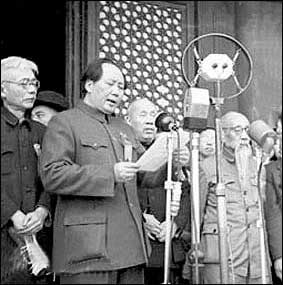
On October 1, 1949 the People’s Republic of China was formally established in a speech given by Mao Zedong from the Imperial Gate at Tiananmen Square. I stood at the very spot where Mao gave his speech and took a photo. From speaking with people – in China – who lived through his reign it was beyond believable. What he put his people through is an unforgivable act of power and brutality.

However, it is images from Mao’s era that some – outside of China – still have of the Chinese people. Nothing could be farther from the truth!

I never met a Chinese government official – did not even see one at least that I can recall. What I did meet were the people of China – the people with whom I had my business and personal interactions. I did not ask them questions about their government nor did they ask questions of mine.

The only political statement that I ever heard was a reference that China’s policy would probably change when the younger generation came into power, someday.

In meetings, over two years ago, I heard about the oil pipeline being built directly from Iran to China. None of the people in that meeting expressed an opinion one way or the other regarding this pipeline. It was a decision the Chinese government made.

Maybe my associates did not approve of dealing with Iran—maybe they did? The point being here is their government made this decision—not my associates.

Whether the officials in power in the US are republican or democrat, they have all made decisions of which I don’t agree. They did not consult me or ask my opinion—am I my government in these situations?

The point I am trying to make is that I found the Chinese people I met just like me in a lot of respects. I enjoyed doing business with them – learning their culture – and becoming their friend. No government – or its actions – is ever going to change that for me!

Note from Blog host – If you plan to do business in China, I recommend visiting the China Law Blog first.

Continued March 1, 2012 in  Americans doing Business in China – Part 10 (a guest post) or return to Part 8

______________

Lloyd Lofthouse is the award-winning author of The Concubine Saga. When you love a Chinese woman, you marry her family and culture too. This is the love story Sir Robert Hart did not want the world to discover.

Subscribe to “iLook China”
Sign up for an E-mail Subscription at the top of this page.

About iLook China

Note:  This guest post first appeared on March 9, 2010


Anna May Wong – the Woman that Died a Thousand Times

February 10, 2012

Almost half a century after her death, Anna May Wong (1905 to 1961) has not been forgotten.

As a child, Anna loved going to the movies and even cut school to go.

Between 1919 and 1961, she acted in 62 films. The Internet Movie Data Base says she was the “first Chinese-American movie star”.

To act, Anna had to play the roles she was given. The Western stereotype cast her as a sneaky, untrustworthy woman that always fell for a Caucasian man. The dark side of achieving her dream of acting in movies was that Anna had to die so the characters she played got what they deserved.

Anna often joked that her tombstone should read, “Here lies the woman who died a thousand times.”

Until Chinese started to emigrate to the U.S. in the mid-19th century, they had never encountered a people who considered them racially and culturally inferior.

However, the discrimination against the Chinese in America was only exceeded by the racism and hatred directed at African-Americans.

In fact, in the 1960s, many of the anti racist laws enacted during the Civil Rights era focused on protecting African-Americans, which created a protected class, and since the Chinese—due to cultural differences often did not complain—they were left behind.

In many respects, this racism toward the Chinese still exists in the US today and manifests itself through the media as China bashing, which supports the old stereotype.

When Anna May Wong visited China in 1936, she had to abandon the trip to her parent’s ancestral village when a mob accused her of disgracing China.

After her return to Hollywood, she was determined to play Chinese characters that were not stereotypes, but it was a losing battle. To escape the hateful racism, she lived in Europe for a few years.

Since U.S. law did not allow her to marry the Caucasian man she loved, and she was afraid that if she married a Chinese man he would force her to give up acting since Chinese culture judged actresses to be the same as prostitutes, she never married.

Anna May Wong smoked and drank too much. She died of a heart attack in Santa Monica, California at age 56.

Lloyd Lofthouse is the award-winning author of My Splendid Concubine [3rd edition]. When you love a Chinese woman, you marry her family and culture too. This is the unique love story Sir Robert Hart did not want the world to discover.

1-joanna-daneman-review-updated-sept-21-2016_edited-3

Where to Buy

Subscribe to “iLook China”!
Sign up for an E-mail Subscription at the top of this page, or click on the “Following” tab in the WordPress toolbar at the top of the screen.

About iLook China

China’s Holistic Historical Timeline


Women’s Rights in China

February 8, 2012

Dramatic changes in women’s rights have been achieved in a culture where for millennia women were stereotyped as inferior to men, had no rights and served as slaves, concubines and prostitutes. Marriages were arranged—sometimes at infancy.

In 1949, foot binding was abolished; the All-China Women’s Federation (ACWF) was formed and supported by China’s Communist Party (CCP). Change in China, as in the United States, has been a painful evolutionary process. However, the struggle for women to gain equality appears to have moved faster in China since the CCP came to power.

After the CCP was established in 1949, it took less than a year to liberate women and pass laws to speed this process along.

For a comparison, after the United States was established in 1776, it took one hundred and forty-four years until August 26, 1920 when the Congress voted in the 19th Amendment to the US Constitution giving women the right to vote.

At the 10th National Women’s Congress in the Great Hall of the People in Beijing, in 2008, Deputy-Chairwoman HuangQingyi said, “Sex discrimination in employment should be eradicated and the income gap between men and women should be further narrowed.”

It was also been reported that domestic violence is a severe threat to women. Chinese authorities reported 50,000 complaints annually, according to figures released by the ACWF. The domestic violence fact sheet shows this is also a problem in the United States.


Role of Women in China Then and Now

Sexual discrimination was supposed to have been abolished in China back in 1949, when Chairman Mao Zedong famously announced, “women hold up half the sky”, but it wasn’t. It has only been a few years since China outlawed sexual harassment. Laws may be written to bring about change but change comes slowly.

Today, statistics show China has about 27,000 women and children’s rights protection agencies. However, China’s critics and enemies will only point out what they believe is wrong without giving credit to what has changed for the good of women in China.

______________

Lloyd Lofthouse is the award-winning author of The Concubine Saga. When you love a Chinese woman, you marry her family and culture too. This is the love story Sir Robert Hart did not want the world to discover.

Subscribe to “iLook China”
Sign up for an E-mail Subscription at the top of this page.

Note: This revised and edited post first appeared on March 21, 2010


China’s Bound-Feet Women

February 7, 2012

According to historical accounts, foot binding appeared in China during the Sung Dynasty (960-1276 AD).

The process of foot binding usually started between the ages of four and seven. Feet were soaked in a blood and herb mixture. Toes were broken. Then the arch was broken. There was extreme pain since no pain relief was used. It is estimated that in a thousand years about two billion women went through the process.


What would you do for beauty?

The Manchu leaders of the Qing Dynasty (1644 to 1911) tried with little success to stop foot binding, and Manchu women did not bind their feet. Mostly Han (the majority in China) women continued the practice.

In 1928, the Nationalist government announced plans to do away with foot binding. This attempt to end foot binding met with mixed success. In rural areas, large feet were still considered unattractive and unacceptable and the practice continued.

While working in China for National Geographic on a three part Marco Polo series, Michael Yamashita, a veteran photographer, went in search of women who had bound feet. He found them living in remote urban villages.

Even in 19th century San Francisco, there were Chinese girls and women with bound feet. Source: Virtual Museum of the City of San Francisco

In most of China, social and sexual customs resist rapid change. For millions of women, the practice would continue until 1949 when the Communists came into power.

Then the popularity of foot binding to enhance a woman’s beauty ended.

______________

Lloyd Lofthouse is the award-winning author of The Concubine Saga. When you love a Chinese woman, you marry her family and culture too. This is the love story Sir Robert Hart did not want the world to discover.

Subscribe to “iLook China”
Sign up for an E-mail Subscription at the top of this page.

About iLook China

Note: This post first appeared November 7, 2010.