If you haven’t heard of it, Sexy Beijing (produced by Goldmines Film and Video Production since 2006) is an Internet TV station run by an in-house production team.
Sexy Beijing says “Our shows have also aired on NBC in Los Angeles, Hunan TV, China Educational TV, and many other stations around China as well as conferences around the world.”
I dare all Westerners that believe the Chinese are depressed and heavily censored to watch Sexy Beijing regularly to learn the truth of China.
Any censorship that exists in the media in China focuses mostly on a few topics such as the Dalai Lama and Tibetan or Islamic separatists that are considered the same to China’s leaders as Islamic terrorists are to the United States government.
In this episode of Sexy Beijing, Su Fei, Anna Sophie Loewenberg, tries to please her mother and go find one of her own kind.
Sue Fei, the Jewish host of this segment, says, “Most people are surprised to find out just how multi-cultural Beijing is. And when it comes to a husband search, I could just as easily be bringing home an African or Muslim suitor to meet my Jewish mother as I could a Chinese one.”
Sue Fei then heads for the new Chabad Jewish community center in Beijing to find out what it would be like to become an Orthodox Jew.
______________________________
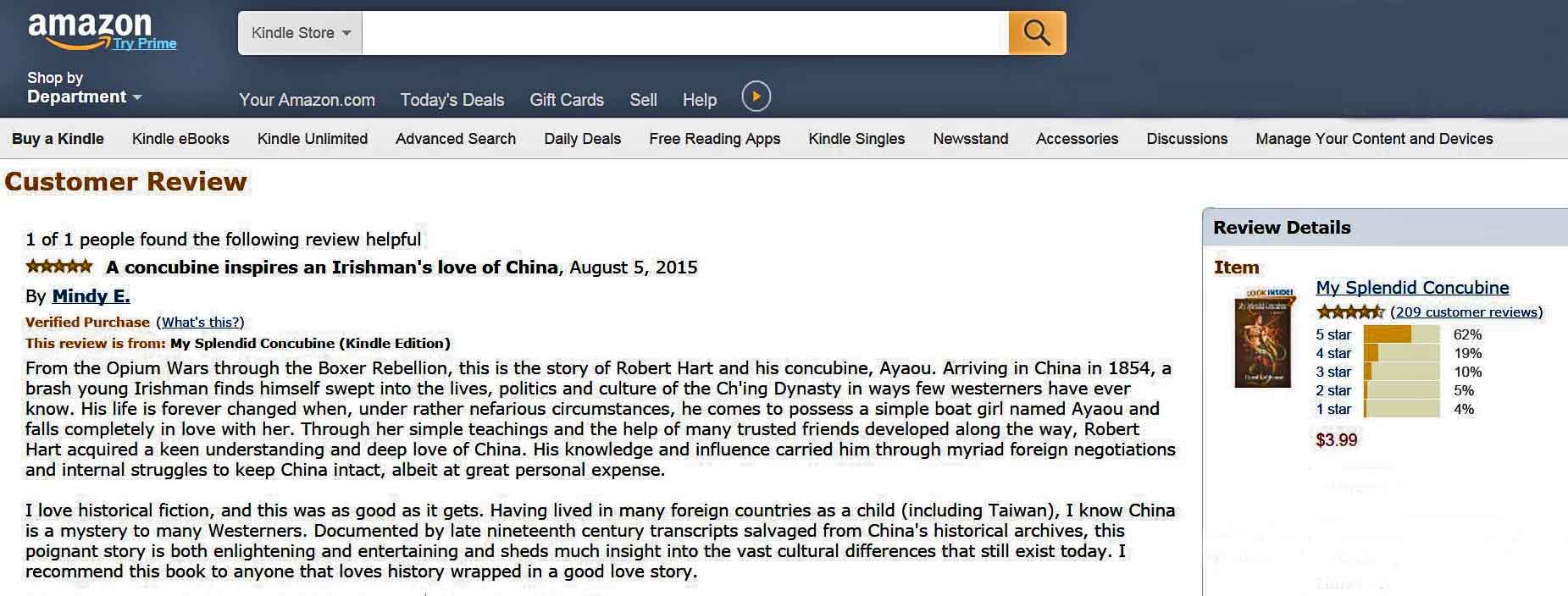
Lloyd Lofthouse is the award-winning author of My Splendid Concubine [3rd edition]. When you love a Chinese woman, you marry her family and culture too. This is the lusty love story Sir Robert Hart did not want the world to discover.
Subscribe to “iLook China”!
Sign up for an E-mail Subscription at the top of this page, or click on the “Following” tab in the WordPress toolbar at the top of the screen.
According to Jewish tradition, the Torah was revealed to Moses about the time of China’s Shang Dynasty (1766 – 1122 B.C.), more than three thousand years ago.
In fact, the Talmud is an organic interpretation through discussion and debate of what the Torah means and teaches.
In most of Asia, the perception of Jews as expert moneymakers does not have the religion-based antagonism that often accompanies the same stereotype elsewhere in the world. While both Christians and Muslims have persecuted Jews for religious reasons, China hasn’t done this.
Instead, South Korea and China respect what may be learned from the wisdom of Judaism.
The Muqata says, “Close to 50 million people live in South Korea, and everyone learns Gemara (Talmud) in school. ‘We tried to understand why the Jews are geniuses, and we came to the conclusion that it is because they study Talmud,’ said the Korean ambassador to Israel.”
“In my country we also focus on family values,” The South Korean Ambassador said. “The (Jewish) respect for adults, respect and appreciation for the elderly parallels the high esteem in my country for the elderly.”
Another significant issue is the respect for education. In the Jewish tradition, parents have a duty to teach their children and devote a lot of energy and attention to it.
For South Korean parents, their children’s education is also a top priority. For contrast, in the United States too many ignorant and lazy parents blame teachers when their children are not learning, but not in Asia.
How valuable is education to Jewish tradition? “Maimonides (1135 – 1204 C.E.) in his great code of Jewish law has an entire section devoted to teaching, teachers, students and the concept of knowledge and education. The basic value is that teachers are to be respected and given honor.
“One should rise before one’s teacher, speak respectfully to one’s teacher, and treat one’s teacher with greater probity than even one’s parent.” The Talmud teaches, “parents bring a child into this world but a teacher can bring a child into the World to Come” into a world of spirit, creativity, ideas and self-worth and ultimate immortality.
In fact, “the Talmud itself attributes to God, so to speak, the attribute of being a teacher. “He Who teaches Torah to His people Israel.” Even mortal teachers are viewed in Judaism as being engaged in holy work.
These ancient Jewish values have also found a home in China.
Newsweekreported, “The apparent affection for Jewishness has led to a surprising trend in publishing over the last few years: books purporting to reveal the business secrets of the Talmud that capitalize on the widespread impression among Chinese that attributes of Judaism lead to success in the financial arts.”
Newsweek said, “Titles such as Crack the Talmud: 101 Jewish Business Rules, The Illustrated Jewish Wisdom Book, and Know All of the Money-Making Stories of the Talmud share the shelves with stories of Warren Buffet and Bill Gates.”
“The admiration for Judaism stems from a history that goes beyond business,” Newsweek continues. “About half of the dozen or so Westerners active in Mao Zedong’s China were Jewish, and that also led to increased interest in Jewish culture among Chinese intellectuals,” says Xu Xin, professor of Jewish studies at Nanjing University.
______________________________
Lloyd Lofthouse is the award-winning author of My Splendid Concubine [3rd edition]. When you love a Chinese woman, you marry her family and culture too. This is the lusty love story Sir Robert Hart did not want the world to discover.
Subscribe to “iLook China”!
Sign up for an E-mail Subscription at the top of this page, or click on the “Following” tab in the WordPress toolbar at the top of the screen.
Under Qin Shi Huangdi, China’s first emperor, who united China in 221 BC, a standardized written language was mandated for an empire that once resembled Europe with many countries and written languages, and this created a unique cultural identity from the rest of the world.
To understand this, I’m turning to a conversation thread from the Yuan-Xiao Festival. Alessandro, a European with a degree in East Asian studies, who lives in China with his Chinese wife, wrote a comment that helped me understand something I’d read years ago written by Lin Yutang.
Writing of the Chinese Mind on page 81 of the 1938 Holcyon House Edition of My Country and My People, Lin Yutang wrote, “The Chinese language and grammar … in its form, syntax and vocabulary, reveals an extreme simplicity of thinking, concreteness of imagery and economy of syntactical relationships.”
I didn’t clearly understand what Lin Yutan meant until Alessandro’s comment. “The Latin alphabet is a phonetic one,” Alessandro said, “and as such, it simply reproduces the sounds of the spoken language, making it more susceptible of changes whenever the spoken language changes. Chinese Hanzi, on the other hand, conveys almost no ‘phonetic’ information by itself … (and doesn’t change much in its meaning as time passes).”
Cultural Competence: Managing Your Prejudices
Alessandro went on to say, “Both Europe and China have had political upheavals and long periods in which they were divided, but (China) having a stable writing system that doesn’t change as much as an alphabetic one helped them not to lose an important element of cultural unity, therefore of ‘national’ identity…
“The Chinese concept of ‘nation’ has nothing to do with the ‘nation state’ concept common in Europe (and North America).
“European nation states are more or less based on ethnicity, while in China it was – and it still somewhat is – based on cultural elements.
“You were Chinese because you shared a common culture, because you acted as a Chinese and assumed Chinese customs.
“Europe never regained the unity that existed during the Roman Empire, while China always strove to regain unity after each period of division. The traditional saying 合久必分,分久必合 — means more or less ‘after unity comes division, after division comes unity’.”
While the West—North America and Europe—has many written languages, China has had one for more than two millennia and this has been the glue that creates a sense of unity and what it means to be Chinese. Westerns don’t have that sense or cultural identity or unity.
______________________________
Lloyd Lofthouse is the award-winning author of My Splendid Concubine [3rd edition]. When you love a Chinese woman, you marry her family and culture too. This is the lusty love story Sir Robert Hart did not want the world to discover.
Subscribe to “iLook China”!
Sign up for an E-mail Subscription at the top of this page, or click on the “Following” tab in the WordPress toolbar at the top of the screen.
This post was inspired from Foreign Policy.com’s Meet China’s Pro-Life Christians. The subtitle of the piece ran with “Can they succeed in a country with the most abortions in the world?”
When I read that question, my first thought was to fact check and discover if this claim was true, because anyone who reads that question might conclude that China has the highest ratio of abortions on the planet—and, as I discovered, they would be wrong.
The result was that the claim in the U.S. media that China had the most abortions in the world spawned a protest from a small number of Christians in Chengdu, China (various statistical analyses have found that between 2% and 4% of the Chinese identify as Christian)—“Their faces downcast, they carried large posters with gruesome photos of aborted fetuses and headlines that read, ‘A fetus is a child too’.”
But a fetus is not a child. To compare a child to a fetus is deliberately misleading to cause an emotional reaction from ignorant people who are easily fooled. More on this later.
There is also a BIG difference between the number of abortions and the ratio of abortions. After all China has the largest population in the world. The country with the largest ratio of abortions in the world has a population of 56,483 compared to China’s almost 1.4 billion people.
The Foreign Policy piece started by mentioning the anti-abortion movement against Planned Parenthood in the United States, and then in the second paragraph said, “The news quickly reached China, and within days the video had been posted to Chinese video streaming site iQiyi, where it received more than 170,000 views (0.012% of total population). China has the highest number of abortions in the world, with an estimated 13 million performed annually.”
I’m curious what the other 99.988% of China’s people think about this issue. I mean, are they allowed to have an opinion or do only the Christians in China count—you know, the 2% – 4%?
But in countries where abortion is not available and/or is illegal, women who don’t want a child get an abortion anyway regardless of the pro-life, anti-abortion mob and their lies about fetuses being children. In fact, “Globally, approximately three births occur for every abortion performed, and half of all abortions are unsafe.” – Abortion Ratios Worldwide in 2008 and Abortion Laws Worldwide
How does China compare to other countries with the percent of known pregnancies ending in a legal abortion?
Greenland was #1 in 2012 at 49.9%. China was ranked #12 at 29.2%, and the United States was ranked #32 at 20.2%. – Johnston Archive.net (You might be interested in looking at the list to discover what country had the lowest number of legal abortions).
And according to Nation Master.com, “It is estimated that there are 44 million induced abortions annually, half of them in countries where abortion is illegal.”
In addition, the US National Library of Medicine reports that “Every year, worldwide, about 42 million women with unintended pregnancies choose abortion, and nearly half of these procedures, 20 million, are unsafe. Some 68,000 women die of unsafe abortion annually, making it one of the leading causes of maternal mortality (13%). Of the women who survive unsafe abortion, 5 million will suffer long-term health complications.”
Now, back to the Christian claim that “a fetus is a child too”
“The just-conceived prenatal life form is called a zygote (not a child). While migrating down the woman’s Fallopian tube to her uterus, it is named a morula (not a child), and from days five to 12 post-conception, a blastocyst (not a child). The blastocyst implants in the nutrient-rich lining of the mother’s uterus. From day 12 through week six, this being is termed an embryo (not a child or even a fetus).”
The rest of the description of the fetal development timeline may be found at baby center.com. For instance, during the first 3 weeks, “Your baby-in-the making is a ball of cells called a blastocyst (still not a fetus or a child).” … It isn’t until week ten that the embryo becomes the famous fetus that is still not a child.
In conclusion, back to that protest sign in Chingdu, China that said, “A fetus is a child too”. It‘s obvious from the facts that this cannot be true. It also helps to know the reasons why most women make the choice to have an abortion, and according to WebMD on Women’s Health, the most common reasons women consider abortion are:
Over half of all women who have an abortion used a contraceptive method during the month they became pregnant. (This means these women were not planning to get pregnant.)
Inability to support or care for a child. (often caused by poverty, and did you know that 1 of every 4 children the United States lives in poverty?)
To end an unwanted pregnancy
To prevent the birth of a child with birth defects or severe medical problem
Pregnancy resulting from rape or incest
Physical or mental conditions that endanger the woman’s health if the pregnancy is continued.
In addition, in the United States 9 out of 10 abortions are performed in the first 12 weeks of pregnancy while most are done within the first 9 weeks and technically the embryo isn’t even a fetus yet. In fact, very few abortions are done after 16 weeks of pregnancy when the fetus is a long way from becoming a baby or even a child.
Did you know that fetuses spend most of their time sleeping. At 32 weeks, the fetus sleeps 90% to 95% of the day and this is the result of an immature brain. To learn more about the development of the brain, I suggest you read this piece from Harvard.edu. For instance, “at 9 months (after birth), the human brain is too immature to firmly register experiences, while at 17-21 months it has developed enough to record and retrieve memories of single distinctive experiences,” Kagan says.
To the pro-life, anti-abortion people, how does a fetus become a child when 90% of abortions take place before the embryo becomes a fetus and a fetus is never a child?
And last but not least, why pick on China when there are eleven other countries with higher ratios of abortions?
By the way, I learned something in the last few weeks. While talking to a few members of pro-life, anti-abortion crowd outside of a Planned Parenthood clinic, I learned that Christians in the United States are just as ignorant as Christians in China when it comes to knowing the difference between a fetus, a baby and a child. Do you know the difference? If not, watch the first video in this post.
I think every woman should have the legal choice to a safe abortion as long as it is still an embryo or an early fetus and not a baby or child, but truth be told, you can’t abort a baby or child from a womb because a baby or child has already been born and has left the womb.
______________________________
Lloyd Lofthouse is the award-winning author of My Splendid Concubine [3rd edition]. When you love a Chinese woman, you marry her family and culture too. This is the lusty love story Sir Robert Hart did not want the world to discover.
Subscribe to “iLook China”!
Sign up for an E-mail Subscription at the top of this page, or click on the “Following” tab in the WordPress toolbar at the top of the screen.
September is right around the corner and that means Mooncake Mania in China.
Back in 2010, I wrote a post about China’s Mid-Autumn Festival, which is also the time of year for giving and eating mooncakes. At the time, I had no idea that Haagen-Dazs sold the most sought after modern version of this Chinese traditional treat.
My wife learned from a friend in China of the popularity of Haagen-Dazs and mentioned the mooncakes, so I did some scooping for this post. Mooncakes are traditional gifts to friends, family and clients during the Chinese mid-autumn festival, and Haagen-Dazs’s Mooncakes have shown a 25% annual growth in sales since they were first introduced in 1997 and represented 28% of Haagen-Dazs’s revenue every year!
Fast forward to 2015 and over 50% of the Chinese people have now heard of Haagen-Dazs—that’s more than 650 million people or more than twice the population of the United States.
Mooncake Mania for China’s September Holiday
Kai Ryssdal reported for American Public Media’s Marketplace that China’s mid-Autumn Festival and tradition of eating mooncakes has become an underground business possibly worth billions.
Marketplace’s Shanghai correspondent Rob Schmitz says mooncakes carry about a thousand calories and most of the cakes bought are gifts as a way to show respect to business partners and people you want to be close to.
Imagine the size of the market—more than 1.3 billion people, which explains why Starbucks, Nestle and Dairy Queen got into the business of selling mooncakes in China too. In fact, Starbucks offers espresso and hazelnut mooncakes; Godiva promotes a chocolate variety; Häagen-Dazs features cookies-and-cream ice cream mooncakes.
2009 Haagen-Dazs Chinese Mooncake Commercial
Industry groups estimate that mooncakes bring in $2 billion in annual sales in greater China, accounting for 200,000 metric tons (about 220,400 tons) of production each season. – New York Times
______________________________
Lloyd Lofthouse is the award-winning author of My Splendid Concubine [3rd edition]. When you love a Chinese woman, you marry her family and culture too. This is the lusty love story Sir Robert Hart did not want the world to discover.
Subscribe to “iLook China”!
Sign up for an E-mail Subscription at the top of this page, or click on the “Following” tab in the WordPress toolbar at the top of the screen.


 Posted by Lloyd Lofthouse
 iLook China