I woke up this morning thinking that many in the West want nothing less than China to be something he or she understands, which means a capitalist, multi-party republic, Christian nation with a culture based on individualism rather than China’s more than two-thousand year old collective culture without religion.
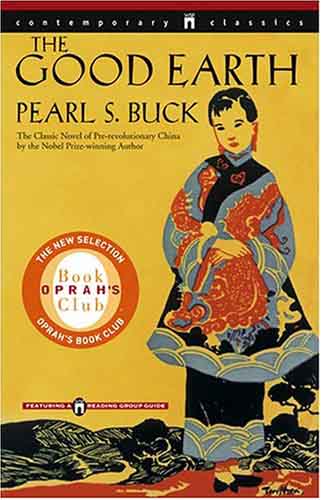
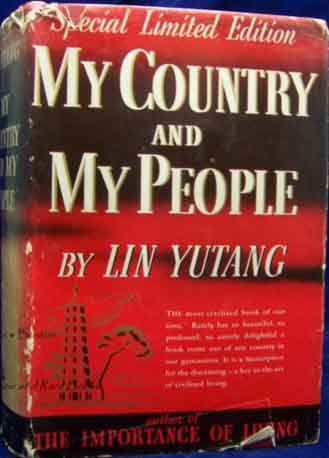
To help dispel this atmosphere of ignorance in the West, Pearl S. Buck urged Lin Yutang to write a book about China and its people. In the Preface for My Country and My People (1935), Lin Yutang wrote, “I write only for men of simple common sense…” Later, in the Prologue, he mentions how for every Sir Robert Hart, the Irish godfather of China’s modernization, there are ten thousand who do not understand the Chinese and do not care to learn.
Then in the Introduction for Lin’s book, Buck wrote, “It (My Country and My People) is truthful and not ashamed of the truth: it is written proudly and humorously and with beauty, seriously and with gaiety, appreciative and understanding of both old and new.”
It is unfortunate that most Sinophobes have no concept of China and its culture and do not want to learn, and men and women of simple common sense are as rare today as in Lin Yutan and Pearl S. Buck’s time.
Lloyd Lofthouse is the award-winning author of the concubine saga, My Splendid Concubine & Our Hart. When you love a Chinese woman, you marry her family and culture too.
Andrew Clark contributed a post to Politics Daily about China’s minorities and the autonomous regions they call home. As Andrew clearly pointed out, “Han Chinese make up 92 percent of the People’s Republic of China. The remaining 8 percent is made up of minority groups, mainly Tibetan, Zhuang, Uyghur, Mongolian, Miao, Manchu, and Hui (these are the major ethnic groups — China officially recognizes 55 minority populations).”
Clark concludes with, “It remains to be seen whether the Chinese government can successfully assimilate these groups, or if consistent suppression of uprisings can force social tranquility.”
The Chinese map has inflated and deflated for more than two-thousand years. Some of these minorities have been in China longer than others. The Mongolians Clark visited, like the Tibetans and the Uyghur, are three who haven’t been inside China as long since they were conquered by the Qing Dynasty (the Manchu minority), who ruled China from 1644 – 1911.
One other minority ruled China for a brief time and that was the Mongols as the Yuan Dynasty (1277 – 1367). Both the rulers of the Qing and the Yuan were assimilated into the Han culture while they ruled China. That’s was primarily because they were surrounded by Han Chinese in the capital.
Tibet broke from China in 1913 and stayed out until 1950 when Mao sent an army into Tibet, which has always been a difficult place for China to rule since sending armies there to enforce control was difficult. But today, a highway and a railroad make that journey easy. If those transportation routes are cut, there’s still air transportation. The travel distance between Tibet and Beijing is shorter than it was a century ago.
Currently, China is adding about 40 thousand more kilometers of rail throughout China and building another grid of high-speed rail. This improved transportation system is also bringing about change and causing a Han migration that would have been unthinkable more than a century ago when most of China didn’t have electricity or roads.
For centuries, China ruled over these minorities without moving Han Chinese into their territories, but times have changed and the Han Chinese, like the Americans Europeans moving West, have been migrating into the autonomous regions for years, which may have more of an impact keeping these territories part of China than armies ever have. And if that doesn’t work, China still has the largest standing army in the world.
Clark also claimed, “the United States has seemingly countless ethnic and cultural minorities that are proud to call themselves American…” While somewhat true, many of almost 2,500 American native tribes still hold to their old ways and live on reservations proud to be Navaho or Sioux, Black Foot or Apache, maybe more so than being American.
Lloyd Lofthouse is the award-winning author of the concubine saga, My Splendid Concubine & Our Hart. When you love a Chinese woman, you marry her family and culture too.
President Obama demonstrates that he does not understand the Chinese thought process in his response to President Hu Jintao of China over how to handle North Korea’s recent sinking of the Cheonan, a South Korean naval ship.
The New York Times Asia Pacific section reports that President Obama has accused Beijing of “willful blindness” toward what North Korea has done. Some American officials say this was an act of war. Obama indicated the way China is handling this would not solve the problem.
There are two voices to pay attention to. Leon E. Panetta and China’s spokesman, Qin Gang. Mr. Qin said, “China is a neighbor of the Korean Peninsula, and on this issue our feelings differ from a country that lies 8.000 kilometers distant. We feel even more direct and serious concerns.”
Leon E. Panetta, the Director of the Central Intelligence Agency, said he believed that the sinking of the Cheonan was part of a succession struggle in North Korea.”
America tends to handle crises of this kind like a bull in a China shop, and what gets broken doesn’t hurt the US homeland. China, on the other hand, will handle this issue like delicate surgery. One wrong move could end in disaster. After all, who is closer to that nuclear bullring and how can Obama understand when China’s shoes won’t fit his feet?
Lloyd Lofthouse is the award-winning author of the concubine saga, My Splendid Concubine & Our Hart. When you love a Chinese woman, you marry her family and culture too.
The Huffington Post published another piece about Foxconn, a Taiwan based company, and mentioned, once again, the recent suicides among workers at their south China facility. The Post also reported that Foxconn might be planning to build a new factory in the city of Hebei in Henan province and hire another 300,000 workers.
Since Foxconn already has about 800,000 workers in China, that would bring the total above a million. Does that mean more suicides are on the horizon? The answer may surprise you.
China already has one of the highest suicide rates in the world at 230 per million, while the global average is 100 per million. Source: Association for Asian Research
There were ten suicides at Foxconn in five months and several attempts were stopped proving that Foxconn has preventative measures in place. Since the suicide rate at Foxconn was 1.25 suicides per 100,000, the evidence suggests a much safer, healthier environment than outside Foxconn’s walls—including the US with 10.9 suicides per 100,000. Source: NIMH
In fact, I’m not alone in my opinion. Tom Foremski, writing for zdnet, says that the World Health Organization suicide figures for China show 18 male and 14.8 female suicides per 100,000.
The media is misrepresenting the facts about Foxconn.
Why?
A) Yellow Journalism
B) It happened in China
C) Both A & B
Lloyd Lofthouse is the award-winning author of the concubine saga, My Splendid Concubine & Our Hart. When you love a Chinese woman, you marry her family and culture too.
It would be difficult to talk about Chinese art without understanding Chinese calligraphy and its artistic inspiration. A painting has to convey an object, but a well-written character conveys only its beauty through line and structure.
In Shanghai, or Beijing, I’ve watched men with longed handled brushes, as seen in the first video, using water for ink and concrete for paper. With grace, they exhibit the skills of a Rembrandt breathing life to the characters.
Lin Yutang writes in My Country and My People that Western art is more sensual, more passionate, fuller of the artist’s ego, while the Chinese artist and art-lover contemplates a dragonfly, a frog, a grasshopper or a piece of jagged rock—more in harmony with nature.
Owing to the use of writing calligraphy with a brush, which is more subtle and more responsive than the pen, calligraphy as art is equal to Chinese painting. Through calligraphy, the scholar is trained to appreciate, as regards line, qualities like force, suppleness, reserved strength, exquisite tenderness, swiftness, neatness, massivness, ruggedness, and restraint or freedom.
Maybe this helps explain why the Chinese are not as warlike as Christian and Islamic cultures.
Lloyd Lofthouse is the award-winning author of the concubine saga, My Splendid Concubine & Our Hart. When you love a Chinese woman, you marry her family and culture too.
If you want to subscribe to iLook China, there is a “Subscribe” button at the top of the screen in the menu bar.


 Posted by Lloyd Lofthouse