The Growing Education Gap between the US and China

July 28, 2010

G. E. Anderson, The China Tracker, takes a post from Computerworld about “China is getting ready to clean America’s technological clock,” and expresses an opinion that even if China graduates more scientists and technicians than the US, nothing is being done to nurture the kind of creative and critical thinking that produces innovation. He goes on to say that few in China have a passion for what they are learning.

Anderson is wrong.

The Chinese Collective Culture at Work
An example of cooperation!

The Chinese collective culture has a long history of innovation. The Chinese invented the compass, paper, the printing press, gunpowder and the multistage rocket. Without those Chinese innovations, I doubt the West would have the civilization it has today.

In December 2009, the Cornell Daily Sun reported that 45% of foreign students at American graduate schools are from India and China. In 2008, some 672 thousand international student attended U.S. colleges and universities. Source: The Chronicle of Higher Education

Comparing the motivation of Chinese to American students is like comparing Red Delicious apples to Chinese dumplings. To a Chinese student, the pressure to measure up is always there, which explains why our daughter (my wife is Chinese and grew up in China during Mao’s Cultural Revolution) graduated from a US high school with a 4.66 GPA and straight A’s since she was five. Stanford University accepted her as a Biology major and she has plans to pursue a medical career. Since she speaks both languages fluently, she may take her skills to China one day.

Most American parents could care less and say, “Go have fun. Do what you want to do. Follow your passion.” If anything, this type of thinking will be the downfall of America. I know. I taught in the US educational system for three decades and this self-esteem cancer is still spreading.

Most Chinese students set goals and work “hard” to gain “face” for his or her family, while most Americans don’t set goals since they are too busy having fun and chasing passion. In fact, China has been a collective culture influenced by Confucius and Laotse for more than two thousand years.

While China graduates more than 30% in the sciences and engineering, America graduates that percentage in psychology and the arts and less than 5% in the sciences.

If creative and critical thinking isn’t being focused on in China, it is in the US and hundreds of thousands of Chinese students return to China each year after graduating from US institutions (mostly in the sciences), and many teach in Middle Kingdom universities imparting what they learned in the US to the next generation of Chinese.

For example, a Chinese immigrant friend of ours came to the US in the 1980s and earned his PhD in the sciences. Today, he is the department chair in the Chemical and Materials Engineering Departments of two universities—one in China and the other in the US. His innovative skills are so valuable that both universities cooperate so he can fly between countries sharing his skills and knowledge in NanoScience in Biomedicine. He’s published two books on the subject in both countries and languages.

If that isn’t enough, recently China built a super computer that equals what the US has and China is the only nation with a viable space program.  On top of that, China is the leader in green technology (solar and wind) and has developed an all-electric car ahead of the US.

This all happened while the US has been mired in partisanship and Tea Party Politics while the children are out chasing their passions.

See Investing BIG in Education

______________

Lloyd Lofthouse is the award-winning author of The Concubine Saga. When you love a Chinese woman, you marry her family and culture too. This is the love story Sir Robert Hart did not want the world to discover.

Subscribe to “iLook China”!
Sign up for an E-mail Subscription at the top of this page, or click on the “Following” tab in the WordPress toolbar at the top of the screen.

About iLook China


Executing the Sour Stink of Corruption

July 28, 2010

The BBC reports that Bo Xilai, the man in charge of Chongqing, China, is prosecuting corrupt government officials in his province. Recently, a top justice official in the city was executed for corruption and many in his family went to jail.

In 2012 – Changing the Guard, I wrote about Bo Xilai and his crusade against crime and corruption, which has made him popular with the people.

To understand why Bo Xilai is popular, focus on the real reason workers started the Tiananmen Square protests. The workers who started the protest were concerned about crime and corruption.

The students, who have been given credit for a democracy movement, did not start the protest—they hijacked it.

The BBC said, “This (crime and corruption) worries China’s leaders, who are seriously concerned that public anger at levels of corruption is undermining support for the Communist Party.” 

Considering the size of China, its population and the complexity of its multi-ethnic culture, this is a large challenge for China’s leaders.

Corruption also brought down the Qing Dynasty (1644 – 1911).  In fact, the major cause of the collapse of most of China’s Dynasties is linked to corruption and moral decay.

Also, when the Ming Dynasty (1368-1643) collapsed, the last emperor hung himself because he had not done his job properly.

Why can’t we send the Bernie Madoffs of America to China?

__________________________

Lloyd Lofthouse is the award-winning author of the concubine saga, My Splendid Concubine & Our Hart. When you love a Chinese woman, you marry her family and culture too. 

Sign up for an RSS Feed for iLook China


China’s Privately Passionate Poetry

July 26, 2010

I’m sure that most Westerners do not think of love poems when they think of China. However, there has to be a reason for more than 1.3 billion people besides the Great Wall of China, the Pacific Ocean and the biggest mountain range on the planet, the Himalayas, which helped wall China from the violence that rocked the rest of the world for centuries—at least until the Opium Wars.

For poetry lovers, this book imparts a sense of the private passion that beats in the Chinese heart. The three arts of poetry, calligraphy and painting, the Triple Excellence, are represented on the pages.

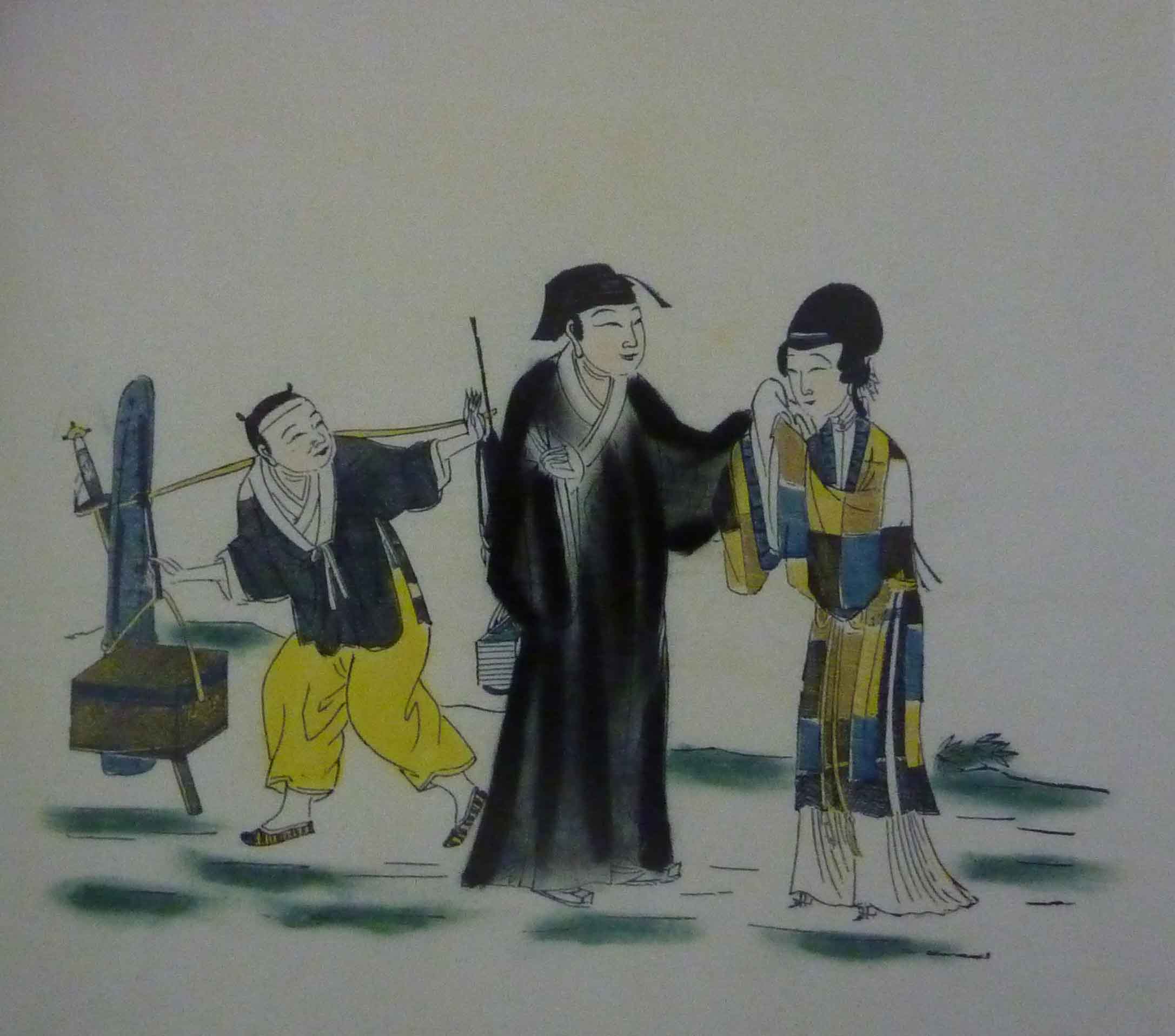
The painting, lady weeping at parting from husband, 17th century, comes from the Qing Dynasty and the book says it is a color woodblock print on paper.

Chinese poetry is frequently personal and often linked to a particular occasion (page 9).

Deeply in love, but tonight
we seem to be passionless;
I just feel, before our last cup of wine
a smile will not come.
The wax candle has sympathy ­­–
weeps at our separation:
Its tears for us keep rolling down
till day breaks.

by Du Mu (803-852 AD)

As you can see, the Chinese are a passionate people—they just don’t dramatize these passions publicly as many in the West do—at least until the West invaded China to force—if possible—a different set of values on China’s collective culture.

The Golden Age of Poetry in China was in the Tang Dynasty (618-906 AD).  This book of Chinese Love Poetry was edited by Jane Portal (© 2004) and published by Barnes & Noble Books (ISBN 0-7607-4833-0).

discover China’s Sexual Revolution or Yu Opera with Mao Wei-tao

_______________

Lloyd Lofthouse is the award-winning author of My Splendid Concubine [3rd edition]. When you love a Chinese woman, you marry her family and culture too. This is the love story Sir Robert Hart did not want the world to discover.

His latest novel is the multiple-award winning Running with the Enemy.

Subscribe to “iLook China”!
Sign up for an E-mail Subscription at the top of this page, or click on the “Following” tab in the WordPress toolbar at the top of the screen.

About iLook China

China’s Holistic Historical Timeline


Human Rights – East versus West

July 24, 2010

The loudest voices for human rights originate in the West where the individual has more value than the whole. In China, the opposite is true. In China, the emphasis is on collective rights, which explains why China has the death penalty with the highest execution rate in the world.  The idea is to get rid of individual threats to the collective welfare.

Dr. Sun Yat-sin (1866 – 1925), who is celebrated in mainland China and in Taiwan as the father of modern China, said it best, “An individual should not have too much freedom. A nation should have absolute freedom.”

Interpreted, that means individuals in China will not have the level of freedoms as exercised in Western nations and even if China were to hold democratic elections, that situation will probably not change. Human rights in China does exist but from a collective point of view.

Joe Amon, writing in the Huffington Post, shows his ignorance of Chinese culture when he says, “But the government should be held to account for stifling the work and voices of Chinese AIDS activists and nongovernmental organizations.”

To work for change in China, one must understand the collective thought process of most Chinese.  If change is to take place, it must come from within China and it must be done from a collective point of view. In fact, it is culturally taboo to talk about HIV/AIDS in China since the Chinese seldom talk publicly about the so called white-elephant in the room anyway.

See Human Rights the Chinese Way

______________

Lloyd Lofthouse is the award-winning author of the concubine saga, My Splendid Concubine & Our Hart. When you love a Chinese woman, you marry her family and culture too. 

If you want to subscribe to iLook China, there is a “Subscribe” button at the top of the screen in the menu bar.


Tiananmen Square Revisited

July 23, 2010

When I was writing and posting Part 8 for China’s Capitalist Revolution, there was a scene in that segment of the documentary of a student dressed in pajamas sitting in a chair.  This so-called student leader for the Tiananmen Square incident was rude, arrogant and demanding.

There was no sign of the piety I see everyday—that I have lived with and witnessed since I married into a Chinese family. My wife and her family lived in China during Mao’s time. They suffered through the same changes everyone else did but their respect for piety never changed.

I read the “What is the truth about Tiananmen Square?” post again.

Why did President H. W. Bush change ambassadors in the middle of the incident with a man who had once been an operative for the CIA working in Asia inserting agents into China? James Lilly wouldn’t have to meet with the students himself. He knew who the double agents in China were. He had to know.

“The protesters were not demanding Western style politics or an end to Communist Party rule as many in the West believe.  They wanted the government to listen to their opinions about   reforms and corruption.  The banners the protesters carried said, “We Support the Great Glorious Communist Party of China.” Source: China’s Capitalist Revolution, Part 7

It was the Western media and the rude, arrogant students, who turned the event into a democracy movement but only after Lilly was in the country or on his way. Did President Bush seize an opportunity?

In fact, it wasn’t until after that student treated his elders with disrespect, that Deng Xiaoping sent the troops in—a reaction to be expected in a country with a collective culture like China’s where practicing piety is the same as breathing.

What choice did he have?  After all, the students had demanded the negotiations be broadcast live on TV to the nation. Embarrassed in front of the country he ruled, Deng had no choice. It was a great loss of face for him and the government.  Loss of face is probably the leading cause of suicide in Asian countries like Japan and the two Koreas.

That student acted as if he was untouchable–that he had insurance. Maybe he did. He had taken a huge risk to gain face, and it turned into a tragedy.

Moreover, why has America’s media made such a big deal out of the Tiananmen Square incident where hundreds died and almost nothing about the slaughter conducted by (an American ally) Chiang Kai-shek’s troops in Taiwan where almost thirty thousand were murdered? See 2/28 Massacre in Taiwan

_________________________

Lloyd Lofthouse is the award-winning author of the concubine saga, My Splendid Concubine & Our Hart. When you love a Chinese woman, you marry her family and culture too. 

Sign up for an RSS Feed for iLook China