Mao’s Last Dancer

August 20, 2010

I saw the movie, Mao’s Last Dancer today.  Unlike most Westerners, I went with two people who grew up in China and survived the Cultural Revolution.

As we left the theater, my Chinese friends made these comments. “Great movie. Well done. It shows what China went through. If American audiences don’t see this movie because the lead is Chinese, they don’t want to learn about China.”

Evidently, the movie’s distributor agreed since Mao’s Last Dancer was only in one old theater near us that plays serious, artsy movies.

However, for the first showing of the day, it was a nice audience—several hundred at least.

Mao’s Last Dancer was a great but misleading title.  How could Li Cunxin have been Mao’s last dancer when there are ballet troupes all over China (even today) as in Beijing where Li learned ballet?

The Huffington Post review said the movie was middlebrow and rises above the pack if only by a little.  The film critic was Marshall Fine, and I disagree with him.

If Fine knew more about the Chinese and China’s history, he might understand why I disagree. 

When Li was a child, China was in the middle of the Cultural Revolution, a form of national (or collective) madness that lasted about a decade and ended after Mao’s death thanks to Deng Xiaoping.

Mao’s Last Dancer does a subtle but good job showing what rural life was like during the Cultural Revolution and afterward as attitudes started to change in China.

The movie also shows how tough the Chinese are when it comes to education. Working to gain an education is serious business in China—even today.  What you see while Li and the other children are learning ballet reveals the Chinese mindset.

The New York Times review was kinder but still off the mark.  Mike Hale, writing for the Times, says, “Mao’s Last Dancer is a story of a young and flexible Chinese man who comes to America, where he’s seduced by disco, creative freedom and a honey-haired Houston virgin…”

Can anyone blame young Li for being seduced by a glitzy party country build on debt while the early 1980s China is a drab, colorless place just emerging from its shell? At that time, China’s metamorphosis was just beginning.

If Li had gone home to China and married the Chinese ballerina he was sweet on, today he would be living a lifestyle similar to what he saw in America then. China has changed that much. 

What took America more than a century to achieve, China accomplished in the thirty years since 1980. In fact, I was disappointed that there wasn’t a scene near the end showing one of China’s modern cities that compares to the Houston Li saw when he first arrived in America.

Hall’s conclusion was wrong. Mao’s Last Dancer is not “strenuously brainless”.  If Hall knew more about China, he would understand why my two Chinese friends believe the movie is worth seeing for its story and its educational value.

See The Home Song Stories

_______________

Lloyd Lofthouse is the award-winning author of the concubine saga, My Splendid Concubine & Our Hart. When you love a Chinese woman, you marry her family and culture too. 

Sign up for an RSS Feed for iLook China


Sun Tzu’s “The Art of War” – 4/10

August 20, 2010

Sun Tzu said, “Keep plans as dark as night.”

The NVA (North Vietnamese Army) and Vietcong did this by moving supplies and troops through miles of tunnels built in the 1950 and 60s.

Deception was also one of Sun Tzu’s rules.

To achieve deception, the NVA and Vietcong announced they would honor a cease-fire on January 31, 1968, the Tet New-Year Holiday.

Sun Tzu said, “In battle use a direct attack to engage and an indirect attack to win,” meaning to deceive your enemy so you can win your real objective.

To achieve this goal, the NVA launched a surprise attack on Khe Sanh, a remote US base, one week before the Tet Offensive.

The South Vietnamese and American military are surprised when the NVA launches the Tet Offensive.  At first, it looks like the Vietcong will win, but the NVA ignored one of Sun Tzu’s rules—moral influence.

Moral influence means a leader must have the people behind him to win.

During the early days of the Tet, the Vietcong rounded up and brutally assassinated several-thousand South Vietnamese government workers and killed many Catholic nuns losing the support of the people.

However, in America, watching the violence of the Tet Offensive on TV turned more Americans against the war.

Eight years later, in 1975, Saigon falls to the NVA and America loses the war even though the US had military superiority.

Go to Sun Tzu’s “The Art of War” – Part 5 or return Sun Tzu’s “The Art of War” (HQ) – Part 3

中

Lloyd Lofthouse is the award-winning author of My Splendid Concubine [3rd edition]. When you love a Chinese woman, you marry her family and culture too. This is the unique love story Sir Robert Hart did not want the world to discover.

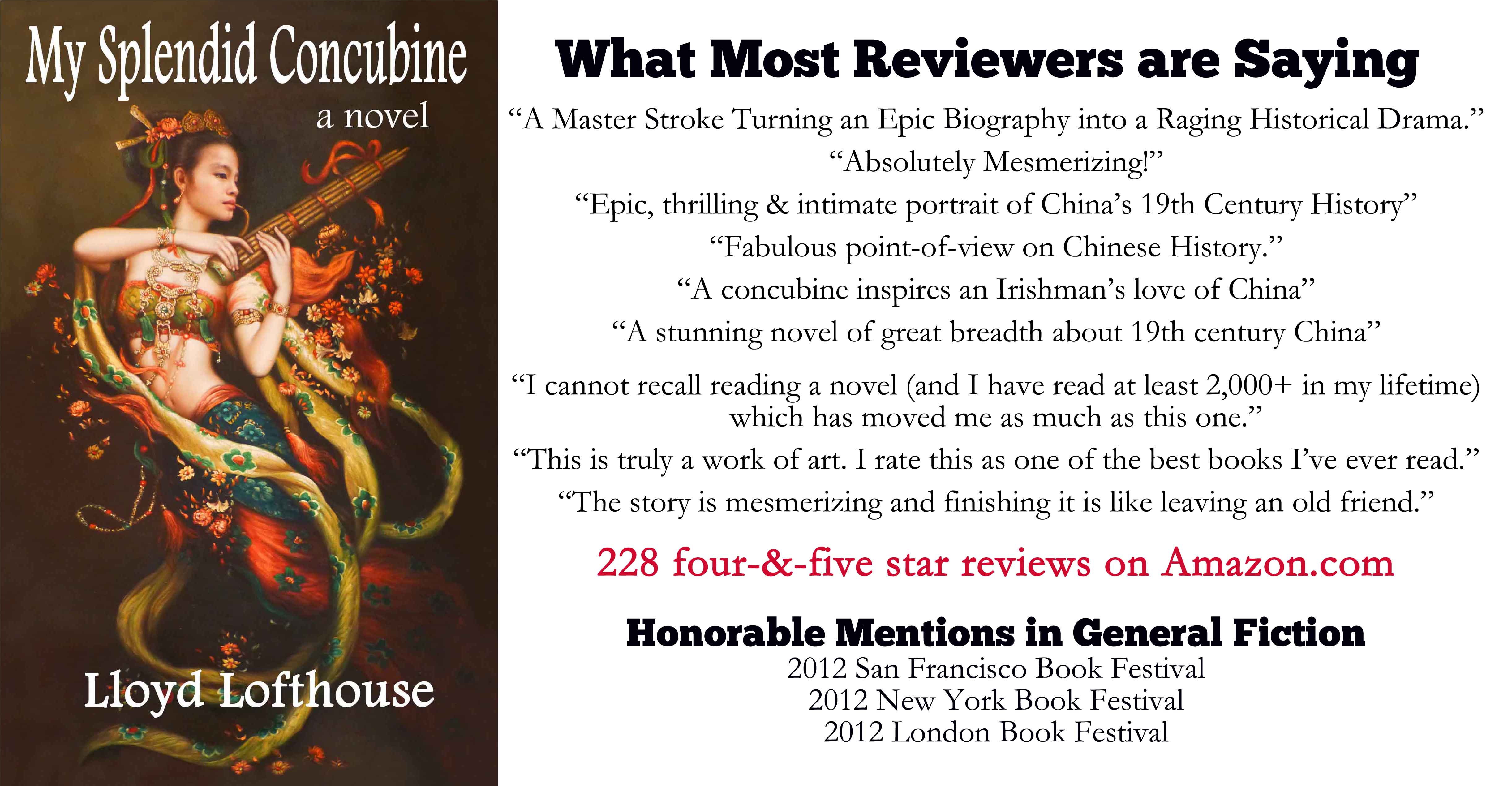
A1 on March 13 - 2016 Cover Image with BLurbs to promote novel

Where to Buy

Subscribe to “iLook China”!
Sign up for an E-mail Subscription at the top of this page, or click on the “Following” tab in the WordPress toolbar at the top of the screen.

About iLook China

China’s Holistic Historical Timeline


Misconceptions of China – The Chinese Government

August 20, 2010

This three-part series comes from a young Chinese man speaking on YouTube about Western misconceptions of China.

Larry says that one of the greatest misconceptions about China’s government is that people outside China believe it is completely Communist—a machine that gets rid of what it doesn’t like.  Even Larry’s Chinese-American friends feel this way.  That opinion is wrong.

Larry says that China does censor a few things like Facebook, Twitter and YouTube. The reason for that are because of Falun Gong, and Tibetan or Muslim (in Xingjian province) separatists.

Source: ShiWoLarry

Larry says many Westerners believe if you say bad things about the Chinese government, you will be arrested. The only instance where that might be true is if you used a loud speaker in the center of Tiananmen Square.  

Larry then talks about the few human rights violations Westerners hear so much about. The central government reacts the way it does toward the Falun Gong, Tibetan Separatists and the Muslims in Xingjian province because the Communists came to power through rebellion and want to avoid the same thing happening to them.  

After the Qing Dynasty collapsed in 1911, China went through chaos and anarchy for decades—millions suffered and died.  Any rebellion would mean a return to those horrible times and regardless of any negativity one hears or reads about China, there is a lot of good things going on that we don’t hear about in the West.

_______________

Lloyd Lofthouse is the award-winning author of the concubine saga, My Splendid Concubine & Our Hart. When you love a Chinese woman, you marry her family and culture too. 

Sign up for an RSS Feed for iLook China


Sun Tzu’s “The Art of War” – 3/10

August 20, 2010

Sun Tzu liked the enemy to maneuver and respond to his moves. This way he was in charge of the battlefield.

A US report after the Vietnam War revealed that 80% of the time, it was the North Vietnamese and Vietcong who decided where and when to fight.

Sun Tzu said, “Once you know the enemy’s strengths and weaknesses, you can avoid the strengths and attack the weaknesses.” At the beginning of the war, almost 80% of Americans supported it.

As the Vietnam war continued with mounting US causalities, that support at home shifted against the war, which achieved another of Sun Tzu’s rules, “The skillful leader subdues enemy’s troops without any fighting. One does not win wars by winning battles.”

Although the North Vietnamese and Vietcong did not win battles, they won the war by turning the American people against it. To achieve this goal, the North Vietnamese commander was willing to lose ten men for every American killed.

In the end, the US lost 53 thousand troops and the North Vietnamese and Vietcong more than a million with several million more noncombatants killed as collateral damage to the American bombing.

Sun Tzu felt spies were important, and he devoted one chapter to spies.  He said, “Use your spies for every kind of business,” and the North Vietnamese and Vietcong followed that advice.

Sun Tzu said, “An accurate knowledge of the enemy is worth ten divisions.”

He also said, “Let your plans be as dark as night – then strike like a thunderbolt.”  The Tet Offensive in January of 1968 was that thunderbolt.

Go to Sun Tzu’s “The Art of War” – Part 4 or return to Sun Tzu’s “The Art of War” (HQ) – Part 2

中

Lloyd Lofthouse is the award-winning author of My Splendid Concubine [3rd edition]. When you love a Chinese woman, you marry her family and culture too. This is the unique love story Sir Robert Hart did not want the world to discover.

A1 on March 13 - 2016 Cover Image with BLurbs to promote novel

Where to Buy

Subscribe to “iLook China”!
Sign up for an E-mail Subscription at the top of this page, or click on the “Following” tab in the WordPress toolbar at the top of the screen.

About iLook China

China’s Holistic Historical Timeline


Sun Tzu’s “The Art of War” – 2/10

August 19, 2010

The state of Wu has only 33,000 troops while Chu can field a force of 300 thousand.

Outnumbered ten to one, Sun Tzu could build his defenses and wait for the attack. However, he does the unexpected. He invades Chu.

He doesn’t attack Chu’s main army. Instead, he attacks outposts and weaker targets. When Chu sends an army to fight, Sun Tzu slips away emphasizing maneuver, surprise and deception.

After every battle, Sun Tzu learns more about his enemy.

During another war more than two thousand years later, Sun Tzu’s ultimate secret becomes more evident. In the mid 1960s, the world’s largest super power is fighting in Vietnam—a country smaller than the state of Montana.

The American general sees the battlefield like a chessboard where armies stand and fight. However, Vietnam has no clear objectives to attack and destroy.

The Communist general understands Sun Tzu and uses the Viet Cong in hit and run attacks against fixed US positions.

Sun Tzu said, “It is more important to outthink your enemy than outfight him. In war, numbers alone confer no advantage. Do not advance relying on sheer military power.”

The US commander breaks these rules.

Go to Sun Tzu’s “The Art of War” – Part 3 or return to Sun Tzu’s “The Art of War” – Part 1

中

Lloyd Lofthouse is the award-winning author of My Splendid Concubine [3rd edition]. When you love a Chinese woman, you marry her family and culture too. This is the unique love story Sir Robert Hart did not want the world to discover.

A1 on March 13 - 2016 Cover Image with BLurbs to promote novel

Where to Buy

Subscribe to “iLook China”!
Sign up for an E-mail Subscription at the top of this page, or click on the “Following” tab in the WordPress toolbar at the top of the screen.

About iLook China

China’s Holistic Historical Timeline