Mean Chinese Supermoms are Right while Positive Self-Esteemism is Wrong

January 13, 2011

Thanks to an old friend, I recently read Amy Chua’s excellent January 8, Saturday Essay in The Wall Street Journal of Why Chinese Mothers Are Superior.

That essay activated the dendrites in my dyslexic, PTSD challenged brain, which started to buzz with ideas for this post.

Then I thought of my mother, who defied the early tide of Positive Self-Esteemism that started to wash America clean of common sense as early as the 1950s. I shudder to think of what might have happened to me if she hadn’t done that.

Most “isms” have something to offer. Capitalism offers that a few get filthy rich. Socialism offers protection for the working class from greedy capitalists so the workers at least have food and shelter.

However, Positive Self-Esteemism has nothing to offer. It is a cancer eating the young minds of the most powerful nation on the planet.

Amy Chua, a professor at the Yale Law School and author of the Battle Hymn of the Tiger Mother, may be on a crusade to save American education by pointing out why Chinese mothers do a better job raising children that go on to do better in school.

Don’t you find it interesting that bad American teachers are blamed for the academic failure of many American students, while most Chinese-American students learned from those same teachers and go on to academic success anyway? Our daughter, who is Chinese-American, had bad teachers too but she also had mean parents, and she was accepted to Stanford University after graduating from high school with a 4.65 GPA.

Horror of horrors, as a child, our daughter had no telephone or TV in her room and no video games. Instead of watching TV nightly as most American kids do, she had to read. The TV was on only two hours a week to watch 20/20 and 60 Minutes.

In her Wall Street Journal essay, Chua says, “What Chinese parents understand is that nothing is fun until you’re good at it. To get good at anything you have to work, and children on their own never want to work, which is why it is crucial to override their preferences. This often requires fortitude on the part of the parents because the child will resist; things are always hardest at the beginning, which is where Western parents tend to give up.”


Amy Chu talks of her book, Day of Empire.

I despise Positive Self-Esteemism as much as or more than America’s Founding Fathers despised democracy.

I learned the hard way years ago how wrong Positive Self-Esteemism was. I taught for thirty years as a classroom teacher in the public schools and was in the trenches being shot at on an annual basis by the politically correct troops spreading this cancer.

In fact, we teachers were told to stop using the word “work” to describe the assignments we had our students doing because studies pointed out that American kids don’t like work. It was also suggested that we correct student work with green ink instead of red because red makes kids feel bad.

However, back in 1952, I was fortunate. For a brief time my mother defied Positive Self-Esteemism and taught me to read when educational experts decided I would never learn to read or write. A decade earlier, the same verdict had been made of my brother and he died illiterate at 64.

At 17, my brother Richard had already been in jail and was drinking booze and doing drugs. He was cutting school too. Why go when you cannot read?

Without knowing it, due to my older brother’s behavior, our mother learned the hard way that Positive Self-Esteemism was wrong. She didn’t blame bad teachers or the schools as many American parents are doing today.

After mother heard the verdict that her youngest son would also be illiterate, she drove home in tears. Both my mother and dad [due to the Great Depression they both dropped out of school at fourteen to work and never graduated from high school] loved to read. The thought of me not sharing a passion for the written word was too much to bear.

By the time we reached home, mother decided to teach me behind closed doors where none of the early shock troops of Positive Self-Esteemism could accuse her of being an abusive parent.

To motivate me, mother used a wire coat hanger and mean language. If I complained, mother hit me with the coat hanger and accused me of being stupid.

I learned to read and write.

When mother was 89 and near death, she asked my forgiveness for being mean to motivate me to read.  Mother said she had lived with guilt for what she had done for more than five decades.

I replied, “Mom, I wished you had told me this before. There is no reason to feel guilty or ask me for forgiveness for teaching me to read by being mean. If you hadn’t done that, I would have followed in Richard’s footsteps. Without being able to read, I may have gone to jail as he did. Thank you for using that coat hanger. Thank you for being mean and forcing me to learn.”

A few weeks later my mother died.

My brother spent fifteen years in jail, was an alcoholic and dabbled seriously in drugs. All those flaws didn’t matter to me. I still loved my brother.

He died having never read a book. In fact, if he were alive today, he wouldn’t be able to read Amy Chua’s work.

Learn more of how the Self-Esteem Movement Helps Cripple US Education System

______________

Lloyd Lofthouse is the award-winning author of the concubine saga, My Splendid Concubine & Our Hart. When you love a Chinese woman, you marry her family and culture too.

If you want to subscribe to iLook China, there is a “Subscribe” button at the top of the screen in the menu bar.


The Economist on China – Seriously – Part 4/4

January 13, 2011

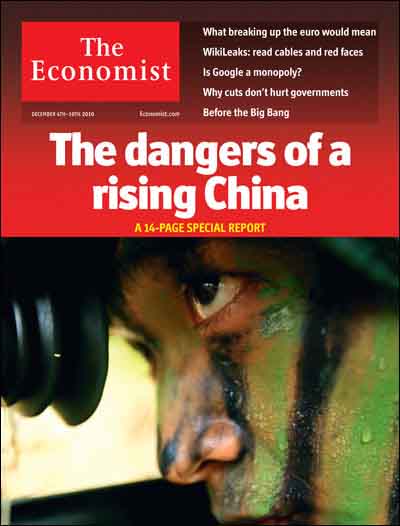
Although I feel that some of the advice from The Economist (ET) of The dangers of a rising China is flawed, the most important advice for America is to abide by its own rules — and if it must break them, it should factor in the real cost of doing so.

I say that the problem here is the fact that every few years, the leadership of America changes and the new leadership (depending on political agendas and promises made to win votes) often does not respect agreements made by previous administrations.

However, China’s central government tends to be much more stable than that of the US. This may help.

Since the US has a history of breaking rules (and treaties), The Economist (TE) does offer valuable advice but I doubt if the US government will listen. The nature of US politics and much ignorance of China among many American voters increases the risk of making a costly mistake.

In fact, there are political factions in the US that do not care how many die or suffer to achieve their political/religious goals.

TE also offers important advice for the Chinese Communist Party to stop using censors… and to draw less on historic grievances.

I suspect that as long as life in China continues to improve, the majority of Chinese could care less about the censored topics.

However, what TE means by historic grievances is more important and a larger challenge for the Chinese to overcome. There are 19th century invasions of China by Western powers that led to the Opium Wars; the devastation of the Taiping Rebellion caused by a Christian convert; the results of the Boxer Rebellion and what happened in World War II when Japan invaded China slaughtering millions of innocent people.

In the 18th and 19th century, China wanted to avoid contact with the West but the West due to its politics and religious beliefs refused and forced China to open its doors to trade resulting in much suffering in China.

Forgetting those grievances, which smashed China’s “collective” pride, may be difficult for many Chinese to do now that the pride that was lost has been found again.

In fact, do not forget that many in China feel a serious connection to the ancestors who suffered at the hands of Western countries and Japan between the Opium Wars and the conclusion of World War II.

It may be difficult and even impossible for people in an “individualist” culture such as the US to understand why many Chinese may have difficulty letting go of these historic grievances.

After all, in America, it is easy to forget about the ancestors, the past and history. Many even believe it is a waste of time to learn of history.

Return to The Economist on China – Seriously – Part 3

______________

Lloyd Lofthouse is the award-winning author of the concubine saga, My Splendid Concubine & Our Hart. When you love a Chinese woman, you marry her family and culture too.

If you want to subscribe to iLook China, there is a “Subscribe” button at the top of the screen in the menu bar.


The Economist on China – Seriously – Part 3/4

January 12, 2011

Part 3 continues the coverage of The Economist’s special report of China.

4. In the balance, The Economist (TE) says, “Their wealth (all of Asia) depends on China, their security on America. Which way should Asian countries face?”

In conclusion, TE says, “Either way, American and China are likely to compete to win the loyalty of the region. That, too, could poison the most important relationship of all—the one between China and America.”

I say that the rest of Asia will be tempted to play America against China to gain more from the rivalry and this will increase the danger of a conflict between the US and China.

5. In Friends, or else, TE says, “Living with China’s rise will test America’s diplomacy as never before.”

In Conclusion, TE says, “Not since the 19th century have they (diplomats) had as great a task as managing the relationship between China and America…”

I say this is an area where the US is weak due to political partisanship in the US.

It doesn’t help when different political agendas in the US such as that of conservative evangelical Christians or the neoconservative movement is manipulating the votes of millions of Americans.

Groups such as these believe they have more to gain by making China an enemy and a scapegoat than a friend.

In the end, if such groups win, we all lose.

The political atmosphere in the US will make the job of American diplomats almost impossible to accomplish since most mainland Chinese believe that what they hear from the US media is the voice of America’s government as the Chinese media is the voice of China’s central government.

6. In “Strategic reassurance“, TE says, “Many things could worsen relations between China and America.”

Then TE offers ten ways to make relations between China and the US better. In Part 4 of this series, I will offer a conclusion along with what TE has to say.

Return to The Economist on China – Seriously – Part 2

______________

Lloyd Lofthouse is the award-winning author of the concubine saga, My Splendid Concubine & Our Hart. When you love a Chinese woman, you marry her family and culture too.

If you want to subscribe to iLook China, there is a “Subscribe” button at the top of the screen in the menu bar.


Amy Chua on Superior Chinese Mothers

January 11, 2011

I’m sure that Amy Chua had no idea she was about to light a Baby Boomer fuse that would explode when she wrote her essay published in The Wall Street Journal about Why Chinese Mothers are Superior.

In 2000, Paul Begala, a political strategist for President Bill Clinton, wrote in Esquire, “The Baby Boomers are the most self-centered, self-seeking, self-interested, self-absorbed, self-indulgent, self aggrandizing generation in American history.”

Begala was right.

The Boomers also gave birth to the narcissistic, self-esteem generation.

Amy Chua’s memoir, Battle Hymn of the Tiger Mother went on sale today (January 11, 2011), and my wife and I went to the local Barnes and Noble and bought a copy.

Nancy (not her real name), who works for Barnes and Noble, told us of an experience she had substitute teaching in a girls P.E. Class. She said there were about 150 girls. Half were Asian and half were Caucasian.  When Nancy told them to sit and read or do what they wanted, the Asians took out books and studied. The Caucasians started to text, do makeup and gossip.

Studies show that the average American Boomer parent talks to his or her children less than five minutes a day and more than 80% never attend a parent-teacher conference. Boomer parents are so self-absorbed with other interests that TV, the Internet, video games and other teens raised many of their children.

However, when Chinese mothers come together, their conversations focus on their children and education, which explains why studies show Asian students have the lowest incidence of STDs, teen pregnancy, illegal drug use and the highest GPAs, graduation rates from high school and highest ratio of college attendance.

What do you think Boomer mothers talk about when they get together?

A close friend of mine, who isn’t Chinese, read Amy Chua’s essay and many of the comments attacking Chua for her tough stance as a mother. He said it is obvious that Chinese mothers love their children and American mothers don’t because love means sacrifice.

The vicious responses I have been reading on Blogs and in some book reviews are obviously a guilt reaction for not being good parents. The truth hurts.

Learn about Education Chinese Style

______________

Lloyd Lofthouse is the award-winning author of the concubine saga, My Splendid Concubine & Our Hart. When you love a Chinese woman, you marry her family and culture too.

If you want to subscribe to iLook China, there is a “Subscribe” button at the top of the screen in the menu bar.


The Economist on China – Seriously – Part 1/4

January 10, 2011

The wind is blowing and it is raining. When I started writing this post, the Internet and phone had been out for several days. I thought the storm had caused it, but it turned out vandals broke into several junction boxes and cut the lines to thousands of homes. It took several days before being reconnected.

Until you lose your connection to the Internet, you do not realize how much your life has been taken over by the virtual beast.

I have The Economist’s (TE) December 4th issue in front of me. It has a fourteen page, six-part, special report on The dangers of a rising China.

Don’t read much into that title. After reading the report, you will realize the danger comes more from the US than China. One sentence says, “The best way to turn China into an opponent is to treat it as one.”

There’s a message in this sentence the US government should heed.

In fact, as China expands into the world economically and militarily, what happens in the future is up to America more than China.

In Half a cheer for China, which comes before the 14 page report, TE quoted Antonio Chiang, a political analyst and former editor-in-chief of the Taipei Times, as saying, “The point of no return (for Taiwan rejoining the mainland sometime in the future) has already passed”.

Chiang believes that President Ma Ying-jeou’s administration’s goal is to unify with China. If this happens, this will not go over well in the US after selling billions of high-tech weapons to Taiwan.

After all, if Taiwan unites with China, all of those US weapons may belong to China.

This topic will be continued in Part 2. Meanwhile, learn of the 2/28 Massacre in Taiwan

______________

Lloyd Lofthouse is the award-winning author of the concubine saga, My Splendid Concubine & Our Hart. When you love a Chinese woman, you marry her family and culture too.

If you want to subscribe to iLook China, there is a “Subscribe” button at the top of the screen in the menu bar.