China still has millions of poor people — poor by U.S. standards where many that live in poverty often drive cars and have TVs.
However, contrary to the belief of many gloating China bashers and Sinophobes, the Communist Party did not create this situation and has been working hard since the early 1980s to solve this challenge.
The Guardian.co.uk says, “The report, by authors from the China Institute for Reform and Development and other think tanks, describes the nation’s progress over the past 30 years of reform as a miracle in the history of poverty reduction….“
In fact, in 1949, most of China still lived in an environment similar to Europe’s middle ages.
To escape this poverty, many Chinese still immigrate illegally to the US. The reason so many do this is because there is a myth in China that America is “Gold Mountain”.
Golden Venture, a documentary about the US immigration crises, says, “The first major waves of Chinese immigrants came to the U.S. after hearing of the “Golden Mountain” or “Gum Saan” when California’s Gold Rush began in 1848.”
However, the US is not the mythical Gold Mountain.
Steve Lendmansays, “On September 16, the Census Bureau reported that US poverty rose to 43.6 million in 2009, an increase of 3.8 million in the past year – the largest total since the first 1959 estimates. It shows one in seven Americans are impoverished, the official 14.3% rate the highest since 1994, by the Bureau’s conservative measures.”
Of China, the United Nationssays, “Both national and international indicators show that China has already achieved the goal of halving the number of people in extreme poverty by 2015 set by the UN as one of eight Millennium Development Goals. Remaining poverty is however becoming increasingly difficult to address, as the rural poor are now concentrated in remote regions with difficult natural conditions.”
“China also accounts for nearly all the world’s reduction in poverty. Excluding China, (global) poverty fell only by around 10%.” Source: Global Issues
Lloyd Lofthouse is the award-winning author of the concubine saga, My Splendid Concubine & Our Hart. When you love a Chinese woman, you marry her family and culture too.
If you want to subscribe to iLook China, there is a “Subscribe” button at the top of the screen in the menu bar.
China’s longest lasting dynasties survived due to one or more great emperors.
After China was unified by Qin Shi Huangdi (221 – 207 BC), there were only five dynasties that survived for long periods — the Han, Tang, Sung, Ming, and Qing Dynasties.
Although China’s civilization survived, the country’s history is rampant with rebellions, palace coups, corruption among palace officials, and insurrections. Between the five longest dynasties, the country usually fell apart into warring states as it did after 1911.
The most successful emperors managed to stabilize the country while managing wisely as the Communist Party has done since 1976.
EmperorHan Wudi (ruled 141 – 87 B.C.) of the Han Dynasty (206 B.C. – 219 A.D.) was fifteen when he first sat on the throne.
Wudi is considered one of the greatest emperors in China’s history. He expanded the borders, opened the early Silk Road, developed the economy, and established state monopolies on salt, liquor and rice.
After the Han Dynasty collapsed, China fell apart for almost 400 years before the Tang Dynasty was established (618 -906). The Tang Dynasty was blessed with several powerful emperors.
The first was Emperor Tang Taizong (ruled 627-649).
According to historical records, Wu Zetain, China’s only woman emperor also ruled wisely.
Emperor Tang Zuanzong , Zetain’s grandson, ruled longer than any Tang emperor and the dynasty prospered while he sat on the throne.
After the dynasty fell, there would be short period of about 60 years before the Sung Dynasty reestablished order and unified the country again.
The second emperor of the Sung Dynasty, Sung Taizong (ruled 976 – 997) unified China after defeating the Northern Han Dynasty. The third emperor, Sung Zhenzong (ruled 997-1022) also deserves credit for maintaining stability.
The Sung Dynasty then declined until a revival by Sung Ningzong (ruled 1194 – 1224) After he died, the dynasty limped along until Kublai Khan defeated the last emperor in 1279.
After conquering all of China, Kublai Khan founded the Mongol, Yuan Dynasty (1277-1367). Not long after Kublai died, the dynasty was swept away.
In 1368, a peasant rebellion defeated the Yuan Dynasty and drove the Mongols from China.
The Ming Dynasty (1271 – 1368) is known for rebuilding, strengthening and extending the Great Wall among a list of other accomplishments.
Historical records show that the rule of the third Ming Emperor, Ming Chengzu (ruled 1403 – 1424), was the most prosperous period.
After Chengzu, the dynasty would decline until 1567 when Emperor Ming Muzong reversed the decline.
His son, Emperor Ming Shenzong, also ruled wisely from 1573 to 1620.
After Shenzong’s death, the Ming Dynasty quickly declined and was replaced by the Qing Dynasty in 1644.
The Opium Wars started by England and France and the Taiping Rebellion led by a Christian convert in the 19th century would contribute to the fall of the Qing Dynasty in 1911.
The Qing Dynasty was fortunate to have three powerful, consecutive emperors: Emperor Kangxi (1661 – 1722), Yongzhen (1722-1735) and Qianlong (1735-1796). For one-hundred-and-thirty-five years, China remained strong and prosperous.
After the corrupt Qing Dynasty was swept aside in 1911 by a rebellion led by Dr. Sun Yat-sen, China fell apart and warlords fought to see who would rule China.
When Sun Yat-sen died, the republic he was building in southern China fell apart when Chiang Kai-shek broke the coalition that Sun Yat-sen had formed between the Nationalist and Communist Parties. Mao’s famous Long March shows how the Communists survived.
Then Japan invaded, and China would be engulfed in war and rebellion until 1945 when World War II ended. After World War II, the rebellion between the Nationalist and Communists ended in victory for the Communists in 1949.
This victory was made possible because the Communists were supported by China’s peasants that hated, despised and distrusted the Nationalist Party, which represented China’s ruling elite.
The Communists gained the support of the peasants by treating the peasants with respect and promising reforms that would end the suffering.
Then Mao’s Great Leap Forward and the Cultural Revolution extended the peasants suffering.
However, since the early 1980s, the Communist Party has been working to fulfill the promises made during the revolution, and the lifestyles of China’s peasants are slowly improving.
There are many impatient voices in the West and a few in China that are not happy with the speed of China’s reforms or how the Party has handled them.
In fact, China has modernized and improved lifestyles in China since the early 1980s at a pace that has never been seen before in recorded history.
_______________
Lloyd Lofthouse is the award-winning author of My Splendid Concubine [3rd edition]. When you love a Chinese woman, you marry her family and culture too. This is the love story Sir Robert Hart did not want the world to discover.
His third book is Crazy is Normal, a classroom exposé, a memoir. “Lofthouse presents us with grungy classrooms, kids who don’t want to be in school, and the consequences of growing up in a hardscrabble world. While some parents support his efforts, many sabotage them—and isolated administrators make the work of Lofthouse and his peers even more difficult.” – Bruce Reeves.
Subscribe to “iLook China”!
Sign up for an E-mail Subscription at the top of this page, or click on the “Following” tab in the WordPress toolbar at the top of the screen.
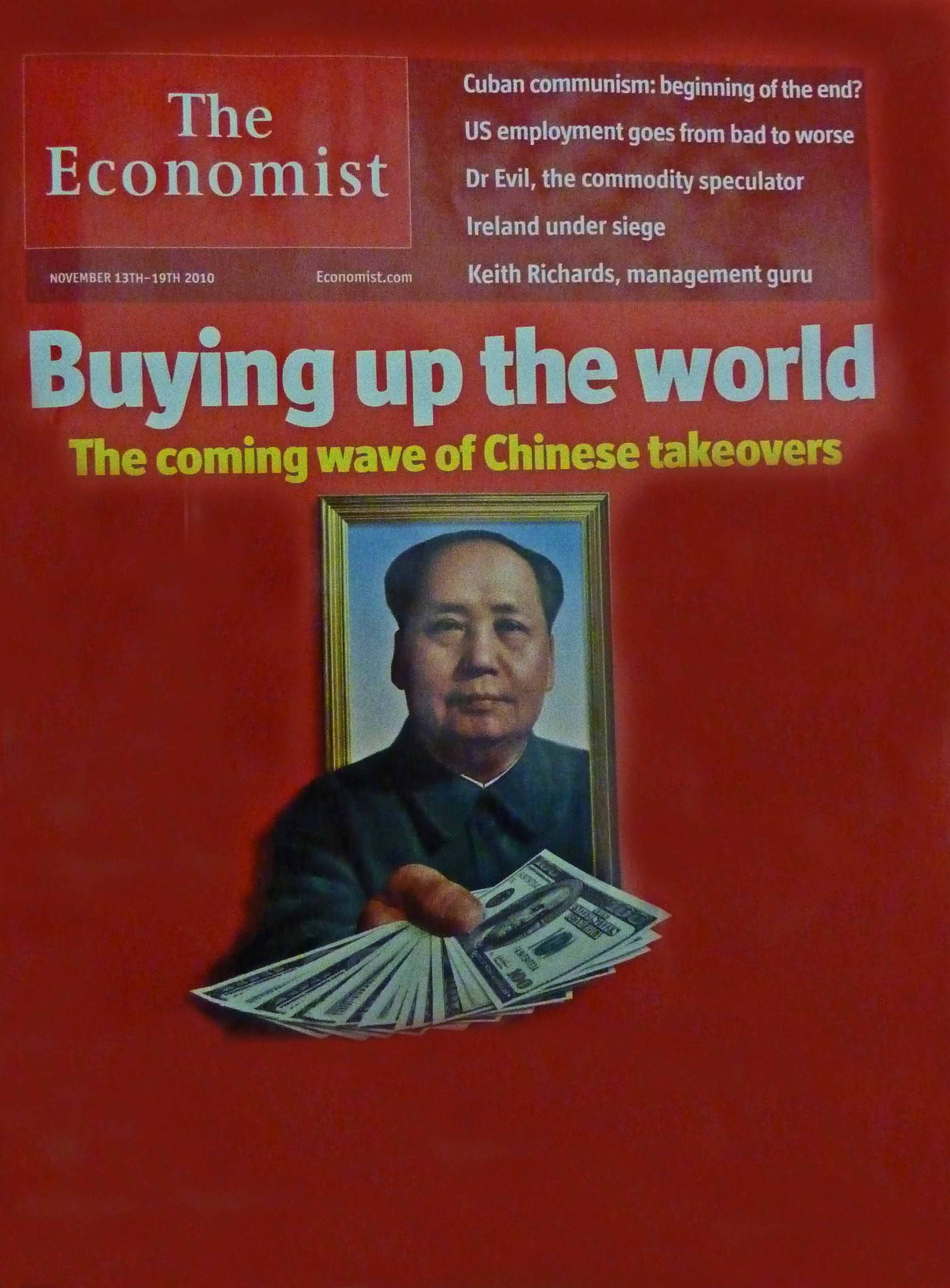
The cover of The Economist’s November 13 issue plays on fear to sell magazines.
I haven’t read Buying up the world, The coming wave of Chinese takeovers yet, which is the feature piece. I’ll probably write another post about that once I do.
Instead, I’m writing about the magazine’s cover, which is taking advantage of the West’s PTCSD (Post Traumatic Chinese Stress Disorder) that has roots in the “history” of a fear of the word “Communist”, the Korean Conflict and the Cultural Revolution.
I’m sure most Sinophobes that see this cover will have flashbacks of the People’s Liberation Army (PLA) and the rest of China dressed in drab Mao jackets marching across the world to take possession of everything China buys.
However, Mao isn’t the proper man to adorn The Economist’s cover.
Why? Because after Mao died in 1976, Deng Xiaoping and his allies rejected Maoist Revolutionary thought and embraced CAPITALISM in a very big way.
In fact, surviving Maoists consider the Party that rules China today to be traitors to Mao and the revolution.
Do you remember the 1980s, when wealthy Japanese spent billions buying property in America then a real estate bubble burst, Japan lost a lot of money, and its economy has been limping since?
If anyone should be afraid, it should be the Chinese fearing spending habits in the US, Canada and Europe where debt and plastic rule.
______________
Lloyd Lofthouse is the award-winning author of the concubine saga, My Splendid Concubine & Our Hart. When you love a Chinese woman, you marry her family and culture too.
To subscribe to iLook China, look for the “Subscribe” button at the top of the screen in the menu bar, click on it then follow directions
Yasheng Huang at Foreign Policy magazine saysin an opinion piece — identified as an “argument” — that the US should bypass China’s government and “somehow” directly reach the Chinese people with the message that the US knows what’s best for China.
Considering China’s history with the West starting with the first Opium War and the West’s support of the Dalai Lama, Tibetan and Islamic Separatists, outspoken Chinese democracy activists and religious cults such as the Falun Gong, I’m sure that would be well received — not.
Wanting to know more about Yasheng Huang, I discovered that he has a long title and is a professor of political economy and international management at the Massachusetts Institute of Technology. He also holds a special-term professorship at Fudan University with an honorary professorship at Hunan University.
Impressive resume. You may want to check it out. Just click on his name above. I’m sure the good professor wears his many titles well.
Professor Yasheng Huang may be right when he says, “To be sure, the vast majority of serious economists are absolutely right that in the long run, a currency revaluation is in the interest of the Chinese. But this is politics, where the issue is not about the technocratic intricacies of who is right and who is wrong.”
However, the professor is wrong to suggest that Washington D.C. find a way to communicate more effectively with the Chinese people by bypassing China’s government.
Consider how Americans would take to China’s Communist Party bypassing Washington and going directly to the entire US population with a huge media campaign to win them over.
The US already tried that in the Middle East and that hasn’t worked well. Islamic Fundamentalists have done a much better job winning Muslims over to their cause than the US has.
Griffel writes, “Muslim fundamentalist movements encourage the use of the internet among their followers, for instance, not in order to sell something by e-mail order, but rather to promote the creation of a network of like-minded people who share a common understanding of what ‘Islam’ means and what it advocates.”
The same is true of the Chinese, who use the Internet differently than people in the West and are promoting a network of like-minded people who share a common understanding of what being “Chinese” means.
Most Chinese are not interested in being told how to think or what to do by anyone outside China.
I suggest that the good professor stick to economics and let the politicians do their job even if they don’t always get it right. Doesn’t he understand that it is impossible to even get a majority of Americans to listen and agree on one concept?
Lloyd Lofthouse is the award-winning author of the concubine saga, My Splendid Concubine & Our Hart. When you love a Chinese woman, you marry her family and culture too.
If you want to subscribe to iLook China, there is a “Subscribe” button at the top of the screen in the menu bar.
During one assassination attempt from one of his gangsters, Nicky Louie was shot in the head but managed to run to the police station to save himself.
He agreed to work with the police and the federal prosecutors.
However, to gain the government’s protection, he had to admit to his own crimes and was sentenced to fifteen years in prison.
This led to the end of the era of New York’s Chinatown Triads.
Today in the U.S., the Chinese Triads consist of an elusive array of constantly changing alliances among many small gangs scattered across the country.
The only bond between the gangs is the desire for making money. These Triads are involved in everything from human trafficking and smuggling to heroin smuggling.
For the first time, the Chinese American Triads are moving beyond the Chinese community and are willing to work with anyone as long as they make money.
FBI Unit Chief Kingman Wong says this makes the Triads in the U.S. a more significant threat to the safety of American citizens.
It is not easy to define Chinese organized crime today. The Triads are difficult to penetrate.
Lloyd Lofthouse is the award-winning author of the concubine saga, My Splendid Concubine & Our Hart. When you love a Chinese woman, you marry her family and culture too.
If you want to subscribe to iLook China, there is a “Subscribe” button at the top of the screen in the menu bar.


 Posted by Lloyd Lofthouse
 iLook China