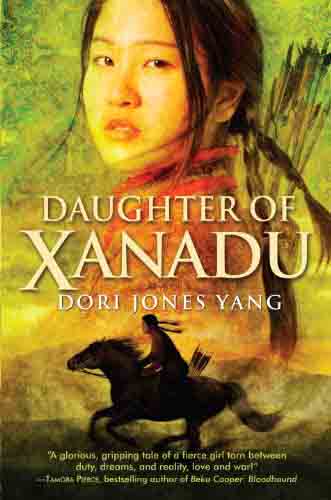
Daughter of Xanadu – Part 2/4

April 18, 2011

A review (guest post) by Tom Carter of Daughter of Xanadu by Dori Jones Yang

The merchants’ young son turns out to be one Marco Polo, the now-legendary Venetian journeyer credited for introducing Asian culture to the west.

To Emmajin, however, he is just another “colored-eye man,” a court curiosity from Christendom whose gallantry and romantic gestures are as ridiculous to the manly Mongolians as his facial hair (“his beard was so thick I could imagine food sticking in it”).

Try as she might, however, Emmajin, caught in the peak of puberty, is unable to resist Marco’s western charm, and quickly finds herself enamored by his worldly vision (“I had learned to see the world through Marco’s eyes”) as well as his pelt.

“What would the hair on his arm feel like?” she often fantasized about at night.

But she was a Mongolian first, and reluctantly sacrifices her blossoming relationship with the foreigner to complete her spy mission (“He was not a friend but a source of information.”).

Continued on April 19, 2011 in Daughter of Xanadu – Part 3 or return to Part 1

View as Single Page

______________

Travel photographer Tom Carter is the author of China: Portrait of a People (San Francisco Chronicle Book Review), a 600-page China photography book, which may be found at Amazon.com.

Discover more “Guest Posts” from Tom Carter with Is Hong Kong Any Place for a Poor American?

If you want to subscribe to iLook China, there is a “Subscribe” button at the top of the screen in the menu bar.


Daughter of Xanadu – Part 1/4

April 17, 2011


A review (guest post) by Tom Carter of Daughter of Xanadu by
Dori Jones Yang

Who would win in a fight: Mulan or Emmajin Beki or Teenage Angst, Mongolian-style? “Can you imagine, a mere girl fighting on the battlefield?”

The role of females in combat is a debate as timeless as war itself, and one that remains divisive and unresolved to this century.

While present-day arguments for and against allowing women in the military revolve around psychological and biological issues, back in olden times, one needed only cite “tradition” and “familial roles” to silence  the detractors.

The teenaged heroine of Dori Jones Yang’s new 13th-century historical fiction novel, Daughter of Xanadu, is one such detractor, albeit immutable.


Often imagining herself on the battlefield, “the son my father never had,” Emmajin Beki, the granddaughter of Mongolian king (and emperor of China’s Yuan Dynasty) Khubilai Khan (1215-1294), learned to ride a horse before she could walk and can outshoot all her cousins in archery.


She confidently and outspokenly aspires to emulate her female ancestors who assisted Chinggis Khan in conquering Asia (“the blood of all these earlier strong women flowed in my veins”).

Unfortunately, for this princess, “the days of strong women had ended once luxurious court life had begun.”

The Mongols, fattened, lazy and resting on their laurels, now prefer to tell stories of battles-past over lavish “orgies of excess” rather than engage in new wars, much to Emmajin’s restless discontent.

When she makes known her desire to “become a legend” like real-life women warriors Aiyurug Khutulun and Hua Mulan of China, the great Khan placates her by sending her on a secret mission to spy on a family of foreign merchants currently visiting the Mongol court.

Continued on April 18, 2011 in Daughter of Xanadu – Part 2

View as Single Page

______________

Travel photographer Tom Carter is the author of China: Portrait of a People (San Francisco Chronicle Book Review), a 600-page China photography book, which may be found at Amazon.com.

Discover more “Guest Posts” from Tom Carter with Is Hong Kong Any Place for a Poor American?

If you want to subscribe to iLook China, there is a “Subscribe” button at the top of the screen in the menu bar.


When it comes to Parenting, One Size Does Not Fit All – Part 5/5

April 11, 2011

There is a difference in values and education between urban and rural parents since many Chinese in rural China never went to school or had a school close to the village while larger towns and cities all had schools.

In the last thirty years that has been changing. After Mao died in 1976 and as late as 1980, twenty percent of Chinese were literate and 80% were not.  In the last thirty years, literacy has been raised to above 90%. If the average Chinese parent was a SAP, that wouldn’t have happened. 

In fact, I’ve heard that Amy Tan’s (the author of The Joy Luck Club) mother’s primary concern was that her daughter speak English without an accent.

Amy Tan writes that her mother wanted her to be a doctor and a concert pianist. Amy Tan’s mother was an immigrant from mainland China and she was not a SAP parent by any definition but she wasn’t as extreme as Amy Chua either.

China’s leaders in Beijing knew that for China to modernize and prosper, the people would have to be literate and educated so starting in the 1980s, the public schools spread into rural China for the first time in history to reach as much of the rural population as possible.

However, urban education is still better than rural education. It takes more than a generation to bring about changes this drastic.

Meanwhile, the opposite is happening in the United States where the average literate person reads at or below fifth-grade level and among younger Americans we find few serious readers.

While China promotes education and is supported by Tiger Parents of all stripes, in America for the last sixty years, the SAPs have waged a war on education to make learning more fun than educational, which has damaged America’s ability to maintain its economic status in the world.

To reverse this trend, what America needs is more Tiger Parents of all stripes and fewer SAPs.

Return to Part 4 or start with Part 1

______________

Lloyd Lofthouse is the award-winning author of the concubine saga, My Splendid Concubine & Our Hart. When you love a Chinese woman, you marry her family and culture too.

If you want to subscribe to iLook China, there is a “Subscribe” button at the top of the screen in the menu bar.


When it comes to Parenting, One Size Does Not Fit All – Part 4/5

April 10, 2011


In China and Asia, the average parent is the polar opposite of the average American parent. That’s why they are often called Tiger Parents.

However, Chinese/Asian parents will not all be the same. Though most would fit the description of a Tiger Parent as opposed to the average American parent more concerned with self-esteem and the child having daily fun, the average Chinese/Asian parent sets standards that do not take into account self-esteem or having fun, but those standards would vary from parent to parent.

Most urban parents in China would have higher standards than most rural parents. The higher the status and success of the parent, the better chance the standards would be higher for the child too, which explains why Amy Chua’s expectations for her daughters are set so high (Amy Chua is the author of Battle Hymn of the Tiger Mother.)

After all, Amy Chua is a Yale professor and the author of two New York Times bestsellers. Chua’s father also teaches or taught at the University of Berkeley in California as a math professor.

In China, most mothers identify who they are by the success of their children in school and later in life.

By contrast, American SAP parents may act as if their children were from another planet and a member of a fragile species until the child turns 18, becomes an adult, and reverts to being a member of the human species.

To be continued in Part 5, April 11, 2011 at 12:00 PST, or return to Part 3

______________

Lloyd Lofthouse is the award-winning author of the concubine saga, My Splendid Concubine & Our Hart. When you love a Chinese woman, you marry her family and culture too.

If you want to subscribe to iLook China, there is a “Subscribe” button at the top of the screen in the menu bar.


When it comes to Parenting, One Size Does Not Fit All – Part 3/5

April 9, 2011


When I was a teacher, I often heard parents tell their children/teens, “If you don’t want to do what the teacher asks, you don’t have to.” Then when the child earned a failing grade in the class the accusation directed at me would often be, “You were boring. That’s why he/she didn’t want to do the work in your class.”

If I was so boring, why did any student earn As and Bs in my class and some always did?

Every year, one or more parents concerned more with the child’s self-esteem than his or her education would demand that the student be moved from my class to another teacher that was easier — which meant a teacher that never failed a student.

I knew a teacher at the high school where I taught that automatically gave credit for 50% of the grade to every student as if it were a gift.   All a student had to do in his class was five percent of the work to get a D- since every student started with a 50% handicap.  If another student did 40% of the work, that resulted in an A-.

We talked of this for months, and he never yielded his opinion that it was the only fair way to grade a student.

I also know a property owner with apartments that once had a single-mother tenant that took her two children to Disneyland in Florida for a week but could not pay her rent that month.

I heard this dead-beat parent (that seldom paid her rent on time) say she would rather have her children in a class where their self-esteem wouldn’t suffer than have her children in a demanding teacher’s class. She wanted her children to have fun everywhere they went — at last until those children turned 18.

I had an opportunity to see inside the apartment. The children shared the larger of two bedrooms. There was a TV, a computer with an Internet connection and an expensive video game with toys scattered across the floor.  Both children were in grade school at the time and had mobile phones with unlimited texting.

If you want to see how these SAPs (Parents that belong to the self-esteem arm of Political correctness) fight for their beliefs, click to Amazon and read enough reviews and comments of Amy Chua’s memoir Battle Hymn of the Tiger Mother to discover a more complete picture.

To be continued in Part 4, April 10, 2011 at 12:00 PST, or return to Part 2

______________

Lloyd Lofthouse is the award-winning author of the concubine saga, My Splendid Concubine & Our Hart. When you love a Chinese woman, you marry her family and culture too.

If you want to subscribe to iLook China, there is a “Subscribe” button at the top of the screen in the menu bar.