Amy Chua talks to China’s Tiger Women

March 13, 2012

Have you forgotten the infamous Tiger Mother? Last year, I wrote several posts that focused on her and even did battle on this Blog and on Amazon with what I considered obsessed, anal Americans that accused Chua of child abuse and other horrible acts predicting her two daughters would need therapy in the future.

Well, Amy Chua is back, because the paperback of her memoir, Battle Hymn of the Tiger Mother, was released recently.

In addition, she has interviewed four of China’s most successful women entrepreneurs for Newsweek’s March 12, 2012 edition, and the same piece appears on The Daily Beast.


The paperback for “Battle Hymn of the Tiger Mother” was released recently.

The four extraordinary Chinese tiger women Chua interviewed for Newsweek and The Daily Beast were Zhang Xin (a factory worker turned real estate billionaire), Zhang Lan (China’s premier celebrity restaurateur), Peggy Yu Yu (the founder of Dangdang, a leading online retailer in China) and Yang Lan (talk show host and co-owner of Sun Television Cybernetworks).

Although Amy Chua covers a number of topics in the Newsweek/Daily Beast piece, there is one theme these Chinese tiger women mention — children and education.

Amy Chua says, “Zhang Xin is a rags-to-riches tale right out of Dickens… At 14, she left for Hong Kong with her mother, and for five years she worked in a factory by day, attending school at night.”

Xin told Chua, “My mother drove me in school so hard.”

It would appear that having a real Chinese tiger mother paid off, since Forbes lists Zhang Xin as one of the 50 most powerful women in the world today.

“As a mother”, Amy Chua says, “Zhang remains more Chinese than Western. When her sons, now 11 and 13, get home from school, she makes them practice Chinese characters every day for two hours, rebuffing their pleas to go to friends’ houses or play soccer.”

Yang Lan tells Amy Chua, “The parent’s job is to help their children find their true passion … as long as they get a 90 or better (on school work), that’s all I ask.”

Yang says of the Chinese children known as little emperors, belonging to the billion spoiled brats of the one-child generation, that “These spoiled, children often study and drill from 7 a.m. to 10 a.m. every day.”

In addition, Zhang Lan revealed that she was “a hard-driving mother, regularly threatening and spanking her son when he didn’t make top grades.” Today, “he has repeatedly said how grateful he is to her.”

The kicker to me was what Peggy Yu Yu said to Chua. “Working women in China have advantages over their American counterparts … at least in business, women and men in China operate largely on a level playing field.

“Sixty years of communism, ” Yu said, “did one really good thing: bring true equality between the sexes.”

To read more of Amy Chua, the infamous Tiger Mother, see In Defense of Tiger Mothers Everywhere, Amy Chua Responds to Tiger Mother Critics, Tiger Parents Saving America One Child at a Time, Amy Chua’s Suicide Critics and my Review of “Battle Hymn of the Tiger Mother”

______________

Lloyd Lofthouse is the award-winning author of The Concubine Saga. When you love a Chinese woman, you marry her family and culture too. This is the love story Sir Robert Hart did not want the world to discover.

Subscribe to “iLook China”!
Sign up for an E-mail Subscription at the top of this page, or click on the “Following” tab in the WordPress toolbar at the top of the screen.

About iLook China


China’s Educated Women Work to Bring about Change from Within

March 12, 2012

“You must matter,” she tells the girls that are her students. “You must be independent.”

The teacher wants her students to know the alternatives so they have choices. She says, “You don’t change overnight. It takes time. The ideas have to sink in.” This also applies to a country where less than a century ago women were the property of men and their feet were broken as children and bound to restrict growth.

The students are schoolteachers from China’s rural areas. They have come to Beijing for workplace training and to learn more about themselves.

Moreover, this is happening in Communist China and most Western critics have no idea this is going on.

The rural teachers in this program study the Chinese Constitution to learn about their rights and responsibilities.

After all, men and women are equal under the law in China, but there is a long way to go to change the old habits and ways of thinking to achieve all that equality offers.

As in the US, women in China are not paid the same as men for the same jobs.

One of the schoolteachers from rural China said, “You come to believe that you are not as good as men. But I hope when I return to my town that I will have the strength to stand up for myself.”

In October 2011, Chen Zhili, vice-chairperson of the National Congress Standing Committee and president of the All-China Women’s Federation, joined representatives from eleven other Asian and African countries and regions at a conference in Seoul, South Korea.  In her speech at the conference, she “emphasized the four concepts of education as a fundamental right; of education as a means to achieving gender equality and empowering women; of the health and social benefits to be gained from investing in women and girls’ education; and of the responsibility all state governments and international society bear in promoting gender equality.” Source: Women of China

In addition, “Data from China’s National Bureau of Statistics shows that women in China ages 18 to 64 have had an average of 8.8 years of education compared to 9.1 years for men. The gender gap in average years of education has decreased from 1.5 years in 2000 to 0.3 years in 2010.” Source WIA Report – Tracking the Progress of Women in Academia


worth watching if you have the time – a PBS 2007 documentary running almost one hour

______________

Lloyd Lofthouse is the award-winning author of The Concubine Saga. When you love a Chinese woman, you marry her family and culture too. This is the love story Sir Robert Hart did not want the world to discover.

Subscribe to “iLook China”
Sign up for an E-mail Subscription at the top of this page.

Note: This revised and edited post first appeared November 8, 2010


Chinese Women in Science & Business

February 14, 2012

Business Week.com says, “Women now hold 34 percent of senior management roles in China, excluding Hong Kong, up from 31 percent in 2009, according to a 2011 Grant Thornton International Business Report, a survey of global companies.”


Tianjin Women’s Business Incubator (China)

The Harvard Business Review says, “In the decades since Deng Xiaoping instituted market reform, millions of women have profitably followed Deng’s dictate that “to get rich is glorious.” Half of the 14 billionaires on Forbes magazine’s 2010 list of the world’s richest self-made women are from mainland China… Backing them up are legions of qualified and ambitious women who, increasingly, are the engines powering China’s economic juggernaut.”

However, in the Western media, I often read or hear about sex slaves and prostitution in China, which is an example of Yellow Journalism at its worst. Seldom do we hear about China’s women in business and the sciences.


Professor Vivian Wing-Way Yam from China – 2011 Laureate for Asia and Pacific

What we should hear about from the Western media but often do not are stories about women like Dr. Zhang Yanxuan, an innovative scientist, who started a successful business in China to destroy mites that eat food crops. With twenty-seven years of scientific knowledge and government support, she raises predatory mites, a biologically safe method to kill the mites that eat crops. Her products are also being exported to other countries.


RSC Council member Professor Helen Fielding introduces leading Indian and Chinese scientists who talk about their inspiration and give advice to women starting out in science

China is currently the world’s leading pesticide user allowing chemical companies to make hefty profits while poisoning the environment and the people. However, Dr. Yanxuan’s predatory mites may replace pesticides as China’s government is becoming greener in their thinking.

______________

Lloyd Lofthouse is the award-winning author of The Concubine Saga. When you love a Chinese woman, you marry her family and culture too. This is the love story Sir Robert Hart did not want the world to discover.

Subscribe to “iLook China”
Sign up for an E-mail Subscription at


Meet the Winemaker from Shanxi Province

February 11, 2012

In August 2010, the China Daily reported, “The number of private enterprises reached 7.5 million, accounting for half of China’s gross domestic product, 70 percent of the nation’s technical innovations and 60 percent of its patents.” In addition, “China’s top 500 private companies have surpassed State-owned enterprises in many indicators, especially tax payments and employment creation, according to a report from the All-China Federation of Industry and Commerce.”

In fact, Bloomberg.com says, “Many of the world’s richest self-made women are Chinese,” and Psychology Today.com tells us, “Women own more than 40% of private businesses in China.”

Meet one of those women. Judy Leissner was 24 when she became the CEO and President of 168-acre Grace Vineyard in Shanxi province, south of Beijing after she quit her job at Goldman Sachs.

The first grape-vine plantings were in 1997 and the first vintage in 2001. Judy started the winery because her father liked to drink. Today, Judy produces a quality wine—about 700,000 bottles annually.

Most people do not know that quality wine is produced in China. In fact, Judy has competition since there are about 400 wineries in China.

Judy says there is an opportunity in China to make a lot of money in a short period of time, because the country is developing and growing.

The difference between the wine market in China and the rest of the world is that most drinkers in China must drink because they have to. It’s part of the culture of doing business and developing guanxi.

In an update, Grape Wall of China.com visited Grace Vineyard in September 2011, and Jim Boyce says he visited Grace CEO Judy Leisser. He says, “About a week ago, she sent an email that the wines Grace bottled under screw cap earlier this year are doing fine and, if all goes well with final trials, the winery will switch closures this year for its entry level and premium level wines. Grace’s Premium Chardonnay ranks among the better Chinese wines and is found in top hotels and restaurants in Beijing and Shanghai.”

In addition, in an interview at 24×75.com with Judy Leissner October 17, 2011, she was asked how different the work environment for Grace Vineyard was compared to Goldman Sachs where she worked prior to becoming CEO of the vineyard in Shanxi Province. She said, “Goldman Sachs is a fast-pace, can-do, efficient place.” However, for the winery, she said, “The whole atmosphere was rather sleepy.”

In another question, Judy was asked about social responsibility and what those two words mean.  She responded with, “We guarantee our growers basic income… Grace is a perfect example of an environmentally friendly and sustainable business. We provide many jobs for people from nearby villages.”

______________

Lloyd Lofthouse is the award-winning author of The Concubine Saga. When you love a Chinese woman, you marry her family and culture too. This is the love story Sir Robert Hart did not want the world to discover.

Subscribe to “iLook China”
Sign up for an E-mail Subscription at the top of this page.

Note: This updated and revised post first appeared on November 08, 2010


Anna May Wong – the Woman that Died a Thousand Times

February 10, 2012

Almost half a century after her death, Anna May Wong (1905 to 1961) has not been forgotten.

As a child, Anna loved going to the movies and even cut school to go.

Between 1919 and 1961, she acted in 62 films. The Internet Movie Data Base says she was the “first Chinese-American movie star”.

To act, Anna had to play the roles she was given. The Western stereotype cast her as a sneaky, untrustworthy woman that always fell for a Caucasian man. The dark side of achieving her dream of acting in movies was that Anna had to die so the characters she played got what they deserved.

Anna often joked that her tombstone should read, “Here lies the woman who died a thousand times.”

Until Chinese started to emigrate to the U.S. in the mid-19th century, they had never encountered a people who considered them racially and culturally inferior.

However, the discrimination against the Chinese in America was only exceeded by the racism and hatred directed at African-Americans.

In fact, in the 1960s, many of the anti racist laws enacted during the Civil Rights era focused on protecting African-Americans, which created a protected class, and since the Chinese—due to cultural differences often did not complain—they were left behind.

In many respects, this racism toward the Chinese still exists in the US today and manifests itself through the media as China bashing, which supports the old stereotype.

When Anna May Wong visited China in 1936, she had to abandon the trip to her parent’s ancestral village when a mob accused her of disgracing China.

After her return to Hollywood, she was determined to play Chinese characters that were not stereotypes, but it was a losing battle. To escape the hateful racism, she lived in Europe for a few years.

Since U.S. law did not allow her to marry the Caucasian man she loved, and she was afraid that if she married a Chinese man he would force her to give up acting since Chinese culture judged actresses to be the same as prostitutes, she never married.

Anna May Wong smoked and drank too much. She died of a heart attack in Santa Monica, California at age 56.

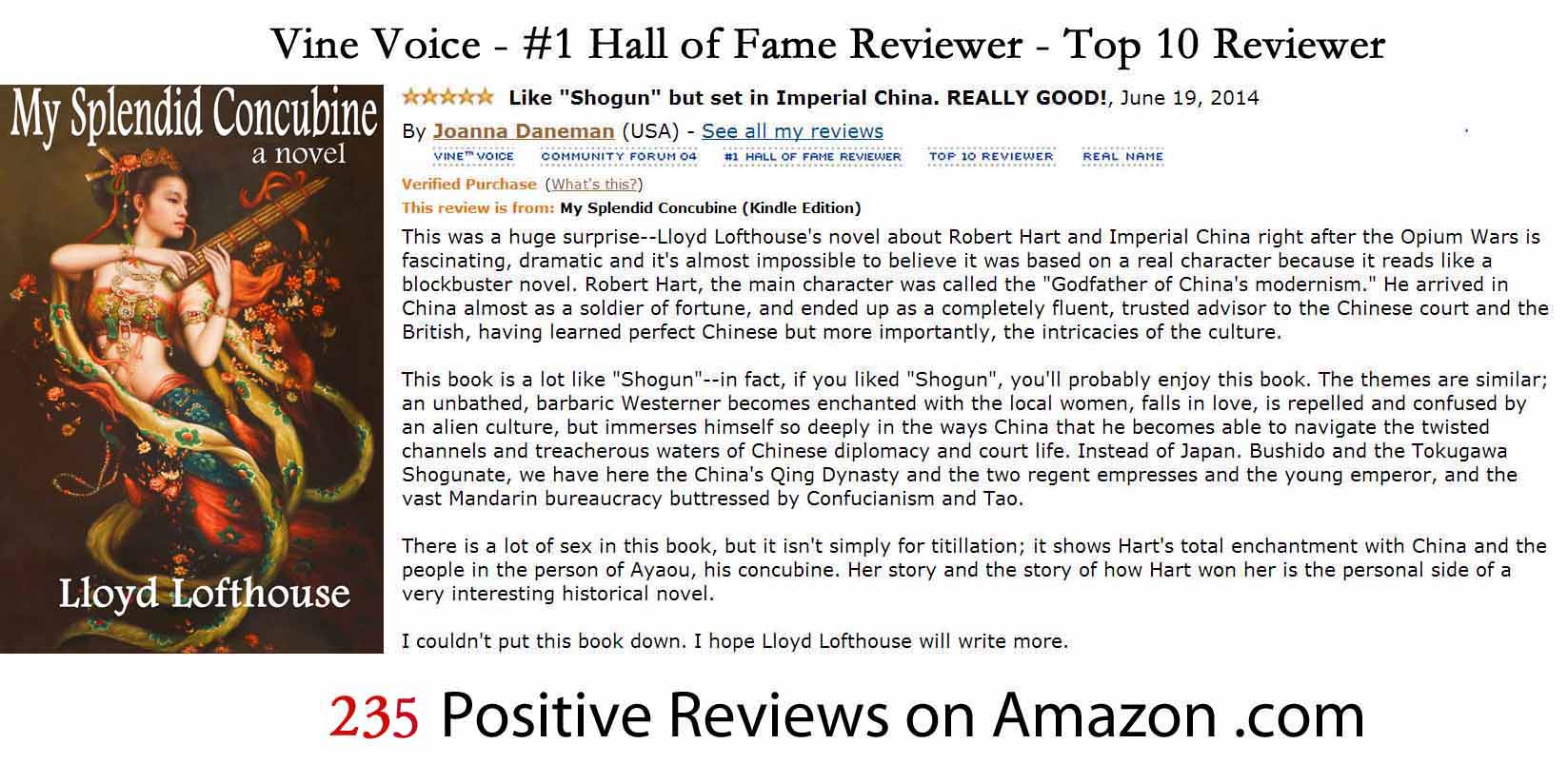
Lloyd Lofthouse is the award-winning author of My Splendid Concubine [3rd edition]. When you love a Chinese woman, you marry her family and culture too. This is the unique love story Sir Robert Hart did not want the world to discover.

1-joanna-daneman-review-updated-sept-21-2016_edited-3

Where to Buy

Subscribe to “iLook China”!
Sign up for an E-mail Subscription at the top of this page, or click on the “Following” tab in the WordPress toolbar at the top of the screen.

About iLook China

China’s Holistic Historical Timeline