Rice and its History

August 28, 2019

When you think of rice, do you think of China? If not, you should. China is the world’s largest producer of rice with 208-million metric tons in 2017, and the crop makes up a little less than half of the country’s total grain output.

Ricepedia.org reports, “Based on archeological evidence, rice was believed to have first been domesticated in the region of the Yangtze River Valley in China.” Then “In the late 3rd millennium BC, there was a rapid expansion of rice cultivation into mainland Southeast Asia and westwards across India and Nepal.”

Fast forward ten-to-eleven thousand years from the domestication of rice in China to 2017, and Statista reported, that almost 496-million metric tons of husked rice were produced in the last harvest year worldwide, and China’s share was almost 42-percent of the global total.

When we compare rice to wheat production, “the global amount of wheat produced came to about 755-million metric tons in crop year 2016-2017.”

World Atlas.com says, China is (also) the largest producer of wheat in the world. “China produces more wheat than any other country, followed by India, Russia, and the United States.”

How difficult is it to grow rice? “All rice cultivation is highly labour intensive. Rice is generally grown as a wetland crop in fields flooded to supply water during the growing season. Transplanting seedlings requires many hours of labor, as does harvesting. Mechanization of rice cultivation is only minimally advanced. Rice cultivation also demands more of other inputs, such as fertilizer, than most other crops.”

When comparing the benefits of rice to wheat, “A study published … by a group of psychologists in the journal Science finds that China’s noodle-slurping northerners are more individualistic, show more ‘analytic thought’ and divorce more frequently. By contrast, the authors write, rice-eating southerners show more hallmarks traditionally associated with East Asian culture, including more ‘holistic thought’ and lower divorce rates. The reason? Cultivating rice, the authors say, is a lot harder.”

How important is rice when it comes to feeding the world? Thought Co.com tells us: “Today, rice feeds more than half the world’s population and accounts for 20-percent of the world’s total calorie intake.”

Next time you eat a bowl of rice, you might want to thank the Chinese for domesticating it for the world?

Lloyd Lofthouse is the award-winning author of My Splendid Concubine, Crazy is Normal, Running with the Enemy, and The Redemption of Don Juan Casanova.
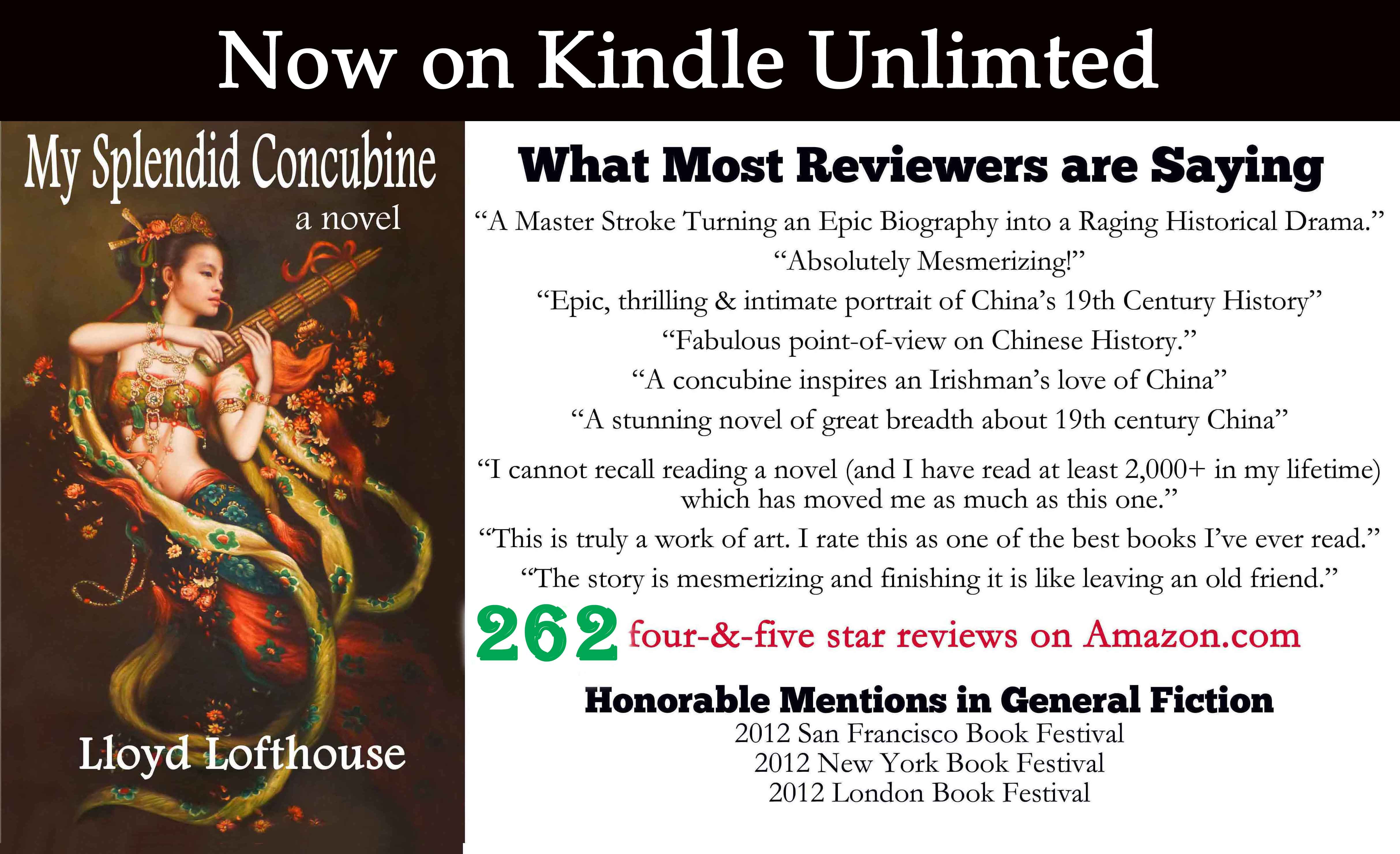
Where to Buy

About iLook China


Still in Use Today

August 21, 2019

Several years ago, I had a debate on this Blog with an individual who claimed the Chinese could not be innovative because they did not live in a democracy. Eventually, as I tore his opinion to shreds, the debate turned mean and he started to attack me with insults and threats like internet trolls often do.

For anyone that thinks the Chinese cannot be innovative unless they live in a democracy like the United States with its current repressive, mean President Donald Trump, who is not innovative, I want you to know a few things about China.

First, most of the world knows about China’s Great Wall (first built during the Spring and Autumn period (771 – 476 BC) and portions of that Great Wall, rebuilt by the Ming Dynasty (1368 – 1644 AD) is still around for tourists to visit today.

China’s Grand Canal is not as well-known as the Great Wall, but that canal (started building in 486 BC) is the longest one in the world and it is still in use today. To make it work, the Chinese invented the Pound Lock in the 10th century more than a thousand years ago. The Pound Lock is a Chinese innovation and without it, there would be no Suez and Panama canals. The first Pound Lock built in the West was in the Netherlands in 1373 AD.

Did someone in the Netherlands reinvent the Pound Lock or was that innovation stolen from China?

What most of the world doesn’t know is that seventeen ancient irrigation sites in China have been inscribed as world Heritage Irrigation Structures, reports China Central Television.

One of those seventeen irrigation sites was built 2,275 years ago, and it is still in operation. The Dujiangyan irrigation system is located in Dujiangyan, Sichuan Province and was built for irrigation and flood control. Even massive earthquakes have not destroyed it. Japanese troops in World War II were ordered to destroy it, but they couldn’t find it.

UNESCO says, “The Dujiangyan irrigation system, located in the western portion of the Chengdu flatlands at the junction between the Sichuan basin and the Qinghai-Tibet plateau, is an ecological engineering feat originally constructed around 256 BC. Modified and enlarged during the Tang, Song, Yuan and Ming dynasties, it uses natural topographic and hydrological features to solve problems of diverting water for irrigation, draining sediment, flood control, and flow control without the use of dams.”

Is there another country in the world that can match what China built more than two thousand years ago that is still in use today?

Lloyd Lofthouse is the award-winning author of My Splendid Concubine, Crazy is Normal, Running with the Enemy, and The Redemption of Don Juan Casanova.

Where to Buy

About iLook China


According to the Ancient Chinese, I was born as a Rooster

August 14, 2019

I was born in 1945 on August 14. Each Chinese zodiac animal has personality traits assigned to it by the ancient Chinese. Chinese people believe these traits will be embodied in people, according to their zodiac sign.

The Chinese Zodiac says as a Rooster, I am observant, hardworking, and courageous.

China’s ancient calendar is based on a twelve-year lunar cycle. At one time, the Chinese calendar was confusing and complex. Buddhists have been given credit for simplifying it by replacing a complex system of numerical symbols with the twelve animals of the Chinese Zodiac.

There are several Chinese calendars, which are still in use today. Each has its own purpose. Farmers in rural China use one. There’s even a Chinese gender calendar to help conceive a boy or girl.

In addition to the lunar, numerical, astronomical, gender and agricultural calendars, each day also has a name from one of twenty-eight constellations, with a ruling spirit for the day.

In charting the sky, the Chinese divided the heavens into 28 constellations located along the Equator and the ecliptic (the apparent path of the Sun on the celestial sphere), each named after a star in the vicinity.

Explorable.com says (see previous link), “Unlike other cultures charting the stars at this period, astrologers were separate from astronomers and their job was to interpret occurrences and omens portended in the sky. As the astronomers began to chart regular events, such as lunar eclipses, these were removed from the realm of astrologers, who Emperors consulted before every major decision.

“As a result, the Chinese developed an extensive system of the zodiac designed to help guide the life of people on Earth. Their version of the zodiac was called the ‘yellow path’, a reference to the sun traveling along the ecliptic. As is the case with Western astrology, the Chinese had twelve houses along the yellow path, although the names they gave were different.”

2019 is the Year of the Pig according to the Chinese zodiac.

Chinese years are counted in a repeating twelve-year sequence, each year symbolized by an animal: rat, ox, tiger, rabbit, dragon, snake, horse, sheep, monkey, rooster, dog, and pig.

Lloyd Lofthouse is the award-winning author of My Splendid Concubine, Crazy is Normal, Running with the Enemy, and The Redemption of Don Juan Casanova.

Where to Buy

About iLook China


Army Day in China

August 7, 2019

China and the United States both honor their military. The United States does this on Veterans Day (Monday, November 11) and Memorial Day (Monday, May 25). China celebrates its annual Army Day on August 1st.

Veterans Day in the United States is a federal holiday to honor military veterans that have served in the United States Armed Forces.

History.com says, “Memorial Day is an American holiday, observed on the last Monday of May, honoring the men and women who died while serving in the U.S. military.”

In the United States, federal employees get the day off for Veterans Day and Memorial Day.

China celebrates Army Day August 1st, and according to China HIGHLIGHTS.com, the men and women that are active-duty troops have half a day off. Although Army Day in China is a holiday, it is a working holiday and not an official day off.

Army Techology.com says, China Military Online estimated in 2015, that 53,000 women (less than 5 percent of the total number of troops) also serve in China’s Army. In the United States, according to the Defense Department, women now make up 20 percent of the Air Force, 19 percent of the Navy, 15 percent of the Army and almost 9 percent of the Marine Corps.

The Basics explained by Chinese American Family.com: The People’s Liberation Army was founded on August 1, 1927, in Nanchang during a rebellion against nationalist Kuomintang forces. They were known simply as the Red Army during the Chinese Civil War (April 1927 – May 1, 1950). The People’s Liberation Army assumed its role as the armed forces of the People’s Republic of China in 1949. Today, the People’s Liberation Army counts more than two million troops.

I think it is important to note that China’s Civil War started days after the Shanghai massacre of April 12, 1927 when Generalissimo Chiang Kai-shek had his troops slaughter thousands of Communist Party members and union workers without warning followed by a full-scale purge (executions without trials) of Communists in all areas under the KMT’s military control. Before April 12, 1927, the Communist Party was one of the political parties that made up the fledgling Republic of China started by Dr. Sun Yat-sen.

“You’re unlikely to see any public celebration of Army Day outside of China, except for perhaps a joint ceremony with a host country at a foreign embassy. Otherwise, this is a domestic state occasion marked by speeches and military demonstrations.”

AnydayGuide reports, “The Central Committee of the Communist Party of China established Red Army Day in 1933.”

Lloyd Lofthouse is the award-winning author of My Splendid Concubine, Crazy is Normal, Running with the Enemy, and The Redemption of Don Juan Casanova.

Where to Buy

About iLook China


Singapore’s Role in the Successful Birth of Modern China

July 10, 2019

Born in 1923, Lee Kuan Yew would become Singapore’s founding father. He was elected its 1st Prime Minister in 1959. After victory in seven elections, Lee stepped down in November 1990, making him the world’s longest-serving prime minister.

In 1978, Deng Xiaoping visited Singapore and Lee offered him advice on how to modernize China, and it wasn’t by following America’s example.


CNN’s Fareed Zakaria talks with Lee Kuan Yew about his life as prime minister of Singapore.

“I want everyone to be a homeowner,” Lee Kuan Yew told CNN’s Zakaria. “I want investments. Do I want to be like America? Yes, in its inventiveness and creativeness, but not like America’s inability to control its drought problem. No! Or the gun problem. No!”

Lee also said, “I believe that during the second half of the 21st century, America will have to share the top spot with China and also India, make space for them, too.”

When Lee is asked by Zakaria if India will have an advantage because it is a democracy and China is not, Lee replies, “Let me put it this way, if India was as well organized as China, it will go a different speed, but it is going at the speed it is because it is India.  It is not one nation. It is many nations. It has 320 different languages and 32 official languages.”

India cannot reach all of its people with one language like Beijing can.

The South China Morning Post reported in 2015, “Singapore’s founder (Lee Kuan Yew) was alone among world leaders in his belief China would emerge as a global power and his views proved prescient. … In his memoirs, Lee makes plain his admiration for the late paramount leader Deng Xiaoping who led China’s opening up in 1978. Lee recalled his conversations with Deng, including one that year when Deng visited Singapore. …

“There was nothing that Singapore had done which China could not do, and do better,” Lee wrote. When Deng Xiaoping told the Chinese people to do better than Singapore, Lee knew he had taken up the challenge he had quietly tossed to Deng 14 years earlier.

Mothership reveals “Singapore was special because it represented the achievement of an estranged relative. Nowhere else outside China was there a country with ethnic Chinese in its majority.

“Lee Kuan Yew told (Deng) that if Singapore Chinese who were the descendants of poorly-educated coolies could make good, how much better mainland China could be if the right policies were adopted. …

“On the economic front, China studied Singapore’s developmental experience to glean lessons for itself. … Deng’s visit to Singapore in 1978 had left an indelible imprint on his mind. That year, some 400 delegations from China visited Singapore (to learn more). …”

In addition, “China’s decision to open up the Internet within China (based on how Singapore managed its internet), (by) … keeping the internal universe separate from the universe outside …. (led to) the vibrant (and controlled) cyberspace we now see in China.

“For many years, Singapore was an inspiration to China … Increasingly, however, Singapore has also much to learn from a China that is breaking new grounds in many fields.” Something that Lee Kuan Yew predicted in 1978 when he met with Deng Xiaoping.

Lloyd Lofthouse is the award-winning author of My Splendid Concubine, Crazy is Normal, Running with the Enemy, and The Redemption of Don Juan Casanova.

Where to Buy

Subscribe to my newsletter to hear about new releases and get a free copy of my award-winning, historical fiction short story “A Night at the Well of Purity”.

About iLook China