Comparing China’s Tiananmen Incident to the U.S. War on the Philippine People

April 22, 2015

China has admitted that some of its citizens and troops were wounded and killed during the unrest known as the Tiananmen Incident and/or Massacre. On Wiki, you will read that there were 241 – 2,600 deaths and 7,000 – 10,000 injured. In addition, on June 19, Beijing Party Secretary Li Ximing reported to the Politburo that the government’s confirmed death toll was 241, including 218 civilians (of which 36 were students), 10 PLA soldiers and 13 People’s Armed Police, along with 7,000 wounded (5,000 soldiers and police along with 2,000 civilians).

Now for the barbaric war the United States waged on the Philippine people. If you haven’t heard about this war before, don’t be surprised, because it has been suppressed (not censored). I mean, when’s the last time you’ve heard about it in the U.S. media compared to the number of times you’ve heard of China’s Tiananmen Square Massacre in 1989. In fact, when I posted What really happened in Tiananmen Square in 1989, Michael Brant left this comment, “This could have been written by the PRC media spin department.”  I wonder what Brant would say about the U.S. war against the Philippine People—if he’s ever heard of that brutal war.

After the Spanish American War, America took possession of the Philippine islands and waged war against the native people killing between 300k – 1 million noncombatants. This conflict was caused by the struggle of the First Philippine Republic to gain independence from the United States following the latter’s acquisition of the Philippines from Spain after the Spanish–American War.

There is a 2010 film about this war called Amigo. I think the odds favor that you have never heard of this film that doesn’t portray the U.S. as the freedom loving country most Americans think it is. In fact, the film’s widest release in the U.S. was in 10 theaters and total domestic earnings were $184,705.  The production budget for the film was $1.5 million, and it never had a global release. The film is available through Amazon as an instant video to stream, but no DVD is available. I haven’t seen this film yet, because I’m still waiting for the DVD.

I think it’s always good to have the facts before passing judgment, and history does count if you are aware of it as long as it isn’t suppressed or revised.

Jesus Christ said, So when they continued asking Him, He lifted Himself up and said unto them, “He that is without sin among you, let him first cast a stone at her.” John 8:7

If we take what He said seriously, then does any American have a right to annually condemn China for what happened during the Tiananmen incident in 1989 without also condemning the United States for what it did in the Philippines?

______________________________

Lloyd Lofthouse is the award-winning author of My Splendid Concubine [3rd edition]. When you love a Chinese woman, you marry her family and culture too. This is the love story Sir Robert Hart did not want the world to discover.
2015 Promotion Image for My Splendid Concubine

Subscribe to “iLook China”!
Sign up for an E-mail Subscription at the top of this page, or click on the “Following” tab in the WordPress toolbar at the top of the screen.

About iLook China

China’s Holistic Historical Timeline


China is also an Eating Culture

April 8, 2015

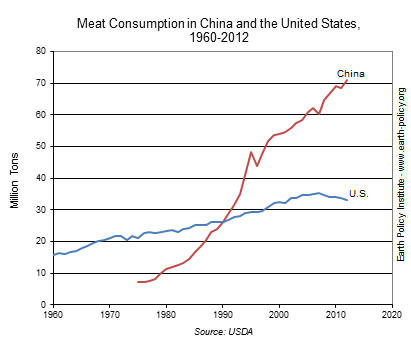
China is an eating culture.  Although today’s Chinese don’t eat the huge quantities of meat the average American does, China accounts for half of global pig production because pork is the popular meat to eat.  Small farmer producers raise ninety-nine percent of pork in China.

Even when grain production falls in China that does not translate into a shortage since China has historically kept large food-grain stockpiles and those individual small farmer/producers help ensure food security. – China through a Lens

Meat consumuption in China vs US

As China continues to grow a consumer middle class, food demand and eating habits are changing along with waistlines.  To meet this demand, Chinese have set up large pork and chicken operations in Australia to meet the growing demand for meat on the mainland. – Food Crisis

To insure a dependable supply of food to feed its people, Chinese companies have also bought or leased land in Africa sending Chinese laborers to produce crops for sale on the world market and back home. The Guardian.com reports, “Africa’s population is expected to match or overtake China’s by 2050, but the paper says China will soon need to develop deeper trade ties with key African countries to help feed its 1.3 billion population.”

______________________________

Lloyd Lofthouse is the award-winning author of My Splendid Concubine [3rd edition]. When you love a Chinese woman, you marry her family and culture too. This is the love story Sir Robert Hart did not want the world to discover.

2015 Promotion Image for My Splendid Concubine

Subscribe to “iLook China”!
Sign up for an E-mail Subscription at the top of this page, or click on the “Following” tab in the WordPress toolbar at the top of the screen.

About iLook China

China’s Holistic Historical Timeline


Gongwangfu, a Prince’s Palace and Garden in Beijing worth seeing

April 7, 2015

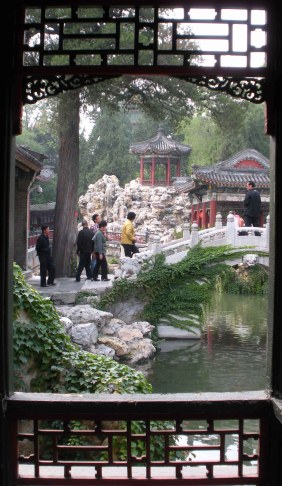
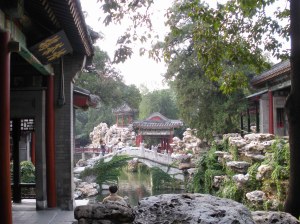
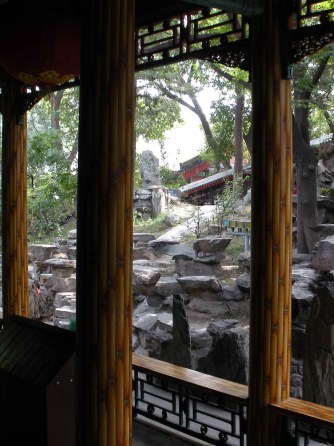
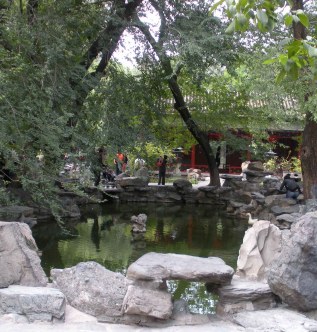
I took these photos in Prince Kung’s (1833-1898) palace and garden (once called Gongwangfu). This palace is in Beijing’s Beihai district. Prince Kung was Emperor Hsein Feng’s (1831-1861) younger brother.

As Inspector General for the Emperor of China, Robert Hart, known as the Godfather of China’s modernism, lived in the same hutong that Prince Kung lived in. Robert Hart, the main character in My Splendid Concubine, often met Prince Kung in this garden.

After 1950, for several decades, the palace and garden became a communal home for many Chinese. In recent years, the garden, considered one of the best in China, was renovated and is now a tourist attraction, which attracts thousands of visitors daily. Tiananmen Square, Mao’s Mausoleum, and the Forbidden City are all within walking distance.

To design a proper Chinese garden one must build a big place in a small space.  Prince Kung’s garden and estate is surrounded by a high wall and outside is Beijing.

Once inside, it is easy to forget that outside the walls is a crowded city. It was also easy for the Qing (Manchu) royals to forget about what was happening throughout China.

______________________________

Lloyd Lofthouse is the award-winning author of My Splendid Concubine [3rd edition]. When you love a Chinese woman, you marry her family and culture too. This is the love story Sir Robert Hart did not want the world to discover.

2015 Promotion Image for My Splendid Concubine

Subscribe to “iLook China”!
Sign up for an E-mail Subscription at the top of this page, or click on the “Following” tab in the WordPress toolbar at the top of the screen.

About iLook China

China’s Holistic Historical Timeline


The Mother of Chinese Operas

March 31, 2015

Kun Opera is the most refined and literary form of Chinese opera with a six hundred year history.  This opera is known as the mother of a hundred Chinese operas.

Kun Opera ushered in the second Golden Era of Chinese drama and almost vanished when it was suppressed during Mao’s Cultural Revolution.


a scene from The Peony Pavilion, a classical Kun Opera

When Kun Opera was dying in China during Mao’s rule, it was still being performed in the British Crown Colony of Hong Kong.  Prior to the Cultural Revolution, there were over 500 classical Kun Operas. Today there are about 100 that have survived.

Kun Opera is known for the tenderness of the actor’s voices, delicate hand gestures, dramatic facial expressions, beautifully abstract movements, gorgeous costumes and stage design.


The Peach Blossom Fan is considered to be a landmark in this form of Chinese opera.

______________________________

Lloyd Lofthouse is the award-winning author of My Splendid Concubine [3rd edition]. When you love a Chinese woman, you marry her family and culture too. This is the lusty love story Sir Robert Hart did not want the world to discover.

Finalist in Fiction & Literature – Historical Fiction
The National “Best Books 2010” Awards

Low-Res_E-book_cover_MSC_July_24_2013

Honorable Mentions in General Fiction
2012 San Francisco Book Festival
2012 New York Book Festival
2012 London Book Festival
2009 Los Angeles Book Festival
2009 Hollywood Book Festival

Subscribe to “iLook China”!
Sign up for an E-mail Subscription at the top of this page, or click on the “Following” tab in the WordPress toolbar at the top of the screen.

About iLook China

China’s Holistic Historical Timeline


China’s Grand Canal more than 2,500 years later and still in use

March 24, 2015

Encyclopedia Britannica says, “This ancient waterway was first constructed as early as the 4th century BC, was rebuilt in 607 AD, and has been used ever since.”

The Great Wall of China and the Grand Canal are examples of Confucianism and the Chinese work ethic. To understand the significance, it helps to compare it to the Suez and Panama Canals.

In the 19th century, the French built a canal 100 miles across the Isthmus of Suez. When it opened, the Suez Canal was only 25 feet deep, 72 feet wide at the bottom and 200 to 300 feet wide at the surface. About 20,000 ships use the canal each year. – History.com

The Panama Canal was started in 1881 by the French but ended a failure. The Americans finished the canal between 1904 – 1914, and it was 51 miles long. Today, it handles over 12,000 ships a year. – The Panama Canal

When I was in grade school, we learned about the Panama Canal in glowing terms. I’m sure the French and British brag about the Suez Canal in their textbooks too.

Until my first trip to China in 1999, I had never heard of the Grand Canal, which is the oldest and longest man-made canal in the world at more than a thousand miles from Beijing to Hangzhou south of Shanghai.

The construction started about five hundred years before the birth of Jesus Christ and was completed centuries later. The canal is still in use today. To finish it, the Pound lock was invented in the 10th century during the Song Dynasty. There are 24 locks and about 60 bridges. – Wikipedia

The canal is one example that China’s authoritarian, Confucian, collective culture is more than capable of innovation. For instance, there is the Pound lock pioneered by Qiao Weiyo,  a government official and engineer in 984 AD, which replaced earlier double slipways that had caused trouble and are mentioned by the Chinese polymath Shen Kuo (1031–1095 AD) in his book Dream Pool Essays (published in 1088 AD), and fully described in the Chinese historical text Song Shi (compiled in 1345 AD).

In the 18th century the West built the Suez and Panama Canals—that combined were 151 miles long. China started building the Grand Canal centuries before Christ, and when finished, it was more than a thousand miles long.

_______________

Lloyd Lofthouse is the award-winning author of My Splendid Concubine [3rd edition]. When you love a Chinese woman, you marry her family and culture too. This is the lusty love story Sir Robert Hart did not want the world to discover.

Finalist in Fiction & Literature – Historical Fiction
The National “Best Books 2010” Awards

Low-Res_E-book_cover_MSC_July_24_2013

Honorable Mentions in General Fiction
2012 San Francisco Book Festival
2012 New York Book Festival
2012 London Book Festival
2009 Los Angeles Book Festival
2009 Hollywood Book Festival

Subscribe to “iLook China”!
Sign up for an E-mail Subscription at the top of this page, or click on the “Following” tab in the WordPress toolbar at the top of the screen.

About iLook China

China’s Holistic Historical Timeline